Author: James Kwak

More on the Deduction Fairy

By James Kwak

[Updated with Mnuchin’s position on charitable contribution deduction.]

I wrote two days ago about the fairy tale that you can lower tax rates for the very rich yet avoid lowering their actual taxes by eliminating those mythical beasts, loopholes and deductions. The basic problem with this story is that, at the very high end of the distribution, deductions and exclusions (with the possible exception of the deduction for charitable contributions) just don’t amount to very much as a percentage of income. Therefore, eliminating those deductions may increase rich people’s taxes by tens of thousands of dollars, but that is only a tiny proportion of their overall tax burden, and not enough to offset any significant rate decrease.

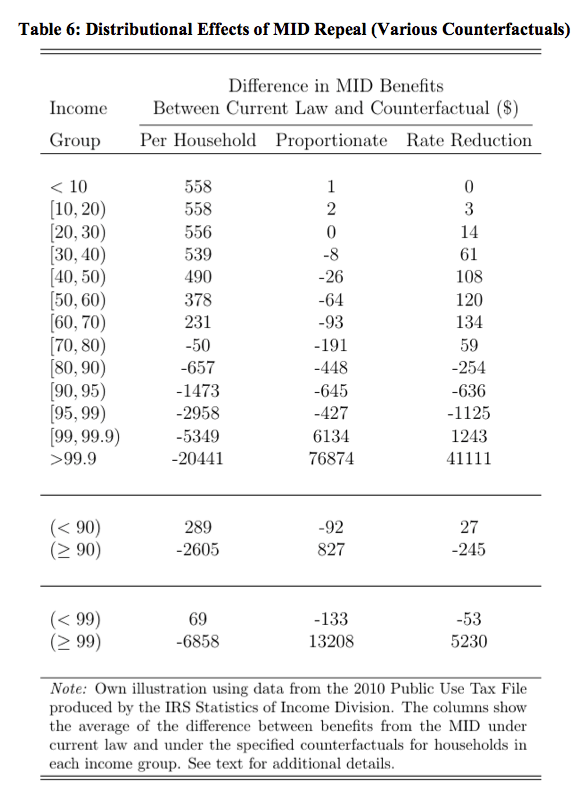
Unlike me, Daniel Hemel and Kyle Rozema are actual tax scholars (Hemel has a blog on Medium), and their detailed research largely tells the same story. They have a forthcoming paper that analyzes the mortgage interest deduction (MID) and shows that, while it is worth more dollars to rich people than poor people (for all the well-known reasons—bigger houses, higher marginal rates, itemizing), the MID causes people in the top 1% to pay a larger share of the overall tax burden. Therefore, eliminating the MID and using the increased tax revenue to reduce tax rates for everyone (what Mnuchin proposed in concept) would be a large windfall for the top 0.1% and a small windfall for the rest of the 1%.

The numbers are in the last column of this table:
screen-shot-2016-12-02-at-2-35-43-pm

Continue reading “More on the Deduction Fairy”

Economics 101, Economism, and Our New Gilded Age

By James Kwak

My new book—Economism: Bad Economics and the Rise of Inequality—is coming out on January 10 (although, of course, you can pre-order it from your local monopoly now). If you’d like more information about the book, the book website is now up at economism.net. (I used Medium instead of WordPress.com this time.) The post below, which is also the top story on the book website, summarizes the main themes of the book.

Income inequality is at levels not seen for a century. Many working families are struggling to get by, only kept afloat by Medicaid and food stamps. The federal minimum wage is just $7.25 per hour—below the poverty line even for a family of two. The bright outlook for corporate profits has driven the S&P 500 to record levels. Surely it makes sense to raise the minimum wage, forcing companies to dip into those profits to pay their workers a bit more.

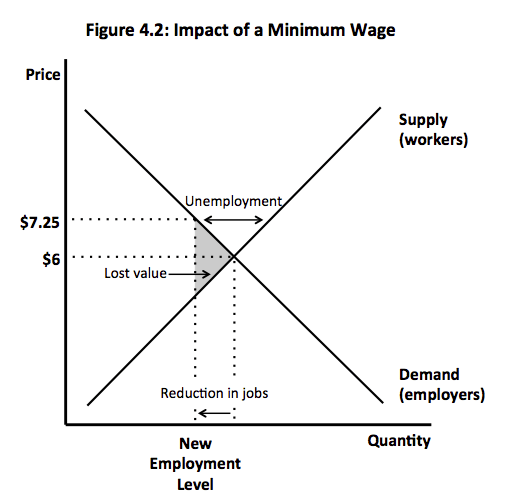
But that’s not what you learn in Economics 101. The impact of a minimum wage is blissfully easy to model using the supply-and-demand diagram that dominates first-year economics courses.

screen-shot-2016-11-28-at-2-57-46-pm

Continue reading “Economics 101, Economism, and Our New Gilded Age”

The Deduction Fairy

By James Kwak

Incoming Treasury Secretary Steven Mnuchin promised a big tax cut for corporations and the “middle class,” but not for the rich. “Any tax cuts for the upper class will be offset by less deductions that pay for it,” he said on CNBC.

This is impossible.

The tax cutting mantra comes in two forms. The more extreme one claims that reducing the overall tax burden on the rich will turbocharge the economy because they will save more, increasing investment, and will also work more, starting companies and doing all those other wonderful things that rich people do. The less extreme version is that we should lower tax rates to reduce distortions in the tax code, but we can maintain the current level of taxes paid by the rich by eliminating those famous “loopholes and deductions.” Donald Trump the candidate stuck with the former: his tax proposal, as scored by the Tax Policy Center, gave 47% of its total tax cuts to the top 1%, who also enjoyed by far the largest reduction in their average tax rate.

Mnuchin’s comment implies that he favors the latter version: lowering rates but making it up by “broadening the base.” This math might work for the merely rich—say, families making $200,000–400,000 per year. Take away the mortgage interest tax deduction, the deduction for retirement plan contributions, and the exclusion for employer-provided health care—which together can easily shield $50–75,000 in income—and you could probably fund several percentage points of rate decreases. (Of course, it would be politically impossible to completely eliminate those tax breaks, but that’s another story.)

Continue reading “The Deduction Fairy”

What You Can Do

By James Kwak

Several of my friends, some of whom I haven’t spoken with in a long time, have reached out to me over the past week to discuss what to make of last week’s election. I imagine this is happening with a lot of people.

Although I don’t have any simple answers, I do have some thoughts on what we can do in response to the prospect of Donald Trump and the Republicans controlling the entire federal government, as well as a large majority of states. But first, we need a short detour—for a bit of perspective.

Maurice Walker is a fifty-five-year-old man with schizophrenia whose only income is $530 per month in Social Security disability payments. On September 3, 2015, he was arrested by police in Calhoun, Georgia for being a “pedestrian under the influence”—something many of us have been guilty of at one time or another. If Walker had been able to come up with $160 (something most people reading this blog could do in seconds), he would have walked free. Instead, he was locked up in jail, without his medication.

Continue reading “What You Can Do”

Narratives

By James Kwak

[Updated to add another headline leading with “white voters.”]

Two days later, some of the world’s leading newspapers—or their headline-writers, at least—are saying it was all or largely about race:

screen-shot-2016-11-10-at-7-55-28-amscreen-shot-2016-11-10-at-7-56-18-am

screen-shot-2016-11-10-at-10-01-57-amThe respective roles of race and class in this year’s election are a highly contentious issue. I’d like to add to that contentiousness as little as possible while pointing out that this race-based framing isn’t really supported by exit poll data. I want to get ahead of the vitriol by stipulating that the exit polls don’t provide conclusive evidence for either side.

OK, here’s the data:

screen-shot-2016-11-10-at-8-06-00-am

Those are vote shares in the presidential election by racial or ethnic group. The numbers at the right show you the shift from the previous election.* In this case, the Democratic-Republican gap among white voters shifted by 8 points toward the Republican. That’s evidence that the election was about white voters, right?

Except those are the 2012 exit polls. The 8-point shift is relative to the 2008 exit polls.

Continue reading “Narratives”

The Biggest Voter Suppression Campaign of All

By James Kwak

This election day, spare a thought for the largest group of citizens who aren’t eligible to vote: children.

When I was in high school, I believed strongly that there should be no voting age whatsoever. Anyone should be able to vote, no matter her age. Well, I still feel that way, particularly after watching my ten-year-old daughter knocking on doors and explaining to adults why she doesn’t want her school to be grade-reconfigured. And I feel that way even though I also have a four-year-old son whose vote could be bought for a lollipop. (Whether he would stay bought is another question.)

There are two main arguments against a voting age. The first is that any plausible justification for a minimum voting age could be better served by some other test—which would be illegal. Many people think it is obvious that children shouldn’t be allowed to vote because they are uninformed, irresponsible, lack the necessary cognitive skills, are easily swayed by their parents, or something along those lines. (Note that similar arguments were made about all the other groups that used to be unable to vote.) But if the point of a voting age is to ensure that the electorate is properly informed about the issues and the stakes, we could administer a test, which would do a better job than an arbitrary age cutoff. (Who is the vice president? Which house of Congress approves judicial nominations? Etc.) That test would violate the Voting Rights Act, just like literacy tests.

Continue reading “The Biggest Voter Suppression Campaign of All”

Models of Economic Policymaking

By James Kwak

The evening that he won the Iowa caucus in January 2008, Barack Obama said this:

Hope is the bedrock of this nation. The belief that our destiny will not be written for us, but by us, by all those men and women who are not content to settle for the world as it is, who have the courage to remake the world as it should be… . [the belief that] brick by brick, block by block, callused hand by callused hand, … ordinary people can do extraordinary things.

That speech is at the opening of K. Sabeel Rahman’s new book, Democracy Against Domination. It invoked one of the central mobilizing themes of Obama’s 2008 campaign, which set him clearly apart from Hillary Clinton: the idea that the senator from Illinois would usher in a new kind of politics, a more democratic, more inclusive approach to government as opposed to business as usual inside the Beltway.

Well, that didn’t happen. Whatever you think of President Obama’s policy goals and accomplishments, he had little impact on how our political system works. Plenty of blame for that goes to the Republicans, who set out from Inauguration Day focused exclusively on making him a one-term president. But it’s also true that the new president did not make political reform a priority during those first two years when he had majorities in both houses of Congress.

Continue reading “Models of Economic Policymaking”

The Last Chapter Problem

By James Kwak

Like many analytically minded liberals, I’m good at identifying problems and less good at coming up with solutions—a common disease sometimes called the “last chapter problem.” I recently finished reading The Reconnection Agenda by Jared Bernstein (which you can even download from his blog), which takes the opposite approach.

The problem he addresses is one that we all know about—inequality, stagnant real wages, the divergence between productivity gains and living standards, etc. Bernstein recalls a meeting with a group of insiders in 2014, when a pollster interrupted a discussion of the post-Great Recession economic recovery to say:

If you mention the word “recovery” to people, they don’t know what you’re talking about. And they conclude you don’t know what they’re talking about. It’s not just that they feel disconnected from an economy that’s supposedly growing. It’s that they don’t think anyone understands or knows what to do about their situation.

Continue reading “The Last Chapter Problem”

Time to Vote; No on 5

By James Kwak

20161024_090409.jpg

If you live in Massachusetts, early voting has begun. You can ask for an early ballot by mail, or just find a polling place here. This is what my town hall looks like today:

20161024_093942.jpg

Not surprisingly, I voted for Hillary Clinton (more about why here). If you don’t live in Amherst, Massachusetts, you may want to stop reading. If you do live in Amherst, I’d like you to consider voting no on Question 5.

Continue reading “Time to Vote; No on 5”

Ideas, Interests, and the Challenge for Progressives

By James Kwak

Updated based on feedback from Matt Stoller. See bottom.

Mike Konczal wrote an article a few days back arguing that various progressive policies aimed at helping poor people would not be able to pry the “white working class” away from Donald Trump and Trumpism. I think the article was insightful and intelligently argued. This was my quick response:

In other words, it’s the long term that matters. We need policies that create broadly shared prosperity not because they will peel away Trump supporters in the short term, but because they are the right thing to do. And in the long term, if progressives prove that they can deliver the goods—a society with less inequality and less economic insecurity—that will change the political landscape.

Dani Rodrik wrote a longer, better response to Konczal. Rodrik’s perspective, which he’s presented in greater depth in the Journal of Economic Perspectives and a recent paper with Sharun Mukand, is that political outcomes result from the interaction of interests and ideas. As he writes in his recent post, “The politics of ideas is about activating identities that may otherwise remain silent, altering perceptions about how the world works, and enlarging the space of what is politically feasible.” Politicians appeal in part to voters’ interests, but also attempt to make salient identities that they share (or pretend to share) with particular segments of the electorate.

Continue reading “Ideas, Interests, and the Challenge for Progressives”

Structure and Superstructure

By James Kwak

Noah Smith begins his latest Bloomberg column this way:

Stanford historian Ian Morris is fond of saying that “each age gets the thought it needs.” According to this maxim, ideas like the Enlightenment, communism or even Christianity are a product of the economic and political circumstances of their times.

This is something I’ve long believed, dating back before my days as a graduate student in intellectual history. It’s also pure Marx. In the “Contribution to the Critique of Political Economy,” the great bearded one wrote:

With the change of the economic foundation the entire immense superstructure is more or less rapidly transformed. In considering such transformations a distinction should always be made between the material transformation of the economic conditions of production . . . and the legal, political, religious, aesthetic or philosophic—in short, ideological forms in which men become conscious of this conflict and fight it out.

When I was a junior in college, I underlined that passage in my bright red copy of The Marx-Engels Reader. (As I’ve often said, Harvard social studies majors will probably be the last people on the planet still reading Marx.)

Continue reading “Structure and Superstructure”

Economic Anxiety and the Limits of Data Journalism

By James Kwak

[Updated: see bottom of post.]

There is an ongoing battle among the liberal intelligentsia over “economic anxiety.” The basic question is whether economic factors—loss of manufacturing jobs, decline in living standards, increase in insecurity—are a valid explanation for the rise of Trump. To simplify, one side claims that economic anxiety is one reason, along with racism (and sexism, and anti-Semitism, and …), for Trump’s popularity; the other side claims that the economic argument is wrong, and the Trump phenomenon is all about racism (and sexism, and anti-Semitism, and …).

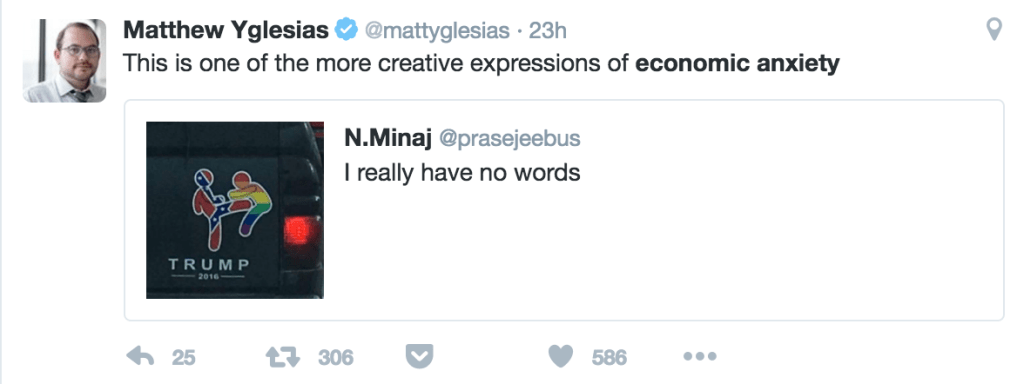
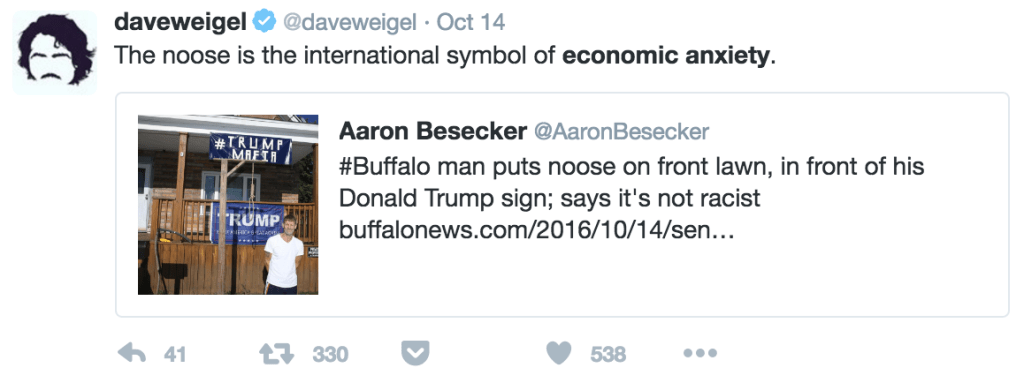
This debate has reached its cultural apogee with the genre of the economic anxiety tweet, which features a racist, sexist, anti-Semitic, or otherwise reprehensible Trump supporter, accompanied by a sarcastic comment about the supporter’s “economic anxiety.” Here are some recent examples (screenshots because WordPress doesn’t seem to display the second-level embedded tweet properly):

screen-shot-2016-10-16-at-8-42-07-pm

screen-shot-2016-10-16-at-8-42-37-pm

Why this particular debate has become so bitter has been lost to history. Probably the economic anxiety deniers think that explaining Trump in (partially) economic terms amounts to excusing or ignoring racism, while the economic anxiety believers think that the racism-only story ignores the erosion of the middle class over the past thirty years. This is why—since we’re all well-meaning liberals here—when not confined to 140 characters, the deniers take pains to say that we should help poor people, while the believers take equal pains to say that racism is bad.

The people thinking of the clever economic anxiety tweets are just doing it to annoy the other side; they know that one anecdote, or several dozen, doesn’t prove anything. But periodically there are attempts to disprove the economic anxiety hypothesis—with data! Dylan Matthews of Vox is the latest to take up the challenge, with a long, heavily documented, and very heated argument that the Trump phenomenon is about race, not economics. But it fails, for a simple reason: You just can’t prove what he wants to prove with the data we’ve got.

Continue reading “Economic Anxiety and the Limits of Data Journalism”

The Problem with Personality Contests

By James Kwak

This presidential election has come down to a referendum on Donald Trump, the man muppet whatever he is. Tactically speaking, that’s probably a good thing. Trump is an absolutely horrendous life form, and as long as he can’t get more than 43% of the vote, he almost certainly can’t be president. (Gary Johnson just isn’t that appealing.) Of course, focusing on personal attributes has been the Hillary Clinton strategy all along, even dating back to the primaries, when she focused on her experience and seriousness in the face of Sanders’s popular proposals (single payer, free college, etc.). It’s been even more true of the general election, in which Clinton has gone out of her way to portray Trump as a unique, rather than as the culmination of the evolution of the Republican Party.

Ordinarily we bemoan the focus on personalities rather than issues. (How many millions of times have Democrats complained about voters who chose George W. Bush because they would rather have a beer with him than Al Gore or John Kerry?) This time around, we seem happy enough with the personality contest, either because it increases Clinton’s chances of winning, or because Trump is so toxic that, this time, personality really does matter.

Continue reading “The Problem with Personality Contests”

The Absolutely Best Debate

By James Kwak

Judging from my Twitter feed, there is one thing that we all agree on after the first two debates (including Kaine-Pence): the moderators are useless. They ask dumb questions, they don’t ask important questions, they can’t get the candidates to answer the questions anyway, they don’t call out the candidates when they lie (OK, this mainly applies to one of the candidates), etc.

So … let’s get rid of the moderators!

Continue reading “The Absolutely Best Debate”

Is Inequality Rising or Falling?

By James Kwak

Last week, Council of Economic Advisers chair Jason Furman took to the Washington Post to announce that President Obama has “narrowed the inequality gap.” Furman’s argument, bolstered by charts and data from a recent CEA report, has won over some of the more perceptive commentators on the Internet, including Derek Thompson, who concludes that Obama “did more to combat [income inequality] than any president in at least 50 years.” In 538, the headline on Ben Casselman’s summary reads, “The Income Gap Began to Narrow Under Obama.”

But is it true?

I already wrote about the key misdirection in Furman’s argument: his measures of reduced inequality compare the current world not against the world of eight years ago, but against a parallel universe in which, essentially, the policies of George W. Bush remained in place. (This is not something either Thompson or Casselman fell for; they both realized what Furman was actually arguing.) Today I want to address the larger question of whether inequality is actually getting worse or better.

Continue reading “Is Inequality Rising or Falling?”