Tag: taxes

My Medicare Deficit Solution

By James Kwak

David Brooks, perhaps realizing that it was a bad idea to swallow a politician’s PR bullet points whole, is now backpedaling. The Ryan Plan, which he originally hailed as “the most comprehensive and most courageous budget reform proposal any of us have seen in our lifetimes,” now has the principal virtue of existing: “Because he had the courage to take the initiative, Paul Ryan’s budget plan will be the starting point for future discussions.”

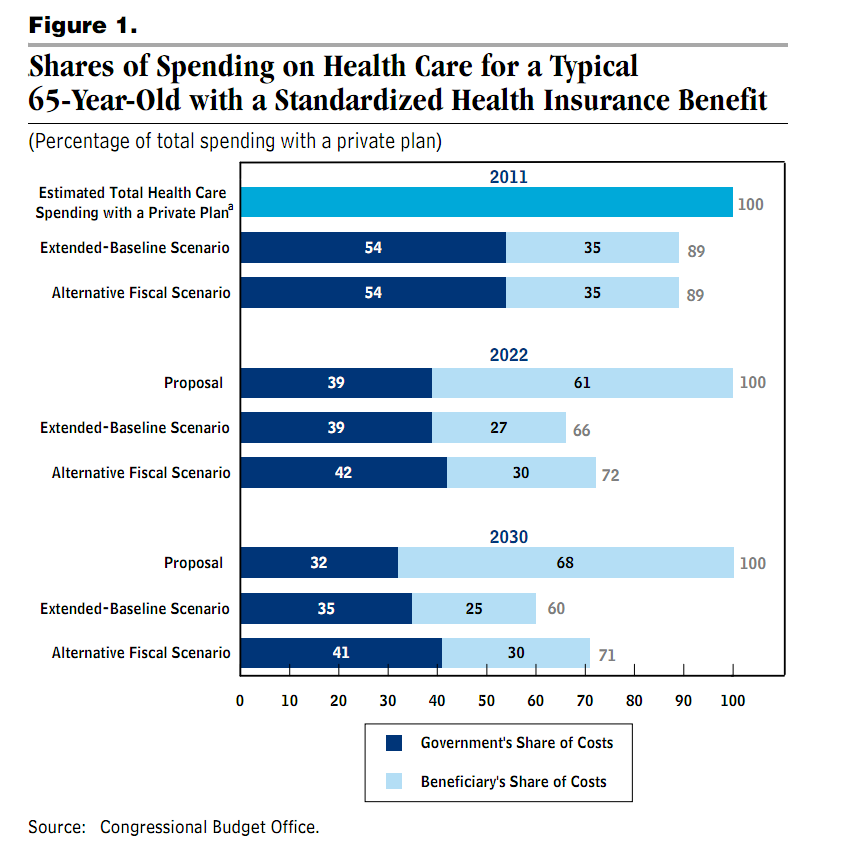
As I’ve discussed before, the Ryan Plan is just one bad idea dressed up with the false precision of lots of numbers: changing Medicare from a health insurance program to a cash redistribution program that gives up on managing health care costs. Here’s the key chart from the CBO report:

Continue reading “My Medicare Deficit Solution”

Taxes and Spending for Beginners

By James Kwak

Over the long term, we are projected to have large and growing federal budget deficits. Assuming that is a problem, which most people do, there seem to be two ways to solve this problem: raising taxes and cutting spending. Today, the political class seems united around the idea that spending cuts are the solution, not tax increases. That’s a given for Republicans; Paul Ryan even proposes to reduce the deficit by cutting taxes. But as Ezra Klein points out, President Obama and Harry Reid are falling over themselves praising (and even seeming to claim credit for) the spending cuts in Thursday night’s deal. And let’s not forget the bipartisan, $900 billion tax cut passed and signed in December.

The problem here isn’t simply the assumption that we can’t raise taxes. The underlying problem is the belief that “tax increases” and “spending cuts” are two distinct categories to begin with. In many cases, tax increases and spending cuts are equivalent — except for the crucial issue of who gets hurt by them.*

Continue reading “Taxes and Spending for Beginners”

Convenient Arguments

By James Kwak

Here’s my solution to our national debt. We have a one-time, 100 percent tax on all wealth (net worth) of all United States residents, with a $10 million per-person exemption. With household wealth at around $60 trillion, that should be plenty to pay off the accumulated debt and shore up Social Security and Medicare for the next century.* The government promises never to do it again. Since we only care about future behavior, a one-time wealth tax should have no impact on people’s incentives to work, and hence no distorting effect on the economy.

Don’t like that idea? How about this one. The Federal Reserve creates $20 trillion in money but, instead of crediting it to large banks’ accounts at the Fed, it credits it to Treasury’s account. Again, no more debt. Again, the Fed promises never to do it again.

Continue reading “Convenient Arguments”

$1.30 > $1.00

By James Kwak

Bruce Bartlett (hat tip Catherine Rampell) reproduces a table from a paper by Suzanne Mettler showing that most people don’t realize that they are beneficiaries of government social programs. For example, 60 percent of people who take the mortgage interest deduction say they “have not used a government social program.” Now, while the mortgage interest deduction is a subsidy designed to enable people buy houses, you could get into an argument about whether it’s really a “social program.” But these are the analogous figures for some more classic welfare programs:

  • Social Security retirement and survivors’ benefits: 44%
  • Unemployment insurance: 43%
  • Medicare: 40%
  • Social Security Disability Insurance: 29%
  • Medicaid: 28%
  • Food stamps: 25%

Continue reading “$1.30 > $1.00”

Who Benefits from Tax Expenditures?

By James Kwak

Ezra Klein points out a new tax expenditure database from The Pew Charitable Trusts. More attention to tax expenditures — exceptions in the tax code that reduce tax revenue or, put another way, subsidies channeled through the tax system* — is always a good thing. But Klein also says something interesting that I don’t agree with:

“they’re basically the welfare state for the middle class, cleverly arranged such that they don’t look like the welfare state for the middle class. If every year, the government sent every American — from the richest CEO to the greenest public-school teacher — a check covering 30 percent of their health-care costs, we’d think that a bit weird. We’d think it much weirder if we only sent the checks to the workers who happened to be at firms that offered benefits. . . .

“Yet that’s pretty much exactly what we do. We just hide it in the tax code rather than write it on a check.”

I agree with all of that, except the bit about the middle class. Tax expenditures primarily benefit the rich, for a few reasons.

Continue reading “Who Benefits from Tax Expenditures?”

Tax-Exempt Bonds for Beginners

By James Kwak

Felix Salmon linked to an article by David Kotok on Build America Bonds (BAB), which reminded me that I’ve been meaning to write about them (now that they no longer exist). BAB were introduced in the 2009 stimulus bill. If a state or local government issues BAB, the federal government pays 35 percent of the interest on the bonds; the bondholder pays tax on all the interest, as usual for corporate bonds — but not for traditional state or local government bonds (“munis”). BAB were initially only authorized for two years, and were not extended in the recent tax cut compromise.

The Republican attack line on BAB is that they “subsidize states in more imprudent-type budget and debt scenarios” (Rick Santelli, quoted in Kotok’s article) or they are “a back-door handout for profligate state and local governments, allowing them to borrow more money while shifting some of the resulting interest costs to the federal government” (Daniel Mitchell). Well yes, BAB are a subsidy for state and local borrowing. But to criticize them for that without even mentioning the alternative is either uninformed or irresponsible.

Continue reading “Tax-Exempt Bonds for Beginners”

The Moderate Republican Stimulus

By James Kwak

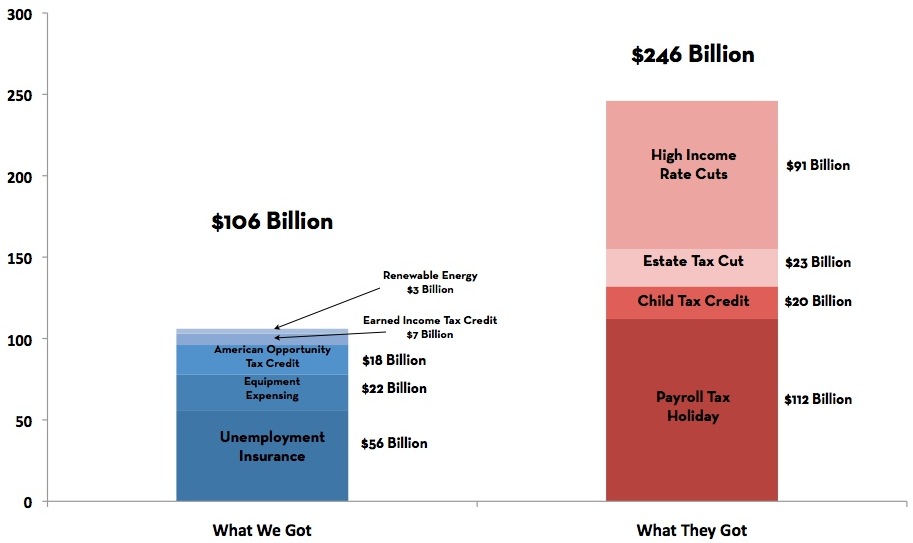
One of the great things about the Internet, as opposed to, say, law school, is that other smart people will do my homework for me. Last week I said that Obama’s position on the tax cuts was a “moderate-Republican line in the sand” and that the tax deal was closer to the Republicans’ ideal outcome than the Democrats’, but the latter argument was based on some guesses about Republican preferences. Now Mike Konczal has done some of the harder argument, uncovering hard evidence that the Republicans would have agreed to the extended child tax credit sweetener anyway and presenting five points for the argument that the Republicans wanted payroll tax cuts – in particular, they wanted them more than Making Work Pay tax credit that they replaced.

Here’s Mike’s version of the administration’s chart:

He calls it the “Moderate Republican Stimulus Package 2.0.”

Who Wanted What?

By James Kwak

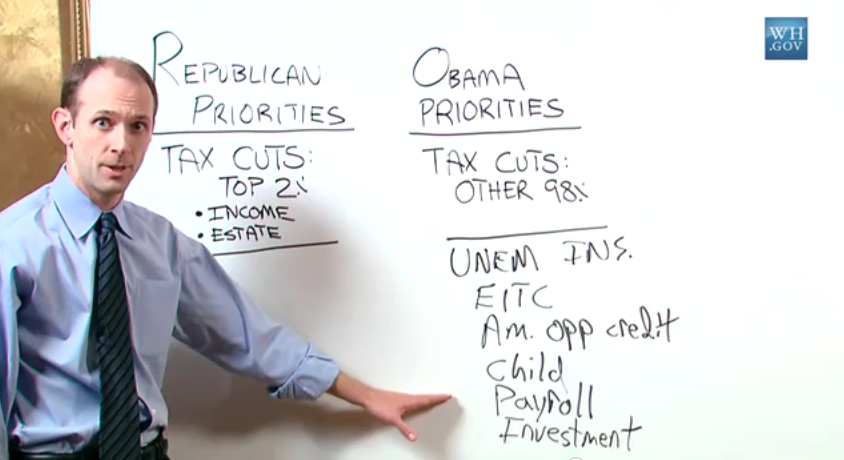
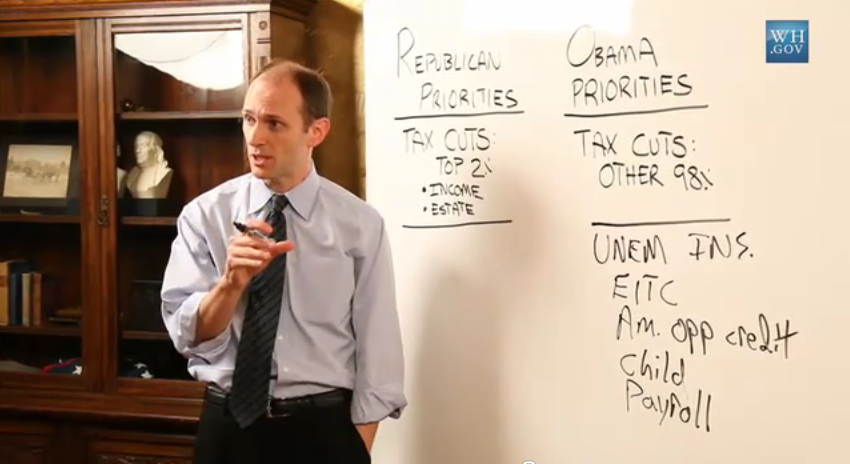
Look, I’m familiar with the argument for the tax cut deal. It’s not a terrible argument. In simple form, it goes, the top priorities are to stimulate the economy and to cushion the impact of unemployment, and a two-year tax cut extension was worth it to get that, especially since we can kill the Bush tax cuts in 2012. Now, no one who wasn’t born yesterday buys that bit about killing the Bush tax cuts in 2012, but you could still make the argument that two years of stimulus is worth making the tax cuts effectively permanent. (I don’t agree, but it’s not a crazy argument.)

But that’s not Austan Goolsbee’s argument on YouTube.

Here’s his slide:

Continue reading “Who Wanted What?”

Tax Cut Ironies

By James Kwak

From The New York Times:

“Congressional Republicans in recent days have blocked efforts by Democrats to extend the jobless aid, saying they would insist on offsetting the $56 billion cost with spending cuts elsewhere.”

Instead, as it turns out, they agreed to offset the cost with tax cuts elsewhere.

Still, though, I place the blame for this one squarely on the White House. The Republicans are just doing what Republicans do: arguing for lower government spending and lower taxes. The fact that they justify the former by saying it will cut the deficit and the latter by saying it will stimulate the economy (when you could just as easily switch the arguments and make them point the other way) is just a detail.

Continue reading “Tax Cut Ironies”

Why Our Tax Code?

By James Kwak

In honor of the deficit commission, Ezra Klein is running a number of posts about the commission’s proposals and our tax code, including one about the mortgage interest tax deduction. Although this is often defended as a middle-class tax break, on a percentage-of-income basis it mainly benefits people between the 80th and 99th income percentiles; above that they make so much money that they can’t buy big enough houses to keep up. (On a dollar basis, of course, the correlation between income and tax savings is perfect.)

This should not be surprising, since like any itemized deduction (a) it’s worthless if you have a small house and take the standard deduction instead, (b) it’s proportional to the size of your mortgage, and (c) it’s proportional to your tax bracket. Klein says, “I’m not really clear why we’re giving people making hundreds of thousands a year large subsidies to buy a house, but I’m sure there’s a good reason.” I’m sure he knows the reason, but I’ll spell it out anyway.

Continue reading “Why Our Tax Code?”

Dear Mr. President

By James Kwak

There have been (admittedly unclear) indications from your administration that you may accede to the Republicans’ demand to extend the Bush tax cuts for everyone.  I urge you not to do this.

The question is: Is it better to extend the tax cuts for everyone or for no one? The answer is to extend them for no one.

The Bush tax cuts have always overwhelmingly benefited the rich, not the middle class, and that is no less true today than when they were enacted. They were bad policy then and they are bad policy today. Extending the tax cuts would dramatically enrich the wealthy relative to everyone else. 65.5 percent of the total benefit would go to the top quintile by income, 26.8 percent to the top 1 percent, and 14.7 percent to the top 0.1 percent.*

Leaving aside discredited, Reagan-era theories about trickle-down economics, there are two main arguments for extending the tax cuts:

Continue reading “Dear Mr. President”

Bad Arguments Against Tax “Increases”

By James Kwak

Last week, a professor making more than $250,000 per year (with his wife’s income) put up a blog post (since taken down) criticizing President Obama for wanting to “raise” his taxes.* The post basically said, after all of their basic expenses, “we are just getting by despite seeming to be rich.” If his taxes go up, he says he will have to cut back on spending, which will depress the economy, or perhaps even sell his house or cars, which will depress those asset markets. The problem, he argues, is that the tax “increases” won’t affect the true super-rich, because they use tax dodges to avoid paying taxes; instead, they will just hurt the economy.

This post has been the target of some howitzers on the Internet, mainly focused on the professor’s income and expenses, but I wanted to raise a few more general policy points.

First, it’s just not true that the rich will reduce their spending dollar-for-dollar as their taxes go up. The reason that tax cuts are a lousy form of stimulus applies in reverse: just as extra cash leads to more saving, less cash leads to less saving. And this is especially true for the rich, who have more slack in their budgets. There might be individual rich households that will reduce their spending dollar-for-dollar, but in aggregate it just won’t happen.

Continue reading “Bad Arguments Against Tax “Increases””

Monopoly and Taxes

By James Kwak

A couple of weeks ago, Planet Money did a podcast based on a game of Monopoly. One of the participants was Russell Roberts, who professes to hate monopoly because it teaches the wrong lessons about business and the economy. At one point, Roberts said he would prefer the game if it had a progressive income tax with transfer payments to poor players. “As a result of that, you could get kids to resent taxes at an even earlier age.”

But Daniel Hamermesh, who likes Monopoly, called him on it. Hamermesh pointed out that if you had a transparent system of taxing the rich and transferring the money to the poor, players in the aggregate would be neutral, and might even understand the whole point of taxes and government spending.

Continue reading “Monopoly and Taxes”

The VC Tax Break

By James Kwak

The House of Representatives is considering a bill that would change the tax treatment of venture capitalists’ income (and that of private equity fund managers as well). Currently, VCs typically are paid “2 and 20” — that is, an annual fee of 2 percent of assets, plus 20 percent of profits. For example, let’s say a fund starts out with $200 million. Most of that money is invested by the fund’s limited partners — pension funds, endowments, insurance companies, the usual suspects. After ten years (roughly the average life of a VC fund), the investments made by the fund are now worth $400 million — a pretty humdrum return of 7 percent per year (before fees). The venture capitalists themselves will earn about $14 million ($200 million x 2% x 7 years)* plus $40 million (20% x ($400 million – $200 million)) equals $54 million. (Note that they earn that $40 million even for doing worse than the stock market’s long-term average return.) The limited partners get what’s left over after those fees. And before you start crying for the VCs, remember that a typical VC firm will have multiple VC funds going at once.

Right now, the $14 million is taxed as ordinary income, but the $40 million is taxed as capital gains — that is, at a tax rate of 15%. The bill would tax the $40 million as ordinary income (actually, 75% as ordinary income and 25% as capital gains), for an effective tax rate of about 35%.

The current tax treatment has never made sense to me. The lower rate on capital gains is supposed to provide an incentive for capital investment.** This is why, if you buy stock and sell it more than a year later, you pay tax on your gains at a lower rate. So clearly the actual investment returns on money invested in the VC fund should be treated as capital gains — but not the VCs’ 20 percent fee, since that’s compensation for fund management services, not returns on their investment. (VCs typically invest their own money in a fund, but it is only a small fraction of the whole, and no one is debating how that money should be treated.)

Continue reading “The VC Tax Break”