Tag: politics

Who Wants Tax Cuts?

By James Kwak

Yesterday I wrote an Atlantic column about Republican presidential candidates’ fondness for tax plans that transfer massive amounts of money from the poor to the rich. The main question, to my mind, is why people like Herman Cain and Rick Perry talk about transferring massive amounts of money to the rich when polls show that even a majority of Republicans think the rich should pay more in taxes.

Many of the readers here could probably  have written that column themselves, but it does have a wonderful picture of Cain and Perry in all their well-dressed glory.

Edmund Burke and American Conservatism

By James Kwak

It has become a truism that modern American conservatism is revolutionary in the sense that it seeks to overturn the established order rather than to preserve it. “Reagan Revolution,” “Tea Party”—the very names for the movement announce that is about more than defending the status quo. In the conservative worldview, America (or “Washington,” or the “mainstream media,” or some other powerful stratum) is dominated by a liberal-intellectual-academic-bureaucratic-socialist-internationalist (pick two or more) elite that must be overthrown. So in at least a mythical sense, conservatism is about restoration, which is something very different from “conserving” what exists today.

When did this happen? According to one view of the world, to which I have been partial in the past, there was once an ideology called conservatism that really was conservative in the narrow sense: that is, it counseled maintaining existing institutions on the grounds that radical change was dangerous. The Rights of Man and the Citizen may be great, but soon enough you have the Committee of Public Safety and the guillotine. On this reading of history, conservatism became radical sometime after World War Two, when it gave up accommodation with the New Deal in favor of rolling the whole thing back, ideally all the way through the Sixteenth Amendment.

In The Reactionary Mind,* however, Corey Robin has a different take: conservatism, all the way back to Edmund Burke, has always been about counterrevolution, motivated by the success of left-wing radicals and consciously copying their tactics in an attempt to seize power back from them. Conservative thinkers were always conscious of the nature of modern politics, which required mobilization of the masses long before Nixon’s silent majority or contemporary Tea Party populism. The challenge is “to make privilege popular, to transform a tottering old regime into a dynamic, ideologically coherent movement of the masses” (p. 43). And the way to do that is to strengthen and defend privilege and hierarchy within all the sub-units of society (master over slave, husband over wife, employer over worker).

Continue reading “Edmund Burke and American Conservatism”

Happy Constitution Day

By James Kwak

(Actually, it was on Saturday.) I just read Invisible Hands: The Making of the Conservative Movement from the New Deal to Reagan (W.W. Norton, 2009), by Kim Phillips-Fein. It’s a history of the resistance from the business community to the New Deal and how it gave birth to at least one major strand of the modern conservative movement. One of Phillips-Fein’s major points is that the conservative movement is not just a reaction to the civil rights movement, the 1960s, and the women’s liberation movement (and Roe v. Wade). Those trends gave the conservative movement more energy and support, but business leaders had for decades been trying to build an intellectual and political movement that could reverse the New Deal. And while some of them talked about Christian values, what they really cared about were breaking unions and lower taxes.

Continue reading “Happy Constitution Day”

Citizens United and Corporate Political Spending

By James Kwak

Today’s Atlantic column is about corporate political spending in the wake of Citizens United and what, if anything, can be done about it. A group of corporate and securities law professors has petitioned the SEC to write rules requiring companies to disclose their political spending, just like they have to disclose their executive compensation today. As usual, I’m not too optimistic about what disclosure can achieve, especially disclosure in SEC filings or proxy statements: who reads those things, anyway? But it’s better than nothing, and with the current makeup of the Supreme Court, nothing is just about what we’ve got now.

A Foray into Monetary Policy and Tangentially Related Speculations

By James Kwak

Yesterday I wrote an Atlantic column about the bizarre situation that the Federal Reserve is in. Ordinarily, we think central bank independence is important because it permits the bank to take unpopular, anti-growth steps when the political branches of government want popular, pro-growth steps. But today we’re in Bizarro world: the political branches are intent on strangling the economy, so the Fed should be ignoring the political winds and stimulating the economy—especially since it’s clear that fiscal policy is off the table. Rick Perry just provided a last-minute dose of color.

Obviously Perry and the Republicans don’t want the Fed to stimulate the economy because they don’t want the economy to recover before the 2012 elections. But I think there’s something deeper here, which Mike Konczal gets at in this great post. Konczal summarizes the nineteenth-century gold-standard ideology this way: “Paper money decreases the power of the husband over his wife and the father over his family, loosens the natural leadership that serves as the best protection against ‘effeminate’ manners, and gives us a democracy without nobility.”

Continue reading “A Foray into Monetary Policy and Tangentially Related Speculations”

Barack Obama and Harry Potter

By James Kwak

Helene Cooper of the New York Times wrote a “news analysis” story saying that the challenge for President Obama is this:

“Is he willing to try to administer the disagreeable medicine that could help the economy mend over the long term, even if that means damaging his chances for re-election?”

The problem, she goes on to say in the next paragraph, is that the economy is in bad shape:

“The Federal Reserve’s finding on Tuesday that there is little prospect for rapid economic growth over the next two years was the latest in a summer of bad economic news.”

Continue reading “Barack Obama and Harry Potter”

A Few Thoughts on the Debt Ceiling Deal

By James Kwak

1. Obama still has his hostage—if he wants it. As far as I can tell, the Bush tax cuts are nowhere in the debt ceiling agreement, which means that at current course and speed they expire at the end of 2012. Extending the tax cuts would reduce revenue by about $3.5 trillion over the next decade. According to news reports, Obama was willing to extend the Bush tax cuts in exchange for $800-1,200 billion of additional tax revenue—in other words, he was willing to cut taxes by about $2.5 trillion relative to current law. Boehner and Cantor walked out because of some combination of (a) they couldn’t get their members to vote for that tax “increase” or (b) they think they will be able to extend all the tax cuts if they negotiate that deal separately. I wouldn’t be so sure about (b). Remember, gridlock means the tax cuts expire.

2. The next step of the deal is that a joint Congressional committee is supposed to come up with a plan to reduce deficits by $1.2-1.5 trillion over ten years. If they fail to come up with a plan, or their plan is rejected by Congress, then there will be major automatic cuts in discretionary spending, including defense. (There will also be cuts in Medicare reimbursement rates, but not in Social Security or Medicaid.) The idea on Obama’s side is that the prospect of major defense cuts will force Republicans to negotiate. But if they were willing to let the government default rather than increase taxes—even by closing tax loopholes—why do we think they will be afraid of some defense budget cuts? Traditional Republicans may have liked high defense spending, but not the new breed. Ron Paul is basically an isolationist; Grover Norquist thinks the defense budget should be reduced.

Continue reading “A Few Thoughts on the Debt Ceiling Deal”

Two Can Play

By James Kwak

Quick, what was the greatest conservative accomplishment of the George W. Bush presidency? It wasn’t Medicare Part D: that was a clever way to steal a Democratic issue and pass it in a form that was friendly to the pharmaceutical industry. It wasn’t Roberts and Alito: yes, they are young and conservative, but the majority is still only 5-4. It wasn’t Social Security privatization: that didn’t happen. Iraq? Getting political support to invade Iraq was a major coup, but everything went downhill from there.

The answer is obvious: the tax cuts of 2001 and 2003. Together, they were a wish list of conservative tax policy: a reduction in the top marginal income tax rate from 39.1 percent to 35 percent; a reduction in the top rates for capital gains and dividends to 15 percent; much higher contribution limits for tax-preferred retirement accounts (meaning that if you have enough money to save, you can shield more of it from taxes); and eventual elimination of the estate tax. In total, when fully phased in, the Bush-era tax cuts sliced almost 3 percent of GDP out of federal government revenues.*

Continue reading “Two Can Play”

Hoisted from the Archives

By James Kwak

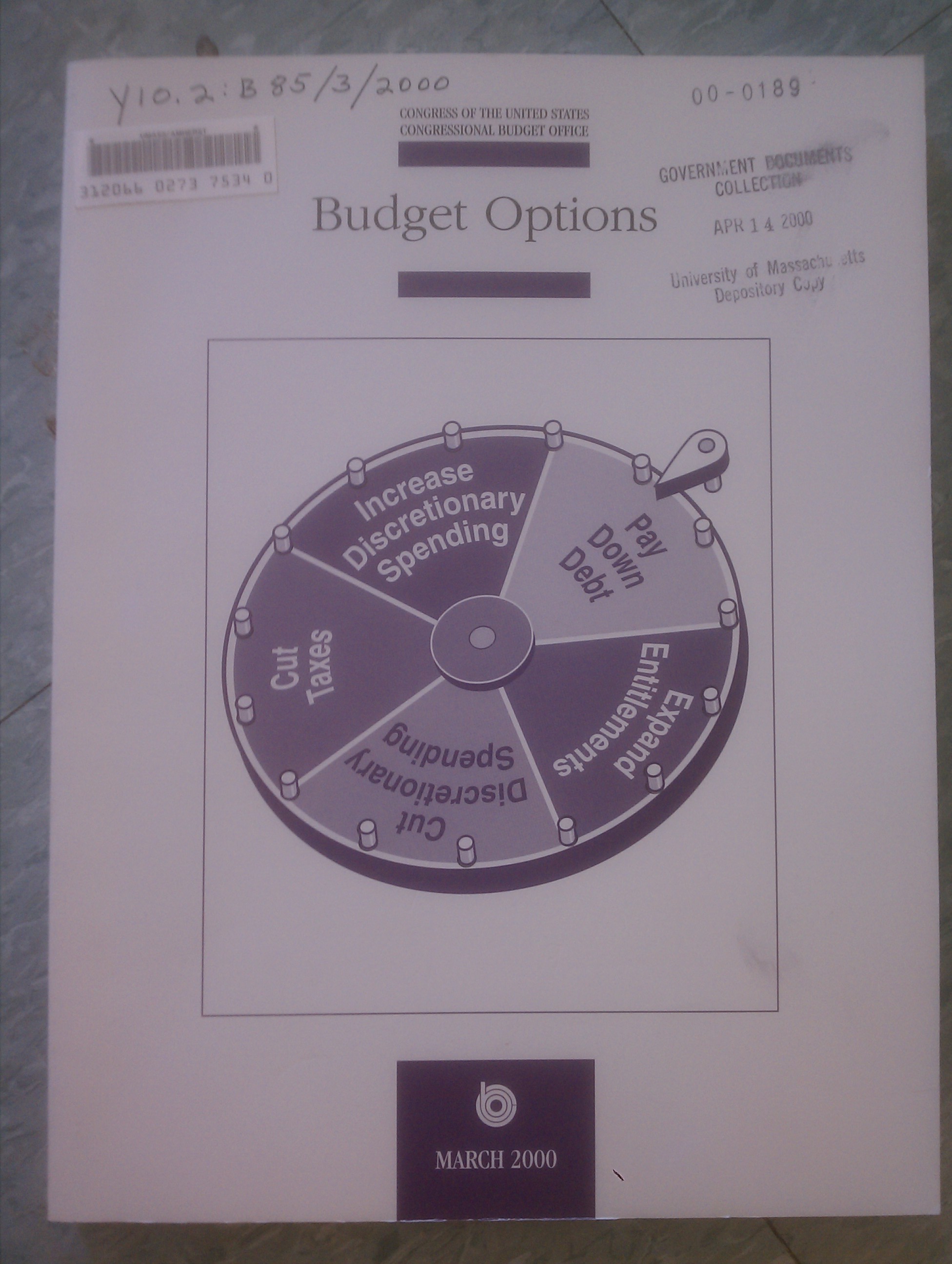
What was the budget debate about eleven years ago?


As you can see, that is the cover of the CBO’s March 2000 Budget Options report. (You can get it online, but without the cover.*) For most of the 1980s and 1990s, this report was called Reducing the Deficit: Spending and Revenue Options; this year’s version has reverted to that title.

The context for the picture above was the budget surpluses of the late 1990s. At the time, the CBO was projecting surpluses for at least the next twenty years, amounting to over $3 trillion in the first decade of the twenty-first century. (See the 2000 Budget and Economic Outlook, Summary Table 1.) And although most of the surpluses were off-budget (surpluses of Social Security payroll tax revenues over benefit payouts), there were supposed to be ten years of on-budget surpluses as well.

We all know what happened next: a (mild) recession, the Bush tax cuts of 2001 and 2003, the Afghanistan and Iraq Wars, and the Medicare prescription drug benefit, among other things. But the question for now is: did those surpluses really exist?

Continue reading “Hoisted from the Archives”

What Is This “Washington”?

By James Kwak

(Warning: Very elementary post ahead. Most of you probably know all this already.)

Mitch McConnell, Senate Republican Leader, quoted in Bloomberg: “We have seen the consequences of giving Washington a blank check. My message to the president is simple: It’s time for Washington to focus on fixing itself. It’s time Washington take the hit, not the taxpayers.”

That sounds good (if you don’t like “Washington,” that is), but what does it mean? McConnell wants people to think that their tax dollars go to feed some animal named “Washington,” and therefore our budget problems can be solved by simply feeding Washington less — without “taxpayers” taking the hit.

That might be true if “Washington” simply consumed money for its own sake, but the problem is that most of the federal budget isn’t consumed by the federal government.

Continue reading “What Is This “Washington”?”

The Silliness of Spending Caps

By James Kwak

One of the new old ideas floating around Washington these days is an aggregate spending cap for the federal government. For example, both the House Republicans’ budget and one of those “moderate bipartisan” Senate proposals calls for limiting total government spending at around 21 percent of GDP. This is silly for at least two reasons.

First, and less controversially, the number of dollars that flow from the federal government to entities that are not the federal government is not an economically significant number*. The most obvious example of this is tax expenditures: subsidies that are implemented through the tax code, usually as deductions or credits. For example, let’s say the government wants to promote renewable energy. It can increase taxes and write checks to companies that produce solar panels; or it can keep taxes the same and enact tax breaks for companies that produce solar panels. Same difference — except that the former “counts” as government spending and the latter doesn’t. So a spending cap simply motivates Congress to spend money through tax credits rather than by writing checks, which is bad for all sorts of reasons. (It is harder to target, it reduces the tax base, etc.).

Continue reading “The Silliness of Spending Caps”

Not Clear on the Concept

By James Kwak

From Congressman Spencer Bachus’s Media Center (these are the actual titles of four consecutive press releases):

Conventional Meaninglessness

By James Kwak

David Brooks may be a wonderful person, but I don’t like his columns (and I didn’t like Bobos in Paradise, either). It’s hard to put my finger on why, but he helped me out with yesterday’s column. For one thing, he has this annoying habit of trying to claim the reasonable center, often by making false equivalences between the two things he is trying to sound more reasonable than. So, for example:

“No place is hotter than Wisconsin. The leaders there have done everything possible to maximize conflict. Gov. Scott Walker, a Republican, demanded cuts only from people in the other party. The public sector unions and their allies immediately flew into a rage, comparing Walker to Hitler, Mussolini and Mubarak.”

Comparing the other side to Hitler is bad.* Pushing for legislation that hurts the other side is something else. In the abstract, that legislation may be justified; Walker did just win an election, after all. But it’s a completely different category from making stupid signs to hold at rallies, and it’s a classic David Brooks false equivalence.

But that’s just a minor peeve. It’s when Brooks adopts his pseudo-reasoned “everybody knows” tone that I get really mad.

“Everybody now seems to agree that Governor Walker was right to ask state workers to pay more for their benefits. Even if he gets everything he asks for, Wisconsin state workers would still be contributing less to their benefits than the average state worker nationwide and would be contributing far, far less than private sector workers.”

Continue reading “Conventional Meaninglessness”

Paul Ryan Criticizes Bernanke for Failing to Contain Tooth Fairy

By James Kwak

In a Congressional hearing today, Representative Paul Ryan (R-WI), chair of the House Budget Committee, strongly criticized Federal Reserve Chair Ben Bernanke for failing to contain the severe inflation threat posed by the Tooth Fairy.

Ryan pointed to numerous studies showing that, despite ongoing economic sluggishness, the Tooth Fairy is paying much more for children’s baby teeth than in past years. In neighborhoods such as Winnetka, Cleveland Park, the Upper East Side, and Palo Alto, children can receive more than $20 per tooth — a dramatic increase from the 25-50 cents that the Tooth Fairy paid only a decade or two ago. In the Hamptons, summertime prices for teeth can easily exceed $100, according to a survey commissioned by the American Enterprise Institute.* Because the Tooth Fairy is able to create money magically, her purchases of unused teeth (with no apparent economic value**) increase the money supply, fueling inflation. Without explicitly accusing Bernanke of participation in the Tooth Fairy’s scheme, Ryan implied that the Tooth Fairy’s higher payouts may be part of the Federal Reserve’s quantitative easing scheme.

Continue reading “Paul Ryan Criticizes Bernanke for Failing to Contain Tooth Fairy”

Deficit Hawkoprite, Eric Cantor

By James Kwak

Eric Cantor, House Republican Majority Leader, said the Republicans will demand spending cuts in exchange for the votes necessary to raise the debt ceiling.

Eric Cantor, member of Congress, voted for:

  • The 2001 tax cut
  • The 2003 tax cut
  • The 2003 Medicare prescription drug benefit
  • The 2010 tax cut

In other words, of the big five budget-busting measures of the past decade, the only one he didn’t vote for was the 2009 stimulus. In other words, he had the opportunity to vote for $3.1 trillion of the 2011 debt, and he voted for 75 percent, or $2.3 trillion — just like most Republicans who were in Congress for those five votes.

For explanation and sources, see this post.