A Sad Day

I have nothing new or insightful to add, but it feels wrong to go back to blogging without paying respects to Ted Kennedy. When I was younger and perhaps more idealistic, I used to carry around a copy of his speech at the 1980 Democratic National Convention. He was a man who cared about the poor, the unemployed, and the sick, even as their cause became less and less fashionable over the past four decades. He believed that justice went beyond formalistic legal rights and extended to economic and social conditions as well. The Senate needs another person like him, but sadly will not find one.

By James Kwak

Chat Today About Bernanke Nomination For Reappointment (1pm Eastern)

The Washington Post is hosting an on-line chat about Ben Bernanke and his likely reappointment as chairman of the Federal Reserve Board of Governors (today, 1pm eastern: use this link to chat).  News story on President Obama’s announcement of Bernanke’s renomination this morning, with video of press conference, is here.

You can submit questions in advance or live during the chat, which will probably run until about 2pm.

By Simon Johnson

Update: here’s the transcript of the chat; a lot of very good questions.

Medicare and the Public Option

Simon and I have our latest weekly column up at the Washington Post. The topic is contradictions: opponents of the public option who bill themselves as defenders of Medicare, opponents of cost savings who support private health insurers, and so on. It’s also about a world without a public option:

Imagine health-care reform without a public option: Insurers have to charge the same price regardless of customers’ medical history; everyone has to buy insurance; and poor people get subsidies to help them afford it. From the insurers’ perspective, they get more than 40 million new customers, they subsidize the old and sick by overcharging the young and healthy (who have to overpay because of the mandate), and the government even pays people to buy their product. There are no new competitors (additional choices for customers), and there is no pressure to reduce costs. What could be better?

As we’ve said before, I think this is still far better than the current situation. Ezra Klein recently made the point much more forcefully. But still, reform without the public option could be a recipe for private insurers to charge whatever they feel like charging. Alex Tabarrok, not the first person you would expect to write a post called “In Defense of the Public Option,” writes:

Since escape via non-purchase will no longer be a potential response to higher prices, mandatory purchase will reduce the elasticity of demand giving firms an incentive to increase prices.  Moreover, in oligopolistic markets, a more homogeneous product can increase the ability of firms to collude.

I believe that health insurance reform will increase the market power of insurance firms and drive up prices.  In this scenario, the public option at least has a raison d’etre, although whether it actually fulfills it’s purpose is an open question.

By James Kwak

Which Bernanke? Whose Bubble?

Ben Bernanke will be nominated for a second term as chairman of the Federal Reserve.  But which Bernanke are we getting?  There are at least three.

  1. The Bernanke who led the charge to rescue the US (and world’s) financial system after the Lehman-AIG collapse.  If you accept that the choice from late September was “Collapse or Rescue,” this Bernanke did a great job.
  2. The Bernanke who argued for keeping interest rates low as the housing bubble developed.  This Bernanke was part of the Greenspan Illusion – the Fed should ignore bubbles and “just clean up afterwards.”  Is that still Bernanke’s view?  Surely, he has learned from that experience.
  3. Then there is Bernanke-the-reformer.  Given #1 and #2 above, shouldn’t he be pushing hard for tough re-regulation of the financial system – particularly those dodgy parts where markets meet banking?  But is there any sign of such an agenda, even with regard to recently trampled consumers – let alone “too big to fail” financial institutions?

Most likely, we’re in for another bubble. Continue reading “Which Bernanke? Whose Bubble?”

Change or More of the Same?

Matt Yglesias‘s comments on James Surowiecki on the health care reform debate triggered a few thoughts in my head.

First, Surowiecki (after describing how people fear reform because they tend to fear change):

Because it’s hard for individuals to get affordable health insurance, and most people are insured through work, keeping your insurance means keeping your job. But in today’s economy there’s obviously no guarantee that you can do that. On top of that, even if you have insurance there’s a small but meaningful chance that when you actually get sick you’ll find out that your insurance doesn’t cover what you thought it did (in the case of what’s called “rescission”). In other words, the endowment that insured people want to hold on to is much shakier than it appears. Changing the system so that individuals can get affordable health care, while banning bad behavior on the part of insurance companies, will actually make it more likely, not less, that people will get to preserve their current level of coverage.

This is basically what Simon and I argued in the Washington Post a couple weeks ago, and I’m glad that someone with a much bigger platform is saying it, too.

Continue reading “Change or More of the Same?”

Fun with Derivatives

Fresh off my vacation, I have jury duty tomorrow, but today I got a jump on my fun reading for the courthouse – Traders, Guns, & Money, the anecdote-packed overview of derivatives by Satyajit Das, a prolific consultant, author, and commentator on the topic. Das says that his book “does not attempt to make a case for and against derivatives” (p. xiii), and it’s true that he does point out some of the useful, value-creating functions of derivatives. But this passage (p. 41) is probably more typical, and one I thought deserved being typed out:

We needed ‘innovation’, we were told. We created increasingly odd products. These obscure structures allowed us to earn higher margins than the cutthroat vanilla business. The structured business also provided flow for our trading desks. The more complex products were stripped down into simpler components that traders hedged. …

New structures that clients actually wanted were not that easy to create. Even if somebody came up with something, everybody learned about it almost instantaneously. They reverse-engineered the structure and then launched identical products.

Continue reading “Fun with Derivatives”

More by Arindrajit Dube

Last month Arindrajit Dube wrote a guest post for us analyzing private insurer stock market returns following the news that the Senate Finance Committee “Group of Six” would be dropping the public plan; he estimated that avoiding a public plan would be worth $28-35 billion to three major insurers. Last week he did a similar analysis based on last Sunday’s comments by Kathleen Sebelius and Robert Gibbs indicating potential willingness to drop the public plan (something the administration has tentatively backpedaled from). I was on vacation, but his analysis is available on Economist’s View, and his bottom-line number is $32 billion, or 40% of their market value.

Dube also co-authored an op-ed in The New York Times on San Francisco’s experience with comprehensive, government-mandated health insurance. One of their points is that in an environment where all competitors are forced to pay something for health insurance, this creates a level playing field where all companies can pass on the higher costs to consumers – as opposed to a situation where companies race to the bottom by cutting benefits in order to minimize costs.

By James Kwak

One Last Thought on FDIC and Political Will

So this is Mike Konczal signing off for the week – I’d like to thank James and Simon for giving me the opportunity to guest-blog here. And I’d like to thank all the readers and commenters for sparking discussions and refining my thoughts about many of the issues here.

You can follow my blogging at the rortybomb blog, and I’m also on twitter.

I want to close on one last note about where we, as a country, need to go from here. As a longtime fan of The Baseline Scenario, I read that there’s a project here to show the way in which capture by the financial industry has taken place in this country; through regulatory capture, through social networks and connections, etc.

There’s another element to it as well, and that’s what we as a country expect our government to be able to do about it. I want to point out this netroots nation video of Chris Hayes, an editor at The Nation, talking about The New Deal versus today (5m20s start):

Think about FDIC, how would we design FDIC today?…What we would do is, we wouldn’t set up an independent government agency which works very well, has worked smoothly, has prevented bank runs, since the bad old days of bank runs…we wouldn’t do that today. The banks would be like ‘what? you are just going to step into this market?’ What we’d do today if we were designing FDIC is we’d choose a bunch of the banks and we’d subsidize them insuring other banks…

The Home Ownership Loan Corporation…we have a lot of foreclosures, a lot of people underwater on mortgages. What are we doing? We are subsidizing the lenders with public dollars and telling them ‘if we give you guys some money, will you go help those people?’ And surprise, surprise, they have not really gotten their asses to do it. Now the Home Ownership Loan Corporation was faced with the same exact problem…and it went out and bought the mortgages and directly re-negotiated the terms of the mortgages, and it was very, very successful.

This is a massive conceptual problem.

I find this fascinating because I completely agree that, if we were to encounter bank runs for the first time today, this is how we’d try to set up FDIC. FDIC is an example of a government program that works, and the banks-insuring-one-another-with-public-money is exactly the kind of operation we’d expect to fail. I also find it fascinating because I believe part of what happened in this crisis is that we started a banking system in the capital markets, a ‘shadow bank system’ if you will, that collapsed in a new 21st century style bank run, and going forward we need to find a way to regulate it properly to make sure it doesn’t happen again (here’s interview I did with Perry Mehrling about it).

It’s one thing to identify the problem – finding the will to conceptualize the problems, and begin to fix them, is the other half of the solving the problem. And that is what this country needs more of, less hoping that the problems will fix themselves if we shove enough public money to private parties, and more of working to find the solutions ourselves.

Thanks for the great week all!

The Limits of Arbitrage

Wow, it’s already Friday. I’ll feel that I’ve short-changed you if we don’t do some Finance Theory before I go.

Did you see this roundtable about the state of macroeconomics in The Economist’s Free Exchange? Fascinating stuff; in particular it became a bit of an odd defense of the Efficient Markets Hypthosis (EMH). A representative comment was made by William Easterly, in defense of EMH:

The most important part of the much-maligned Efficient Markets Hypothesis (EMH) is that nobody can systematically beat the stock market. Which implies nobody can predict a market crash, because if you could, then you would obviously beat the market. This applies also to other asset markets like housing prices.

This is not true, and I want us to walk through why it isn’t. In March of 1997, Andrei Shleifer and Robert Vishny published a paper titled The Limits of Arbitrage (pdf) in the Journal of Finance. I think it’s the most important finance paper of the past 15 years, something everyone even remotely connected to financial markets should become familiar with. It builds on and summarizes a decade long research project, research they conducted with people such as Joseph Lakonishok and Brad Delong. In it they say that arbitrageurs, the very smart and talented traders at hedge funds who will take prices that are out of line and bring them back into line, making a good fee and making prices reflect all available information, the very building block necessary for EMH to work, can’t do their job if they are time or credit constrained. Specifically, if they are highly leveraged, and prices move against their position before they return to their fundamental value – if the market stays irrational longer than they can remain solvent – they’ll collapse before they can do their job.
Continue reading “The Limits of Arbitrage”

The Two-Track Economy

The quick way to talk about how any economy is doing is in terms of “growth”.  This is just what it sounds – a measure of how much the total value of production in a country has increased in the last month, quarter, or year.

Thinking in terms of total production – more precisely, this is usually Gross Domestic Product, GDP – never tells you everything that you want to know, but it usually gives you a sense of the near term dynamics: are business prospects expanding or contracting; is unemployment going to rise further; and will people’s wages outpace or fall behind inflation? 

Seen in these terms, the balance of opinion on the near term outlook for the U.S. today has definitely shifted towards being more positive.  A number of prominent analysts have revised upwards their growth expectation for the second half of this year considerably – for example, the ever influential Goldman Sachs was recently expecting 1 percent growth (annualized), now they guess it will be closer to 3 percent.

“Potential” growth in the U.S. is generally considered to be between 2 and 3 percent per annum – this is how fast the economy can usually grow without causing inflation to increase.  So the Goldman swing in opinion is equivalent to switching from saying the second half of this year will be “miserable” to saying there will be a fairly strong recovery.

But at this stage in our economic boom-bust cycle, is it still helpful to think in terms of one aggregate measure of output?  Or are we seeing the emergence of a two-track economy: one bouncing back in a relatively healthy fashion, and the other really struggling? Continue reading “The Two-Track Economy”

Dean Baker’s Right To Rent

There’s another problem with trying to deal with the foreclosure problem – the most obvious solution, mortgage cramdowns, are very unpopular. They failed to pass last spring, and are probably even less likely to pass now. People don’t like thinking that they are rewarding those who made bad mortgage decisions. Very few people have ever come close to trading a credit default swap – every adult has had to make a choice about mortgages over the past 10 years, and rewarding, in the words of CNBC, “the losers” is a political no-go in the United States.

What is another choice? How about “Right To Rent”? Here’s Simon Johnson back in November of 2008 calling what would happen over the next 10 months and then suggesting a version of Right To Rent:

Washington is beginning to turn its attention to housing, and there is progress on plans to make it easier to modify delinquent mortgages where there is a win-win solution for the borrower and the lender.

At best, though, this is only a partial solution. Many homeowners will be unable to afford any mortgage that lenders will accept. Complicated relationships between servicers and secondary-market investors will make it difficult, impossible or illegal to restructure many mortgages…

In addition to limiting the number of foreclosures, it will be critical to manage the flow of foreclosed properties onto the market. Otherwise, the mounting wave of foreclosed condos and single-family homes threatens to push housing prices far below long-term sustainable levels, inflicting unneeded pain on homeowners and the economy…. Here are some ways to facilitate an orderly unwinding of real estate…

The borrower turns over the deed to the servicer and rents the property back from the mortgage investor for some period of time. At the end of the period, the renter can get a new mortgage from the investor at prevailing market rates if the borrower qualifies; if not, the property goes on the market.

I want to take that idea and flesh it out further. I think the best approach is the version suggested by Dean Baker’s, who also originated the idea, described here:

There is an easier route. In recognition of the extraordinary situation created by the housing bubble and its collapse, Congress could approve a temporary change to the rules governing the foreclosure process. This change would give homeowners facing foreclosure the right to stay in their homes, paying the market rent for a substantial period of time (eg seven to 10 years).

This change would have two effects. First, it would immediately give housing security to the millions of families facing foreclosure. If they like the house, the neighbourhood, the schools for their kids, they would have the option to remain there for a substantial period of time.

Also by keeping homes occupied, this rule change can help prevent the blight of foreclosures that has depressed property values in many areas. Vacant homes are often not maintained and can become havens for drug use and crime.

Dean Baker has had this proposal out there for a while, since at least 2007. Felix Salmon had it as one of his Fixing The World Ideas in The Atlantic Monthly. Some conservative economists, including Andrew Samwick have signed on, and there’s a version of a bill floating out there.

So what are the advantages? The foreclosure is avoided, keeping pressure off the community and not displacing a family. The rent is set by an appraiser to the neighborhood renting value, and reassessed whenever either the lender or borrower requests it at their cost. This prevents it from becoming a de facto form of rent control, while the externality effect of people losing the value of being able to sell their home because of foreclosures down the block has gone away, not to mention the more general social cost of abandoned housing.

Now is this a gift to those who made terrible decisions? No. As opposed to a normal foreclosure in most states, it is purposely designed so that any equity built up in the loan isn’t transferred over to the consumer. Normally if the bank sells your house for more than the loan outstanding plus fees in a foreclosure, you get the remainder. Not so with Right to Rent, the bank gets all that upside and the other party gets their equity wiped out.

Some versions of similar plans are designed so the bank is required to sell back to the renter first at a later date; I see no reason for this, as the bank will almost certainly offer it first to the people at the property if they can afford it. If they sell it to someone else however, the person still gets to rent their home. Personally I’d like to see the timeframe for the home rental to be on the order of 3-5 years, though that is debatable. Ideally it would also have accelerated eviction rules, so that people who couldn’t even afford the rent aren’t still living in said property.

This requires no taxpayer funding, and can be done in our very efficient bankruptcy courts. How great of a deal is that?

What are the downsides? It is an intrusion onto the property rights of the lender. The lender can still sell, but will sell with a tenant attached to the property. For the time being, the social costs being accumulated by neighborhoods as properties sit vacant is devastating, enough so that we need to take action. Lendors will become landlords, though there are a lot number of civic groups, third parties, businesses, etc. who can contract that labor out if it can’t be done in-house.

What are your critiques? Thoughts? Personally, in terms of our current political dialogue, I wonder if the type of social conservative who is willing to lock up large segments of the population to prevent a “broken window” from forming would be willing to ask a lender to take a small haircut to save the entire house from rotting in foreclosure, windows included. Nothing increases the “disorder” of a neighborhood than having foreclosed houses rotting away on them…

Has Mortgage Modification failed?

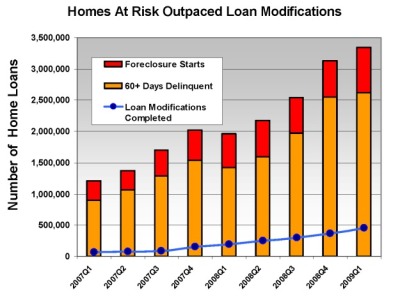
Obama’s mortgage modification plan, HAMP (Home Afforable Modification Program), isn’t working very well. Designed to help prevent foreclosures by incentivizing and giving legal protection to previously indifferent middle-men servicers it isn’t producing anywhere near the number of modifications that were anticipated. Is it likely to work in the future? My guess is no. Let’s discuss some reasons why.

Servicers Gaming the System Over the past few months, more and more stories have come out about servicers finding ways to line their pockets while consumers and investors are getting shortchanged. The one that brought the gaming issue to everyone’s attention is Peter Goodman’s article in the New York Times. Here are my favorite three since then:

Story One, Financial Times:

JPMorgan Chase, one of the first mega banks to champion the national home loan modification effort, has struck a sour chord with some investors over the risk of moral hazard posed by certain loan modifications.

Chase Mortgage, as servicer of several Washington Mutual option ARM securitizations it inherited last year in acquiring WAMU, has in several cases modified borrower loan payments to a rate that essentially equals its unusually high servicing fee, according to an analysis by Debtwire ABS. Simultaneously, Chase is cutting off the cash flow to the trust that owns the mortgage. In some cases, Chase is collecting more than half of a borrower’s monthly payment as its fee.

Story Two, Credit Slips

Countrywide Home Loans (which is now part of Bank of America) has been the subject of proceedings in several bankruptcy courts because of the shoddy recordkeeping behind their claims in bankruptcy cases. Judge Marilyn Shea-Stonum of the U.S. Bankruptcy Court for the Northern District of Ohio recently sanctioned Countrywide for its conduct in these cases…The resulting opinion makes extensive reference to Credit Slips regular blogger Katie Porter and guest blogger Tara Twomey’s excellent Mortgage Study that documented the extent to which bankruptcy claims by mortgage servicers were often erroneous and not supported by evidence. Specifically, the court adopted Porter’s recommendation from a Texas Law Review article that mortgage servicers should disclose the amounts they are owed based on a standard form. Judge Shea-Stonum found that such a requirement would prevent future misconduct by Countrywide.

Mary Kane, Washington Independent

Even as the Obama administration presses the lending industry to get more mortgage loans modified, the practice of forcing borrowers to sign away their legal rights in order to get their loans reworked is a tactic that some servicers just won’t give up on…

In a dramatic confrontation last July, Rep. Barney Frank (D-Mass.), chairman of the House Financial Services Committee, told representatives of Bank of America to get rid of waivers in their agreements. His pronouncement came after Bank of America representatives denied they were using the waivers – and Julia Gordon, senior policy counsel at the Center for Responsible Lending, produced one from her briefcase.

Check out those stories. The first has the servicers set the payment to maximize their fees, and not anything beyond (to make sure very poor and desperate mortgage holders are able to pay each month), making sure their interests are above the lender’s ones. The second one shows that it is very difficult to determine incompetence from maliciousness with the way that servicers are handling their documents on the borrowers end. And the third would be a great piece of classic comedy if it wasn’t so terrible. I bet these guys sleep like babies at night too.

The servicer’s interests are their own – and if they can rent-seek at the expense of the parties at either end, ‘nudging’ them with $1,000 isn’t going to make a big difference.

Redefault Risk There’s another story where the servicers aren’t modifying loans because it isn’t profitable for the lenders. There’s a very influencial Boston Federal Reserve paper by Manuel Adelino, Kristopher Gerardi, and Paul S. Willen titled “Why Don’t Lenders Renegotiate More Home Mortgages? Redefaults, Self-Cures, and Securitization.” They point out that, according to their regressions, redefault risk is very high – the chances that even under a modification there will still be a foreclosures, so why not foreclosure immediately?

I’d recommend Levitin’s critique (Part 1, Part 2), notably that the securitization regression doesn’t control for type of modification, specifically they don’t variable whether or not the modification involved principal reduction, which is probably does for the on-book loans and not for the off-book loans.

But regardless, this is a valid argument as U3 unemployment starts its final march to 10% we are going to see consumers become riskier and riskier, and that will be a problem for modification that will get worse before it gets better.

General Inexperience Servicers were never designed to do this kind of work; they don’t underwrite, and paying them $1,000 isn’t going to give them the experience needed for underwriting. It’s hard work that requires experience and dedication, skills that we don’t have currently. (Isn’t it amazing with the amount of money we’ve put into the real estate finance sector over the past decade we have a giant labor surplus of people who can bundle mortgages into bonds but nobody who can actually underwrite a mortgages well?)

But isn’t it at least possible that as the sophistication of the servicers increase, they’ll become equally good at learning how to game the system? I don’t mean this as a gotcha point, because I think it is the fundamental problem here, and there isn’t any way to break it. The servicers get paid when they have to get involved, and learning the contracts better will give them more reasons to get involved.

It’s been know for several years now that this was a weak spot in the mortgage backed security instruments. In the words of the creator of this instrument, Lewis Ranieri in 2008: ” The problem now with the size of securitization and so many loans are not in the hands of a portfolio lender but in a security where structurally nobody is acting as the fiduciary. And part of our dilemma here is ‘who is going to make the decision on how to restructure around a credible borrower and is anybody paying that person to make that decision?’ … have to cut the gordian knot of the securitization of these loans because otherwise if we keep letting these things go into foreclosure it’s a feedback loop where it will ultimately crush the consumer economy.”

He’s right of course; the people we are trying to ‘nudge’ into acting as the fiduciary are going to be more than happy to rent-seek these instruments while they crush the consumer economy. This ‘gordian knot’ has to be broken, but it’ll need to be done outside the instruments – in the bankruptcy court.

Vermont, Texas, and Subprime Loans

The Wall Street Journal has a story about Vermont and subprime loans:

…For the past five years, as home loans went to even Americans with poor credit and no proof of steady work, Ms. Todd couldn’t get a mortgage in spite of her good credit and low debt. Vermont banks told the self-employed landscaper that her income stream was unreliable. The 32-year-old changed careers, taking a permanent job as a teacher, to boost her chances.

Vermont’s strict mortgage-lending laws largely prevented the state’s residents from signing the types of dubious home loans written in other markets across the country. Its 1990s legislation made mortgage lenders warn customers when their rates were relatively high, and put the brokers who arranged loans on the hook if their customers defaulted. Now, by at least one measure, the state has the lowest foreclosure rate in the U.S…

These tendencies help explain how, in the 1990s, the state moved to rein in mortgage lenders based on just a few instances its chief regulator says raised red flags. According to Vermont’s Department of Banking, Insurance, Securities and Health Care Administration, one broker solicited customers through newspaper classified ads, charging up to $5,000 for referring customers to a lender. Another searched property records for owners’ tax liens, a town clerk reported, searching for what the department believes were people who could be desperate to borrow….

In laws passed between 1996 and 1998, Vermont required lenders to tell consumers when their rates were substantially higher than competitors’, with notices printed on “a colored sheet of paper, chartreuse or passion pink.” And in what officials believe is the first state law of its kind, Vermont declared that mortgage brokers’ fiduciary responsibility was to borrowers, not lenders. This left Vermont brokers partly on the hook for loans gone sour…

Vermonters didn’t see the same sharp rise in home ownership that swept much of America in recent decades, which, despite the bust, buoyed economic growth. And while part of the increase in U.S. home ownership reflected excesses in lending and borrowing, some of it represented real progress in the form of more Americans achieving the cherished goal of getting — and keeping — a home of their own. By 2007, the percentage of owner-occupied households as a whole reached 68.1%, up from 63.9% in 1990, according to U.S. Census data. Vermont started at a higher base but saw ownership rise just 1.1 percentage points in that span, to 73.7%.

Daniel Indiviglio follows up it with an in-depth comparison to Florida, while Tim Duy goes through the article and ends with this fantastic note: “according to the article, the ‘pitfalls’ amount to: Informed consumers, fewer foreclosures, healthier banks, higher rates of homeownership, and virtually no impact on average growth. Those are some ‘pitfalls’ – truly, greater consumer financial protection would spell ruin for us all.” Ha!

Two additional things:

Prepayment Penalties To go back to an old soapbox of mine, it’s worth noting that Vermont has outlawed prepayment penalties. Why is this important? My own thoughts, and the research is finding this as well, is that “lenders designed subprime mortgages as bridge-financing to the borrower over short horizons for mutual benefit from house price appreciation…Subprime mortgages were meant to be rolled over and each time the horizon deliberately kept short to limit the lenderís exposure to high-risk borrowers.” The prepayment penalty is what made these bad-faith loans profitable to the lenders, and with house prices increasing, prepayment penalties allowed lenders to bet directly on this housing appreciation.

To put it a different way, banks, instead of underwriting borrowers, were betting that house prices would increase, and paying consumers to sit in the houses. The fees and prepayment penalties were the payout that made this bet profitable (with that consumer getting what’s left over in housing appreciation). Banks don’t normally bet on house prices – they have exposures, but they are secondary exposures related to recoveries and risks – they bet on consumers. Getting rid of these prepayment penalties keeps them from taking that side bets. It also helps markets actually do their job, by allow borrowers to shop between outfits and products while reducing this transaction cost – and allow the innovation of interest rate risk management to make things a little easier for the consumer.

Texas Like Vermont, Texas has some of the strictest mortgage regulations on the books. No prepayment penalties, no balloon mortgages, etc., and as a result of the Homestead Act of 1839 and subsequent laws strict rules on Home Equity Loans (pdf).

I mentioned earlier in the year, that these consumer protection laws may have played a major role in keeping Texas from having a major housing bubble. I did not know at the time that there was a study at the Dallas Federal Reserve, Why Texas Feels Less Subprime Stress than U.S., that also came to the same conclusion:

Due to the state’s strong predatory lending laws and restrictions on mortgage equity withdrawals, a smaller share of Texas’ subprime loans involve cash-out refinancing, which reduces homeowner equity and makes default more likely when mortgage payments become unaffordable….

State data on subprime mortgage delinquencies suggest that housing prices and local economic factors are still the primary drivers of subprime default rates. Even so, mortgage characteristics also matter—from the incidence of ARMs to the purpose for which the loan was taken out. In general, cash-out refinancing loans are more prone to delinquency than loans for outright purchases.

Recent tightening of credit standards in the mortgage market has put a lid on the growth of subprime and exotic mortgages. Nevertheless, a sharply deteriorating economy, weak home sales and a continued downward trend in housing prices suggest that delinquencies and foreclosures will continue at a high level.

I find it very ironic that places like the AEI are using Texas as the role model for The Way States Should Conduct Themselves in the future, which is by association bootstrap-tugging laissez-faire financial capitalism. The research produced at the Dallas’ Federal Reserve, by economists on the ground, points out the exact opposite – consumer protection is a major reason why Texas isn’t Arizona or California or Florida. Consumer protection allows a baseline of financial safety, a net where the work of building our real economy can take place.

United States Inequality in the Recovery Period

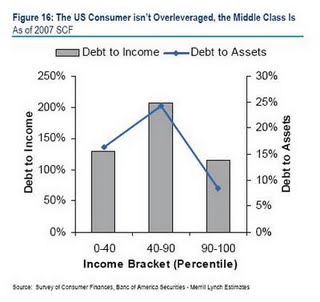
I want to point out this post from the LA Times, The consumer isn’t overleveraged — the middle class is:

That’s one conclusion to draw from a new Bank of America Merrill Lynch report this week, “The Myth of the Overlevered Consumer.”

The report hammers home what you might already suspect: The consumer debt problem in the economy really is a debt problem for the middle class. The need to work off a chunk of that debt will sap middle-class families’ spending power for perhaps years to come.

By contrast, the upper 10% of income earners face a much smaller debt burden relative to income and net worth. Those people should have ample spending power to help fuel an economic recovery.

Using 2007 data from the Federal Reserve, BofA Merrill defines the middle class as people in the 40%-to-90% income percentiles. It defines lower-income folks as those in the zero to 40% income percentiles, and the wealthy as those in the top 10%.

debt_to_income

I looked at similar data here; what I find interesting is one of their conclusions, one I’m trying to think through these days. There’s a general assumption that, to whatever extent historically record-high inequality is present, it will almost certainly be gone post-recession. But what if it isn’t? What if this recession, and the recovery, will cement inequality in the United States even further? From them:

What’s more, on the asset side, BofA Merrill says the middle-class has suffered more than the wealthy from the housing crash because middle-class families tended to rely more on their homes to build savings through rising equity. Also, the wealthy naturally had a much larger and more diverse portfolio of assets — stocks, bonds, etc. — which have mostly bounced back significantly this year.

There are a lot of moving parts going on with the interaction between the top percents and the middle class, inequality and collapse, but it isn’t hard to see a story where the stock market picks up, housing is in decline for a decade, and we have a jobless recovery. I’m not sure how that would effect our quantitative measures of inequality, like the gini coefficient, but we could end up with much more inequality, and inequality that stings a lot harder than it did during the boom times.

I bring it up because, in a separate analysis of similar data, Zero Hedge made similar points in their massive weekend A Detailed Look At The Stratified U.S. Consumer (my underline):

…It is probable that the dramatic increase in savings as disclosed previously, is an indication that at long last the richest 10% of America may be finally feeling the sting of a collapsing economy. Yet estimates demonstrate that even though on an absolute basis the wealthy are losing overall consumption power, the relative impact has hit the lower and middle classes the strongest yet again

The main reason for this disproportionate loss of wealth has to do with the asset portfolio of the various consumer strata. A sobering observation is that while 90% of the population holds 50% or more of its assets in residential real estate, the Upper Class only has 25% of its assets in housing, holding the bulk of its assets in financial instruments and other business equity. This leads to two conclusions: while average house prices are still dropping countrywide, with some regions like the northeast, and the NY metro area in particular, still looking at roughly 40% in home net worth losses, 90% of the population will be feeling the impact of an economy still gripped in a recession for a long time due to the bulk of its assets deflating. The other observation is that only 10% of the population has truly benefited from the 50% market rise from the market’s lows: those better known as the Upper class.

And to add insult to injury, the segment of housing that has been impacted most adversely in the current downturn, is lower and middle-priced housing: that traditionally occupied by the lower and middle classes. The double whammy joke of holding a greater proportion of net wealth in disproportionately more deflating assets is likely not lost on the lower and middle classes.

Consumption and savings might be hit relatively harder among the working and middle classes, as their primary investment vehicle deflates away while green shoots in the financial markets should kick start the healing for the upper classes. I don’t want to put my name too strongly on these predictions, because this part of the economy is very uncertain, but it’s a development I’m watching very closely.