Yet Another Proposal To Raise My Own Taxes

By James Kwak

In chapter 7 of White House Burning, we proposed to eliminate or scale back a number of tax breaks that I benefit from directly, including the employer health care exclusion, the deduction for charitable contributions, and, most importantly, tax preferences for investment income. We did not, however, go after tax breaks for retirement savings, on the grounds that Americans already don’t save enough for retirement.

Well, in my latest Atlantic column, I’m going after that one, too. I changed my mind in part for the usual reason—the dollar value of tax expenditures is heavily skewed toward the rich. But the other reason is that the evidence indicates that this particular subsidy doesn’t even do what it’s supposed to do: increase retirement savings. Instead, we should take at least some of the money we currently waste on tax preferences for 401(k)s and IRAs and use to shore up Social Security, the one part of the retirement “system” that actually works for ordinary Americans.

Of course, this isn’t going to happen anytime soon. President Obama proposed capping tax-advantaged retirement accounts at $3.4 million, which is a step in the right direction. ($150,000 would be a better limit, since most people reach retirement with far less in their 401(k) accounts.)* But even that was attacked by the asset management industry as theft from the elderly.

* Yes, I know about the issue of small business owners who only set up accounts for their employees because they want to benefit from them themselves. It’s a red herring. First, if an employer doesn’t have a 401(k), employees can contribute $5,000 to an IRA—and $5,000 is a lot more than most middle-income, small business employees are currently contributing. Second, the right solution would be to default everyone into a retirement savings account instead of relying on employers to decide whether or not to set up 401(k) plans.
Frat Boys and Tech Companies

By James Kwak

Matt Bai’s recent article on how Curt Shilling’s gaming company, 38 Studios, managed to secure a $75 million loan from the State of Rhode Island and then flame out into bankruptcy is a reasonably fun read. Bai’s main emphasis, which I don’t disagree with, is on Rhode Island’s Economic Development Corporation, which managed to invest all of its capital in a single company in a risky industry that, apparently, had failed to secure funding from any of the VC firms in the Boston area. Overall, this seems like another example of why government agencies shouldn’t be trying to act like lead investors.

But the story has another moral, which struck closer to home for me. Shilling apparently founded the company because he liked MMORPGs and because he wanted to become “Bill Gates-rich.” When the going got tough, in Bai’s words, Shilling “seemed to think that he could will Amalur into being, in the same way he had always been able to pitch his way out of a bases-loaded jam, even with a throbbing arm. His certainty reassured employees on Empire Street, who had no idea that he was running out of money.”

Software is hard. Really hard. And it’s even harder when you’re up against good competition. It has to be done right, and you cannot get it done twice as fast by working “twice” as hard. Too many software companies have been run into the ground by people who wanted to make a fortune but had no understanding of how software is built. Most of them are back-slapping frat boys who climbed the corporate hierarchy in sales, not world-famous athletes. But Curt Shilling, apparently, was just like them.

Protecting Boards from Their Own Shareholders

By James Kwak

I teach corporate law, and one of the topics in a typical introductory corporate law course is hostile takeovers. The central legal question is: to what extent is a board of directors allowed to undertake defenses against a takeover bid, even if (as is always the case) the potential acquirer is offering a premium over the current market price?

Whenever I teach one of these cases, I always bring up the nagging economic question: if the share price is $20, and Big Bad Raider is offering $30 in cash to each and every shareholder, where does the board get the chutzpah to claim that, under its leadership, the true value of the company is more than $30? (I understand the argument that Bigger Badder Raider might be convinced to pay more than $30, but the law, at least in Delaware, allows boards to use some takeover defenses to fend off any acquirer.) This always baffles me, but the law is premised on the idea that there is some fundamental value that is hidden deep inside the current board’s “strategic plans,” and that Big Bad Raider may rob shareholders of this fundamental value.

Continue reading “Protecting Boards from Their Own Shareholders”

Fatal Sensitivity

By James Kwak

One more post on Reinhart-Rogoff, following one on Excel and one on interpretation of results.

While the spreadsheet problems in Reinhart and Rogoff’s analysis are the most most obvious mistake, they are not as economically significant as the two other issues identified by Herndon, Ash, and Pollin: country weighting (weighting average GDP for each country equally, rather than weighting country-year observations equally) and data exclusion (the exclusion of certain years of data for Australia, Canada, and New Zealand). According to Table 3 in Herndon et al., those two factors alone reduced average GDP in the high-debt category from 2.2% (as Herndon et al. measure it) to 0.3%.*

Continue reading “Fatal Sensitivity”

Are Reinhart and Rogoff Right Anyway?

By James Kwak

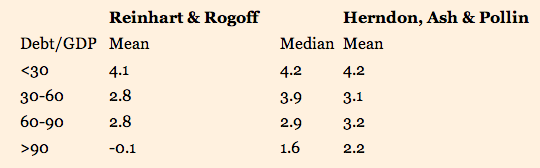
One more thought: In their response, Reinhart and Rogoff make much of the fact that Herndon et al. end up with apparently similar results, at least to the medians reported in the original paper:

Screen shot 2013-04-18 at 4.20.55 PM

So the relationship between debt and GDP growth seems to be somewhat downward-sloping. But look at this, from Herndon et al.:

Screen shot 2013-04-18 at 4.18.02 PM

Continue reading “Are Reinhart and Rogoff Right Anyway?”

More Bad Excel

By James Kwak

In 1975, Isaac Ehrlich published an empirical study purporting to show that the death penalty saved lives, since each execution deterred eight murders. The next year, Solicitor General Robert Bork cited this study to the Supreme Court, which upheld the new versions of the death penalty that several states had written following the Court’s 1973 decision nullifying all existing death penalty statutes. Ehrlich’s results, it turned out, depended entirely on  a seven-year period in the 1960s. More recently, a number of studies have attempted to show that the death penalty deters murder, leading such notables as Cass Sunstein and Richard Posner to argue for the maintenance of the death penalty.

In 2006, John Donohue and Justin Wolfers wrote a paper essentially demolishing the empirical studies that claimed to justify the death penalty on deterrence grounds. Donohue and Wolfers attempted to replicate the results of those studies and found that they were all fatally infected by some combination of incorrect controls, poorly specified variables, fragile specifications (i.e., if you change the model in minor ways that should make little difference, the results disappear), and dubious instrumental variables. In the end, they found little evidence either that the death penalty reduces or increases murders.

Now the macroeconomic world has its version of the death penalty debate, in the famous paper by Carmen Reinhart and Ken Rogoff, “Growth in a Time of Debt.” Thomas Herndon, Michael Ash, and Robert Pollin released a paper earlier this week in which they tried to replicate Reinhart and Rogoff. They found two spreadsheet errors, a questionable choice about excluding data, and a dubious weighting methodology, which together undermine Reinhart and Rogoff’s most widely-cited claim: that national debt levels above 90 percent of GDP tend to reduce economic growth.

Continue reading “More Bad Excel”

“Gut Instinct Doesn’t Matter”

By James Kwak

I’m no fan of the genre of CEO interviews published in the Sunday Times. But this past Sunday’s CEO-of-the-week column featured Marcus Ryu, a good friend and someone I’ve worked with at three different companies.

Marcus is not only very smart and someone who really knows what it’s like to build a company from the ground up, but he’s also someone who has thought very hard about what it takes to succeed as a company and what a company needs in its CEO. Unlike many CEOs, he doesn’t believe in gut instinct or the magical ability to judge character. He believes that success in business is hard and, as I’ve heard him say many times, there never is a day when suddenly everything becomes easy. If you are or want to be a CEO someday, I recommend it.

Memo to Employers: Stop Wasting Your Employees’ Money

By James Kwak

Now that I’m a law professor, people expect me to write law review articles. There are some problems with the genre—not least its absurd citation formatting system and all the fetishism surrounding it—but it’s not a bad way to make arguments about how and why the law should change in ways that might actually help people.

That was my goal in my first law review article, “Improving Retirement Options for Employees, which recently came out in the University of Pennsylvania Journal of Business Law. The general problem is one I’ve touched on several times: many Americans are woefully underprepared for retirement, in part because of a deeply flawed “system” of employment-based retirement plans that shifts risk onto individuals and brings out the worse of everyone’s behavioral irrationalities. The specific problem I address in the article is the fact that most defined-contribution retirement plans (of which the 401(k) is the most prominent example) are stocked with expensive, actively managed mutual funds that, depending on your viewpoint, either (a) logically cannot beat the market on an expected, risk-adjusted basis or (b) overwhelmingly fail to beat the market on a risk-adjusted basis.

Continue reading “Memo to Employers: Stop Wasting Your Employees’ Money”

Go For Gold

By Simon Johnson, April 1, 2013

In both 13 Bankers (2010) and White House Burning (published 2012, paperback just came out) James Kwak and I weighed the merits of going back on a global gold standard.  In those books, we ended up siding with the prevailing fiat currency system – in which money is backed by nothing more than your confidence in central banks.

In the light of recent events – in the US and in Europe – I feel we should reconsider the arguments.  On balance, I am now in favor of going back on gold for ten main reasons. Continue reading “Go For Gold”

Gee Whiz, Incentives Matter

By James Kwak

Back in the heady days of the financial crisis, I used to recommend Planet Money as a good way for non-specialists to learn about some of the basic economic and financial issues involved. Over the years, I’ve become less thrilled with the show, for reasons that will become obvious below. In particular, whenever Ira Glass dedicates a full This American Life episode to a Planet Money story, I cringe nervously, but I listen to it anyway, since, well, I’ve listened to just about every TAL episode ever, and I’m not about to stop now.

But I can’t let this weekend’s episode, on Social Security disability benefits, pass without comment. In it, Chana Joffe-Walt “investigates” the Social Security disability program, first by visiting Hale County in Alabama, where 25% of all working age adults are receiving disability benefits, and then by talking to different types of people (lawyers and public sector contractors) who help people apply for benefits.

Continue reading “Gee Whiz, Incentives Matter”

The Value of “Top Talent”

By James Kwak

From a Wall Street Journal article about The Children’s Investment Fund:

“[The fund] lost 43% in 2008, among the worst losses by a hedge-fund that year.”

“Both investors and employees defected during the crisis, with top talent leaving to start hedge funds of their own.”

“But with a 30% return in 2012 and a 14% gain this year, TCI has crossed its high-water mark.”

Makes you think.

Sir John Peace Should Resign As Chairman of Standard Chartered Bank

By Simon Johnson

On Thursday, March 21, Sir John Peace conceded that he lied to investors on March 5, 2013 when he said of Standard Chartered Bank,

“We had no willful act to avoid sanctions; you know, mistakes are made – clerical errors – and we talked about last year a number of transactions which clearly were clerical errors or mistakes that were made…”

Specifically, he now says that these remarks were both legally and factually incorrect” because Standard Chartered had previously conceded that it deliberately laundered money. 

In plain English, what Sir John said is called lying.  Or, if you prefer the language of securities lawyers, he engaged in deliberate misrepresentation.  He also violated Standard Chartered’s deferred prosecution agreement with US authorities.

Here is the full statement today.

Sir John should resign immediately as chairman of Standard Chartered. Continue reading “Sir John Peace Should Resign As Chairman of Standard Chartered Bank”

Moving the Goalposts

By James Kwak

Ezra Klein yesterday highlighted one of the underlying problems with even apparently informed discussions of deficits and the national debt: the CBO’s “alternative fiscal scenario.” As opposed to the (extended) baseline scenario, which simply projects the future based on existing law, the alternative scenario is supposed to be more realistic. And it is more realistic in some ways: for example, it assumes that spending on Afghanistan will follow current drawdown plans, not a simple extrapolation of the current year’s spending. But the problem is that it has become excessively conservative in recent years—to the point where, as Klein says, “Policy makers, pundits and others almost exclusively use this model to stoke Washington’s deficit anxieties.”

Continue reading “Moving the Goalposts”

“Some Of These Institutions Have Become Too Large”

By Simon Johnson

In a recent interview with PBS’s Frontline, Lanny Breuer – head of the criminal division at the Department of Justice – appeared to admit that some financial institutions were too big to prosecute.  In the “too big to fail is too big to jail” controversy that ensued, lobbyists and other supporters of big Wall Street firms tried all kinds of complicated ways to spin Mr. Breuer’s words.

Their job got a lot harder yesterday when Eric Holder, the attorney general, stated clearly to the Senate Judiciary Committee,

“I am concerned that the size of some of these institutions becomes so large that it does become difficult for us to prosecute them when we are hit with indications that if you do prosecute, if you do bring a criminal charge, it will have a negative impact on the national economy, perhaps even the world economy,” (Watch the video for yourself.)

According to Mr. Holder, speaking as the top enforcer of the country’s laws, “some of these institutions have become too large.”

Senator Sherrod Brown (D, OH), a leading voice for making the biggest banks smaller, reacted in this way, Continue reading ““Some Of These Institutions Have Become Too Large””

Lessons of the Sequester

By James Kwak

The automatic sequester—the across-the-board cuts to discretionary programs that President Obama said “will not happen”—happened. The reason is simple and predictable: Republicans insist that the sequester be replaced entirely by spending cuts, while Democrats insist that tax increases must be part of the bargain.

One of the more controversial positions that I have taken, on several occasions over the past two years, was that the Bush tax cuts should have been allowed to expire completely. Now we see why.

In White House Burning, Simon and I calculated that the Bush tax cuts would be worth 2.5 percent of GDP in the long term. In other words, extending the tax cuts would mean that, in order to stabilize the debt-to-GDP ratio in the long term, we would have to come up with other tax increases or spending cuts equivalent to 2.5 percent of GDP—in today’s terms, about $400 billion per year.

Continue reading “Lessons of the Sequester”