More on Wasting Shareholders’ Money

By James Kwak

A few weeks ago I wrote a post about my most recent “academic” paper, on the issue of whether corporate political contributions might constitute a breach of insiders’ fiduciary duty toward shareholders. The thrust of that paper was that some political contributions could be contested as breaches of the duty of loyalty—for example, if a CEO causes the corporation to give money to a candidate who promises to lower the CEO’s individual income taxes—which would result in the courts applying a higher standard of review.

Joseph Leahy, another law professor, recently directed me to a paper that he wrote last year (but is still being edited for publication in the Missouri Law Review) on basically the same topic. He argues first that corporate political contributions do not qualify as “waste” (which has a precise legal definition), barring the kind of extreme facts that you only see in law school hypotheticals. I agree with that, although my only discussion of the point was in a footnote (79).

Continue reading “More on Wasting Shareholders’ Money”

Stopping Russia

By Simon Johnson

The rhetoric of confrontation with Russia seems to be escalating, including with the remarkable suggestion – from Mike Rogers, the chairman of the House Intelligence Committee – that the US provide “small arms and radio equipment” to Ukraine.

Encouragement for a military confrontation is not what Ukraine needs.  As Peter Boone and I have argued in a pair of recent columns for the NYT.com’s Economix blog, Ukraine needs economic reform (with a massive reduction in corruption as the top priority).   This reform requires, above all, a massive and immediate reduction in – or elimination of – corruption.

Throwing a lot of external financial assistance at Ukraine’s government, for example with a very large loan from the International Monetary Fund, is unlikely to prove helpful.  Based on recent prior experience, such lending may even prove counterproductive.

And this seems to be exactly the path that our foreign policy elite has placed us on.

Skew

By James Kwak

There is a common phenomenon in legal disputes over the value of something, be it a company, a piece of land, or a person’s expected lifetime earnings. Each side hires an “expert” who produces an estimate based on some kind of model. And miraculously, every single time, the expert for the party that wants a higher number comes up with a high number, while the expert for the party that wants a lower number comes up with a low number. No one is surprised by this.

Yesterday, the Federal Reserve posted the results of the latest periodic bank stress tests mandated by the Dodd-Frank Act. For these tests, the Fed comes up with various scenarios of how things could go badly in the economy, and the goal is to see how banks’ income statements and balance sheets would respond. The key metrics are the banks’ capital ratios; the goal is to identify if, in bad states of the world, the banks would still remain solvent. If not, the banks won’t be allowed to do things that reduce their capital ratios today, like paying dividends or buying back stock.

For the most part, the results look pretty good: capital levels even under the severely adverse scenario should remain above the levels reached during the 2008–2009 crisis. (Of course, there are several huge caveats here. You have to believe: first, that the scenarios are sufficiently pessimistic; second, that the banks’ current financials are accurately represented; third, that the model is sensible; and fourth, that the capital levels set by current law are high enough.)

But there’s something else going on here. As part of the stress testing routine, each bank is supposed to do its own simulation of how it would respond to the scenarios specified by the Fed, using its own internal model. And—surprise, surprise!—the banks virtually uniformly predict that they will do better than the Fed.

Continue reading “Skew”

Whiskey Costs Money

By James Kwak

A few days ago I wrote a post that began with New York Fed President William Dudley talking tough about banks: “There is evidence of deep-seated cultural and ethical failures at many large financial institutions.” The thrust of that post was that I’m not very encouraged when regulators talk about culture and the “trust issue” but don’t indicate how they are going to actually affect industry behavior.

As they say, talk is cheap, whiskey costs money. What’s more important than what regulators say is what they do—and don’t talk about. Peter Eavis (who wrote the earlier story about bank regulators that my previous post was responding to) wrote a new article detailing how that same William Dudley has delayed the finalization of the supplementary leverage ratio: the backup capital standard that requires banks to maintain capital based on their total assets, not using risk weighting.

Dudley has said, “I do not feel that I in any way hold any allegiance or loyalty to the financial industry whatsoever.” That may be true; he certainly made enough at Goldman that he has no real financial incentive to continue to make nice with Wall Street.* Yet at the same time he appears to be parroting concerns raised by some of the big banks, raising a concern about the leverage rule that Felix Salmon calls “very silly” and that, according to Eavis, the Federal Reserve mother ship in Washington didn’t consider significant.

In the grand scheme of banks and their allies weakening and slowing down new regulation, this is probably not a particularly momentous battle. But it does put things in perspective.

* Of course, we know that among some people (many of whom live in New York and work in finance), no amount of money is ever enough.

There’s No Substitute for the Government

By James Kwak

Mike Konczal wrote an excellent article for Democracy about the problems with a voluntary safety net and the superiority of government social insurance. The article draws on serious historical research (by other people) to prove two main points: first, there never was a Golden Age of purely voluntary charity; second, and more important, what charitable support mechanisms existed were not up to the challenges of the Second Industrial Revolution of the late nineteenth century and completely collapsed with the onset of the Great Depression.

This shouldn’t come as a surprise. There are basic economic reasons why public social insurance is superior to voluntary charity. The goal here is to protect people against risk: of unemployment, of health emergency, of outliving one’s savings, and so on. For a risk-mitigation scheme to work, there are a few things that are necessary. One is that people actually be covered. This is something you can never have with a private system (unless it’s regulated to the point of being essentially public), since charities get to pick and choose whom they want to help. As Konczal says of private agencies before the Depression,

“They were also concerned they’d lose their ability to stigmatize—or to protect—various populations; by playing a role in determining who wasn’t deserving of assistance, they could shield those they felt worthy of their support.”

Continue reading “There’s No Substitute for the Government”

You Don’t Say

By James Kwak

Last week Peter Eavis of DealBook highlighted a statement made last year by New York Fed President William Dudley (formerly of Goldman Sachs, then a top lieutenant to Tim Geithner): “There is evidence of deep-seated cultural and ethical failures at many large financial institutions.” There was a point, say in 2008, when many people probably thought that our largest banks were just guilty of shoddy risk management, dubious sales practices, and excessive risk-taking. Since then, we’ve had to add price fixing, money laundering, bribery,  and systematic fraud on the judicial system, among other things. 

Eavis also tried to make something positive out of a couple of other recent comments. Dudley said, “I think that trust issue is of their own doing—they have done it to themselves,” while OCC head Thomas Curry said, “It is not going to work if we approach it from a lawyerly standpoint. It is more like a priest-penitent relationship.”

Continue reading “You Don’t Say”

Insurance Companies and Systemic Risk

By James Kwak

The systemic risk posed by insurance companies is something that I’ve never been entirely clear about. I know it’s an enormous issue for large insurers who want to avoid additional oversight by the Federal Reserve. I’m well aware of the usual defense, which is that insurers are not subject to bank runs because their obligations are, in large measure, pre-funded by policyholder premiums, and policyholders must pay a price in order to stop paying premiums. But this has never seemed entirely convincing to me, because some insurers are enormous players in the financial markets, and the nature of systemic risk seems to be that it can arise in unusual places.

So I find very helpful Dan and Steven Schwarcz’s new paper discussing the ins and outs of systemic risk and insurance. Because it’s written for a law review audience, it covers all the basics, so you can follow it even if you know little about insurance. They cover the usual arguments for why insurers do not pose a threat to the financial system, but then posit a number of reasons for why they could pose such a threat.

A big reason is that insurers make up a large proportion of the buy side, especially for particular markets—owning, for example, one-third of all investment-grade bonds. Furthermore, insurers tend to concentrate their purchases within certain types of securities that provide them with regulatory benefits (sound familiar?)—such as the structured products that promised higher yield while providing the investment-grade ratings that insurers needed. The big fear is that large numbers of insurers could be forced to dump similar securities at the same time, causing prices to fall and harming other types of financial institutions. This may seem unlikely, since insurers only have to make cash payouts when insurable events occur (houses burn down, people die). But insurers have to meet capital requirements just like banks, so falling asset values will require them to adjust their balance sheets.

Another major problem is that it’s not clear that insurers are prepared for those insurable events. For example, insurers are not prepared for a global pandemic, just like they weren’t prepared for large-scale terrorist attacks prior to September 11, 2001.

Finally (and I’m skipping several factors), it’s possible that entire segments of the insurance industry are under-reserving for certain types of risks. This stems from the usual cause: companies compete for market share, and the way to win share is to charge lower prices, and the way to charge lower prices is to underestimate risk. This is all good in the short term, resulting in larger bonuses, and bad in the long term, when the risk actually materializes. Yet it seems that insurance regulators are shifting to “a process of principles-based reserving (‘PBR’), which would grant insurers substantial discretion to set their own reserves based on internal models of their future exposures.” For even a casual observer of the last financial crisis, this sounds like the system is taking on a large amount of model risk and regulatory competency risk, and we know how that story ended last time.

Schwarcz and Schwarcz conclude that the federal government should play a larger role in monitoring systemic risk in the insurance industry, which will make them just about the least popular people in most insurance circles. Given the downside risks, though, it seems like pretending that there’s no reason to worry about insurers is not a good long-term strategy.
 

The Cost of Comp Plans

By James Kwak

Enterprise software is the industry that I know best. Both of the real companies I worked for (sorry, McKinsey is a fine institution in many ways, but it isn’t a real company) were in enterprise software: big, complicated, expensive software systems for midsize and large companies that can take years to sell.

Although the development of enterprise software is (often) highly sophisticated, sales is typically governed more by tribal custom. One trait we probably shared with other big ticket, business-focused industries is the “comp plan”: the system for calculating salespeople’s commissions on sales. The comp plan is just about the most important thing to any red-blooded salesperson. (Its only competition would be the territory assignment, which determines what companies he is allowed to sell to—or, more specifically, for sales to what companies he will earn a commission.) It is the source of months of lobbying, the subject of intense executive- and even board-level scrutiny, and the target of almost every complaint.

Continue reading “The Cost of Comp Plans”

It Keeps Getting Better

By James Kwak

Remember when Steve Schwarzman said that taxing carried interest was “like when Hitler invaded Poland in 1939”? Or when Lloyd Blankfein said he was doing “God’s work”? Apparently, titans of finance can’t stop themselves from giving good copy. The latest is in Max Abelson’s Bloomberg article in Bloomberg on Wall Street’s search for a Republican presidential candidate who will wave their flag: low individual taxes and a rollback of financial regulation. John Taft, U.S. CEO of RBC Wealth Management, “likened his fear for the country to ‘hiding under my desk during air-raid drills because of the Cuban missile crisis,’ when ‘literally the future of humanity hung in the balance,'” before beginning a suggestion, “If I were God.”

More seriously, the financial sector expects to be able to choose the next Republican presidential nominee. In the words of one political strategist, with Chris Christie on the rocks, “The establishment is now looking for another favorite. . . . And by the establishment, I mean Wall Street.” At the moment, the big money is desperate enough to be looking at fringe candidates like Rand Paul, Ted Cruz, and Marco Rubio (although what they most long for is the third coming of Bush). Basically, there are huge piles of cash looking for a friendly political home, and the level of hysteria is likely to surpass what we saw in 2012. We should at least get some entertaining quotes out of it.

The Free Market’s Weak Hand

By James Kwak

“Except where market discipline is undermined by moral hazard, owing, for example, to federal guarantees of private debt, private regulation generally is far better at constraining excessive risk-taking than is government regulation.”

That was Alan Greenspan back in 2003. This is little different from another of his famous maxims, that anti-fraud regulation was unnecessary because the market would not tolerate fraudsters. It is also a key premise of the blame-the-government crowd (Wallison, Pinto, and most of the current Republican Party), which claims that the financial crisis was caused by excessive government intervention in financial markets.

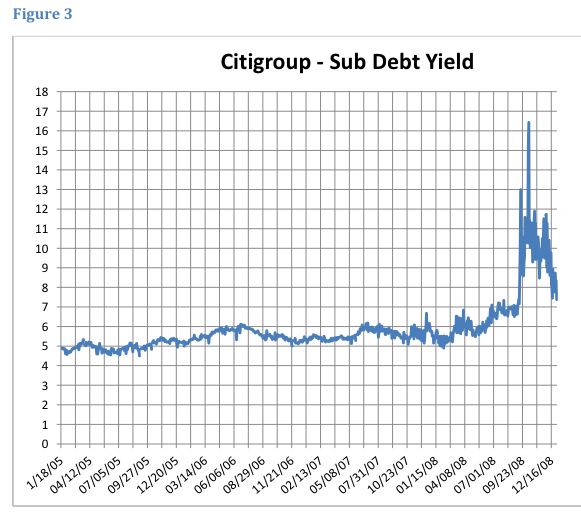
Market discipline clearly failed in the lead-up to the financial crisis. This picture, for example, shows the yield on Citigroup’s subordinate debt, which is supposed to be a channel for market discipline. (The theory is that subordinated debt investors, who suffer losses relatively early, will be especially anxious to monitor their investments.) Note that yields barely budged before 2008—despite the numerous red flags that were clearly visible in 2007 (and the other red flags that were visible in 2006, like the peaking of the housing market).


Screen shot 2014-03-11 at 5.47.38 PM

Continue reading “The Free Market’s Weak Hand”

Good Times for Capital

By James Kwak

Last week, the Wall Street Journal highlighted a Federal Reserve report on total household net worth. Surprise! Americans are richer than ever before, both in nominal and real terms.

At the same time, though, wealth inequality is increasing from its already Gilded Era levels. The main factor behind increasing household net worth over the past year was the rising stock market (followed far behind by rising housing prices). These obviously only help you if you own stocks—not if, say, you never had enough money to buy stocks, or you had to cash out your 401(k) in 2009 because you were laid off. Put another way, rising asset values help you if you are a supplier of capital more than a supplier of labor.

Is there anything we can do about this? The conventional wisdom from the political center all the way out to the right fringe is that we shouldn’t tinker too much with the wealth distribution—otherwise people won’t work as hard, which is bad for everyone. But perhaps it isn’t true.

Continue reading “Good Times for Capital”

The Fallacy of Financial Education

By James Kwak

In White House Burning, there is a section on the rise and political influence of the conservative media. At one point, I looked up the top ten talk radio shows by audience. Nine of them were unabashedly right-wing, politically oriented shows. The tenth was Dave Ramsey. Ramsey has plenty of conservative elements: religion, moralism, glorification of wealth. But his show isn’t about conservative politics. It’s about personal finance.

Ramsey is a huge success because—in addition to his charisma and marketing skills—he is peddling one of the huge but popular illusions of American culture: that people can become rich by making better financial decisions. He’s also one of the characters skewered by Helaine Olen in her recent book, Pound Foolish, which describes the fallacies, hypocrisies, and borderline-corrupt schemes of personal finance gurus like Ramsey and Suze Orman. It’s a fun read—a bit repetitive, but that’s largely because all personal finance “experts” are pushing a small handful of myths.*

Continue reading “The Fallacy of Financial Education”

Posturing from Weakness

By James Kwak

President Obama’s 2015 budget proposes a number of tax increases that will mainly affect the rich. They include:

  • Limiting the tax savings on deductions to 28 percent of the deduction amount (and applying this limit to exclusions as well, such as the one for employer-provided health benefits)
  • Requiring a minimum 30% income tax on income less charitable contributions, which is intended to limit the benefit of tax preferences on capital gains and qualified dividends
  • Reducing the estate tax exemption from $5.34 million to $3.5 million and raising the estate tax rate from 40% to 45%
  • Eliminating tax preferences for retirement accounts once someone’s account balance is enough to fund a $200,000 annuity in retirement (simplifying slightly)

These are all good things, given the size of the projected national debt and the urgent needs elsewhere in society. But, of course, they have no chance of actually happening.

If President Obama really wanted these outcomes, there was a way to get them. He could have let the Bush tax cuts expire for good a year ago, making high taxes on the rich a reality. Then, a year later, he could have proposed a middle-class tax cut and dared the Republicans to block it in an election year. (He could also have traded a reduction in the top marginal rate—from the 39.6% that would have resulted, not counting the 3.8% Medicare tax—for the reforms he is now proposing.)

But no. Instead, he locked in low marginal rates, including low rates on dividends, that cannot be budged so long as Republicans have 41 votes in the Senate. And today he’s left waving a “roadmap” that has no chance of becoming reality.

“Retirement Security in an Aging Society,” or the Lack Thereof

By James Kwak

James Poterba wrote up a very useful overview of the retirement security challenge in a new NBER white paper. (I think it’s not paywalled, but I’m not sure.) He provides overviews of much of the recent research and data on life expectancies, macroeconomic implications of a changing age structure, income and assets of people at or near retirement, and shifts in types of retirement assets.

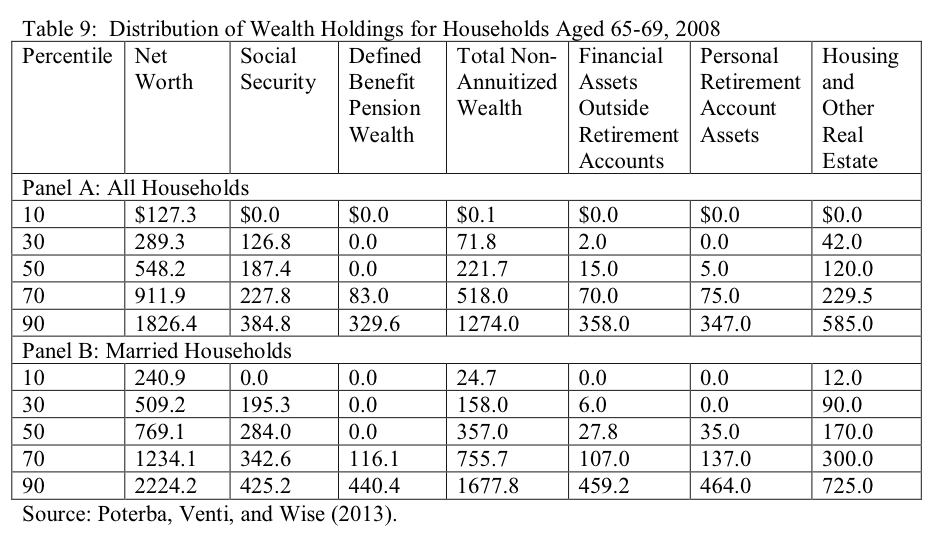
In the past, I’ve used the Federal Reserve’s Survey of Consumer Finances as my source for data about the inadequacy of many households’ retirement savings. Poterba has a new, perhaps even more stark snapshot:

Screen shot 2014-03-04 at 2.20.32 PM

Continue reading ““Retirement Security in an Aging Society,” or the Lack Thereof”

Ukrainian Chess

By Peter Boone and Simon Johnson

U.S. Secretary of State John Kerry arrived in Kiev on Tuesday.  The Obama administration is feeling real pressure from across the political spectrum to “do something”, but the US has no military options and little by way of meaningful financial assistance it can offer to Ukraine.  The $1 billion in loan guarantees offered today by Mr. Kerry means very little.

Millions of people have a great deal to lose if the situation gets out of control, and the Russian leadership is behaving in an unpredictable manner.  The sharp drop in the Russian stock market index on Monday morning, alongside an emergency hike in interest rates by the Central Bank, demonstrates that Russia’s financial elite was also caught completely off guard.

Mr. Kerry can and has made threats, but it would be better to join the Europeans in helping to calm the situation.  There is a completely reasonable and peaceful path to a solution available, but only if everyone wants to avoid a major conflict. Continue reading “Ukrainian Chess”