Category: Commentary

The Two-Track Economy

The quick way to talk about how any economy is doing is in terms of “growth”.  This is just what it sounds – a measure of how much the total value of production in a country has increased in the last month, quarter, or year.

Thinking in terms of total production – more precisely, this is usually Gross Domestic Product, GDP – never tells you everything that you want to know, but it usually gives you a sense of the near term dynamics: are business prospects expanding or contracting; is unemployment going to rise further; and will people’s wages outpace or fall behind inflation? 

Seen in these terms, the balance of opinion on the near term outlook for the U.S. today has definitely shifted towards being more positive.  A number of prominent analysts have revised upwards their growth expectation for the second half of this year considerably – for example, the ever influential Goldman Sachs was recently expecting 1 percent growth (annualized), now they guess it will be closer to 3 percent.

“Potential” growth in the U.S. is generally considered to be between 2 and 3 percent per annum – this is how fast the economy can usually grow without causing inflation to increase.  So the Goldman swing in opinion is equivalent to switching from saying the second half of this year will be “miserable” to saying there will be a fairly strong recovery.

But at this stage in our economic boom-bust cycle, is it still helpful to think in terms of one aggregate measure of output?  Or are we seeing the emergence of a two-track economy: one bouncing back in a relatively healthy fashion, and the other really struggling? Continue reading “The Two-Track Economy”

Vermont, Texas, and Subprime Loans

The Wall Street Journal has a story about Vermont and subprime loans:

…For the past five years, as home loans went to even Americans with poor credit and no proof of steady work, Ms. Todd couldn’t get a mortgage in spite of her good credit and low debt. Vermont banks told the self-employed landscaper that her income stream was unreliable. The 32-year-old changed careers, taking a permanent job as a teacher, to boost her chances.

Vermont’s strict mortgage-lending laws largely prevented the state’s residents from signing the types of dubious home loans written in other markets across the country. Its 1990s legislation made mortgage lenders warn customers when their rates were relatively high, and put the brokers who arranged loans on the hook if their customers defaulted. Now, by at least one measure, the state has the lowest foreclosure rate in the U.S…

These tendencies help explain how, in the 1990s, the state moved to rein in mortgage lenders based on just a few instances its chief regulator says raised red flags. According to Vermont’s Department of Banking, Insurance, Securities and Health Care Administration, one broker solicited customers through newspaper classified ads, charging up to $5,000 for referring customers to a lender. Another searched property records for owners’ tax liens, a town clerk reported, searching for what the department believes were people who could be desperate to borrow….

In laws passed between 1996 and 1998, Vermont required lenders to tell consumers when their rates were substantially higher than competitors’, with notices printed on “a colored sheet of paper, chartreuse or passion pink.” And in what officials believe is the first state law of its kind, Vermont declared that mortgage brokers’ fiduciary responsibility was to borrowers, not lenders. This left Vermont brokers partly on the hook for loans gone sour…

Vermonters didn’t see the same sharp rise in home ownership that swept much of America in recent decades, which, despite the bust, buoyed economic growth. And while part of the increase in U.S. home ownership reflected excesses in lending and borrowing, some of it represented real progress in the form of more Americans achieving the cherished goal of getting — and keeping — a home of their own. By 2007, the percentage of owner-occupied households as a whole reached 68.1%, up from 63.9% in 1990, according to U.S. Census data. Vermont started at a higher base but saw ownership rise just 1.1 percentage points in that span, to 73.7%.

Daniel Indiviglio follows up it with an in-depth comparison to Florida, while Tim Duy goes through the article and ends with this fantastic note: “according to the article, the ‘pitfalls’ amount to: Informed consumers, fewer foreclosures, healthier banks, higher rates of homeownership, and virtually no impact on average growth. Those are some ‘pitfalls’ – truly, greater consumer financial protection would spell ruin for us all.” Ha!

Two additional things:

Prepayment Penalties To go back to an old soapbox of mine, it’s worth noting that Vermont has outlawed prepayment penalties. Why is this important? My own thoughts, and the research is finding this as well, is that “lenders designed subprime mortgages as bridge-financing to the borrower over short horizons for mutual benefit from house price appreciation…Subprime mortgages were meant to be rolled over and each time the horizon deliberately kept short to limit the lenderís exposure to high-risk borrowers.” The prepayment penalty is what made these bad-faith loans profitable to the lenders, and with house prices increasing, prepayment penalties allowed lenders to bet directly on this housing appreciation.

To put it a different way, banks, instead of underwriting borrowers, were betting that house prices would increase, and paying consumers to sit in the houses. The fees and prepayment penalties were the payout that made this bet profitable (with that consumer getting what’s left over in housing appreciation). Banks don’t normally bet on house prices – they have exposures, but they are secondary exposures related to recoveries and risks – they bet on consumers. Getting rid of these prepayment penalties keeps them from taking that side bets. It also helps markets actually do their job, by allow borrowers to shop between outfits and products while reducing this transaction cost – and allow the innovation of interest rate risk management to make things a little easier for the consumer.

Texas Like Vermont, Texas has some of the strictest mortgage regulations on the books. No prepayment penalties, no balloon mortgages, etc., and as a result of the Homestead Act of 1839 and subsequent laws strict rules on Home Equity Loans (pdf).

I mentioned earlier in the year, that these consumer protection laws may have played a major role in keeping Texas from having a major housing bubble. I did not know at the time that there was a study at the Dallas Federal Reserve, Why Texas Feels Less Subprime Stress than U.S., that also came to the same conclusion:

Due to the state’s strong predatory lending laws and restrictions on mortgage equity withdrawals, a smaller share of Texas’ subprime loans involve cash-out refinancing, which reduces homeowner equity and makes default more likely when mortgage payments become unaffordable….

State data on subprime mortgage delinquencies suggest that housing prices and local economic factors are still the primary drivers of subprime default rates. Even so, mortgage characteristics also matter—from the incidence of ARMs to the purpose for which the loan was taken out. In general, cash-out refinancing loans are more prone to delinquency than loans for outright purchases.

Recent tightening of credit standards in the mortgage market has put a lid on the growth of subprime and exotic mortgages. Nevertheless, a sharply deteriorating economy, weak home sales and a continued downward trend in housing prices suggest that delinquencies and foreclosures will continue at a high level.

I find it very ironic that places like the AEI are using Texas as the role model for The Way States Should Conduct Themselves in the future, which is by association bootstrap-tugging laissez-faire financial capitalism. The research produced at the Dallas’ Federal Reserve, by economists on the ground, points out the exact opposite – consumer protection is a major reason why Texas isn’t Arizona or California or Florida. Consumer protection allows a baseline of financial safety, a net where the work of building our real economy can take place.

United States Inequality in the Recovery Period

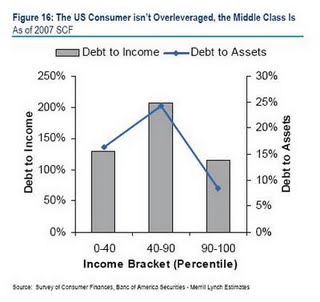
I want to point out this post from the LA Times, The consumer isn’t overleveraged — the middle class is:

That’s one conclusion to draw from a new Bank of America Merrill Lynch report this week, “The Myth of the Overlevered Consumer.”

The report hammers home what you might already suspect: The consumer debt problem in the economy really is a debt problem for the middle class. The need to work off a chunk of that debt will sap middle-class families’ spending power for perhaps years to come.

By contrast, the upper 10% of income earners face a much smaller debt burden relative to income and net worth. Those people should have ample spending power to help fuel an economic recovery.

Using 2007 data from the Federal Reserve, BofA Merrill defines the middle class as people in the 40%-to-90% income percentiles. It defines lower-income folks as those in the zero to 40% income percentiles, and the wealthy as those in the top 10%.

debt_to_income

I looked at similar data here; what I find interesting is one of their conclusions, one I’m trying to think through these days. There’s a general assumption that, to whatever extent historically record-high inequality is present, it will almost certainly be gone post-recession. But what if it isn’t? What if this recession, and the recovery, will cement inequality in the United States even further? From them:

What’s more, on the asset side, BofA Merrill says the middle-class has suffered more than the wealthy from the housing crash because middle-class families tended to rely more on their homes to build savings through rising equity. Also, the wealthy naturally had a much larger and more diverse portfolio of assets — stocks, bonds, etc. — which have mostly bounced back significantly this year.

There are a lot of moving parts going on with the interaction between the top percents and the middle class, inequality and collapse, but it isn’t hard to see a story where the stock market picks up, housing is in decline for a decade, and we have a jobless recovery. I’m not sure how that would effect our quantitative measures of inequality, like the gini coefficient, but we could end up with much more inequality, and inequality that stings a lot harder than it did during the boom times.

I bring it up because, in a separate analysis of similar data, Zero Hedge made similar points in their massive weekend A Detailed Look At The Stratified U.S. Consumer (my underline):

…It is probable that the dramatic increase in savings as disclosed previously, is an indication that at long last the richest 10% of America may be finally feeling the sting of a collapsing economy. Yet estimates demonstrate that even though on an absolute basis the wealthy are losing overall consumption power, the relative impact has hit the lower and middle classes the strongest yet again

The main reason for this disproportionate loss of wealth has to do with the asset portfolio of the various consumer strata. A sobering observation is that while 90% of the population holds 50% or more of its assets in residential real estate, the Upper Class only has 25% of its assets in housing, holding the bulk of its assets in financial instruments and other business equity. This leads to two conclusions: while average house prices are still dropping countrywide, with some regions like the northeast, and the NY metro area in particular, still looking at roughly 40% in home net worth losses, 90% of the population will be feeling the impact of an economy still gripped in a recession for a long time due to the bulk of its assets deflating. The other observation is that only 10% of the population has truly benefited from the 50% market rise from the market’s lows: those better known as the Upper class.

And to add insult to injury, the segment of housing that has been impacted most adversely in the current downturn, is lower and middle-priced housing: that traditionally occupied by the lower and middle classes. The double whammy joke of holding a greater proportion of net wealth in disproportionately more deflating assets is likely not lost on the lower and middle classes.

Consumption and savings might be hit relatively harder among the working and middle classes, as their primary investment vehicle deflates away while green shoots in the financial markets should kick start the healing for the upper classes. I don’t want to put my name too strongly on these predictions, because this part of the economy is very uncertain, but it’s a development I’m watching very closely.

A CFPA Research Brief

I want to point out this research brief on the Consumer Financial Protection Agency (pdf file) from Law Professor Adam Levitin. At 16 pages, it’s the best one-stop paper I’ve seen for understanding why CFPA needs to pass.

As opposed to specific practices, Levitin focuses on four key structural issues that are broken with our current system.

1. Consumer protection conflicts with, and is subordinated to, safety-and-soundness concerns.
2. Consumer protection is a so-called “orphan” mission.
3. No agency has developed an expertise in consumer protection in financial services.
4. Regulatory arbitrage of the current system fuels a regulatory race-to-the-bottom.

The first point is key and informs the rest of them. “Safety-and-soundness” means that regulators currently are focused on making sure the banking system is sound, part of which means that banks have lots of money. So if Americans are paying a mind-boggling $38.5 Billion dollars in overdraft fees a year (more than the GDP of Kenya, as a comparison) that just means regulators can sleep a little more soundly at the wheel.

If having giant banks dedicated to soaking and misleading consumers was creating a safer and more sound financial system, that would be one thing, though preliminary evidence says no:

Since protecting large banks at the expense of consumers is the current goal of the regulatory structure, other goals such as collecting data on actual experiences of consumers (something researchers have a difficult time finding, and have to use poor substitutes like aggregate consumption diaries), having in-depth knowledge locally on scene, and fighting regulatory arbitrage among the current 11 agencies that investigate this material fall by the wayside.

Levitin also brings up this point, mentioned again and again (and worth mentioning again): “Most consumer financial products differ in their class primarily on price, not functionality, but product pricing structure is designed to make comparison shopping difficult in order to avoid commoditization (and inevitably lower profit margins). Better disclosure should encourage commoditization and price competition, which should actually bring down prices.”

If you are in the business of reading or disseminating research papers, I’d recommend that Levitin paper. Though health care is rightfully focusing our minds and attentions these days, this is another piece of necessary reform that could get easily thrown under the bus.

The Demand for Housing

Hello all, my name is Mike Konczal and I’ll be guest-blogging here this week. I want to start off with a request for comments. I think this page has one of the smarter comments sections (that statement is completely self-serving, as I am a commenter here too), and I want to get all of your opinion on a question that I’ve been thinking about lately: Where did the increase in demand for housing and subprime loans come from?

Think of our current story for the increase in subprime loans and the housing bubble: interest rates were kept too low following the attacks of 9/11 and/or there was a global savings glut. Financial deregulation allowed Wall Street to pour capital into mortgages while slicing and dicing them into investment vehicles, and politicians were happy to think the interests of Main Street (and its voters) and Wall Street (and its campaign donations) lined up perfectly. Fly-by-night unregulated subprime lenders steered borrowers into high-interest loans and/or community groups pressured banks to increase the amount of said loans, as well as restricted the increase in new houses in the most desirable areas through regulation and zoning. Alyssa Katz’s Our Lot is the best book I’ve read recently about the way deregulation and political goals worked together to get Wall Street to pour money into dubious loans.

Notice that almost all of these are changes are on the supply side: Someone now wants to offer you more of a mortgage than they did before. But why did we take these mortgages? We could say that supply creates its own demand, but I think that’s too much of a dodge when there are interesting phenomenon to investigate. Here are two standard ones:

Perfectly Rational Karl Smith points out that there may not be a conflict here at all. When it comes to no-money-down liars loans, or leveraged investments more generally, the effect for consumers might be a “heads-you-win, tails-nothing-happens” coin flip. If someone offers you a giant mortgage, and the upside that your new house may become worth a lot more than the fees and interest jumps, and the downside is that you got to live in a nicer house than normal for a year or two and lost your rent, that’s a perfectly rational bet.

That’s not the experience on the ground, where people hang onto their house, fighting, often desperately at times, to keep them. Houses aren’t dumped like underperforming stocks by the overwhelming majority of consumers.

Investments Gone Bad Interest paid on a mortgage is tax deductible. In 1997, President Clinton overhauled the tax code for selling real estates; consumers would no longer have to pay capital gains taxes on their houses. Between that, the collapse of the tech bubble and the worry that there were many more Enrons and Worldcoms waiting to be found, many households didn’t want to invest in the stock market. So people went nuts and invested too heavily in housing for their investment portfolio.

(Technically, if people want to spend more on houses because interest rates are lower, then the interest rate tax deduction may have slowed the housing bubble, since if people are buying more house because interest rates are lower then they must have less interest paid on their house, which is less to write off on their taxes.)

This depends on housing prices appreciating for a long time – here’s an example of economists discussing whether or not that is rational, and trying to fold it into a standard investment story. I often feel that when the story goes too quickly into “irrationality”, it is because we are missing some sociological explanations for why people are doing the things they do. I want to add three additional reasons why the demand for housing may have skyrocketed over the past 10 years, ones I don’t see discussed very often in the standard narrative.

Housing Equity as the new Social Contract As income has become more volatile, health care costs have skyrocketed, unemployment spells have increased, more household spending has gone to hard-to-decrease fixed costs, and all the while there has been a slow unwinding of the social contract, housing equity became a new form of social insurance to navigate the bad times.

A lot of housing equity was tapped to make large consumer purchases – televisions, remodeled kitchens, etc. But a lot of housing equity was tapped to pay medical bills, or as a form of unemployment insurance, as well. It is worth noting that 60% of subprime loan defaults in Massachusetts started off as prime loans, the previously stable households who put money down, paid their bills on time, etc. I’d be curious to see research focused on how much of each played a part in the housing bubbles and demand for subprime loans, and the rise in house prices more generally.

Education There’s a lot of focus on the interest rate deduction that is embedded inside a mortgage. I think the most obvious embedded option inside a mortgage that isn’t discussed is the option to educate your children at the local school district. If sending 3 kids to a private high school at your old houses costs $5,000/year, and if the new house’s public high school is free and equally good then taking a $60,000 bath on the house is break-even. Completely rational.

The value of this option has increased, both with the returns to education but also with a general worry about the robustness of our educational meritocracy. The amount of money and energy that goes into securing access to high-end education has skyrocketed over the past decade, and part of that budget, though it isn’t treated as such, is in your house. And though we often think of educational inequality as a function of a Kozol-narrative of the poorest against the richest, this bidding may be most driven by inequality between the middle and the highest parts of the inequality curve. I’d really like to see some hard research into how much our desire to educate our children in the best way possible has driven subprime and the housing bubble.

Gentrification The term gentrification may not apply anymore, as it usually is meant to describe a small neighborhood. What we’ve seen might be described as a demographic inversion, with the poor being moved from the city to the suburbs. That New Republic article focuses on Chicago, and as a resident of Logan Square during the time in question I can back up the statement: “The reality of demographic inversion strikes me every time I return to Chicago…But that hasn’t prevented Logan Square from changing dramatically again–not over the past generation, or the past decade, but in the past five years.” Even now, with the housing recession underway, it seems that we’ll continue to see a shift to a “new urbanity” over the next ten years.

Gentrification can increase the quality-of-life for people who remain in the area. There will be better services, safer streets, the kind of grocery stores where people with college degrees shop, etc. However the key point there is that people have to remain in the neighborhood. Taking a big bet on housing can be very rational in this case. The rollercoaster jumps in mortgage payments that come from a subprime loan might be less than the uncertainty in the jumps in apartment rents that occurred over the same period.

If you were an adult in the 2000s, you’ve probably spent at least one night thinking “am I making the right housing choices? Should I buy? Should I have bought more? Less?” Since this is the smartest comments section on the nets, I’d like to ask you – why was this?
Has Anyone Taken Responsibility For Anything? (Weekend Comment Competition)

With the anniversary of the Lehman-AIG-rest of the world debacle fast approaching, it seems fair to ask: Who accepts any blame for creating our excessively crisis-prone system?

Friends and contacts who work in the financial sector freely discuss their participation in activities they now regret.  But where is the mea culpa, of any kind, from a public figure – our “leadership”?

I suggest we divide the competition into three classes.

  1. Policymakers who now admit that any of their actions or inactions contributed to the Great Credit Bubble.  Blaming China gets a person negative points; this may hurt Fed officials.
  2. Private sector executives who concede they made mistakes or misjudged the situation so as to lose a lot of Other People’s Money.  Blaming Hank Paulson also earns negative points (too obvious). Continue reading “Has Anyone Taken Responsibility For Anything? (Weekend Comment Competition)”

Management Consulting for Humanities Ph.D.s

Ezra Klein referred me to a 2006 article, “The Management Myth,” by Matthew Stewart, which has just led to a new book by the same name. Stewart has a Ph.D. in nineteenth-century German philosophy and was a founding partner of a management consulting firm; I have a Ph.D. in twentieth-century intellectual history and spent three years as a management consultant (at McKinsey) before co-founding a software company, so I thought I might find a kindred soul. Also, I’ve been thinking for years that I should write a book about my strange journey through the business world, but will probably never get around to it, so I was wondering what that book might have looked like.

Well, we’re not so kindred after all, although my criticisms of the management consulting industry certainly overlap with his. One difference: I have never, ever found myself thinking, “I’d rather be reading Heidegger!,” although (or perhaps because) I read my share of Heidegger back in the day – Being and Time was on my orals list. (That said, I have also never read books about management, which is what Stewart was doing when he was wishing for Heidegger.)

Continue reading “Management Consulting for Humanities Ph.D.s”

Waiting For The Federal Reserve’s Next Apology

In November 2002, Ben Bernanke apologized – for the Fed’s role in causing the Great Depression of the 1930s.  “I would like to say to Milton [Friedman] and Anna [Schwartz]: Regarding the Great Depression. You’re right, we did it. We’re very sorry. But thanks to you, we won’t do it again” (conclusion of this speech).

Bernanke’s point, of course, is that the Fed tightened monetary policy inappropriately – and allowed banks to fail – in 1929-33.  And much has been made of his strong focus, over the past year, on avoiding a repeat of those or closely related mistakes (including here).

But today we need a different kind of apology, or at least a statement of responsibility, from Ben Bernanke and the Fed. Continue reading “Waiting For The Federal Reserve’s Next Apology”

Health Care’s Senior Moment

Seniors have recently emerged as an important battleground in the health reform war. Katharine Seelye of the New York Times has a post on the “new generation gap” separating the elderly from the not-so-elderly, and multiple polls have shown that seniors are more resistant to reform, at least when it is phrased broadly. In addition, the nonsense about “death panels” has worried at least some seniors, enough for the AARP to pitch in to try to shoot it down.*

This should seem ironic, given that people over 65 are the one group that has already most benefited from health care reform – only their reform happened in the 1960s, when Medicare was created. But hey, it’s a democracy, and people don’t have to wish for others the benefits they themselves enjoy.

Continue reading “Health Care’s Senior Moment”

Can the Federal Reserve Protect Consumers?

Ben Bernanke, chairman of the Federal Reserve, insists that the Fed can protect consumers effectively against defective or dangerous financial products.  He and his allies are therefore signaling opposition to – and even defiance of – key parts of the Treasury’s plan for regulatory reform, which involve setting up a new Consumer Financial Protection Agency.

The Fed is a well-regarded institution in general and Bernanke is currently riding a wave of personal popularity and prestige, but are these claims vis-à-vis consumers plausible?

Not really. Continue reading “Can the Federal Reserve Protect Consumers?”

The Problem with Disclosure

Felix Salmon has a good example of why disclosure (the preferred consumer-protection regime of free-market conservatives and bankers) doesn’t work, courtesy of Ryan Chittum. The topic is no-interest balance transfers offered by credit card companies.

As Salmon points out, most people probably realize what the game is. That is, most people know that banks aren’t in the business of lending money for free; they know that the bank is betting that it can raise the interest rate before they pay off the balance. It’s possible that you will end up getting a free loan: “If you’re smart and disciplined and lucky, you might be able to game the system and pay no interest at all on that balance. Bank of America, for its part, does its very best to make you think that you’ll be able to do just that, essentially getting one over on The Man.” But the bank knows it has the numbers on its side; and most consumers know it too, because they know that’s the only reason the bank would make the offer.

Continue reading “The Problem with Disclosure”

Richard Parsons’s Portfolio

According to Bloomberg, Richard Parsons – the chair of Citigroup since February – now owns stock in the company worth, at yesterday’s close, about $350,000 (96,298 shares at $3.69).  For such a well-established and highly remunerated corporate executive, we can reasonably refer to such an amount as “chump change.”  In May, Forbes estimated Mr. Parsons’ net worth as a little under $100m.

I have no particular complaint about Mr. Parsons; he is an experienced banker, with the very best political connections.  But I would point out that while Wall Street likes to talk big about people having “skin in the game,” when it comes to putting their personal net worth on the line, many finance executives prefer a different kind of arrangement.  Specifically, they are attracted to compensation structures in which they have a lot of upside but very little downside.

If you had such a deal, how would this affect your relative interest in risk-taking and careful supervision of subordinates? Continue reading “Richard Parsons’s Portfolio”

China Rising, Rent-Seeking Version

The usual concern about the US-China balance of economic and political power is couched in terms of our relative international payments positions.  We’ve run a large current account deficit in recent years (imports above exports); they still have – by some measures – the largest current account surplus (exports above imports) even seen in a major country.  They accumulate foreign assets, i.e., claims on other countries, such as the US.  We issue a great deal of debt that is bought by foreigners, including China.

There are some legitimate concerns in this framing of the problem – no country can increase its net foreign debt (relative to GDP) indefinitely without facing consequences.  And the Obama administration, ever since the Geithner-Clinton flipflop on China’s exchange rate policy early in 2009, seems quite captivated by this way of thinking: Will they buy our debt? Can we control our budget deficit? What happens if China dumps its dollars?.

The reason real to worry about China, however, has very little to do with external balances, China’s dollar holdings, or even capital flows.  It’s about productivity and rent-seeking. Continue reading “China Rising, Rent-Seeking Version”

Credit Conditions In The Absence Of Consumer Protection

Even some of our most sophisticated commentators doubt a link between consumer protection and any macroeconomic outcomes.  Consumer protection, in this view, is microeconomics and quite different from macroeconomic issues (such as the speed and nature of our economic recovery).

Officially measured interest rates are down from their height in the Great Panic of 2008-09 and the financial markets, broadly defined, continue to stabilize.  But are retail credit conditions, i.e., the terms on which you can borrow, getting easier or tougher?

On credit cards, there’s no question: it’s getting more expensive to borrow, particularly because new fees and charge are appearing.  Of course, lenders have the right to alter the terms on which they provide credit.  We could just note that this tightening of credit does not help the recovery and flies in the face of everything the Fed is trying to do – although it fits with Treasury’s broader strategy of allowing banks to recapitalize themselves at the expense of customers.  

But there is an additional question: will these changes in lending conditions be reflected in the disclosed Annual Percentage Rate (APR)?  Historically, the rules around the APR – overseen by the Federal Reserve – have not forced lenders to include all charges in this calculation.  Why is this OK? Continue reading “Credit Conditions In The Absence Of Consumer Protection”

What Do the People Want?

To the New York Times’s credit, they asked them. And this is what they found (from the beginning of the article, entitled “New Poll Finds Growing Unease on Health Plan”):

President Obama’s ability to shape the debate on health care appears to be eroding as opponents aggressively portray his overhaul plan as a government takeover that could limit Americans’ ability to choose their doctors and course of treatment, according to the latest New York Times/CBS News poll.

Americans are concerned that revamping the health care system would reduce the quality of their care, increase their out-of-pocket health costs and tax bills, and limit their options in choosing doctors, treatments and tests, the poll found. The percentage who describe health care costs as a serious threat to the American economy — a central argument made by Mr. Obama — has dropped over the past month.

The article does cite several statistics from the poll, and does show several signs that are favorable to President Obama, including that the public overwhelmingly favors him over the Republicans when it comes to health care, and overwhelmingly thinks that he is trying to work with Republicans more than the converse. But the overall impression you get is that Americans are afraid of health care reform.

But are they?

Continue reading “What Do the People Want?”