Category: Commentary

Economism and Health Care

By James Kwak

A core feature of competitive markets, according to the basic model, is that they allocate goods to the people or companies that are willing to pay the most for them. In theory, and in many situations, this is a good thing: If I am willing to pay $1,000 for a custom portrait of my (daughter’s) dog, and you are only willing to pay $1 for it, then aggregate satisfaction is likely to be higher if I get the portrait. But not always: If I am willing to pay $10 for a turkey sandwich, but you are only willing to pay $1 because you only have $1, and have no borrowing capacity, then society may very well be better off if you get the sandwich. Yet in an ordinary, healthy market, I get the sandwich.

This problem is acutely apparent when it comes to health care. People place a high value on not dying, but when it comes to the allocation of medical treatment, they can’t bid more than their income allows. The obvious result is that markets deliver unnecessary procedures to rich people while denying essential care to poor people—because that’s what markets do. Obamacare attempted (with mixed success) to mitigate this problem. The Trump administration is rhetorically committed to deregulating health insurance; the question is whether they are willing to accept the political consequences of pricing millions of people out of not dying.

This is the topic of my new guest post, “Health Care and John D. Rockefeller’s Dog,” on Econbrowser (a fabulous economics blog, by the way, written by Menzie Chinn and James Hamilton). For more, head on over there.

Economism and the Future of the Democratic Party

By James Kwak

I haven’t written much about the election itself (except to point out that the same data can be interpreted in diametrically opposing ways). That’s because the election was so close that the fact that Clinton lost can be explained by any number of but-for causes, and much of the Democratic Internet has been a cacophony of people insisting that their preferred cause (Comey, Russian hacking, not enough attention to African-Americans, too much attention to minorities, not enough attention to the white working class, too much emphasis on Trump’s personality, etc.) was the One True Cause.

I do think, however, that if Democrats (a group in which include myself) want to return to power and change the overall political dynamics of this country, one thing we need to recognize is that Republicans have been crushing us on the economic messaging front for decades. We have adapted by becoming Republicans Lite—no longer the party of jobs and the working person, but now the party of minimally intrusive market regulation, technocratic expertise, and free trade agreements.

This is the subject of my article in Literary Hub today, “The Failure of Democratic Storytelling.” Now that Democrats are out of power virtually across the board, we have the opportunity to develop a new vision, without having to compromise with Joe Manchin, Arlen Spector, and Susan Collins to squeak legislation through Congress. The question is what we make of that opportunity.

A Change Is in the Air

By James Kwak

There was one moment, when I was finishing up the manuscript of Economism, that I thought someone had already said what I was trying to say in the book. This is what I read:

“The beauty and the simplicity of such a theory are so great that it is easy to forget that it follows not from the actual facts, but from an incomplete hypothesis introduced for the sake of simplicity. … The conclusion that individuals acting independently for their own advantage will produce the greatest aggregate of wealth, depends on a variety of unreal assumptions …

“Individualism and laissez-faire could not, in spite of their deep roots in the political and moral philosophies of the late eighteenth and early nineteenth centuries, have secured their lasting hold over the conduct of public affairs, if it had not been for their conformity with the needs and wishes of the business world of the day. …

“These many elements have contributed to the current intellectual bias, the mental make-up, the orthodoxy of the day.”

Continue reading “A Change Is in the Air”

The Curse of Credentialism

By James Kwak

I just finished reading J. D. Vance’s memoir, Hillbilly Elegy. I don’t feel like adding to the torrent of instanalysis of the “white working class,” however, so I’ll just comment on the description of Yale Law School—which, in the book, serves the dramatic function of introducing the author to the Elite.

yale_law_school_in_the_sterling_law_building
Photo by Shmitra at the English language Wikipedia (CC BY-SA 3.0)

There are a few details that seem unfamiliar to me—I can’t recall attending a single one of the “cocktail receptions and banquets” that Vance describes as the school’s social rituals—but then again I was thirty-nine and married with a child when I started law school. But there is one thing that Vance nails: the culture of credentialism.

Continue reading “The Curse of Credentialism”

Larry Kudlow and Economics in the Trump Administration

By James Kwak

Noah Smith (along with a fair section of the Internet) has some concerns about Larry Kudlow as chair of the Council of Economic Advisers: he’s overconfident, too much of a partisan, and fixated on nonexistent problems (e.g., inflation). I’m not so worried that he’s on Team Republican; after all, Donald Trump gets to pick the advisers he wants, and they shouldn’t be rejected solely because they take political sides. But I am worried about what Kudlow’s appointment means for the relationship between economics and policy.

The world is a complicated place. Anyone who studies society in depth should learn to have respect for that fact. At any given moment, we have only a hazy understanding of what combinations of transitory phenomena and underlying structural factors produce what outcomes. (For Exhibit A, see the election that took place on November 8.) This tweet at the beginning of Game 7 of the Cubs-Indians World Series, channeling the great French historian Fernand Braudel, is one of my all-time favorites:

Continue reading “Larry Kudlow and Economics in the Trump Administration”

How Not to Invest

By James Kwak

Forty years after John Bogle launched the Vanguard 500 Index Fund, passive investment funds now account for about one-third of the mutual fund and ETF market. You would think this would pose a threat to traditional asset managers that charge hefty fees for actively managed mutual funds, and this is true in part. On average, index funds charge 73 basis points less than active funds, and the average expense ratios for actively managed funds have fallen from 106 bp to 84 bp over the past fifteen years (Investment Company Institute, 2016 Investment Company Fact Book, Figure 5.6).

screen-shot-2016-12-20-at-4-44-16-pm

Continue reading “How Not to Invest”

Jeb Hensarling and the Allure of Economism

By James Kwak

The Wall Street Journal has a profile up on Mike Crapo and Jeb Hensarling, the key committee chairs (likely in Crapo’s case) who will repeal or rewrite the Dodd-Frank Wall Street Reform and Consumer Protection Act. It’s clear that both are planning to roll back or dilute many of the provisions of Dodd-Frank, particularly those that protect consumers from toxic financial products and those that impose restrictions on banks (which, together, make up most of the act).

Hensarling is about as clear a proponent of economism—the belief that the world operates exactly as described in Economics 101 models—as you’re likely to find. He majored in economics at Texas A&M, where one of his professors was none other than Phil Gramm. Hensarling described his college exposure to economics this way:

“Even though I had grown up as a Republican, I didn’t know why I was a Republican until I studied economics. I suddenly saw how free-market economics provided the maximum good to the maximum number, and I became convinced that if I had an opportunity, I’d like to serve in public office and further the cause of the free market.”

Continue reading “Jeb Hensarling and the Allure of Economism”

More on the Deduction Fairy

By James Kwak

[Updated with Mnuchin’s position on charitable contribution deduction.]

I wrote two days ago about the fairy tale that you can lower tax rates for the very rich yet avoid lowering their actual taxes by eliminating those mythical beasts, loopholes and deductions. The basic problem with this story is that, at the very high end of the distribution, deductions and exclusions (with the possible exception of the deduction for charitable contributions) just don’t amount to very much as a percentage of income. Therefore, eliminating those deductions may increase rich people’s taxes by tens of thousands of dollars, but that is only a tiny proportion of their overall tax burden, and not enough to offset any significant rate decrease.

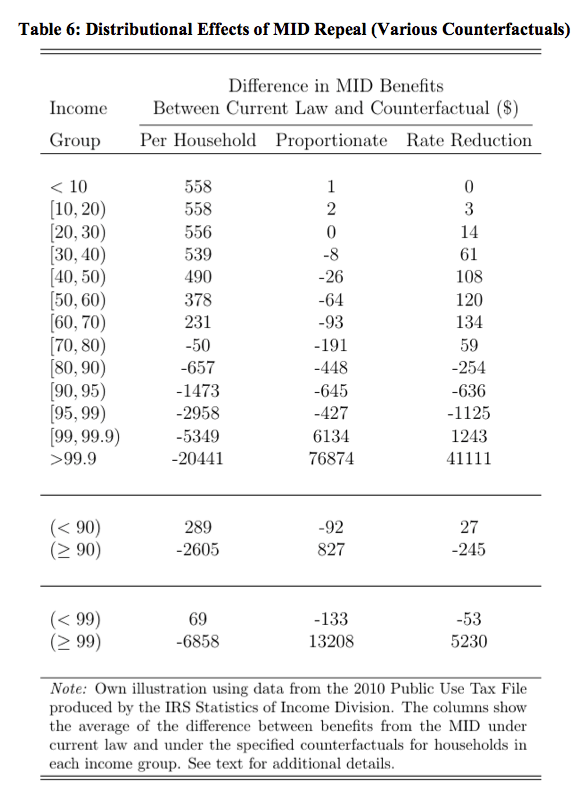
Unlike me, Daniel Hemel and Kyle Rozema are actual tax scholars (Hemel has a blog on Medium), and their detailed research largely tells the same story. They have a forthcoming paper that analyzes the mortgage interest deduction (MID) and shows that, while it is worth more dollars to rich people than poor people (for all the well-known reasons—bigger houses, higher marginal rates, itemizing), the MID causes people in the top 1% to pay a larger share of the overall tax burden. Therefore, eliminating the MID and using the increased tax revenue to reduce tax rates for everyone (what Mnuchin proposed in concept) would be a large windfall for the top 0.1% and a small windfall for the rest of the 1%.

The numbers are in the last column of this table:

screen-shot-2016-12-02-at-2-35-43-pm

Continue reading “More on the Deduction Fairy”

The Deduction Fairy

By James Kwak

Incoming Treasury Secretary Steven Mnuchin promised a big tax cut for corporations and the “middle class,” but not for the rich. “Any tax cuts for the upper class will be offset by less deductions that pay for it,” he said on CNBC.

This is impossible.

The tax cutting mantra comes in two forms. The more extreme one claims that reducing the overall tax burden on the rich will turbocharge the economy because they will save more, increasing investment, and will also work more, starting companies and doing all those other wonderful things that rich people do. The less extreme version is that we should lower tax rates to reduce distortions in the tax code, but we can maintain the current level of taxes paid by the rich by eliminating those famous “loopholes and deductions.” Donald Trump the candidate stuck with the former: his tax proposal, as scored by the Tax Policy Center, gave 47% of its total tax cuts to the top 1%, who also enjoyed by far the largest reduction in their average tax rate.

Mnuchin’s comment implies that he favors the latter version: lowering rates but making it up by “broadening the base.” This math might work for the merely rich—say, families making $200,000–400,000 per year. Take away the mortgage interest tax deduction, the deduction for retirement plan contributions, and the exclusion for employer-provided health care—which together can easily shield $50–75,000 in income—and you could probably fund several percentage points of rate decreases. (Of course, it would be politically impossible to completely eliminate those tax breaks, but that’s another story.)

Continue reading “The Deduction Fairy”

What You Can Do

By James Kwak

Several of my friends, some of whom I haven’t spoken with in a long time, have reached out to me over the past week to discuss what to make of last week’s election. I imagine this is happening with a lot of people.

Although I don’t have any simple answers, I do have some thoughts on what we can do in response to the prospect of Donald Trump and the Republicans controlling the entire federal government, as well as a large majority of states. But first, we need a short detour—for a bit of perspective.

Maurice Walker is a fifty-five-year-old man with schizophrenia whose only income is $530 per month in Social Security disability payments. On September 3, 2015, he was arrested by police in Calhoun, Georgia for being a “pedestrian under the influence”—something many of us have been guilty of at one time or another. If Walker had been able to come up with $160 (something most people reading this blog could do in seconds), he would have walked free. Instead, he was locked up in jail, without his medication.

Continue reading “What You Can Do”

Narratives

By James Kwak

[Updated to add another headline leading with “white voters.”]

Two days later, some of the world’s leading newspapers—or their headline-writers, at least—are saying it was all or largely about race:

screen-shot-2016-11-10-at-7-55-28-amscreen-shot-2016-11-10-at-7-56-18-am

screen-shot-2016-11-10-at-10-01-57-amThe respective roles of race and class in this year’s election are a highly contentious issue. I’d like to add to that contentiousness as little as possible while pointing out that this race-based framing isn’t really supported by exit poll data. I want to get ahead of the vitriol by stipulating that the exit polls don’t provide conclusive evidence for either side.

OK, here’s the data:

screen-shot-2016-11-10-at-8-06-00-am

Those are vote shares in the presidential election by racial or ethnic group. The numbers at the right show you the shift from the previous election.* In this case, the Democratic-Republican gap among white voters shifted by 8 points toward the Republican. That’s evidence that the election was about white voters, right?

Except those are the 2012 exit polls. The 8-point shift is relative to the 2008 exit polls.

Continue reading “Narratives”

The Biggest Voter Suppression Campaign of All

By James Kwak

This election day, spare a thought for the largest group of citizens who aren’t eligible to vote: children.

When I was in high school, I believed strongly that there should be no voting age whatsoever. Anyone should be able to vote, no matter her age. Well, I still feel that way, particularly after watching my ten-year-old daughter knocking on doors and explaining to adults why she doesn’t want her school to be grade-reconfigured. And I feel that way even though I also have a four-year-old son whose vote could be bought for a lollipop. (Whether he would stay bought is another question.)

There are two main arguments against a voting age. The first is that any plausible justification for a minimum voting age could be better served by some other test—which would be illegal. Many people think it is obvious that children shouldn’t be allowed to vote because they are uninformed, irresponsible, lack the necessary cognitive skills, are easily swayed by their parents, or something along those lines. (Note that similar arguments were made about all the other groups that used to be unable to vote.) But if the point of a voting age is to ensure that the electorate is properly informed about the issues and the stakes, we could administer a test, which would do a better job than an arbitrary age cutoff. (Who is the vice president? Which house of Congress approves judicial nominations? Etc.) That test would violate the Voting Rights Act, just like literacy tests.

Continue reading “The Biggest Voter Suppression Campaign of All”

Time to Vote; No on 5

By James Kwak

20161024_090409.jpg

If you live in Massachusetts, early voting has begun. You can ask for an early ballot by mail, or just find a polling place here. This is what my town hall looks like today:

20161024_093942.jpg

Not surprisingly, I voted for Hillary Clinton (more about why here). If you don’t live in Amherst, Massachusetts, you may want to stop reading. If you do live in Amherst, I’d like you to consider voting no on Question 5.

Continue reading “Time to Vote; No on 5”

Ideas, Interests, and the Challenge for Progressives

By James Kwak

Updated based on feedback from Matt Stoller. See bottom.

Mike Konczal wrote an article a few days back arguing that various progressive policies aimed at helping poor people would not be able to pry the “white working class” away from Donald Trump and Trumpism. I think the article was insightful and intelligently argued. This was my quick response:

In other words, it’s the long term that matters. We need policies that create broadly shared prosperity not because they will peel away Trump supporters in the short term, but because they are the right thing to do. And in the long term, if progressives prove that they can deliver the goods—a society with less inequality and less economic insecurity—that will change the political landscape.

Dani Rodrik wrote a longer, better response to Konczal. Rodrik’s perspective, which he’s presented in greater depth in the Journal of Economic Perspectives and a recent paper with Sharun Mukand, is that political outcomes result from the interaction of interests and ideas. As he writes in his recent post, “The politics of ideas is about activating identities that may otherwise remain silent, altering perceptions about how the world works, and enlarging the space of what is politically feasible.” Politicians appeal in part to voters’ interests, but also attempt to make salient identities that they share (or pretend to share) with particular segments of the electorate.

Continue reading “Ideas, Interests, and the Challenge for Progressives”

Structure and Superstructure

By James Kwak

Noah Smith begins his latest Bloomberg column this way:

Stanford historian Ian Morris is fond of saying that “each age gets the thought it needs.” According to this maxim, ideas like the Enlightenment, communism or even Christianity are a product of the economic and political circumstances of their times.

This is something I’ve long believed, dating back before my days as a graduate student in intellectual history. It’s also pure Marx. In the “Contribution to the Critique of Political Economy,” the great bearded one wrote:

With the change of the economic foundation the entire immense superstructure is more or less rapidly transformed. In considering such transformations a distinction should always be made between the material transformation of the economic conditions of production . . . and the legal, political, religious, aesthetic or philosophic—in short, ideological forms in which men become conscious of this conflict and fight it out.

When I was a junior in college, I underlined that passage in my bright red copy of The Marx-Engels Reader. (As I’ve often said, Harvard social studies majors will probably be the last people on the planet still reading Marx.)

Continue reading “Structure and Superstructure”