Daniel Indiviglio did a Q&A with Simon, mainly on financial regulation. Here it is.
(Sorry there isn’t much today . . . proofreading.)
By James Kwak
What happened to the global economy and what we can do about it
Author: James Kwak
Daniel Indiviglio did a Q&A with Simon, mainly on financial regulation. Here it is.
(Sorry there isn’t much today . . . proofreading.)
By James Kwak
Uncle Billy pointed out this post by The Epicurean Dealmaker, which he described as “smoking.” TED actually is an investment banker (or an excellent imitator of one, down to the expensive tastes), so he can say things in more detail and more convincingly than I. Like this:
“But the assertion that large, multi-line financial conglomerates provide customers with services no smaller institutions can deliver is pure poppycock. The mid-1990s concept of globe-striding financial supermarkets has been completely discredited, most notably by their sad-sack poster child, Citigroup. Wholesale institutional clients make a point of using more than one investment or commercial bank for virtually all their financial transactions, no matter what they are. In fact, the bigger the deal, the more banks the customer usually uses. This is because banking clients want to 1) spread transaction financing and execution risk across multiple service providers and 2) make sure none of these oligopolist bastards has an exclusive right to grab the client by the short and curlies.”
There’s more.
By James Kwak
Paul Krugman says that Simon’s idea that he should be chair of the Fed is “crazy.” Krugman’s point is either that he wouldn’t be confirmed or that he wouldn’t be able to bring the Open Market Committee along. Maybe he’s right about the former; a Republican filibuster does seem reasonably likely.
I don’t think he’s right about the latter; or, more precisely, I don’t think it matters. The FOMC is, on paper, a democratic body: they vote. There is a tradition that the votes are generally unanimous because of the perceived importance of demonstrating consensus. I don’t know how old this tradition is; it was certainly in place under Greenspan. But everyone knows that the members of the FOMC disagree about many things; that’s why the various bank president members go around giving speeches objecting (not in so many words) to the FOMC’s decisions. Given that we all know there are debates involved, how important is this fiction of consensus?
From Economics of Contempt (hat tip Brad DeLong):
“The single best thing we could do for financial reform: Triple the budgets of all financial regulatory agencies. Immediately. Regulators are woefully understaffed; this is fact.”
I’m not sure about “single best,” but otherwise dead on. The agencies that are self-funding out of their businesses (banking for the Federal Reserve, insurance for the FDIC) have been less bad than the ones that are not (OCC, OTS).
It’s late January and Scott Brown will be the next senator from Massachusetts, which means it’s time for critical retrospectives on Obama’s first year in office. I’m not going to try my own, but simply point you to two I found worthwhile. One, not surprisingly, is by Ezra Klein, who says this is Obama’s problem:
“Obama’s presidency has tried to show, not tell. He’s not given speeches about how government can work. He’s not tried to change minds about the theoretical possibility of government working. He’s tried to make government work. Winning achievements, not arguments, has been at the center of the administration’s agenda.”
Klein realizes the irony, of course; a president who is doing what we say we want presidents to do–govern–is being stonewalled by a right wing intent on winning the next elections, and sniped at by a left wing for compromising too much and for not scoring enough political points. But, as Klein says, whether the fault is Obama’s, Congress’s, or ours, it’s not working.
Keith Epstein and David Heath of The Huffington Post have an in-depth article about how Sheila Bair got two mortgages on two different properties from Bank of America while she was discussing with them whether the bank could repay its TARP money to the government.
Let me start off by saying that I strongly, strongly doubt that Bair sought out a better deal on her mortgage because she is head of the FDIC or discussed her mortgage with any of the Bank of America bigwigs that she met with. That would be stupid, and it doesn’t fit with anything I know about her. (Granted, I know very little about her.)
That said, WHAT WAS SHE THINKING? Continue reading “Sheila Bair’s Turn”
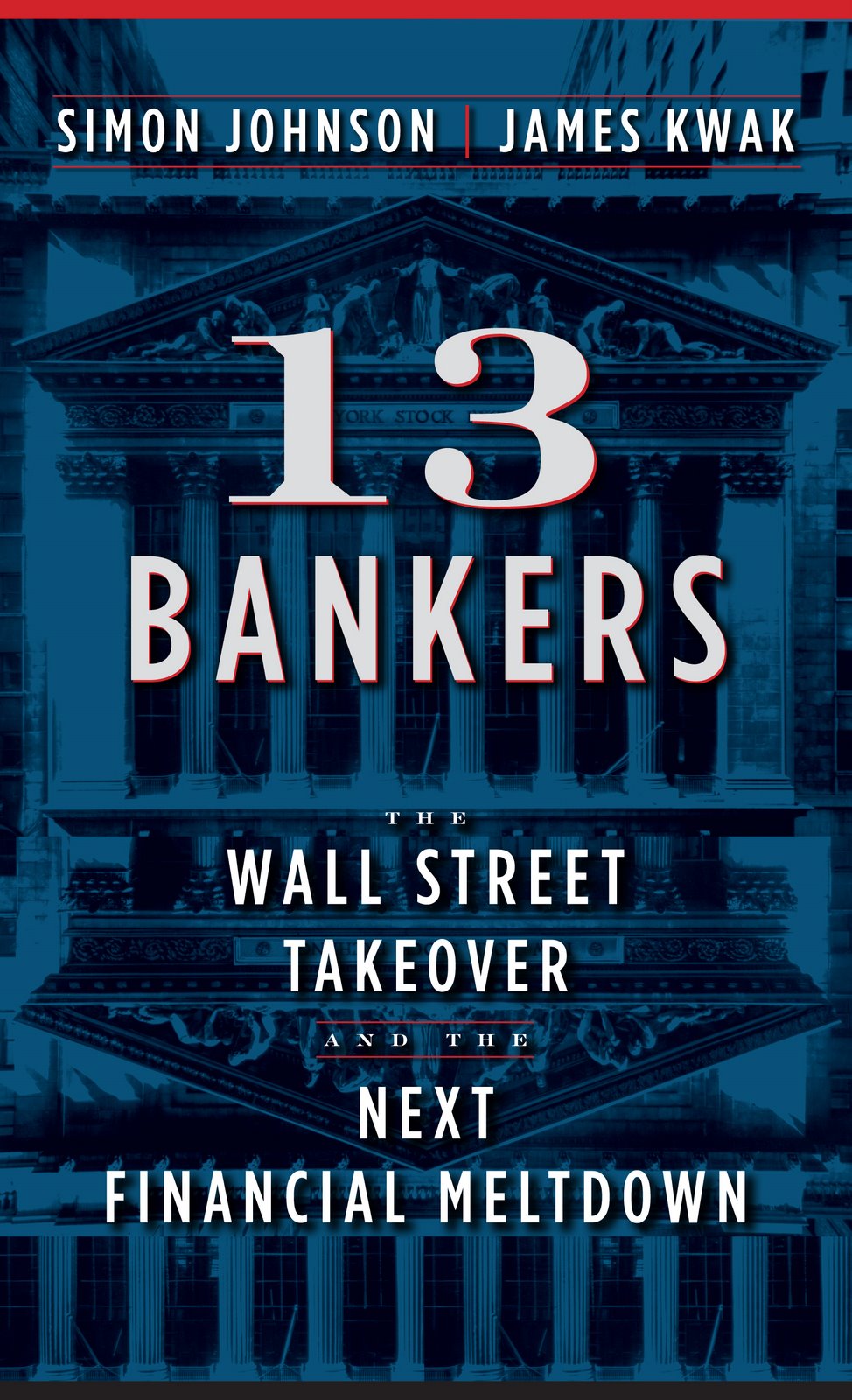 The day that President Obama came out in favor of size and scope limits for banks seems like a good day to tell you about our new book, 13 Bankers: The Wall Street Takeover and the Next Financial Meltdown–in which we argue for hard size limits on banks, among other things. While we end up talking about the financial crisis, the way the government responded to it, and the too big to fail issue, it’s really a book about power–the economic and political power of the banking industry both recently and throughout American history, the problems it creates, and what we can do about it.
The book will be out on April 6 (or maybe a week earlier), but you can already pre-order it wherever books are pre-ordered. In the meantime, to learn more, we have a new book web site with its own blog (for book-related news and thoughts).
Now, back to proof-reading . . .
By James Kwak
So Barack Obama has come around to the idea that big banks need to be made smaller and that smarter regulation (contingent capital, enhanced capital requirements for large banks, resolution authority, etc.) just won’t cut it. Today he proposed limits on market share (measured by a bank’s share of total bank liabilities in the United States) and a prohibition on internal hedge funds, private equity funds, and proprietary trading.
This is great. It means that the administration is moving in the right direction–breaking up big banks–and the president is putting his name behind it. For more on why these are good ideas, see Mike Konczal.
OK, now for the caveats.
. . . on that deficit commission. If I were Peter Orszag, I would be tearing my hair out. (Or maybe not, since he’s happily engaged to be married later this year.)
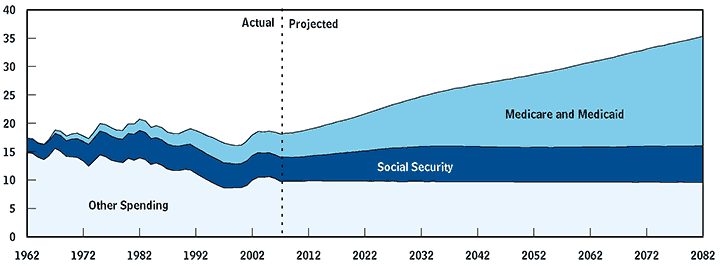
It’s obvious, and I’ve said it before, but I’ll say it again. The big long-term national debt problem is all about health care. This chart is from the January 2008 Budget and Economic Outlook of the Congressional Budget Office–for those keeping score, that’s one year before President Obama took office. It shows projected federal spending as a percentage of GDP.
It looks like President Obama is going to create the bipartisan commission to cut the deficit that Kent Conrad and Judd Gregg have been pitching–except that now Judd Gregg is against it.
According to the original Conrad-Gregg plan, the commission would have eighteen members–eight named by Congressional Democrats, eight by Congressional Republicans, and two by the administration, for a ten-eight split; if fourteen of the eighteen could agree on a deficit-reduction plan, Congress would have to vote it up or down without amendments. The Conrad-Gregg proposal is expected to be voted down in the Senate. So instead, Obama would appoint a commission by executive order, with six people named by Congressional Democrats, six named by Congressional Republicans, and six named by the administration, including at least two Republicans–for a ten-eight split; if fourteen of the eighteen could agree on a deficit-reduction plan, Congress would vote it up or down without amendments; however, Congress could separately choose to amend it. According to the Washington Post, Gregg “called a presidentially appointed panel ‘a fraud’ designed to do little more than give Democrats political cover.” Huh? I’m guessing Gregg’s objection is that Obama’s plan is based on an agreement with Congressional leaders, rather than actual legislation–but if you can’t pass the legislation, what else do you want Obama to do?*
More, important, is this a good thing? My prediction is that it will amount to exactly nothing, although there is a possibility it could turn out badly. I simply don’t see how any plan can get the agreement of fourteen commission members–meaning all the Democrats and four of eight Republicans, or all the Republicans and six of ten Democrats, or something in between.
This guest post was contributed by Dan Geldon, a fellow at the Roosevelt Institute. He is a former counsel at the Congressional Oversight Panel and a graduate of Harvard Law School.
Over the past year, there has been much discussion about how the financial crisis exposed weaknesses in free-market theory. What has attracted less discussion is the extent to which the high priests of free-market theory themselves destroyed meaningful contracts and other bedrocks of functioning markets and, in the process, created the conditions for the theory’s weaknesses to emerge.
The story begins before Wall Street’s capture of Washington in the 1980s and 1990s and the deregulatory push that began around the same time. In many ways, it started in 1944.
Continue reading “How Supposed Free-Market Theorists Destroyed Free-Market Theory”
Who needs blogs? Just listen to Jack Donaghy (Alec Baldwin).
To Kenneth Parcell (Jack McBrayer), in Season 3, Episode 4:
“Next stop homeownership. [Pause] I’m just kidding. The middle class is dying. You’ll be renting forever.”
To Liz Lemon (Tina Fey), in Season 3, Episode 8:
“What do we elites do when we screw up? We pretend it never happened and give ourselves a giant bonus.”
(Yes, I am way, way, behind. My wife and I only watch TV shows on DVD or streaming [Netflix or Hulu], we watch very little TV at that, and for all of 2009 we were watching Battlestar Galactica [still two episodes left].)
By James Kwak
Last week I wrote a post about how banks entice customers with promotions and then fail to keep up their end of the bargain, forcing customers to waste their time just getting the bank to do what it promised to do in the first place. As I wrote, then, the problem is by no means limited to the financial sector.
David Lazarus of the Los Angeles Times has a horror story about Aetna, the large health insurance company. The basic facts are:
The customer in question is a cancer survivor who needs regular medication and checkups–hence the kind of customer that health insurance companies want to drop if at all possible.
“How do you feel about paying such high taxes?”
“I think it is terrific. . . . I get a little bit angry because constantly in Denmark there’s this talk that we have to lower the taxes, lower the taxes, lower the taxes. And I can only say I’m very young, I am only 25 years old, and already the system has provided me with a great education and help whenever I need it. I have been able to go the library whenever I needed it. I have not been to the hospital many times in my life, but when I have been it has not been a problem. I mean, I think we are so privileged that it is so wrong to attack this system.”
That’s a Danish student on Planet Money’s latest podcast, around the 14:40 mark. That seems perfectly sensible to me. If you are getting services that you value from your government, then you are going to be more likely to favor a system with high taxes. Obviously not very many Americans feel this way; since the Reagan Revolution if not the 1970s, there has been an increasingly widespread belief that government spending is wasteful, and therefore people want to hold onto their money. But there’s nothing irrational or bizarre about thinking that high taxes and high benefits are good, and you don’t have to agree with her to see that.
But this is what Adam Davidson of Planet Money had to say about it: “David [Kestenbaum, the reporter on that clip], it’s like you went to Bizarroland, where everything is the opposite.”
Continue reading “The Unproven Tradeoff of Growth and Inequality”
Let’s hope this gets laughed out of consideration. According to the New York Times, the Securities Industry and Financial Markets Association is considering a lawsuit on the grounds that “a tax so narrowly focused would penalize a specific group.” The Times articles doesn’t use the words, but I’m guessing they are thinking of claiming that it is a “bill of attainder”–an act of Congress that punishes specific people for alleged wrongdoing, without a judicial process–which is specifically prohibited by the Constitution.
But even leaving aside the fact that the Supreme Court has rarely overturned anything as a bill of attainder, there are not one, but two barriers in the way. The first is that the original TARP legislation mandated that the government had to recover the costs of TARP from the industry. The second is that the bank tax is really a (too small) tax on large banks that enjoy a too-big-to-fail subsidy from the government. And since the banks enjoy an implicit government guarantee, they should pay a fee for it (in this case, a mere fifteen basis points on uninsured liabilities), both to defray the costs of future bailouts and to (very partially) level the playing field relative to smaller banks without government guarantees. For political reasons, the administration is trying to dress the tax up as punishment for Wall Street, which begins to sound like a bill of attainder. But under the covers, it’s simply sound regulatory policy (though, again, too small).
Update: Greg Mankiw thinks that “on the economic merits, there may be a case for the bank tax” as a means of offsetting the implicit government subsidy for TBTF banks. “It certainly won’t be perfect. But it is possible that it will be better than doing nothing at all, watching the finance industry expand excessively, and waiting for the next financial crisis and taxpayer bailout.”
By James Kwak
 The Baseline Scenario