Year: 2010

One More Thing . . .

. . . on that deficit commission. If I were Peter Orszag, I would be tearing my hair out. (Or maybe not, since he’s happily engaged to be married later this year.)

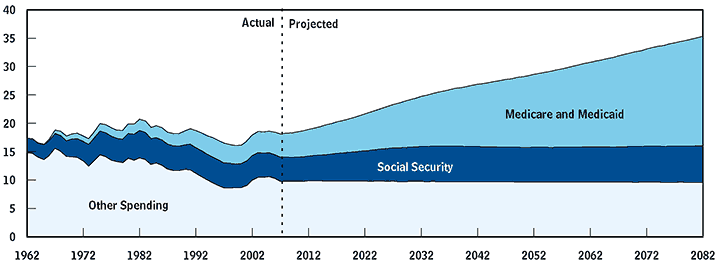
It’s obvious, and I’ve said it before, but I’ll say it again. The big long-term national debt problem is all about health care. This chart is from the January 2008 Budget and Economic Outlook of the Congressional Budget Office–for those keeping score, that’s one year before President Obama took office. It shows projected federal spending as a percentage of GDP.

Continue reading “One More Thing . . .”

Commission to the Rescue!

It looks like President Obama is going to create the bipartisan commission to cut the deficit that Kent Conrad and Judd Gregg have been pitching–except that now Judd Gregg is against it.

According to the original Conrad-Gregg plan, the commission would have eighteen members–eight named by Congressional Democrats, eight by Congressional Republicans, and two by the administration, for a ten-eight split; if fourteen of the eighteen could agree on a deficit-reduction plan, Congress would have to vote it up or down without amendments. The Conrad-Gregg proposal is expected to be voted down in the Senate. So instead, Obama would appoint a commission by executive order, with six people named by Congressional Democrats, six named by Congressional Republicans, and six named by the administration, including at least two Republicans–for a ten-eight split; if fourteen of the eighteen could agree on a deficit-reduction plan, Congress would vote it up or down without amendments; however, Congress could separately choose to amend it. According to the Washington Post, Gregg “called a presidentially appointed panel ‘a fraud’ designed to do little more than give Democrats political cover.” Huh? I’m guessing Gregg’s objection is that Obama’s plan is based on an agreement with Congressional leaders, rather than actual legislation–but if you can’t pass the legislation, what else do you want Obama to do?*

More, important, is this a good thing? My prediction is that it will amount to exactly nothing, although there is a possibility it could turn out badly. I simply don’t see how any plan can get the agreement of fourteen commission members–meaning all the Democrats and four of eight Republicans, or all the Republicans and six of ten Democrats, or something in between.

Continue reading “Commission to the Rescue!”

How Supposed Free-Market Theorists Destroyed Free-Market Theory

This guest post was contributed by Dan Geldon, a fellow at the Roosevelt Institute.  He is a former counsel at the Congressional Oversight Panel and a graduate of Harvard Law School.

Over the past year, there has been much discussion about how the financial crisis exposed weaknesses in free-market theory.  What has attracted less discussion is the extent to which the high priests of free-market theory themselves destroyed meaningful contracts and other bedrocks of functioning markets and, in the process, created the conditions for the theory’s weaknesses to emerge.

The story begins before Wall Street’s capture of Washington in the 1980s and 1990s and the deregulatory push that began around the same time.  In many ways, it started in 1944.

Continue reading “How Supposed Free-Market Theorists Destroyed Free-Market Theory”

Economic Commentary from 30 Rock

Who needs blogs? Just listen to Jack Donaghy (Alec Baldwin).

To Kenneth Parcell (Jack McBrayer), in Season 3, Episode 4:

“Next stop homeownership. [Pause] I’m just kidding. The middle class is dying. You’ll be renting forever.”

To Liz Lemon (Tina Fey), in Season 3, Episode 8:

“What do we elites do when we screw up? We pretend it never happened and give ourselves a giant bonus.”

(Yes, I am way, way, behind. My wife and I only watch TV shows on DVD or streaming [Netflix or Hulu], we watch very little TV at that, and for all of 2009 we were watching Battlestar Galactica [still two episodes left].)

By James Kwak

Design or Incompetence, Part Two

Last week I wrote a post about how banks entice customers with promotions and then fail to keep up their end of the bargain, forcing customers to waste their time just getting the bank to do what it promised to do in the first place. As I wrote, then, the problem is by no means limited to the financial sector.

David Lazarus of the Los Angeles Times has a horror story about Aetna, the large health insurance company. The basic facts are:

  1. Aetna increased a customer’s monthly premium by $32 as of August.
  2. On September 30, Aetna sent her a letter saying her premium had gone up. (This is the letter supplied to the Los Angeles Times by Aetna, which I think is pretty clear proof there was no earlier letter.)
  3. Beginning in October, the customer began paying the higher premium.
  4. In November, Aetna rejected payment for a doctor’s bill.
  5. The customer contacted Aetna, who said she had missed payment for October–which wasn’t true (she had paid the higher premium for October).
  6. When the customer appealed, Aetna wouldn’t let her simply pay the extra $64 (the difference for August and September), and insisted on rescinding her policy.

The customer in question is a cancer survivor who needs regular medication and checkups–hence the kind of customer that health insurance companies want to drop if at all possible.

Continue reading “Design or Incompetence, Part Two”

The Unproven Tradeoff of Growth and Inequality

“How do you feel about paying such high taxes?”

“I think it is terrific. . . . I get a little bit angry because constantly in Denmark there’s this talk that we have to lower the taxes, lower the taxes, lower the taxes. And I can only say I’m very young, I am only 25 years old, and already the system has provided me with a great education and help whenever I need it. I have been able to go the library whenever I needed it. I have not been to the hospital many times in my life, but when I have been it has not been a problem. I mean, I think we are so privileged that it is so wrong to attack this system.”

That’s a Danish student on Planet Money’s latest podcast, around the 14:40 mark. That seems perfectly sensible to me. If you are getting services that you value from your government, then you are going to be more likely to favor a system with high taxes. Obviously not very many Americans feel this way; since the Reagan Revolution if not the 1970s, there has been an increasingly widespread belief that government spending is wasteful, and therefore people want to hold onto their money. But there’s nothing irrational or bizarre about thinking that high taxes and high benefits are good, and you don’t have to agree with her to see that.

But this is what Adam Davidson of Planet Money had to say about it: “David [Kestenbaum, the reporter on that clip], it’s like you went to Bizarroland, where everything is the opposite.”

Continue reading “The Unproven Tradeoff of Growth and Inequality”

A Trap Of Their Own Design

At this stage in the electoral cycle, Democrats should be running hard against big banks and their consequences.  Some roots of our current economic difficulties lie in the Clinton 1990s, but the real origins can be traced to the financial deregulation at the heart of the Reagan Revolution – and all the underlying problems became much worse in eight years of George W. Bush’s unique brand of excess and neglect.

The mismanagement of mammoth financial institutions over the past decade produced a crisis in September 2008 that required a substantial fiscal stimulus – among other bold government measures – simply to prevent the outbreak of a Second Great Depression.  That sensible fiscal response, plus the “automatic stabilizers” that worsen any budget (and help limit job losses) as the economy slows, will end up adding around 40 percentage points to our net national debt as a percent of GDP.  If you want to accuse the Obama administration of wantonly increasing the national debt – then let’s talk about the circumstances that required this fiscal policy.

The theme for the November midterms should be: Which part of the 8 million jobs lost [since December 2007] do you not understand?  The big banks must be reined in and forced to break themselves up, or we’ll head directly for another such crisis

Instead, the Democrats have fallen into a legislative and electoral trap that – amazingly – they built for themselves. Continue reading “A Trap Of Their Own Design”

Wall Street Suing over Bank Tax?

Let’s hope this gets laughed out of consideration. According to the New York Times, the Securities Industry and Financial Markets Association is considering a lawsuit on the grounds that “a tax so narrowly focused would penalize a specific group.” The Times articles doesn’t use the words, but I’m guessing they are thinking of claiming that it is a “bill of attainder”–an act of Congress that punishes specific people for alleged wrongdoing, without a judicial process–which is specifically prohibited by the Constitution.

But even leaving aside the fact that the Supreme Court has rarely overturned  anything as a bill of attainder, there are not one, but two barriers in the way. The first is that the original TARP legislation mandated that the government had to recover the costs of TARP from the industry. The second is that the bank tax is really a (too small) tax on large banks that enjoy a too-big-to-fail subsidy from the government. And since the banks enjoy an implicit government guarantee, they should pay a fee for it (in this case, a mere fifteen basis points on uninsured liabilities), both to defray the costs of future bailouts and to (very partially) level the playing field relative to smaller banks without government guarantees. For political reasons, the administration is trying to dress the tax up as punishment for Wall Street, which begins to sound like a bill of attainder. But under the covers, it’s simply sound regulatory policy (though, again, too small).

Update: Greg Mankiw thinks that “on the economic merits, there may be a case for the bank tax” as a means of offsetting the implicit government subsidy for TBTF banks. “It certainly won’t be perfect.  But it is possible that it will be better than doing nothing at all, watching the finance industry expand excessively, and waiting for the next financial crisis and taxpayer bailout.”

By James Kwak

So This Is What an Election Is Like

Martha Coakley just called me for, oh, the fifteenth time over the long weekend. I get multiple fliers in my mailbox every day. People from other states are calling me and asking me to volunteer. I’m sure I would be seeing nonstop ads on TV, except I don’t watch TV. All this started within the last week when, as many news outlets have noted, the Democrats woke up and realized they might actually lose Ted Kennedy’s Senate seat.

We’re not used to competitive elections here in Massachusetts, certainly not competitive elections with national implications. But this one is huge. The Republicans have been admirably or distressingly able, depending on your perspective, to hold forty votes against more or less anything the Democrats and President Obama want to accomplish, including health care reform. I think it’s a fairly easy bet that if Coakley loses, health care reform is dead until 2013 at the earliest, since there is no chance the Republicans will allow anything that looks like an accomplishment to occur if they can possibly help it. So if you live in Massachusetts, and you care about health care reform one way or the other, you should take the time to vote tomorrow.

Update: A friend emailed to point out that should Brown win, the House Democrats could pass the Senate bill, which presumably would not then have to go back to the Senate to be voted on again. (If the conference committee modifies the Senate bill, then it would have to go back.) Then some provisions could be modified through the budget reconciliation process, which only requires 51 votes. So a Coakley defeat might not be the end.

As for the comment about whether the Democrats could have negotiated with the Republicans to pick off one or two votes, they tried that for months–first via the Baucus Group of Six, then later directly with Snowe. Snowe ended up pulling out saying that the Democrats were rushing the bill, when they had spent several months talking to her specifically.

By James Kwak
The Myth of Ariba

(Warning: long post ahead.)

I was minding my own business, reading Past Due by Peter Goodman (I got it from Simon, who I think got it for free), and there on page 43 I ran into Eric Bochner. I thought that name sounded familiar, and then I remembered what it was. Eric Bochner was a vice president of something or other (and then the vice president of something else or other) at Ariba, where I worked from April 2000 until September 2001 (I was also a consultant there from December 1999). Chapter 2 of Goodman’s book is about the Internet bubble, Ariba is his case study, and Bochner is his source.

As far as I know, no one has made Ariba the poster child for the Internet bubble before–people usually go with WebVan, or Pets.com, or something similarly vaporous. Ariba is a more complicated story, but you can make a case that we deserve to be on the poster. At our peak we were bigger than all those pet food companies combined, with a market capitalization over $40 billion (on quarterly revenues of about $100 million at that time). More to the point, if Pets.com is comedy, Ariba is tragedy (well, not really, but you known what I mean): Ariba was a real company with a real product that got swept up in its own hype, with unfortunate consequences (but not fatal ones–Ariba today earns over $300 million in annual revenues and a small profit).

Continue reading “The Myth of Ariba”

The “Miracle” Still Goes On For Someone…

This guest post is by Ivo Pezzuto, Professor at the Swiss Management Center University (SMCU) in Zurich, Switzerland, and an experienced observer of the global financial services industry.

I share the analysis of most economists and observers that the following are among the main causes of the current global financial crisis:

  • the U.S. Federal Reserve’s low interest rate policy at the beginning of the last decade, the resulting credit euphoria of both lenders and borrowers;
  • the more ”relaxed” credit initiation and control policies and procedures of lenders;
  • the “exotic” innovative features of some mortgage lending products;
  • the overwhelmingly optimistic view of future house prices which prevailed in the market that has led to both the housing and the mortgage lending bubbles;
  • the widespread use of badly controlled (OTC trading) innovative financial engineering tools (i.e., derivatives, securitizations, CDS, CDO, MBS, RMBS, CLO, etc.).
  • Imbalances, exchange rates and interest rates differences between the US and other emerging economies and the resulting speculative trading and arbitrages. Continue reading “The “Miracle” Still Goes On For Someone…”

Baseline Scenario Catches Up to Last Year’s Technology

I finally bothered to figure out how to push new posts (well, links to new posts) into the status messages of our Facebook page. This means that if you are or become a fan of that page, links to new posts will magically appear on your Facebook home page (which they keep redesigning–does anyone besides me find it annoying when Web 2.0 companies keep changing their user interfaces around and forcing you to figure out how they work every couple months?).

I’m doing it this way: Blog -> RSS -> Twitterfeed -> Twitter -> Selective Tweets Facebook application -> Facebook page. So if you follow the Twitter feed you won’t miss anything that’s on Facebook.

Alternatively, if you use Facebook and want to stay within Facebook, you can go to our Facebook page and click on the RSS/Blog tab to read full posts.

As for me, I stopped using Facebook many months ago.

By James Kwak

Too Big to Regulate?

This guest post was submitted by Peter Fox-Penner, a leading expert on regulation at The Brattle Group.  The views expressed herein are those of the author alone. 

At present, the debate among economists over whether our financial regulations should protect institutions on the basis that they are “too big to fail” (TBTF) still rages.  Like many other economists, I distrust the reasoning behind the TBTF justification and rue the fact that the measures taken to prop up the U.S. financial system have made the largest banks even larger, while small banks are failing at record levels.  In my first guest post I argued patchwork attempts to strengthen financial regulation without a “clean sheet” review were likely to be inadequate.

In this second post I look past short term bailouts and address the broader issue of establishing regulation of TBTF firms.  Policymakers are faced with challenge of establishing a large regulator that retains the specialized expertise needed to manage complex markets – specialization more often found in a network of smaller agencies.  To do so they will need to address the size and complexity of the financial sector itself.  As before,  I turn to examples from the utility industry, specifically the establishment and repeal of the Public Utility Holding Company Act of 1935 (PUHCA), that provide lessons for crafting regulation of complex industries.

Continue reading “Too Big to Regulate?”

Entrepreneurs and Risk

I planned to write about Malcolm Gladwell in this post a couple of days  ago, but I had rambled on long enough, so I deferred it until later. Well, Felix Salmon beat me to the punch, which is all for the best anyway, since the connection was going to be John Paulson, and Felix knows much more about hedge funds than I do.

The topic is Gladwell’s still-subscription-only article, “The Sure Thing: How Entrepreneurs Really Succeed,” in which Paulson plays a starring role. The sub-sub-head in the table of contents says, “The myth of the daredevil entrepreneur,” so even though I expected Gladwell to be annoyingly contrarian again, for once I expected to agree with him. The conventional wisdom, in this case, is that successful entrepreneurs get that way by taking big risks.

Continue reading “Entrepreneurs and Risk”

Design or Incompetence?

Or both?

In late summer or early fall, Citibank was running a promotion: if you opened a new account or moved a certain amount of money to your bank account, you would get a $200 bonus within three months. Someone I know took advantage of this promotion, but as of Monday he still hadn’t gotten the $200 bonus, so he visited a branch.

“I was given the ridiculous explanation that I didn’t surrender the promotion letter and  that the promotion code NP55 was not linked (?) in the application. I told them that: (1) the letter is not a coupon to be surrendered, (2) I should not have to tell the customer service rep how to process the promotion, (3) there was no requirement that the letter even  be presented (just go to a financial center, it states), and (4) the code only needed to be mentioned if applying by phone. They called me back in the afternoon and asked me to come back this morning. They first offered me some ‘thank you’ points, but I stood my ground.  After calling several places they finally reached a Texas office that would further research my problem. “

Continue reading “Design or Incompetence?”