Healthcare Rationing Is Good

This guest post was contributed by StatsGuy, a regular commenter on this blog.

In the current healthcare debate, Conservatives warn us that a single payer system will bring government rationing…  Progressives argue that we already have rationing, based on wealth.  Both sides are right, but both pretend that rationing is bad.  Yet as every economist knows, the allocation of scarce resources is the basis of economics itself.  The question is not whether we will have rationing – the question is how to structure a system of rationing that accomplishes our goals.

Two primary themes dominate this debate:

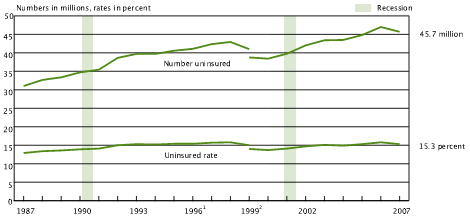
The Uninsured: In the past two decades, both the total number and the percentage of uninsured have increased in spite of some modest programs designed to expand coverage (like CHIP). (Original chart is here.)
hct_coverage_3_sm

The graph above, which extends through 2007, has surely worsened since 57% of US citizens are insured through their workplace (down from 63% in 2000) and unemployment increased from under 5% to 9.4% in the last couple years.

Continue reading “Healthcare Rationing Is Good”

The March of Science and Health Care Reform

On a Planet Money podcast two weeks ago, economist Charlie Wheelan weighed in on the significance of genetic testing – the advancing ability of science to determine your genetic makeup, including your propensity to develop various serious or costly illnesses. This really crystallizes one dimension of the health care debate.

If insurers know what your projected long-term health care costs are, because they can read your genetic code, then they are going to price accordingly – and that’s exactly what insurers should do in an unregulated market. This produces the dystopian world where not only are some people unlucky because their genes make them more likely to suffer in various ways, but on top of that they can’t get health insurance and therefore health care.

Continue reading “The March of Science and Health Care Reform”

“Paying for” Health Care Reform

This week’s Washington Post health care column is on the question of whether we can afford health care reform – meaning whether we can afford to subsidize poor and middle-class people who cannot otherwise pay for health insurance. This has a different meaning depending on you interpret “we” as the U.S. economy in general or the federal government, but in either case we think the answer is “yes.” Or at least, as far as the federal government is concerned, the answer is that we can’t afford not doing some form of health care reform, although it’s not certain that the reforms currently on the table will be sufficient to solve our government’s long-term fiscal problems.

In summary:

“If you are for fiscal discipline, you should be for health-care reform. If our government cannot produce some kind of reform, that will only reinforce the perception that our political system is incapable of resolving our largest, most difficult problem — and that is what will make investors think twice about investing in America.”

By James Kwak

The Nature of Modern Finance

Is modern finance more like electricity or junk food?  This is, of course, the big question of the day.

If most of finance as currently organized is a form of electricity, then we obviously cannot run our globalized economy without it.  We may worry about adverse consequences and potential network disruptions from operating this technology, but this is the cost of living in the modern world.

On the other hand, there is growing evidence that the vast majority of what happens in and around modern financial markets is much more like junk food – little nutritional value, bad for your health, and a hard habit to kick. Continue reading “The Nature of Modern Finance”

Secrecy and Moral Hazard

According to Reuters, the Federal Reserve recently got a stay of a federal district court’s order that the Fed must reveal details about which banks accessed its emergency loan programs during the financial crisis. The arguments on each side are pretty straightforward. Bloomberg, the plaintiff, is arguing that the public has a right to know where their taxpayer money,* via the Federal Reserve, is going. The Fed is arguing that if it reveals the names, that could trigger a run on those banks, because customers will worry about their solvency; it is also arguing that revealing names now will make banks less willing to access emergency lending programs in the future, taking away an important tool in a financial crisis.

I find both of the Fed’s arguments weak.

Continue reading “Secrecy and Moral Hazard”

Soros and Volcker on Financial Innovation

I had a business trip late last week, so I used the plane flight home to read The Sages, by Charles Morris. It includes three short sketches of Warren Buffett, George Soros, and Paul Volcker, wrapped around the thesis that the recent financial crisis showed the importance of pragmatism and experience rather than sophisticated financial models. Obviously I’m just grabbing a couple of passages here that I found interesting.

Here’s Soros (pp. 42-43):

“I am a man of the markets, and I abhor bureaucratic restrictions. I try to find my way around them. … But I do believe that financial markets are inherently unstable; I also recognize that regulations are inherently flawed: Therefore stability ultimately depends on a cat-and-mouse game between markets and regulators. Given the ineptitude of regulators, there is some merit in narrowing the scope and slowing down the rate of financial innovations.”

And here’s Volcker (p. 160), as paraphrased by Morris:

“He scoffed at the notion that clamping down on banks, hedge funds, and other players would stifle ‘innovation.’ The only innovation that real people cared about for the previous twenty or thirty years, he said, was ‘the automatic teller machine.'”

By James Kwak

Paulson Was Right (?)

The New York Times has a story about how the government is making a profit on its TARP investments: “The profits, collected from eight of the biggest banks that have fully repaid their obligations to the government, come to about $4 billion, or the equivalent of about 15 percent annually.” The article has plenty of appropriate caveats – the total bailout went well beyond TARP, the Citigroup and Bank of America investments and asset guarantees are still out there, we still have a ton of money sunk into AIG – but the fact remains that some of the investments are getting paid back, with interest and with a modest bonus from the warrants issued to Treasury.

There is also an ongoing debate about whether Treasury is getting full value for its warrants, which we’ve covered previously, but let’s leave that aside for now. The bigger question, I think, is this: Did Treasury get a fair deal for its investments at the peak of the crisis?

Continue reading “Paulson Was Right (?)”

The Problems with Regulatory Cost-Benefit Analysis

Mark Kleiman (hat tip Brad DeLong) says more clearly what I tried to say a while back: cost-benefit analysis of regulations has a curious way of nailng the costs and underestimating the benefits. He focuses on three points:

  1. Traditional CBA counts all dollar benefits equally, despite the fact that the marginal utility of a dollar depends a lot on who is getting it; a dollar more for a poor person provides a lot more utility than a dollar more for a rich person.
  2. Long-term or uncertain benefits, no matter how large (like preventing the inundation of every coastal city) are typically discounted down to zero.
  3. Benefits that are difficult to quantify because there is no market for them (like feeling better because you are healthy) never get counted. (This is the one I know best because it’s one of the things my wife specializes in.)

Matt Yglesias also comments.

By James Kwak

More On The Two-Track Economy — From The WSJ And Others

The notion of a two-track economy seems to be taking hold.  We kicked the concept around pretty well last week — your 130 comments (as of this morning) helped clarify a great deal of what we know, don’t know, and need to worry about.  The two-track concept overlaps with, and builds on, long-standing issues of inequality in the U.S., but it’s also different.  Within existing income classes, some people find themselves in relatively good shape and others are completely hammered.

New dimensions of differentiation are also taking hold within occupations and within industries – the WSJ this morning has nice illustrations.  The contours of this differentiation begin to shape our recovery or, if you prefer, who recovers and who does not – it’s hard to say how this will play out in conventional aggregate statistics, but these are likely to become increasingly misleading.

For now, I would highlight three points about the two-track future for banks – partly because this matters politically, and partly of the way it impacts the rest of the process. Continue reading “More On The Two-Track Economy — From The WSJ And Others”

Causes: Too Much Debt

Menzie Chinn, one of my favorite bloggers, and Jeffry Frieden have a short and highly readable article up on the causes of the financial crisis. Chinn is not given to ideological ranting and is a great believer in actually looking at data, so I place significant weight in what he says.

Chinn and Frieden place the emphasis on excessive American borrowing, by both the public and private sectors.

This disaster is, in our view, merely the most recent example of a “capital flow cycle,” in which foreign capital floods a country, stimulates an economic boom, encourages financial leveraging and risk taking, and eventually culminates in a crash.

Continue reading “Causes: Too Much Debt”

How Much Does the Financial Sector Cost?

Benjamin Friedman, in the Financial Times (hat tip Yves Smith), questions the high cost (read: compensation) of our financial sector. But he does not simply say that huge bonuses for bankers are unfair. Instead, he says that the costs of financial services need to be balanced against their benefits.

The discussion of the costs associated with our financial system has mostly focused on the paper value of its recent mistakes and what taxpayers have had to put up to supply first aid. The estimated $4,000bn of losses in US mortgage-related securities are just the surface of the story. Beneath those losses are real economic costs due to wasted resources: mortgage mis-pricing led the US to build far too many houses. Similar pricing errors in the telecoms bubble a decade ago led to millions of miles of unused fibre-optic cable being laid.

The misused resources and the output foregone due to the recession are still part of the calculation of how (in)efficient our financial system is. What has somehow escaped attention is the cost of running the system.

In particular, Friedman wonders at the relationship between the value provided by financial services and the opportunity cost involved: “Perversely, the largest individual returns seem to flow to those whose job is to ensure that microscopically small deviations from observable regularities in asset price relationships persist for only one millisecond instead of three. These talented and energetic young citizens could surely be doing something more useful.”

This reminds me of something Felix Salmon wrote about a while back: If profits and compensation in the financial sector go up and keep going up, that’s a priori evidence of inefficiency, not efficiency. Those higher profits mean that customers are paying more for their financial services over time, not less, which means that financial services are imposing a larger and larger tax on the economy. Now, it is possible that they are also increasing in value fast enough to cover the tax, but that is something to be proven.

By James Kwak

Firefighter Arson And Our Macroeconomic Policymakers

Firefighter arson is a serious problem.  The U.S. Fire Administration, part of Homeland Security, concluded in 2003, “A very small percentage of otherwise trustworthy firefighters cause the very flames they are dispatched to put out” (p.1). Illustrative and shocking anecdotes are on pp. 9-15 of that report, as well as here and here.

Macroeconomic policy making now has a similar issue to confront. Continue reading “Firefighter Arson And Our Macroeconomic Policymakers”

A Perspective on Financial Innovation

Simon and I have a new article, “Finance: Before the Next Meltdown,” in the Fall issue of Democracy: A Journal of Ideas on one of our favorite topics, financial innovation. (It’s part of a larger Democracy symposium on innovation in general, available online and on sale on September 15.) Instead of just sniping at specific innovations gone awry, we try to lay out a systemic explanation of why financial innovation is different from other forms of innovation, and how it should be evaluated. In particular, we argue that even though some financial innovation is good, more is not necessarily better.

Financial innovation has also been on the minds of the Planet Money crew recently. Their first episode was a little over the top, basically ascribing all of the benefits of capitalism to financial innovation (I guess this is technically true, since money is a financial innovation, but they make it sound like the joint-stock corporation was a necessary ingredient for all economic progress). But last week they had a panel with prominent bloggers Felix Salmon, Tyler Cowen, and our friend Mike Konczal. Obviously I agree most with Salmon, but I thought Cowen’s position as the “defender” of financial innovation was interesting. Basically he agreed that financial innovation can cause problems, but he first argued that the innovation in question (synthetic CDOs) was a response to bad regulation, and then argued that regulation was likely to cause more problems than it solved, and therefore our best bet is to let the free market sort it out and hope for the best.

By James Kwak

Comments on the Health Care Debate

Last week, Mike Konczal got a little grief for saying that we have “the smartest comments section on the nets,” and while I’m not sure that’s literally true, I am frequently astounded at the quality of many of our comments. Instead of writing more on health care for today, I want to point you to a few comment threads on my previous post, “Medicare and the Public Option.”

1. StatsGuy on why the current reform proposals will subsidize and therefore increase overtreatment and drive up costs (which alone is worth the price of admission).

2. Russ and others on why nothing at all is better than reform without a public option (I don’t agree with him, though).

3. Carson Gross, anne, and Frank Tobin on high-deductible plans and making consumers aware of costs (I don’t agree with Carson, either).

And many, many more …

Also, StatsGuy recommends this article on the incentives faced by physicians, as do I.

By James Kwak

Larry Summers on Preventing and Fighting Financial Crises

This fall I am taking a course on the “international financial crisis” taught by Jon Macey and Greg Fleming (yes, the former COO of Merrill Lynch). The first assigned reading is a speech that Larry Summers gave at the AEA in 2000 entitled “International Financial Crises: Causes, Prevention, and Cures,”* summarizing the state of the art in preventing and combating financial crises. It’s based on experiences from emerging market crises in the 1990s, and doesn’t even contain a hint that something similar might happen here; however, few people could fault Summers for making that oversight back in 2000, and I certainly won’t.

Many people, including Simon and me, have discussed the similarities between our recent financial crisis and the emerging market crises of the 1990s, so I’ll be brief. The main similarities are excessive optimism that creates an asset price bubble, a sudden collapse of confidence that causes the rapid withdrawal of money and credit, a liquidity crunch, and rapid de-leveraging that threatens solvency. (We have also argued that there are political similarities, but let’s leave that aside for now.) The biggest difference is that instead of being compounded by flight from the affected country’s currency and government debt, in our case the exact opposite happened; investors fled toward the U.S. dollar and Treasuries, making things easier for us than for, say, Thailand. Also, to a partial extent, the parallel requires an analogy between emerging market countries and United States banks; for example, the issue of bailouts and moral hazard arises in the context of the IMF bailing out Indonesia and in the context of the United States government bailing out Citigroup.

Summers’s speech makes a lot of sense, so I’ll just highlight a few points he makes that I think are particularly instructive given our recent experience. I think these are all excellent points. For each one, I’ll quote from Summers, and then comment on its relevance to our situation.

Continue reading “Larry Summers on Preventing and Fighting Financial Crises”