By James Kwak
From Stacy Mitchell of the New Rules Project, also on the Huffington Post:

What happened to the global economy and what we can do about it
By James Kwak
Most provisions of last year’s CARD Act restricting certain types of behavior by credit card issuers go into effect today. Card issuers, of course, are adapting by seeking out new ways to make money. One, pointed out by Felix Salmon, is expanding their usage of rewards cards, since (according to the Times) they get a higher interchange fee on rewards cards than on other cards. (This baffles me, but whatever.) Rewards programs, as it turns out, are subsidized by everyone in the form of higher prices for all goods bought at retail.
Put another way, this is the credit card industry (partially) shifting its sights from consumers, who benefit from (modest) legislative and regulatory protections, to the retailers, who don’t. It’s also what you would expect when you have extremely high concentration among card issuers (and transaction networks) and low concentration among retailers. Perhaps consumers aren’t the only constituency that needs a little protection.
By James Kwak
As many of you know, I am a law student. The law is a fascinating subject . . . if you are fascinated by the art of making fine distinctions that most people think are silly. So I thought that the subject of John Yoo and the torture memos might be good material for a good primer on how lawyers think.
The procedural facts are that the Justice Department’s Office of Professional Responsibility wrote a report severely criticizing John Yoo and Jay Bybee for various ethical lapses. Associate Deputy Attorney General David Margolis, however, decided not to take further action against Yoo and Bybee.
This guest post is by David Moss, the John G. McLean Professor at Harvard Business School and the founder of the Tobin Project. (See his previous guest post here.)
The struggle for financial regulatory reform in Washington will fail if the debate continues to focus mainly on the bookends of the crisis – the original subprime shock and the eventual federal bailout. Although both were very serious problems, even more serious was the near collapse of the American financial system that came in between.
A healthy financial system would have been able to absorb the subprime shock, like a well-conditioned fighter who’s able to take a punch and remain standing. But our financial system, wildly overleveraged, crumpled after just one blow. If we don’t fix the leverage problem, everything else will be for naught. Continue reading “Lowering The Boom On Financial Leverage”
By James Kwak
Here’s a letter submitted by a reader, originally from Chase, encouraging her to keep overdraft protection on her checking account.

By James Kwak
From Peter Goodman’s story about long-term unemployment in The New York Times.

For those wondering, U.S. population in 1982 was about 232 million; today it’s about 307 million, or about 33% more.
By James Kwak
Yes, Mark Thoma is generally Democratic-leaning when it comes to policy. But his blog is justly popular because it presents a wide range of views through extensive quotations and relatively little editorial commentary. So I think it’s revealing that he provides the following postscript to an article by Jamie Galbraith:
“Every day that goes by with unemployment higher than it needs to be means that people are struggling needlessly. People need jobs. And not at some point in the future when Congress gets around to it (if they ever do), this can’t wait another day. It should have been done months and months ago.
“Congress ought to have the same urgency in dealing with the unemployment problem as it had when banks were in trouble. Collectively the unemployed are too big to remain jobless, and the millions of individual struggles among the unemployed shouldn’t be tolerated. But Congress doesn’t seem to be in much of a hurry to do anything about it, or give any sign that it much cares.”
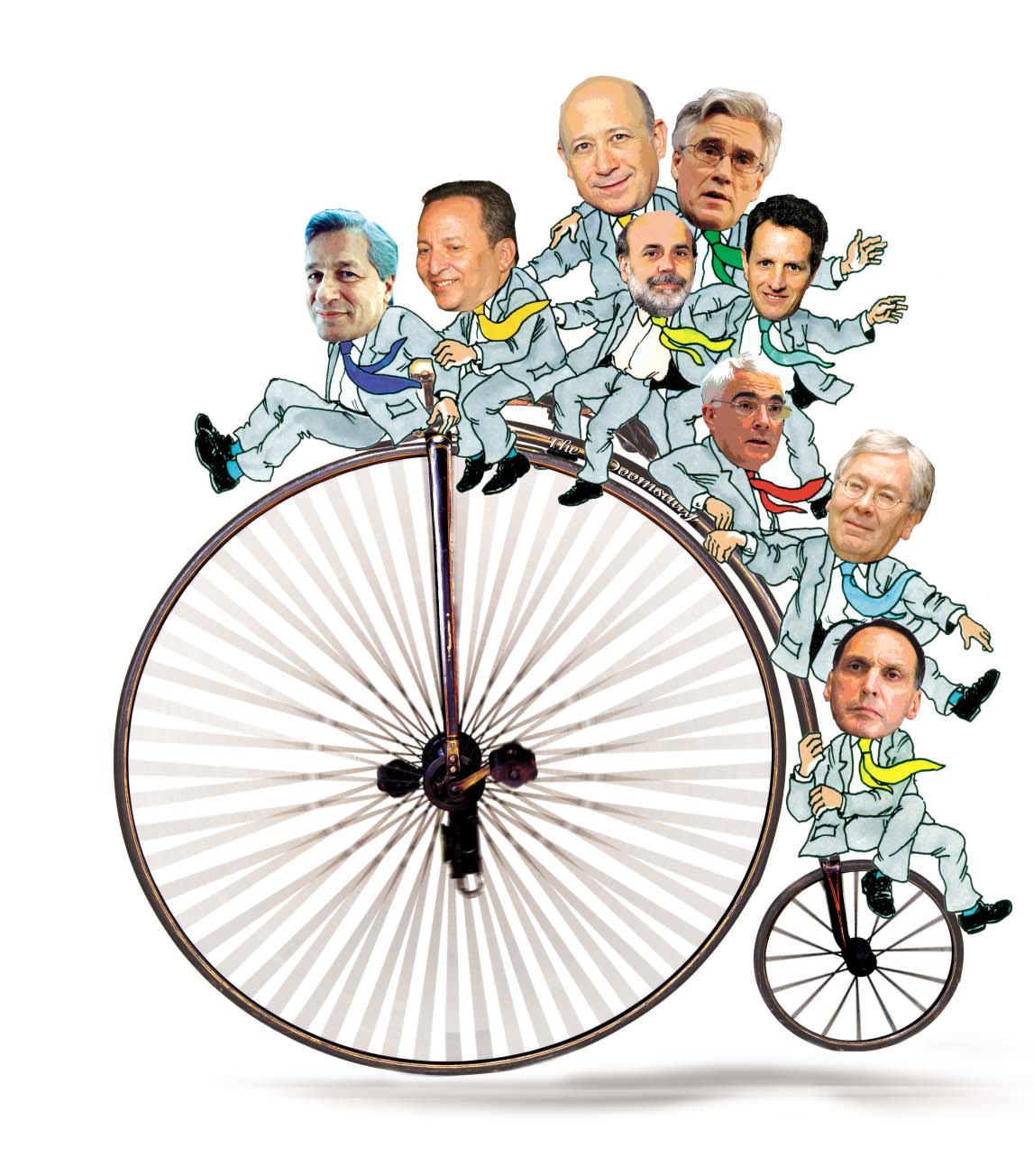 Drawn from “The Doomsday Cycle”, joint with Peter Boone, in LSE’s Centrepiece Winter Issue (permanent/direct pdf link: CEP centerpiece Feb 2010).
I recommend the pictures – designed by the impressive team at the Centre for Economic Performance (we just did the words).
By Simon Johnson
By James Kwak
Jason Paez points out this Reuters story on the claim that new banking regulations will require an additional $221 billion of capital in the industry as a whole. I would take this a little more seriously if the source for the estimate were someone other than JPMorgan Chase, or even if there were a non-JPMorgan source to back it up.
As it is, I think this counts as another “nice little economy you’ve got there” attempt at hostage-taking or, as Paez says, “a threat levied against the entire non-banking economy if we allow the ‘extreme’ case (using the article’s words) of regulation to pass.” For one thing, I don’t see how any analyst could have come up with any number, given that the regulatory proposals I have seen have no numbers in them. That is, they say things like “capital requirements for large firms should be higher” but don’t say how much higher. (It’s possible I missed something recent here.) So what could $221 billion possibly be based on?
By James Kwak
The Corriere della Sera, probably Italy’s most respected newspaper, relays a statement by the Banca d’Italia (Italy’s central bank) that its head, Mario Draghi, had “no role” in the Greece-Goldman Sachs interest rate swaps that have been reported by Der Spiegel and The New York Times. Here are some translated excerpts from the story:
“The transaction with Greece ‘was executed prior to the arrival of Draghi at Goldman Sachs,’ added sources from the [Banca d’Italia*], recalling that the governor [Draghi], who has headed the Banca d’Italia since the beginning of 2006, was vice president and managing director of Goldman Sachs in London from 2002 to 2005.
“On Tuesday, the former chief economist of the IMF, Simon Johnson, in his blog but picked up by other media, drew attention to Draghi, also calling into question the transaction by Italy, while [Draghi] was serving as director general of the [Italian] Treasury. . . . But it was in light of these possible connections, to avoid misunderstandings and rumors on the past role of Draghi, that the Banca d’Italia also chose to specify, on the subject of the Italian transactions in the 1990s, that ‘they had the goal of reducing the cost of the public debt and not to hide the true state of the public’s accounts.'”
The article is referring to this post by Simon asking whether Draghi had any connection to the Goldman-Greece or similar transactions with other governments.
* The actual text says “Istituto di via Nazionale.” The Banca d’Italia is located on the via Nazionale in Rome. This is similar to referring to the U.K. prime minister’s office as “Downing Street.”
By Simon Johnson
Given recent maneuverings around European Central Bank (ECB) appointments and the obvious discomfort of Mario Draghi – he carries the Goldman Sachs connection now like other people carry albatrosses – the German financial-industrial complex seems to regard Axel Weber as a “done deal” to become the new ECB president.
Such an assumption is premature. Mr. Weber, as long standing head of the Bundesbank and general German economic maestro (including, quietly, on fiscal issues), is due to face his own round of questioning – if you listen carefully, you can hear southern Europeans sharpening their arguments, and with good reason.
There are six important and difficult subject areas for Mr. Weber. Continue reading “Six Questions For Axel Weber”
By Simon Johnson
Adair Turner, head of the UK’s Financial Supervisory Authority, has developed a flair for pushing the official conversation on banking forward.
He spoke in favor of a tax on financial services, long before that was fashionable. This idea has been picked by both the UK and US governments – and in some amended form is likely to emerge from the G20 intergovernmental summit process later this year.
Turner also pointed out that much of financial innovation is not actually socially useful – and may, in some instances, be profoundly dangerous. For a while, it seemed that his voice on this point might be lost in the wilderness. But then President Obama launched the Volcker Rules, which essentially attempt to rein in certain forms of risk-taking (and arguably innovation) by very big banks.
Now Adair Turner is at it again, this time in the 14th Chintaman Deshmukh Memorial Lecture, delivered at the Reserve Bank of India in Mumbai earlier this week. Continue reading “Capital Controls Again”
By Simon Johnson
European Union pressure is growing for Greece to “do the right thing” – which means, to the EU’s leaders, a massive and sudden cut in the Greek budget deficit. Greece, without doubt, has gotten itself into a fine mess; still, it is now time for the Greek government push back more effectively.
Fuming at EU arrogance will accomplish nothing. And, while global investment banks may have helped hide the evidence, it seems unlikely they actually designed the great blunder of eurozone admission (and broken Greek promises). It’s time to stop blaming others and get crafty.
Greece should open a semi-official channel to the IMF and talk discretely about taking out a loan. Continue reading “Greece Should Approach The IMF”
By James Kwak
From The New York Times: A council of regulators chaired by the treasury secretary, with the Fed chair or his designate as the vice chair. At present, that would be Tim Geithner and Ben Bernanke.
I wouldn’t ordinarily write a whole post about this (if I just want to link to something, I try to use Twitter), but I had to point out this line by Calculated Risk:
“I can just imagine a council in 2004 and 2005 led by ex-Treasury Secretary John Snow with Alan Greenspan as Vice Chair. Yeah, that would have worked well …”
By James Kwak
This could be a midsize political battle in the run0up to the midterm elections, as discussed by The New York Times. The positions on both sides are too obvious to warrant repeating. If I recall correctly, the Obama administration hurt itself by underestimating the course of future unemployment a year ago when it passed the stimulus (most people were making the same mistake at the time), so now if you compare actual unemployment against original projections it looks like the stimulus had no impact. But that was a forecasting error and has nothing in itself to do with the stimulus itself.
Menzie Chinn has an overview post on the debate in which he argues that, at least from the standpoint of economists, it’s hardly a debate: the stimulus worked.
 The Baseline Scenario