Democrats and the Bush Tax Cuts

By James Kwak

Mark Thoma provides an excerpt from Noam Scheiber on Peter Orszag’s attempt to let all of the Bush tax cuts expire. In short, Orszag wanted to extend the “middle-class” tax cuts for two years (letting the tax cuts for the rich expire); then he expected the middle-class tax cuts to expire as well. President Obama was interested in the plan, which Scheiber takes as evidence that “the president is a true fiscal conservative.”

Thoma frames this as a bad thing:

“The explanation, of course, is that despite hopes to the contrary (and denial by some), the president is, ‘a true fiscal conservative’ — it’s not just an act in an attempt to capture the middle — and that could be bad news not just for middle class tax cuts, but also for important social insurance programs such as Social Security.”

I like and respect Mark Thoma a great deal, and I generally think of him as a mainstream Democrat on economic issues, neither a socialist nor a “moderate Democrat” (what we used to call a Republican). To me, his post is evidence that many Democrats think that most of the Bush tax cuts were an are a good thing. This confuses me. When did we become the party of tax cuts?

Continue reading “Democrats and the Bush Tax Cuts”

Beware of “Centrists” Bearing Consensus

By James Kwak

Floyd Norris has written another good column skewering the Republican candidates’ tax proposals. It’s not hard: all you have to do is list the many ways they want to cut taxes—which make George W. Bush look like a veritable communist, out to confiscate all private wealth—and point out the vast increase in budget deficits that would follow.

Near the end, Norris has this paragraph:

To some deficit hawks, like Maya MacGuineas, the president of the Committee for a Responsible Federal Budget, the campaign so far has been a disappointment. In tax policy circles, she said, there has been growing agreement that a reform similar to the 1986 Reagan tax reform is needed — cutting rates and eliminating loopholes and deductions. But while that reform was revenue-neutral, she said, this one would need to raise revenue.

I wouldn’t call myself a member of “tax policy circles,” so maybe there is such a consensus. “Cutting rates and eliminating loopholes and deductions” was a feature of Bowles-Simpson, Domenici-Rivlin, and the Gang of Six. But that doesn’t make it right.

Continue reading “Beware of “Centrists” Bearing Consensus”

Making the United States More Like Greece

By Simon Johnson

One of the big problems in Greece over the past decade or so is that the government was not honest with its data.  Various people assisted in the matter – including Goldman Sachs with respect to some debt issues – but ultimately this was a political decision at the highest level.  The people running the country decided to conceal the true nature of their budget and their debt.  This deception ended up costing the country dearly – completely undermining its credibility under pressure and making it much harder to turn the fiscal and economic situation around.

House Republicans are now proposing something similar for the United States.

Because this concerns deficits and debt, the details may seem arcane – and that is how similar details escaped attention by almost everyone in Greece.  Fortunately, in the United States we have an excellent guide – an article in Tax Notes by John Buckley.  (“Dynamic Scoring: Will S&P Have Company?,” February 28, 2012; at the moment this is available only behind their paywall but in the public interest I would strongly encourage Tax Notes to make this piece freely available – as they have in the past for other important articles.) Continue reading “Making the United States More Like Greece”

When Did Republicans Become Fiscally Irresponsible?

By Simon Johnson, co-author of White House Burning: The Founding Fathers, The National Debt, and Why It Matters To You, available April 3rd

The United States has a great deal of public debt outstanding – and a future trajectory that is sobering (see this recent presentation by Doug Elmendorf, director of the Congressional Budget Office). Yet the four remaining contenders for the Republican nomination are competing for primary votes, in part, with proposals that would – under realistic assumptions – worsen the budget deficit and further increase the dangers associated with excessive federal government debt.

Politicians of all stripes and in almost all countries claim to be “fiscally responsible.” You always need to strip away the rhetoric and look at exactly what they are proposing.

The nonpartisan Committee for a Responsible Federal Budget does this for the Republican presidential contenders. I recommend making the comparison using what the committee calls its “high debt” scenario. This is the toughest and most realistic of their projections – again, a good and fair rule of thumb to use for assessing politicians everywhere.

Under this scenario, Newt Gingrich’s proposals would increase net federal government debt held by the private sector to close to 130 percent of gross domestic product by 2021, from around 75 percent of G.D.P. this year. Continue reading “When Did Republicans Become Fiscally Irresponsible?”

Why Is Finance So Big?

By James Kwak

This is a chart from “The Quiet Coup,” an article that we wrote for The Atlantic three years ago next month. Many people have noted that the financial sector has been getting bigger over the past thirty years, whether you look at its share of GDP or of profits.

The common defense of the financial sector is that this is a good thing: if finance is becoming a larger part of the economy, that’s because the rest of the economy is demanding financial services, and hence growth in finance helps overall economic growth. But is that true?

Continue reading “Why Is Finance So Big?”

Ron Paul’s Budget Proposals: Fiscally Irresponsible

By Simon Johnson, co-author of White House Burning: The Founding Fathers, Our National Debt, and Why It Matters To You, available from April 3rd.

Representative Ron Paul sees himself as an independent thinker – not afraid to confront the conventional wisdom, whether in the form of Federal Reserve Chairman Ben Bernanke or mainstream views within the Republican Party.  As I have written elsewhere recently, we should take Mr. Paul seriously – and not simply dismiss his proposals out of hand.

However, Mr. Paul’s current proposals for the federal budget can only be described as fiscally irresponsible.  This is completely at odds with his more general stated principles (including in the hearing with Mr. Bernanke this morning), including his well-articulated concern about inflation. Continue reading “Ron Paul’s Budget Proposals: Fiscally Irresponsible”

Some Things Never Change

By James Kwak

That picture is average total annual compensation for top-five named executive officers at U.S. public companies from 2008 to 2010. (It’s from a blog post by Carol Bowie of MSCI, which used to be called Morgan Stanley Capital International.) Over those two years, total annual compensation increased by 37% for all companies and by 54% for companies in the S&P 500. Basically, while bonuses and severance packages have fallen or grown slowly, that effect has been swamped by much bigger stock and option packages. Which is evidence that if you try to rein in some of the more egregious aspects of executive compensation, the executives, their friends on the compensation committee, and their hired guns at the compensation consulting firms will figure out ways to keep the party going.

It’s possible that 2008 was a low year for executive compensation because of the financial crisis and recession, so this is just rapid growth from a low base. But check this out:

A December 2011 survey by pay consultant Towers Watson of 265 mid-size and large organizations found 61 percent expect their annual bonus pools for 2011 “to be as large or larger than those for 2010,” while 58 percent of respondents expect to fund their annual incentive plans “at or above target levels based on their companies’ year-to-date performance.” Moreover, 48 percent of those surveyed expect long-term incentive plans that are tied to explicit performance conditions “to be funded at or above target levels based on year-to-date performance.”

Critically, 61 percent of respondent in the Towers survey said they believe their total shareholder return will decline or remain flat.

Huh?

How Much Do Taxes Matter?

By James Kwak

Christina and David Romer’s new paper, “The Incentive Effects of Marginal Tax Rates: Evidence from the Interwar Era,” is available as an NBER working paper (if you are so lucky). Given the current debates about taxes, the paper is likely to garner some attention.

In the central section of the paper, Romer and Romer regress reported taxable income against the policy-induced change in marginal after-tax income share. The after-tax income share is the percentage of your gross income that is left after taxes; policy-induced changes are those caused by tax changes rather than be macroeconomic changes. They do this for the top 0.05% of the income distribution, broken down into ten sub-groups by income, because the income tax only affected the very rich during the interwar years.

Their headline finding is that “The estimated impact of a rise in the after-tax share is consistently positive, small, and precisely estimated” pp. 15–16). They find an elasticity of taxable income with respect to changes in the after-tax income share of 0.19.

Continue reading “How Much Do Taxes Matter?”

Party of Higher Debts

By James Kwak

The Committee for a Responsible Budget recently released an analysis of the budgetary proposals of the four remaining Republican presidential candidates (hat tip Ezra Klein, who shows the key graph). In short, all of the candidates propose to increase the national debt by massive amounts relative to current law, which includes the expiration of the Bush tax cuts at the end of this year.

CFRB compares the candidates’ plans to a “realistic” baseline that assumes the Bush tax cuts are made permanent and the automatic sequesters required by the Budget Control Act of 2011 are waived, among other things. Relative to that extremely pessimistic baseline, Santorum and Gingrich still want huge increases to the national debt; only Paul’s proposals would reduce it. Romney’s proposals would have little impact, but that was before his latest attempt to pander to the base: an across-the-board, 20 percent reduction in income tax rates.

Continue reading “Party of Higher Debts”

Why Won’t The Federal Reserve Board Talk To Financial Reform Advocates?

By Simon Johnson

The Federal Reserve has great power in modern American society, including the ability to move the economy and, at least indirectly, to create or destroy fortunes. Its powers operate in two ways: through control over monetary policy, meaning interest rates and credit conditions more broadly, and through its influence over how the financial system is regulated generally and how specific large banks are treated.

The secrecy of our central bank has long been a source of controversy. In line with changes at central banks in other countries over recent decades, the Fed’s chairman, Ben Bernanke, has pushed for more transparency regarding how individual members of the Federal Open Market Committee view the economy – and thus how they are thinking about the future course of interest rates (and the Fed keeps us posted). This is a commendable change, helping people throughout the economy understand what the Fed is trying to do and why.

Under pressure from both left and right – for example, in the unlikely alliance of Senator Bernie Sanders of Vermont and Representative Ron Paul of Texas – the Fed has also, after the fact, disclosed more of its actions during the recent financial crisis.

But in terms of its process for determining financial-sector regulation, the Federal Reserve – at least at the level of the Board of Governors in Washington – is moving in the wrong direction. Continue reading “Why Won’t The Federal Reserve Board Talk To Financial Reform Advocates?”

What Is This White House Burning?

By James Kwak

Loyal blog readers have surely noticed the new left-hand sidebar of the blog and may be wondering what this “White House Burning” thing is about. I wanted to give you a bit more background than the jacket flap copy you can read elsewhere.

You don’t have to know a lot of American history to know that the War of 1812 began two hundred years ago. Yet I doubt there will be much celebration, since it’s not a war we’re particularly proud of, like World War II, nor is it one that is particularly controversial, like Vietnam. Its most famous moment is perhaps the burning of Washington in August 1814, although it also gave us the phrase “We have met the enemy and they are ours” (Commander Perry, Battle of Lake Erie), the words to the national anthem, and the political career of Andrew Jackson, victor at the Battle of New Orleans.

Continue reading “What Is This White House Burning?”

Health-Care Costs and Climate Change

By James Kwak

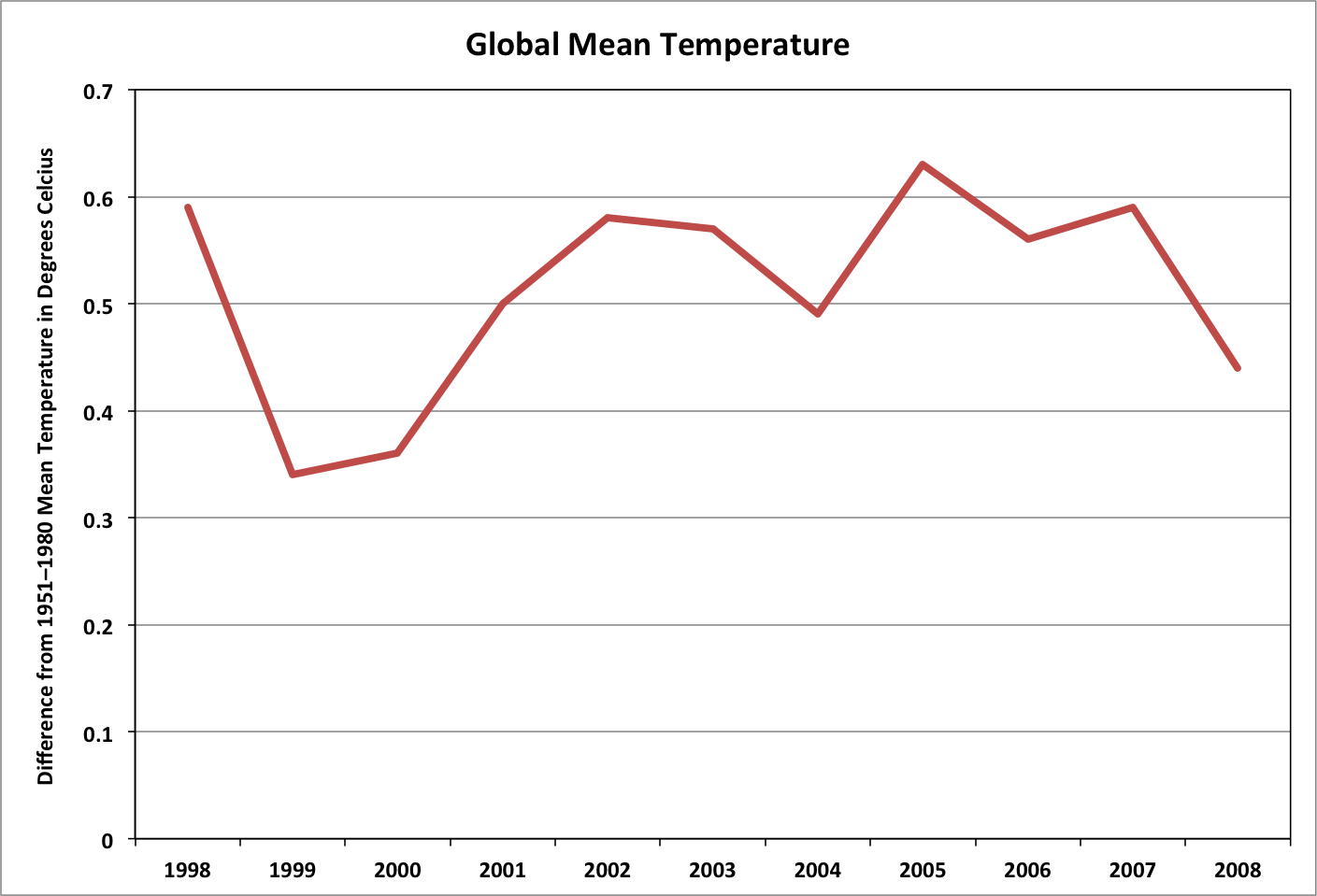
That’s the average global temperature from 1998 through 2008, according to NASA. This, of course, is what enabled George Will to write, in 2009, “according to the U.N. World Meteorological Organization, there has been no recorded global warming for more than a decade.”

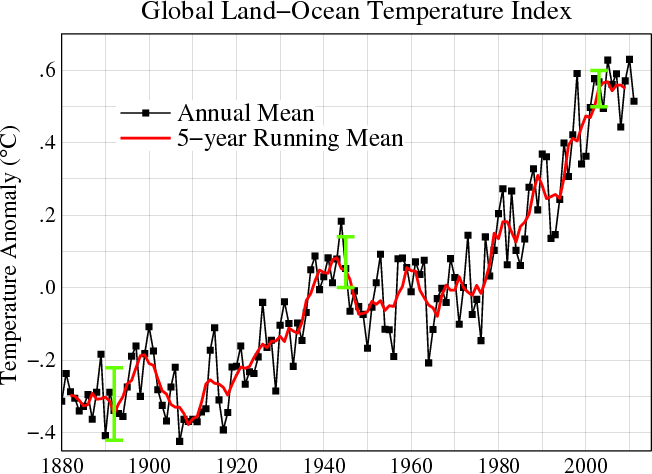
Of course, George Will is just a run-of-the-mill climate change denier with a gift for mis-using statistics. In this case, he was probably citing a World Meteorological Organization study that said, “The long-term upward trend of global warming, mostly driven by greenhouse gas emissions, is continuing. . . . The decade from 1998 to 2007 has been the warmest on record.” And here’s the long-term picture, also from NASA:

You all know this, so why am I bringing it up?

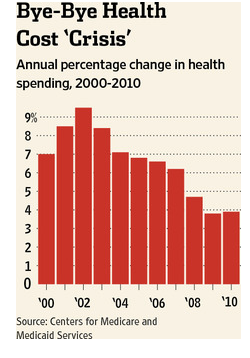
Well, look at this, from J. D. Kleinke of AEI in The Wall Street Journal:

Those are annual percentage changes in nominal terms, so his point is that annual increases are going down. But what does the long term look like?

Continue reading “Health-Care Costs and Climate Change”

Denial or Principle?

By James Kwak

I wanted to make a belated return to Binyamin Appelbaum and Robert Gebeloff’s article on reluctant safety net beneficiaries.  Earlier this week I argued that their framing of an expanding safety net that has spread from the poor to the middle class is wrong, but otherwise the themes they discuss are very important.

Many liberals like to point out the apparent hypocrisy of the people featured in the article, who rail against big government, demand lower spending, and simultaneously rake in benefits from the federal government that they hate. The central figure in the article, Ki Gulbranson, works hard yet has barely enough money to support his family, even with the earned income tax credit* and reduced-price school lunches for his kids. His conclusion: the country is going bankrupt, but people don’t make enough money to pay more taxes, so we should have smaller government. He would rather go without his current benefits—but he can’t imagine retiring without Medicare and Social Security.

I don’t think Gulbranson is a hypocrite at all. I don’t think taking a benefit you don’t think should exist makes you a hypocrite, just like I don’t think Warren Buffett should voluntarily pay higher taxes. I think his position is one part magical thinking and one part principle.

Continue reading “Denial or Principle?”

Under Construction Thursday Night

With WordPress.com, you can’t modify your blog in a sandbox and then promote it to production. Things will be unsettled for a couple of hours.

Update: OK, I think I’m done for now. I’m pretty confident the page nav problem is fixed (thanks to a custom menu). I killed the image at the top of the page to save on white space. We may not need the third column, but we will next week. The Twitter feed filters out all tweets that are just robotic notifications of new blog posts, so it is 100% non-redundant with the rest of the blog.

If the fonts are too small (most common problem, I think), read this (bottom section).