Taking Care of Our Grandchildren

There is a lot of rhetoric these days about making our grandchildren pay for our spending today. Like any “deficits are always bad” argument, this one doesn’t even meet the plausible metaphor test. That is, grandparents routinely spend money (thereby reducing their grandchildren’s eventual inheritances) on things that will make their grandchildren’s lives better.

As Nancy Folbre puts it in Economix (the New York Times blog):

Think of the United States economy as a family farm in need of modernization. Energy prices are going up, but all the tractors are gas guzzlers. Some of our fields have accumulated toxic levels of pesticide, and we need to develop new and better technologies of sustainable production. Our grandchildren want to run the farm, but will need good health and a college education to do it well.

Spending money on increased energy efficiency, research and development, health, and education could increase the value of their assets, helping them repay debt.

That’s just her closing metaphor; I recommend the entire article (it’s pretty short). There is a legitimate debate about what government spending actually benefits our grandchildren and what doesn’t, but it doesn’t make sense to say that every incremental dollar of current spending is hurting our grandchildren.

I tried to make this point on Planet Money, but I like Folbre’s story more.

By James Kwak
Comments and the Spam Filter

If your comments are not showing up: We use WordPress.com, and its optional spam filter, Akismet. I have no control over what Akismet flags as spam. Ordinarily it is very good, but I just looked in the spam folder and noticed that an unusually high number of legitimate comments got accidentally flagged as spam. I freed those I found from spam-land (which should help those of you who are serial commenters), but this problem may recur. I don’t have time to check the spam filter very often, but I will try to glance at it now and then.

We also filter for certain abusive or profane words and for people with a history of writing abusive comments (personal attacks on other people).

By James Kwak

The New Masters of the Universe

Back in the early days of the Clinton administration, James Carville was credited with saying something like this:

I used to think that if there was reincarnation, I wanted to come back as the President or the Pope or as a .400 basball hitter. But now I would like to come back as the bond market. You can intimidate everybody.

The story back then was that bond investors, by buying or selling Treasury bonds, could lower or raise the government’s cost of borrowing and interest rates across the economy, depending on how they felt about government policy.

Today bond investors have discovered a much more direct lever over government policy. I’ve already written about the importance of bondholders in dealing with the financial sector. This week we are seeing their power over the auto industry.

Continue reading “The New Masters of the Universe”

Obama Takes The Lead: G20 Viewer’s Guide

With our myriad banking problems, rapidly rising unemployment, looming political battles over the budget and much more on the pressing domestic agenda, is the G20 summit in London (dinner Wednesday and meeting Thursday) really worth all the time and effort that the President and his team have devoted to it?  And, granted that President Obama has to attend this heads of government meeting for protocol reasons, is there much that this summit can realistically achieve – i.e., are there actions that will be taken as a result of the summit that would not otherwise have happened and that can really make a difference to the parlous state of our economy?

These are all reasonable questions.  And the answer is simple: in terms of the obvious major issues of the day, this summit is unlikely to achieve much.

But every global economic recovery has to start somewhere and it probably has to begin small.  And there are some slight glimmers of hope because (a) President Obama is taking a global leadership role, (b) he is doing this in a creative way that might seem surprising, but which should reduce the chance of a further global meltdown. Continue reading “Obama Takes The Lead: G20 Viewer’s Guide”

The G20 Communique: A Viewer’s Guide

The draft G20 communique, as published on the FT’s website, is not encouraging. To be sure, there are humorous moments, such as:

each of us commits to candid, even-handed, and independent IMF surveillance of our economies and financial sectors, of the impact of our policies on others, and of risks facing the global economy;

Major countries have never allowed this and never will, despite a long tradition of such statements (e.g., ask about whether Gordon Brown welcomed frank assessments of the UK economy during the time he was chair of a ministerial committee that oversees the IMF).  Asserting something blandly in a communique does not make it true, but it does – amazingly – often convince much of the media to applaud politely.  Watching the spinmeisters at work is always entertaining although, under these circumstances, also more than a little scary.

On the real substance, the G20 punts on most of the big issues – as predicted, the language on monetary policy and fiscal policy is completely vacuous (paragraphs 3 and 4; the Europeans won big and the US lost on these issues), and the “regulatory reform” initiative amounts to building more ornate structures (we’re to get a new Financial Stability Board?!?) on the same weak foundations that got us into trouble.  There is simply nothing substantive here that would not have happened without the G20 process; under current dire circumstances, window dressing is not a good reason to hold a summit.

Only three interesting points are apparently still open for discussion, all about some dimension of the IMF. Continue reading “The G20 Communique: A Viewer’s Guide”

Obama Against The Odds

The G20 summit is headed for disaster.  The Europeans have circled their wagons and determined that no sensible policy proposal shall pass.  The background briefings indicate (a) the US has given up on global fiscal stimulus (“declare victory and retreat” springs to mind), (b) and the manifest failures of financial regulators will be addressed through, well, a manifest of failed regulators.

None of the important issues are on the table or even allowed in the building: changing the European Central Bank’s monetary policy, persuading European politicians to acknowledge they were and largely still are asleep at the wheel, and the future of big banks everywhere.

The summit will begin with dinner on April Fool’s Day.  The organizers have clearly not thought much about the symbolism. Continue reading “Obama Against The Odds”

Structured Finance for Beginners

For a complete list of Beginners posts, see Financial Crisis for Beginners.

This is more of an advanced beginners topic – I already covered CDOs (collateralized debt obligations) in my first Beginners article – but I imagine that most of our readers are already familiar with structured products. At least, many people know that first a bunch of securities are pooled together, and then they are “sliced and diced,” in the common media parlance I find incredibly annoying. But Joshua Coval, Jakub Jurek, and Erik Stafford have a new paper, “The Economics of Structured Finance,” which does a brilliantly clear job of describing what these securities are and why they were so widely misunderstood, with the results we all know.

The paper is 27 pages long, not counting references, tables, and figures, and if you are comfortable with probabilities and follow it carefully you can understand everything in it. I will provide a summary to whet your appetite. I am not going to use numerical examples because the examples they use throughout their paper are so good.

Continue reading “Structured Finance for Beginners”

Does Size Matter?

Simon argued in the Atlantic article, and I argued in “Frog and Toad” and “Big and Small”, that the best way to regulate the financial sector is to limit the size of individual institutions. In the interests of providing a contrasting point of view, I want to point out that Kevin Drum thinks that small banks can do just as much damage as big banks:

I think crude bank size is a red herring for our current financial collapse.  Small banks can become overleveraged just as easily as big ones, hedge funds pay higher salaries than Wall Street behemoths, the interconnectedness of the global financial sector is a bigger cause of systemic worries than size alone, and credit expansions spiral out of control largely due to lack of political will, not because Citigroup is large and clumsy.  Those are the things we should be focused on.

Therefore, Drum favors systemic oversight and regulation (which I agree would also be good). Besides the first article cited above, he continues the argument here.

Is The G20 Summit Worth Holding?

We know already much of what the G20 will produce: a communique that looks very much like the last one (dubious reassurances about the great progress being made along vague dimensions), no progress on fiscal stimulus (as we have been projecting for some time), and promises to clamp down on regulation for hedge funds and the like (fine, but how relevant is this to either what caused the crisis or what can sustain a recovery?)

Almost all the important issues are kept off the table by anachronistic diplomatic niceties: monetary policy around the world, Europe’s impending crisis, and how to escape the overweening power of major banks in almost all industrial countries.  The G20 summit has substantially failed even before it begins. Continue reading “Is The G20 Summit Worth Holding?”

Big and Small

Yesterday, Treasury Secretary Geithner presented an outline of his approach to regulating the financial system. The four pillars of that approach seem to be:

  1. Increased power and regulatory centralization to deal with the problem of systemic risk
  2. Increased protections for consumers and investors buying financial products
  3. Closing regulatory gaps by shifting that organizes regulation based on financial functions, not types of financial institutions
  4. International coordination among regulators

This all sounds good to me, and an improvement over where we are today. But reading Geithner’s discussion of systemic risk – the topic he focused on yesterday – I kept thinking it had been too long since he read Frog and Toad to his children.

Continue reading “Big and Small”

Payback Time

Once upon a time there was a president named George. He liked to do things his own way, which annoyed some of his “friends” in Europe. But then a new president named Barack was elected, who not only promised to be nicer to his friends, but was actually very popular in most parts of the world. And the people of the world thought we would see a new era of international cooperation, at least between the U.S. and Europe.

Not so much.

On this side of the Atlantic, the Obama administration and the Fed have been working night and day in an attempt to turn around the economy: Fed funds rate reduced to zero, $800 billion stimulus package, new plan to aid struggling homeowners, new plan for buying toxic assets, new budget, decision by the Fed to buy long-term Treasury bonds, new domestic regulatory framework outlined this week, etc. We’ve been plenty critical of various aspects of the U.S. response, but at least they’re trying.

(Continental) Europe, by contrast, has decided they’ve done enough and it’s time to sit back and watch.

Continue reading “Payback Time”

What the IMF Would Tell the United States, If It Could

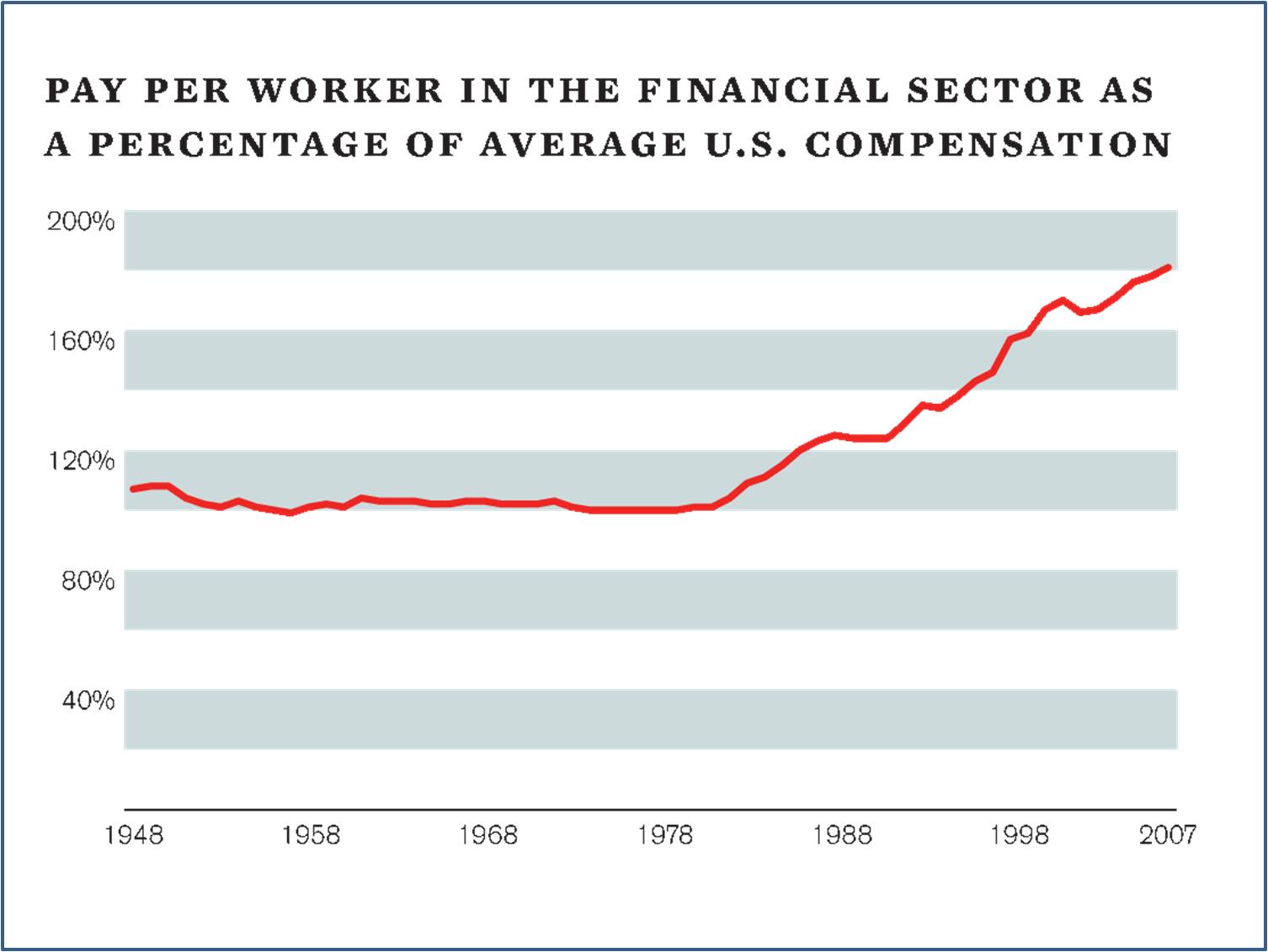
From 1945 until around 1980, the financial sector was one industry among many in the United States. Then something happened.

compensation4

People in finance started making more money,* jobs in finance became more desirable, financial institutions became more influential, and the linkages between the financial sector and the political establishment became stronger. At the same time that our financial sector became more leveraged and more risky, it also became more powerful. The result was a confluence of interests between Wall Street and Washington – one more normally found behind the scenes of emerging market crises, the kind the IMF is called on to resolve.

Simon and I tell this story – and the story of what happened next – in “The Quiet Coup,” an article in the May issue of The Atlantic. (Many thanks to The Atlantic for putting the online copy up as early as they did.) The working title of the article was, “What the IMF Would Tell the United States, If It Could.” Enjoy.

* The data in that chart are from Table 6.6 of the National Income and Product Accounts tables available from the Bureau of Economic Analysis.

Update: Henry Seggerman recently sent us an article he wrote in 2007, comparing the Korean crisis of 2007 to the then-current situation in the United States. He discusses not only the economic similarities, but also some of the political ones.

Update 2: A reader sent us an article about Mark Patterson, formerly Goldman’s chief lobbyist and now Tim Geithner’s chief of staff. Unfortunately, the article was published too late for us to use any of it in our Atlantic article.

By James Kwak

Watch Sternly

Writing in the FT yesterday, Nick Stern made the case for a new international organization to monitor global risks. Drawing on a decade of dealing with governments as board members of such organizations, he is blunt – keep them out of day-to-day oversight, by giving the institution an endowment and a leader appointed for 7 years without possible recall.

Lord Stern is right to be cynical about governments in this context, but his solution feels a bit too much mid-20th century. If the organization got off the ground, governments would compete madly to appoint the leader – trying for someone over whom they have a hold (it has happened). And if the organization really were independent, who would pony up the endowment or be comfortable with the (low) implied level of democratic accountability – it’s hard to see Senate Foreign Relations or Banking (both of which have jurisdiction over the IMF) getting excited about this arrangement.  Without the US there can be no meaningful deal.

And, thinking more about 21st century formats, don’t we already have – albeit in still emergent form – exactly what Professor Stern wants? Continue reading “Watch Sternly”

Frog, Toad, Cookies, and Financial Regulation

My two-year-old daughter loves Frog and Toad.

There is a Frog and Toad story called “Cookies.” It is the only Frog and Toad story I remember from my childhood. Toad bakes some cookies and takes them to Frog’s house. They are very good. Frog and Toad eat many cookies, one after another. They try very hard to stop eating cookies, but as long as the cookies are in front of them, they cannot help themselves.

So Frog puts the cookies in a box. Toad points out that they can open the box. Frog ties some string around the box. Toad points out that they can cut the string. Frog gets a ladder and puts the box on a high shelf. Toad points out .  . .

Finally Frog takes down the box, cuts the string, opens the box, and gives all the cookies to the birds.

“Read more, Daddy,” my daughter says.

“One moment, I have to tell all the nice people the moral to the story.”

Continue reading “Frog, Toad, Cookies, and Financial Regulation”