Category: Commentary

Grover Still Matters

By James Kwak

Last week I wrote a post arguing that Grover Norquist’s Taxpayer Protection Pledge is alive and well and still a binding constraint on Republican lawmakers. The media continue to push the story of Republicans renouncing the pledge, however, and who knows, I could turn out to be wrong. Maybe some Republicans will vote to reduce deductions without a compensating reduction in marginal rates.

Even in that world, however, the pledge will still have a major impact. All this focus on the pledge makes it seem as if the few apostates—Peter King, Lindsey Graham, etc.—are making some enormous, admirable stand on principle. In fact, all they are saying is that they might be willing to close a few loopholes and keep tax rates where George W. Bush left them; they are still adamantly opposed to increases in tax rates (even though those increases, set to take effect on January 1, are the result of Bush’s choosing to use reconciliation to pass his tax cuts).

The specter of the pledge has allowed them to dress up a tiny concession—conservatives should want to get rid of distortions anyway, since they distort economic choices—as a major move to the center. In return for breaking the pledge, they can demand that Democrats agree to major changes to entitlement programs.

The tactical beauty of the pledge is that it credibly committed the Republican Party to never increase taxes, thereby forcing Democrats to meet them not in the middle, but all the way over on their side. (See the tax compromise of December 2010 and the debt ceiling compromise of August 2011, for example.) Even if a few signatories break free, it will still have much the same effect.
Mary Miller vs. Neil Barofsky For The S.E.C

By Simon Johnson

The Obama administration is floating the idea that Mary J. Miller, under secretary for domestic finance at the Treasury Department, could become its nominee to lead the Securities and Exchange Commission. Ms. Miller, a longtime executive in the mutual funds industry, has served in the Treasury under Timothy Geithner since February 2010.

Ms. Miller represents the financial sector’s preferred approach to financial reform – some rhetoric but very little by way of serious effort. She has no time for people who are serious about making the financial system safer. And there is no willingness to really face down powerful people on Wall Street.

Her potential candidacy faces three major obstacles: Neil Barofsky, money market funds and the new momentum for reform. Continue reading “Mary Miller vs. Neil Barofsky For The S.E.C”

Maybe Nate Silver Was Wrong

By James Kwak

I think Nate Silver does a good job aggregating polls to make meaningful quantitative predictions about upcoming elections. But as he said himself shortly before the election, if the polls he relies on are systematically biased, then his forecasts are going to be off.* Many people have noted that Silver (and other quantitative poll aggregators like Sam Wang) correctly predicted an Obama victory and the outcomes in most if not all states.

But the fact remains that Obama did modestly better than the polls, and hence the poll aggregators, expected (not to mention than the Romney campaign expected). We shouldn’t read too much into this, as even where Obama significantly overperformed—like in Iowa, where Silver forecast a 3.2 percentage point victory and the actual came in at 5.7 points—the results were within the confidence intervals. But it’s also possible that the polls really were systematically biased, only they were biased against Obama—not against Romney, as conservative pundits were claiming in the last days.

Continue reading “Maybe Nate Silver Was Wrong”

Neil Barofsky For The S.E.C.

By Simon Johnson

There are two fundamentally different views regarding modern Wall Street. The first is that the financial sector has been terribly and unjustly put upon in recent years – regulated into the ground and treated with repeated disrespect, including by the White House.

There was, for example, an impressive amount of whining this week when no one from a big bank was invited to a high-profile meeting with the president on fiscal issues. As the people holding strongly to this view run large financial institutions and have effective public relations teams, this has become an important part of the conventional or establishment wisdom, repeated without question in some parts of the media.

The second view is that the powerful people who run global megabanks have lost all sense of perspective – including failing to realize that they have more access to people at the top of our political power structures than any other sector has ever had. Anyone who doubts this view – or wonders exactly how the revolving door among politics, lobbying and banking works – should read Jeff Connaughton’s account, “The Payoff: Why Wall Street Always Wins” (which I have written about in more detail before). Mr. Connaughton is most gripping when he describes the failure of law enforcement around securities issues, including issues with both the Department of Justice and the Securities and Exchange Commission. Continue reading “Neil Barofsky For The S.E.C.”

I’m Betting on Grover

In the wake of their overwhelming defeat last week (at least relative to expectations a few months ago), Republicans are wondering how to improve their position in the next election. John Boehner has apparently told his caucus to “get in line” and support negotiations with the president over the “fiscal cliff” and the national debt. More shockingly, The Hill reported rumblings that Grover Norquist’s stranglehold over tax policy may be weakening, with one Democratic aide even saying, “As far as [Norquist’s] ability to sway votes, it’s gone.” Norquist’s Taxpayer Protection Pledge forbids lawmakers from voting for legislation that would either raise tax rates or increase tax revenues; if Republicans are questioning the pledge, that might pave the way for a bipartisan compromise to increase taxes.

Norquist’s response: “Nobody’s actually broken the pledge. That doesn’t keep me up at night.” He’s right not to worry. He has history on his side.

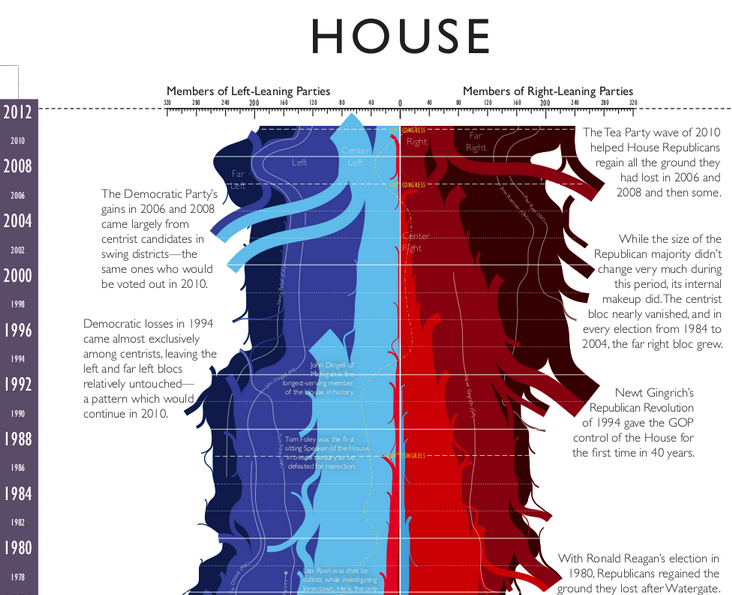
Let’s take a brief look at American political history since the 1970s, courtesy of the incomparable xkcd:

Continue reading “I’m Betting on Grover”

If Entitlement Programs Are Your Top Priority, the Fiscal Cliff Is Your Friend

By James Kwak

There is a lot of low-grade confusion in reporting on the fiscal cliff, primarily because most articles discuss two distinct problems: (a) the contractionary impact of automatic tax increases and spending cuts that go into effect on January 1 and (b) the large and growing national debt—often without clearly distinguishing between them. In fact, (a) and (b) go in opposite directions. Any deal that solves (a) will only make (b) worse; if you really only care about (b), you should be happy about (a). (Instead, Republicans who claim to care only about (b) are squawking about (a) because they want to preserve the Bush tax cuts.) Most reporters understand this and don’t make the obvious mistake of equating the fiscal cliff to the debt problem, but the two are juxtaposed so often they risk blurring into each other.

So, for example, the Washington Post published an article titled “Liberal groups mobilize for ‘fiscal cliff’ fight over Social Security, Medicare.” (As an aside, when did capitalization in titles become optional?) The facts in the article are fine, but you still could get the impression that the fiscal cliff poses a threat to Social Security and Medicare.

Continue reading “If Entitlement Programs Are Your Top Priority, the Fiscal Cliff Is Your Friend”

Some Things Don’t Change

By James Kwak

Which of these things doesn’t belong? John Boehner: “The year 2013 should be the year we begin to solve our country’s debt problem through entitlement reform and a new tax code with fewer loopholes and lower rates.”

Can you imagine Bill Belichick (or any other football coach) saying, “This should be the year we win more games by giving up fewer yards on defense and improving our offense by reducing turnovers and gaining fewer yards per play”?

As long as Republicans persist in claiming to believe that lower tax rates will reduce deficits, nothing in Washington will change. Given their ability to deny both climate change and evolution, denying simple budgetary arithmetic is trivially easy.

The Importance Of Elizabeth Warren

By Simon Johnson

One of the most important results on Tuesday was the election of Elizabeth Warren as United States senator for Massachusetts. Her victory matters not only because it helps the Democrats keep control of the Senate but because Ms. Warren has a proven track record of speaking truth to authority on financial issues – both to officials in Washington and to powerful people on Wall Street.

During the campaign, Ms. Warren’s opponent and his allies made repeated attempts to portray her as antibusiness. In the most bizarre episode, Karl Rove’s Crossroads GPS ran an ad that contended that she favored bailing out large Wall Street banks. All of this was misdirection and disinformation.

Ms. Warren has long stood for transparency and accountability. She has insisted that consumers need protection relative to financial products – when the customer cannot understand what is really on offer, this encourages bad behavior by some companies. If this behavior spreads sufficiently, the entire market can become contaminated – damaging the entire macroeconomy, exactly as we have seen in the last decade. Continue reading “The Importance Of Elizabeth Warren”

And a Few Thoughts About the Election

By James Kwak

Just about everything has been said already, but:

  • There was a lot of talk, and rightly so, about Barack Obama’s overwhelming victory among Latinos. There was little talk about Obama’s even more overwhelming victory among Asian-Americans, who are the fastest-growing demographic group in the country. For decades people have said that Asian-Americans are a natural Republican constituency. But they said that about Latinos, too.
  • In the broad sweep of history, it will be hard to see 2012 as a turning point, given its endorsement of the status quo. With one exception: it was the night that gay rights broke through. Besides Tammy Baldwin, besides victory in all four states (Maine, Maryland, Minnesota, Washington), there was the roar of applause when Barack Obama said “gay or straight,” and even the Republican commentators talking about how their party had to get on the right side of the issue.
  • Last night, when the outcome was clear, David Brooks said that if Obama reached across the aisle, he could gain the support of 15 to 20 Republican senators—proving that he can smoothly transition from being unable to interpret polls to being unable to interpret election results.
  • Amid all the gratifying things about election night (with Elizabeth Warren at the top of the list), here are  few more: “Joe” the “Plumber” losing, the replacement of Joe Lieberman, Karl Rove and Donald Trump displaying their craziness.
  • And, of course, the final word must go to xkcd. Go math!


A Few Thoughts on Nate Silver

By James Kwak

Many people have spilled far more words on this topic than I can read, but I wanted to point out a few things that seem clear to me:

  • As Daniel Engber pointed out, the fact that Obama won (and that Silver called all fifty states correctly) doesn’t prove that Silver is a genius any more than Obama’s losing would have proven that he was a fraud.
  • In fact, Silver appears to have gotten a couple of Senate races wrong, but that still doesn’t prove anything, since his model spits out probabilities, not certainties.
  • To my mind, the crux of the debate was between: (a) people who believe that it is meaningful to make probabilistic statements about the future based on existing data (both current polls and parameters estimated from historical data); and (b) people who believe that there is something ineffable about politics that escapes analysis and that therefore there is something fundamentally wrong, or misleading, or fraudulent about the statistical approach. Silver, through no fault of his own, because associated with (a). To my mind, (a) is right and (b) is wrong because of logic and math, so the idea that one election could have settled the question was crazy to begin with.
  • Within camp (a), there are certainly valid methodological debates, and it’s by no means clear that Silver is the state of the art. Whether, in the last days of an election, he is any better than simple averages is an open question. The value Silver adds or doesn’t add can’t be judged by the final forecast, because one point of his model is to incorporate factors that are not incorporated in current polls (e.g., economic conditions). (Another aspect of the model is to not overreact to short-term trends—but that aspect also largely vanishes by the night before.) So the superiority of the  model, if it is superior, would appear months before the election, not the night before. But that is even harder to verify by ultimate results. Ideally you would have many elections and for each one you would have a Silver forecast six months before and a simple poll average six months before and you would see which had a higher batting average. I would bet on Silver, but we’ll never have enough data to resolve that question.

If the outcome makes people take statistics more seriously and pundits less seriously, that’s a good thing, but it’s not why you should take statistics more seriously.

New Threat to the Financial System: Gravity

By James Kwak

Last week reminded everyone that the heart of our financial system remains in Lower Manhattan, just a few feet above sea level. Amid all the tragedy and hardship, Knight Capital—the firm that earlier almost collapsed because of a software glitch—had to shut down its trading operations on Wednesday when its backup generators ran out of fuel.

Why? The answer is so ridiculous you wouldn’t believe me if I summarized it, so here is the story, according to the Wall Street Journal:

The company calculated that its three fuel tanks held a total of 1,200 gallons, or enough to power the generators “past 2 p.m.” [CEO Thomas Joyce] wrote. But the generators unexpectedly shut down at about 11:45 a.m. The problem: Fuel still in the tanks was useless. “Turns out the intake pipes, which [get] the fuel from tanks to generators, are higher than the bottom of the fuel tanks,” Mr. Joyce wrote. “In short, we had fuel but the construction of the fuel tanks prevented it from getting to the generators.”

So somewhere in the operational chain of command, somebody overlooked the fact that the effective capacity of their fuel tank was less than its actual capacity, because fuel doesn’t levitate. It sounds crazy to me, too, but the alternative is that the truth is even more embarrassing, and this is the story they concocted to cover it up.

Let’s hope that Citigroup knows how to measure the capacity of its backup generators. Some Masters of the Universe.

Too Big To Fail Remains Very Real

By Simon Johnson

Prominent voices within the financial sector are increasingly insisting on one point: We have ended “too big to fail.” The idea is simple: through a combination of legislation (the Dodd-Frank legislation of 2010) and supportive regulation (particularly regarding how big banks would be handled in the event of “liquidation”), very large financial institutions are no longer perceived by investors to be too big to fail.

Unfortunately, while tempting, this idea is completely at odds with the facts. The market perception that some financial institutions are “too big to fail” is alive and well. If you want to remove that perception, you need to break up our biggest banks. Continue reading “Too Big To Fail Remains Very Real”

The Economist on Romney’s Fiscal Policy

By James Kwak

It should be no surprise that I am voting for Barack Obama on Tuesday, despite all his flaws and failures of the past four years. There are just too many dimensions on which he is clearly preferable to Mitt Romney. One of the more important ones, on which I spent most of last year (writing White House Burning), is fiscal policy. And here, since anything I write will be dismissed by many readers as liberal propaganda, is The Economist on the topic:

“Yet far from being the voice of fiscal prudence, Mr Romney wants to start with huge tax cuts (which will disproportionately favour the wealthy), while dramatically increasing defence spending. Together those measures would add $7 trillion to the ten-year deficit. He would balance the books through eliminating loopholes (a good idea, but he will not specify which ones) and through savage cuts to programmes that help America’s poor (a bad idea, which will increase inequality still further). At least Mr Obama, although he distanced himself from Bowles-Simpson, has made it clear that any long-term solution has to involve both entitlement reform and tax rises. Mr Romney is still in the cloud-cuckoo-land of thinking you can do it entirely through spending cuts: the Republican even rejected a ratio of ten parts spending cuts to one part tax rises.”

That’s just about the same summary I would have written.

Why Do People Think the Race Is a Tossup?

By James Kwak

There’s been a minor controversy in the blogosphere not about whether Obama or Romney should be president, and not about whether Obama or Romney is ahead in the polls, but about the esoteric question of whether one should interpret the polls to mean that Obama is the favorite or that the race is a “tossup.” This debate has largely swirled around Nate Silver, who aggregates polling data, recalculates confidence intervals, and incorporates other factors (drawn from analysis of previous elections), and for the past few weeks has rated Obama as having about a 60–80% chance of winning the election. In response, various members of the pundit class have argued that the national polls show a tied race, polls can’t predict the future, or even that since both sides (supposedly) think each has a 50.1 percent chance of winning, their chances must be equal. (See Felix Salmon for a summary.)

Silver has responded to all of the coherent objections that might be made to his forecast, in detail. But what’s at work here isn’t a reasoned debate about how to interpret polls. It’s sheer innumeracy, pure and simple. The statement that Obama has about a 75–80 percent chance of winning is roughly equivalent to the statement—which no one contests—that his average lead in Ohio is about 2–3 points, once you take the confidence interval into account. As Silver has said, it’s analogous to the statement that a team that’s ahead by a field goal deep in the fourth quarter has a better chance of winning than the team that’s behind; no one would call that game a “tossup,” even though either team could win. Even if you can’t predict the next turnover or breakaway running play, that wouldn’t lead you to believe the three-point lead is irrelevant.

It’s the same thing we saw in Moneyball—people who can’t understand numbers claiming that numbers have no practical value. Unfortunately, in political journalism the sample size is so small and the monetary stakes are so low that the incoherent innumerates will never be drummed out of the marketplace.

What the Federal Government Does

By James Kwak

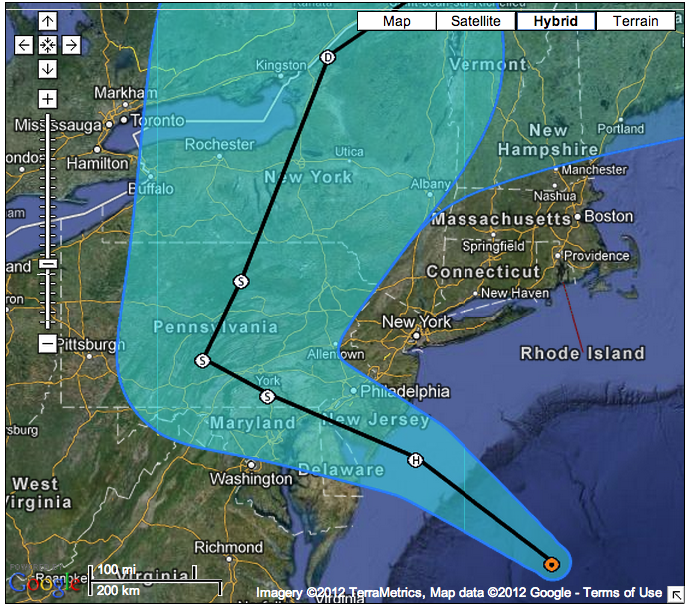
Now is as good a time as any to remind people of who provides all those detailed projections of where Hurricane Sandy is going to hit and how strong it’s going to be: the federal government. No matter how you get your weather news—local TV or radio, The Weather Channel, AccuWeather, whatever—hurricane forecast information originally comes from the National Hurricane Center, which is part of the National Weather Service. The raw data come in part from the Hurricane Hunters, the pilots who fly planes into hurricanes, who are part of the Air Force Reserve and the National Oceanic and Atmospheric Administration. The computer models that predict where hurricanes are going to strike are developed by the NHC.

In August 2011, Simon and I were on vacation with our families in Southern Florida as Hurricane Irene was approaching the East Coast. Simon had the idea of using government weather services as the example to lead off chapter 4 of White House Burning, “What Does the Federal Government Do?” I like this example because almost everyone agrees that the federal government should be engaged in disaster prevention, disaster relief, and even weather forecasting. In 2005, Rick Santorum proposed a bill that would have prevented the National Weather Service from providing weather forecasts to the public—but he insisted that the NWS should gather weather data and provide it to private companies so that they could make money off of it. (AccuWeather is based in Pennsylvania, Satorum’s state, by the way.)

Continue reading “What the Federal Government Does”