Category: Commentary

Regulators Repeat Exactly What They Did During the Last Housing Boom

By James Kwak

The Dodd-Frank Act was supposed to require securitizers to retain 5 percent of the credit risk of the mortgage-backed securities that they issued, in order to reduce the risk of a repeat of the last housing bubble. Today, the federal financial regulators said, “Whatever,” and ignored that requirement. In particular, they created an exemption that would have covered at least 98 percent of all mortgages issued last year.

Why? Because

“adding additional layers of regulation would have contracted credit for first time home buyers and borrowers without large down payments, and prevented private capital from entering the market.”

That’s according to the head of the Mortgage Bankers Association.

This is the exact same argument that was made in favor of deregulation during the two decades prior to the last financial crisis, without the slightest hint of irony. It’s further proof that everyone has either forgotten that the financial crisis happened or is pretending that it didn’t happen because, well, maybe it won’t happen again?

Even leaving aside the specific merits of this decision, the worrying thing is that the intellectual, regulatory, and political climate seems to be basically the same as it was in 2004: no one wants to to anything that might be construed as hurting the economy, and no one wants to offend the housing industry.
Markets Aren’t That Stupid

By James Kwak

In finance, there are rarely battles between good and evil. Instead, you have battles of, say, greedy and corrupt versus greedy and ruthless. This is roughly the case in the debate between entrenched corporate CEOs (and boards) and activist hedge funds.

Activist hedge fund managers, like Daniel Loeb or Bill Ackman, buy large blocks of stock in a target company and agitate for change (new board members, asset sales, dividends or buybacks, etc.). The idea is that either they will get their way, or the company will respond to the pressure by doing a better job for shareholders; either way, the stock goes up, and they sell at a big profit.

Continue reading “Markets Aren’t That Stupid”

The Problem with 401(k) Plans

By James Kwak

Apparently my former professor Ian Ayres has made a lot of people upset, at least judging by the Wall Street Journal article about him (and co-author Quinn Curtis) and indignant responses like this one from various interested parties. What Ayres and Curtis did was point out the losses that investors in 401(k) plans incur because of high fees charged at the plan level and high fees charged by individual mutual funds in those plans. The people who should be upset are the employees who are forced to invest in those plans (or lose out on the tax benefits associated with 401(k) plans.)

In their paper, Ayres and Curtis estimate the total losses caused by limited investment menus (small), fees (large), and poor investment choices (large). Those fees include both the high expense ratios and transaction costs charged by actively managed mutual funds and the plan-level administrative fees charged by 401(k) plans.

Continue reading “The Problem with 401(k) Plans”

The Lame “Uncertainty” Defense

By James Kwak

The indefatigable Brad DeLong has devoted his energies to singlehandedly protecting Larry Summers from the Internet (although, he makes pains to say, he likes Janet Yellen almost as much). Although I’m letting most of the Fed chair sideline debate pass me by, DeLong and others have raised one issue that played an important symbolic role in 13 Bankers and, more generally, the historical background to the financial crisis: Brooksley Born’s proposal to think about regulating OTC derivatives in 1998.

For those who don’t know the story, it basically goes like this. Born, as chair of the CFTC, was worried about the risk posed by OTC derivatives, which were effectively unregulated at the time. On May 7, 1998, the CFTC issued a “concept release”  asking for comments about the regulation of OTC derivatives. Summers, then deputy treasury secretary, along with Treasury Secretary Robert Rubin, Fed Chair Alan Greenspan, and SEC Chair Arthur Levitt, opposed Born, and they issued their own press release on the same day opposing the CFTC. Over the next several months they successfully blocked the CFTC from regulating OTC derivatives, convincing Congress to stop the CFTC from moving forward, a position that was enshrined in statute in the Commodity Futures Modernization Act of 2000.

Continue reading “The Lame “Uncertainty” Defense”

Toxic Trait To Avoid #1

By James Kwak

I generally refuse to be drawn into the Yellen-Summers horse race because (a) everything that can be said, has been said, (b) I have no original information or insight, and (c) it’s all speculation anyway. But I’m going to comment on one parenthesis in Felix Salmon’s good summary post, since it has broader application:

Summers is, to put it mildly, not good at charming those he considers to be his inferiors, but he’s surprisingly excellent at cultivating people with real power.

In my personal experience, especially in the business world, this is absolutely the worst personality trait you can find in anyone you are thinking of hiring. You see it a lot, especially in senior executives. Unfortunately, at the time of hiring, you only see the ability to manage up—not the inability to treat subordinates decently. By the time you figure it out, you’ve already suffered serious organizational damage. (Thanks to my friend Marcus Ryu for identifying this problem so clearly.)

Continue reading “Toxic Trait To Avoid #1”

Wealth Taxes? Don’t Hold Your Breath

By James Kwak

Tyler Cowen thinks that we are entering an age of debates over wealth taxes. If only.

It’s true, as Cowen notes, that national debt everywhere is a relatively small fraction of national wealth and that, therefore, “fiscal problems are best regarded as problems of dysfunctional governance.” One of our central arguments in White House Burning was that the United States obviously, easily has the ability to pay down the national debt, and how it will do so is basically a distributional issue.

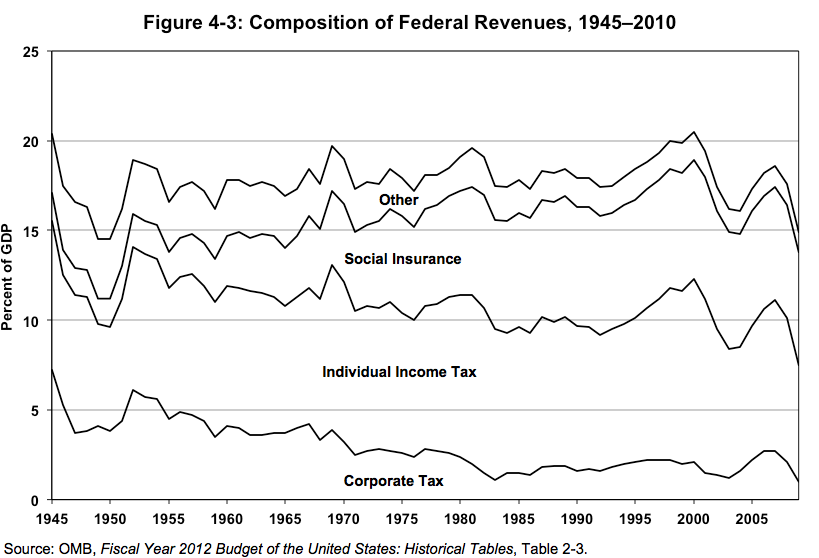
Even if wealth taxes make sense, that doesn’t mean they will happen. Cowen claims that “Like the bank robber Willie Sutton, revenue-hungry governments go ‘where the money is.'” But all that is cleverly phrased is not true. Consider this chart from White House Burning:

Screen shot 2013-07-24 at 1.30.09 PM

Continue reading “Wealth Taxes? Don’t Hold Your Breath”

Yes, We Should Worry About Public Pensions

By James Kwak

In the wake of the Detroit bankruptcy, Paul Krugman has a post pooh-poohing concerns about public pensions. His conclusion:

“Nationwide, governments are underfunding their pensions by around 3 percent of $850 billion, or around $25 billion a year.

A $25 billion shortfall in a $16 trillion economy. We’re doomed!”

(Yes, that’s sarcasm.)

I know why Krugman wants to argue that this isn’t a problem. If everyone believes that public pensions are a big problem, then the austerity crew will convert that belief into a push to cut public pensions—just like they have tried to use future shortfalls in the Social Security and Medicare trust funds to insist on privatizing or voucherizing those programs.

Continue reading “Yes, We Should Worry About Public Pensions”

Remember Citigroup

By Simon Johnson

On Thursday of last week, four senators unveiled the 21st Century Glass-Steagall Act.  The pushback from people representing the megabanks was immediate but also completely lame – the weakness of their arguments against the proposed legislation is a major reason to think that this reform idea will ultimately prevail.

The strangest argument against the Act is that it would not have prevented the financial crisis of 2007-08.  This completely ignores the central role played by Citigroup.

It is always a mistake to suggest there is any panacea that would prevent crises – either in the past or in the future.  And none of the senators – Maria Cantwell of Washington, Angus King of Maine, John McCain of Arizona, and Elizabeth Warren of Massachusetts – proposing the legislation have made such an argument.  But banking crises can be more or less severe, depending on the nature of the firms that become most troubled, including their size relative to the financial system and relative to the economy, the extent to which they provide critical functions, and how far the damage would spread around the world if they were to fall. Continue reading “Remember Citigroup”

CEO Salary Justification Season Is Open

By James Kwak

Proxy season is over. Then comes the annual compilation of executive compensation data. Equilar and the Times, for example, reported that the compensation of the median CEO at a large public company was more than $15 million in 2012.

This means that now we are into the season of justifying these stratospheric numbers—and particularly the high rate of growth of those numbers. (2012 median compensation was 16 percent higher than in 2012.) For example, there was Steven Kaplan’s unconvincing attempt to justify high CEO pay by comparing it to . . . high pay among the top 0.1% (see Brad DeLong for a summary).

Continue reading “CEO Salary Justification Season Is Open”

What Does 9.5% Mean?

By James Kwak

This week, the Federal Reserve approved its final rule setting capital requirements for banks. The rule effectively requires common equity Tier 1 capital of 7 percent of assets (including the “capital conservation buffer”), with a surcharge for systemically important financial institutions that can be as high as 2.5 percent, for a total of 9.5 percent. That sounds like a lot, right?

If it sounds like a lot to you, it’s probably because (a) it’s higher than capital requirements before the financial crisis and (b) the banking lobby has been saying it’s a lot to anyone who will listen. But apart from some people thinking that higher is better and others thinking that lower is better, you rarely get any basis for understanding what the numbers mean.

Continue reading “What Does 9.5% Mean?”

Save If Failure Impending

By James Kwak

Yesterday the House Financial Services Committee held a hearing on the too big to fail problem. Ordinarily a hearing includes a couple of witnesses chosen by the majority who say one thing and one or two witnesses chosen by the minority who say exactly the opposite thing. In this, however, it was hard to tell who was chosen by which side (although I can guess), given the extent of the agreement among former Fed bank president Thomas Hoenig, current Fed bank presidents Richard Fisher and Jeffrey Lacker, and former FDIC chair Sheila Bair.

All agreed that the too big to fail problem still exists, five years after the financial crisis, and that it continues to distort the market for financial services. For example, Lacker, who is perhaps the most sanguine about Dodd-Frank (he likes the living will provisions of Title I), said, “Given widespread expectations of support for financially distressed institutions in orderly liquidations, regulators will likely feel forced to provide support simply to avoid the turbulence of disappointing expectations. We appear to have replicated the two mutually reinforcing expectations that define ‘too big to fail.’”

There was disagreement over whether Dodd-Frank, and the Orderly Liquidation Authority regime that it created, would continue the practice of bailing out failing financial institutions, with Bair arguing that Dodd-Frank “abolished” bailouts. Of course, everyone is against bailouts, but at the same time everyone is in favor of protecting the financial system and the economy against disaster.

Continue reading “Save If Failure Impending”

Want To Reduce the National Debt? Find More Workers

By James Kwak

Why do some people oppose immigration reform? One conservative objection is that we should follow rules and punish lawbreakers (not to mention all the other arguments that have to do with protecting a white, Protestant, English-speaking nation). That fits nicely with the Strict Father worldview identified by George Lakoff. Another common conservative objection is that we can’t afford more immigration because it would increase deficits and the national debt; that also fits with the tough-minded, austerity-loving ethos of modern conservatism. The little problem is that more immigrants, and more legal immigrants, are unambiguously good for the economy and for the federal budget deficit.

This is the conclusion of two reports put out by the Congressional Budget Office this week: one a cost estimate of the bill currently in the Senate, the other an expanded estimate incorporating additional economic impacts of the bill. The bottom line is that the bill would make the economy 5.4 percent bigger in 2033 than it would be otherwise; per capita GNP would be 0.2 percent higher and wages would be 0.5 percent higher in 2033. Finally, immigration reform would reduce aggregate deficits by about $200 billion* over the first decade and about $1 trillion in the second decade.

Continue reading “Want To Reduce the National Debt? Find More Workers”

Goldman Sachs Concedes Existence Of Too Big To Fail

By Simon Johnson

Global megabanks and their friends are pushing back hard against the idea that additional reforms are needed – beyond what is supposed to be implemented as part of the Dodd-Frank 2010 financial legislation.  The latest salvo comes from Goldman Sachs which, in a recent report, “Measuring the TBTF effect on bond pricing,” denied there is any such thing as downside protection provided by the official sector to creditors of “too big to fail” financial conglomerates.

The Goldman document appears hot on the heels of similar arguments in papers by such organizations as Davis Polk (a leading law firm for big banks), the Bipartisan Policy Center (where the writing is done by a committee comprised mostly of people who work closely with big banks), and JP Morgan Chase (a big bank).  This is not any kind of conspiracy but rather parallel messages expressed by people with convergent interests, perhaps with the thought that a steady drumbeat will help sway the consensus back towards the banks’ point of view.  But the Goldman Sachs team actually concedes, point blank, that too big to fail does exist — punching a big hole in the case painstakingly built by its allies.  Continue reading “Goldman Sachs Concedes Existence Of Too Big To Fail”

Liberty for Whom?

By James Kwak

I feel like I should have something deep and original to say about Corey Robin’s fascinating article on nineteenth-century European culture, Nietzsche, and the economic philosophy of Friedrich Hayek. In addition to the things I’m better known for, I studied European intellectual history at Berkeley, with Martin Jay no less, and I’m pretty sure Nietzsche figured somewhat prominently in my orals. But Robin has far surpassed my understanding of Nietzsche, which is almost twenty years old, anyway.

The story, in very simplified form, goes like this. For Nietzsche, and for other cultural elitists of late-nineteenth-century Europe, both the rise of the bourgeoisie and the specter of the working class were bad things—the former for its mindless materialism, the latter  for its egalitarian ideals, which threatened to drown the exceptional man among the masses. One set of Nietzsche’s descendants was the political theorists like Carl Schmitt, who “imagined political artists of great novelty and originality forcing their way through or past the filtering constraints of everyday life.” Another, which Robin focuses on in this article, is the “Austrian” school of economics led by Friedrich Hayek.

Continue reading “Liberty for Whom?”

If the Fed Knows Banks Are Too Big, Why Doesn’t It Make Them Smaller?

By James Kwak

The Federal Reserve is serious—about something.

On May 2, The Wall Street Journal reported that regulators were pushing to require “very large banks to hold higher levels of capital,” including minimum levels of unsecured long-term debt, as part of an effort “to force banks to shrink voluntarily by making it expensive and onerous to be big and complex.” The article quoted Fed Governor Jeremy Stein, who said, “If after some time it has not delivered much of a change in the size and complexity of the largest of banks, one might conclude that the implicit tax was too small, and should be ratcheted up” (emphasis added). 

A few days later, Fed Governor Daniel Tarullo said roughly the same thing (emphasis added):

“‘The important question is not whether capital requirements for large banking firms need to be stronger than those included in Basel III and the agreement on capital surcharges, but how to make them so,’ said Mr. Tarullo, adding later that even with those measures in place it ‘would leave more too-big-to-fail risk than I think is prudent.‘”

Tarullo recommended higher capital requirements and long-term debt requirements for systemically risky financial institutions.

Last week, Governor of Governors Ben Bernanke quoted from the same talking points (emphasis added):

“Mr. Bernanke said the Fed could push banks to maintain a higher leverage ratio, hold certain types of debt favored by regulators, or other steps to give the largest firms a ‘strong incentive to reduce their size, complexity, interconnectedness.’

“The Fed chairman acknowledged growing concerns that some financial companies remain so big and complex the government would have to step in to prevent their collapse and said more needs to be done to eliminate that risk.”

Continue reading “If the Fed Knows Banks Are Too Big, Why Doesn’t It Make Them Smaller?”