Author: James Kwak

Why Bail Out Life Insurers?

That’s the question I woke up with this morning. Sad, isn’t it.

The Wall Street Journal reported this week that Treasury will soon announce that it will use TARP funds to invest in life insurers, or at least those who snuck under the federal regulatory umbrella by buying a bank of some sort. The argument for the bailout is a version of the “No more Lehmans” theory: the failure of a large financial institution could have ripple effects on other financial markets and institutions that could cause systemic damage. For a bank, the ripple effect is primarily caused by two things: (a) defaulting on liabilities hurts bank creditors, and (b) defaulting on trades (primarily derivatives) hurts bank counterparties, if they aren’t sufficiently collateralized (think AIG).

My thought this morning was that life insurance policies are long-term liabilities that are already guaranteed by state guarantee funds, so we don’t have to worry about (a), and hopefully most life insurers were not doing (b) – large, one-sided bets on credit risk like AIG. So why not just let them fail and let the states take over their subsidiaries? But then I checked the facts, and it turns out that the limits on state guarantee fund payouts are pretty low. So the scenario is this: you hear bad things about your life insurer, you decide to redeem your policy (usually at a significant loss to yourself), turning it into a short-term liability, and then the insurer has to start dumping assets into a lousy market, pushing the prices of everything further down and hurting everyone holding those assets. Would this really cause a systemic crisis worse than we’ve already got? I don’t know, but no one in Washington wants to take that risk.
Continue reading “Why Bail Out Life Insurers?”

The Economy and Popular Democracy

One of the central themes of the current economic crisis has been the cozy relationship between “Wall Street” and Washington that resulted from both ideological convergence and old-fashioned campaign contributions. Another theme, as Simon discussed yesterday, has been the absence of a simple left-right axis for opinions to coalesce around. If you think that fixing the banking sector requires a government conservatorship and forcible balance sheet cleanup – rather than periodically dribbling large amounts of cash into institutions and management teams that have already failed by any free-market measure – it’s not clear who your advocates in government are.

Tomorrow, however, you can stand up and be counted. A New Way Forward is organizing demonstrations all around the country, most at 2 PM Eastern Time. The basic message is simple: “If it’s too big to fail, it’s too big to exist. Dismantle the power of the financial elite and make policies that keep a new crop from springing up. We want our economy and politics restored for the public.”

And don’t forget your pitchfork. (Just kidding.)

Inflation Expectations for Beginners

For a complete list of Beginners articles, see Financial Crisis for Beginners.

Only a few years ago, the accepted remedy for a recession was for the Federal Reserve to lower interest rates – namely, the Federal funds rate. Now, however, the economy has been stuck in recession for over fifteen months and the Federal funds rate has spent the last several months at zero. (The Fed funds rate cannot ordinarily be negative, because one bank won’t lend $100 to another bank and accept less than $100 in return; it always has the option of just holding onto its $100.) As a result, the Fed has resorted to other policy tools, most notably large-scale purchases of agency and Treasury securities, funded by creating money. (Here’s James Hamilton’s analysis.)

As the Fed’s monetary policy plays a more prominent role in the response to the economic crisis, there will be more talk of inflation or, more accurately, inflation expectations. While inflation is what affects the purchasing power of the money in your wallet, inflation expectations are what affect people’s behavior in ways that have a long-term economic impact. Take the case of wage negotiations, for example: a union that believes inflation will average 5% over the life of a contract will demand higher wage increases than a union that believes inflation will average only 1%. Once those higher wages are built into the contract, the employer is forced to raise prices in order to cover those wage increases, and inflation begins to ripple through the economy.

Continue reading “Inflation Expectations for Beginners”

Baseline Scenario, April 7, 2009

Baseline Scenario for 4/7/2009 (9am): Post-G20 Edition

Peter Boone, Simon Johnson, and James Kwak, copyright of the authors.

This long-overdue (and hopefully widely-awaited) version of our Baseline Scenario focuses largely on the United States, both because of the volume of activity in the U.S. in the last two months, and also because the U.S. will almost certainly have to be at the forefront of any global economic recovery, especially given the wait-and-see attitude prevalent in Europe.

Global Economic Outlook

The global economy remains weak across the board, with no significant signs of improvement since our last baseline. The one positive sign is that some forecasters are beginning to recognize that growth in 2010 is not a foregone conclusion. The OECD, for example, now forecasts contraction of 4.3% in 2009 for the OECD area as a whole – and 0.1% contraction in 2010.  This is broadly with our previous “L-shaped” recovery view.

Even that forecast, however, expects quarter-over-quarter growth rates to be positive beginning in Q1 2010. (This is not a contradiction: if growth is sharply negative in early 2009, then quarterly rates can be positive throughout 2010, without total output for 2010 reaching average 2009 levels.) While most forecasters expect positive growth in most parts of the world in 2010, those forecasts seem to reflect expected reversion to the mean rather than any identified mechanism for economic recovery. The underlying assumption is that at some point economic weakness becomes its own cure, as falling prices finally prompt consumers to consume and businesses to invest. But given the unprecedented nature of the current situation, it seems by no means certain that that assumption will hold. In particular, with demand low around the globe, the typical mechanism by which an isolated country in recession can recover – exports – cannot work for everyone.

Continue reading “Baseline Scenario, April 7, 2009”

Kindle and Facebook

1. I submitted the blog to Amazon for publication on the Kindle. Their form says they have a backlog, so we’ll see if it ever happens. If you have any pull at Amazon, put in a word for us.

2. We now have a Facebook page called The Baseline Scenario. If that link doesn’t work for you you should be able to search for it and then become a fan. The page imports the RSS feed from the blog, so you can read the blog without leaving Facebook, if that’s your cup of tea. There is also a Wall that you can post things to as usual. In the future, we may figure out more things to do on Facebook, but that’s it for now.*

We do these things (Twitter, too) because we want to make things easier for our readers. It’s a generally correct rule in business that it is a good thing to make life easier for your customers. I believe that if you want people to read your stuff, you have to go where they are – and if that’s Twitter, or Facebook, or Kindle, then that’s where you should be.

* Incidentally, I don’t understand the Facebook model. They seem to be trying to get people to use and enjoy the Internet within the tight confines of Facebook. This reminds me of the old days of CompuServe and AOL. Ordinarily when I work I have about 10-12 tabs open on my browser, and at most one of them is Facebook. There is so much stuff on the Internet, why would you limit yourself to the stuff your friends posted? Besides, I find their user interface non-intuitive, and with each iteration they make it less powerful – and I used to work at a software company.

Two Things That Have Nothing To Do with Each Other

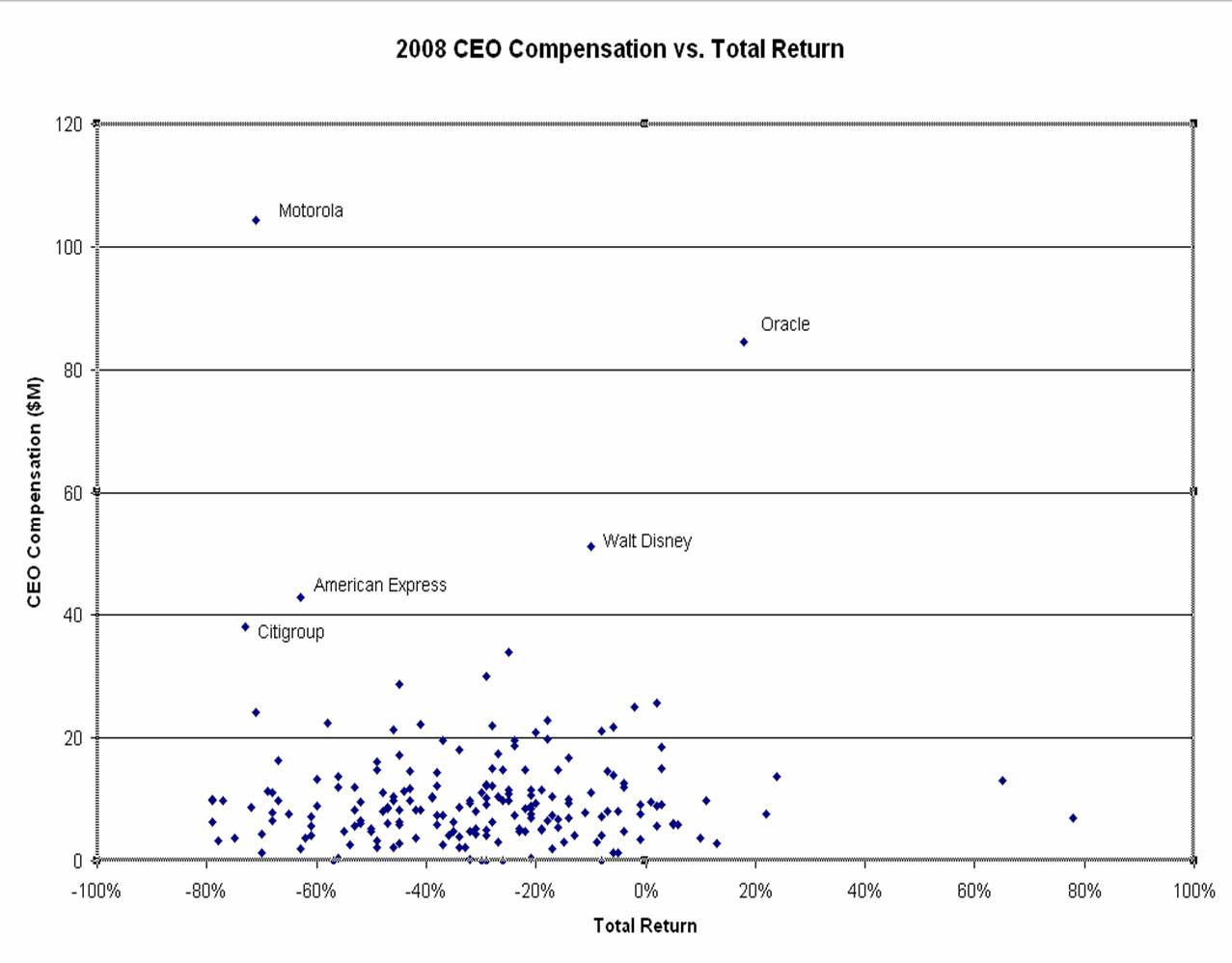
Data from Equilar (methodology), published by The New York Times:

compensation

I know this is simplistic, but I just couldn’t resist.

Some caveats:

  • Stock total return is a poor way to measure CEO performance – yet it’s the one that CEOs and boards commonly point to to justify compensation.
  • A CEO may have been granted a large stock award in 2008 as a reward for “good performance” in 2007. This could explain the combination of high compensation and poor 2008 performance. However, just think about what that means for a second.
  • Most of the large compensation awards are largely restricted stock or stock options. These were valued as of the data of the grant, so if the company’s stock price later fell, the CEO is unlikely to realize the calculated value of the award. But imagine if the stock price had gone up instead: the CEO and the board would be insisting that the award should be valued as of the grant date, not the later exercise date (when it would be worth much more).

Also, I excluded a company called Mosaic, because it’s total return was 257%, so it packed all the other companies into one side of the chart. Mosaic’s CEO earned $6 million.

Continue reading “Two Things That Have Nothing To Do with Each Other”

Making Creditors Suffer

Tyler Cowen, co-author of a prominent independent economics blog, has an article in The New York Times explaining “Why Creditors Should Suffer, Too.”

What the banking system needs is creditors who monitor risk and cut their exposure when that risk is too high. Unlike regulators, creditors and counterparties know the details of a deal and have their own money on the line.

But in both the bailouts and in the new proposals [for financial regulation], the government is effectively neutralizing creditors as a force for financial safety.

I couldn’t agree more (except for the bit about the regulatory proposals, and that’s just because I haven’t read them closely). We need creditors who will pull their money or demand tougher terms from financial institutions that are doing things that are either too risky or just plain stupid; that’s theoretically a more efficient and cheaper enforcement mechanism than regulatory bodies.

Continue reading “Making Creditors Suffer”

Be Nice

Comments are an important part of this blog, and I’m sure that many of you read the blog as much for the comments as for the posts. I’m also very proud of the knowledge, intelligence, and writing ability of our commenters. Simon and I write about a wide range of topics, and so it is never a surprise to me to find comments from people who know any particular topic far better than I do. Looking at other economics blogs, I think we have one of the best discussion communities around, with both a large number and a high average quality of comments.

However, there has been a recent increase in the number of comments that can be construed as offensive in one way or another. While most hardened Internet commenters can probably take a personal  attack now and then, I’m afraid this will intimidate some people and deter them from joining the discussion. So we are creating some guidelines for comments, which are really nothing more than what you should have learned in kindergarten.

1. No profanity.

2. No attacks or insults aimed at other commenters. Calling a public official an idiot is one thing; calling someone who just wrote a comment an idiot is another.

3. No attacks or insults aimed at entire categories of people based on race, gender, religion, national origin or identity, or something similar.

If I see comments falling into these categories, I will delete them. I am also adding filters on a few words to flag comments for moderation. I expect most of those comments will be approved. For example, if you use the word “moronic,” I just want to check that you are referring to, say, the Commodity Futures Modernization Act, not a previous comment.

Thank you for all of your comments. For those of you who do not comment, thank you for reading the blog. It’s no exaggeration to say that Simon and I would not be doing this if it were not for all of you.

By James Kwak

The Mark-to-Market Myth

Today the Financial Accounting Standards Board voted – by one vote – to relax accounting standards for certain types of securities, giving banks greater discretion in determining what price to carry them at on their balance sheets. The new rules were sought by the American Bankers Association, and not surprisingly will allow banks to increase their reported profits and strengthen their balance sheets by allowing them to increase the reported values of their toxic assets.

This makes no sense, for three reasons.

1. Investors and regulators are not idiots. They know what the accounting rules are. If banks claim they were forced to mark their assets down to “fire-sale” prices, investors can look at the facts themselves and apply any upward corrections they want. Now that banks will be able to mark their assets up to prices based solely on their own models, investors will the downward corrections they want. It’s a little like what happened when companies were forced to account for stock option compensation as expenses; nothing happened to stock prices, because anyone who wanted to could already read the footnotes and do the calculations himself.

Continue reading “The Mark-to-Market Myth”

Taking Care of Our Grandchildren

There is a lot of rhetoric these days about making our grandchildren pay for our spending today. Like any “deficits are always bad” argument, this one doesn’t even meet the plausible metaphor test. That is, grandparents routinely spend money (thereby reducing their grandchildren’s eventual inheritances) on things that will make their grandchildren’s lives better.

As Nancy Folbre puts it in Economix (the New York Times blog):

Think of the United States economy as a family farm in need of modernization. Energy prices are going up, but all the tractors are gas guzzlers. Some of our fields have accumulated toxic levels of pesticide, and we need to develop new and better technologies of sustainable production. Our grandchildren want to run the farm, but will need good health and a college education to do it well.

Spending money on increased energy efficiency, research and development, health, and education could increase the value of their assets, helping them repay debt.

That’s just her closing metaphor; I recommend the entire article (it’s pretty short). There is a legitimate debate about what government spending actually benefits our grandchildren and what doesn’t, but it doesn’t make sense to say that every incremental dollar of current spending is hurting our grandchildren.

I tried to make this point on Planet Money, but I like Folbre’s story more.

By James Kwak

Comments and the Spam Filter

If your comments are not showing up: We use WordPress.com, and its optional spam filter, Akismet. I have no control over what Akismet flags as spam. Ordinarily it is very good, but I just looked in the spam folder and noticed that an unusually high number of legitimate comments got accidentally flagged as spam. I freed those I found from spam-land (which should help those of you who are serial commenters), but this problem may recur. I don’t have time to check the spam filter very often, but I will try to glance at it now and then.

We also filter for certain abusive or profane words and for people with a history of writing abusive comments (personal attacks on other people).

By James Kwak

The New Masters of the Universe

Back in the early days of the Clinton administration, James Carville was credited with saying something like this:

I used to think that if there was reincarnation, I wanted to come back as the President or the Pope or as a .400 basball hitter. But now I would like to come back as the bond market. You can intimidate everybody.

The story back then was that bond investors, by buying or selling Treasury bonds, could lower or raise the government’s cost of borrowing and interest rates across the economy, depending on how they felt about government policy.

Today bond investors have discovered a much more direct lever over government policy. I’ve already written about the importance of bondholders in dealing with the financial sector. This week we are seeing their power over the auto industry.

Continue reading “The New Masters of the Universe”

Structured Finance for Beginners

For a complete list of Beginners posts, see Financial Crisis for Beginners.

This is more of an advanced beginners topic – I already covered CDOs (collateralized debt obligations) in my first Beginners article – but I imagine that most of our readers are already familiar with structured products. At least, many people know that first a bunch of securities are pooled together, and then they are “sliced and diced,” in the common media parlance I find incredibly annoying. But Joshua Coval, Jakub Jurek, and Erik Stafford have a new paper, “The Economics of Structured Finance,” which does a brilliantly clear job of describing what these securities are and why they were so widely misunderstood, with the results we all know.

The paper is 27 pages long, not counting references, tables, and figures, and if you are comfortable with probabilities and follow it carefully you can understand everything in it. I will provide a summary to whet your appetite. I am not going to use numerical examples because the examples they use throughout their paper are so good.

Continue reading “Structured Finance for Beginners”

Does Size Matter?

Simon argued in the Atlantic article, and I argued in “Frog and Toad” and “Big and Small”, that the best way to regulate the financial sector is to limit the size of individual institutions. In the interests of providing a contrasting point of view, I want to point out that Kevin Drum thinks that small banks can do just as much damage as big banks:

I think crude bank size is a red herring for our current financial collapse.  Small banks can become overleveraged just as easily as big ones, hedge funds pay higher salaries than Wall Street behemoths, the interconnectedness of the global financial sector is a bigger cause of systemic worries than size alone, and credit expansions spiral out of control largely due to lack of political will, not because Citigroup is large and clumsy.  Those are the things we should be focused on.

Therefore, Drum favors systemic oversight and regulation (which I agree would also be good). Besides the first article cited above, he continues the argument here.

Big and Small

Yesterday, Treasury Secretary Geithner presented an outline of his approach to regulating the financial system. The four pillars of that approach seem to be:

  1. Increased power and regulatory centralization to deal with the problem of systemic risk
  2. Increased protections for consumers and investors buying financial products
  3. Closing regulatory gaps by shifting that organizes regulation based on financial functions, not types of financial institutions
  4. International coordination among regulators

This all sounds good to me, and an improvement over where we are today. But reading Geithner’s discussion of systemic risk – the topic he focused on yesterday – I kept thinking it had been too long since he read Frog and Toad to his children.

Continue reading “Big and Small”