Author: James Kwak

The Political Problem with Resolution Authority

The administration is putting a lot of eggs in the resolution authority basket — the idea that, if it gets the power from Congress, it can take over large banks and wind them down, sell them off, or run them temporarily without taking the financial system down. I agree that taking over Citi last winter would have been preferable to what did happen. But I wrote somewhere (sorry, can’t find it now) that resolution authority has a political problem — if, say, JPMorgan Chase runs into trouble five years from now, how much confidence do we have that the government would actually invoke the power and take over the bank when push comes to shove? Even if a Democratic administration were in place, the executives at JPMorgan would scream bloody murder, as would the Republican Party, and the administration would have to decide if it wants to fight that political battle (“Socialism!!!”) before pulling the trigger.

Continue reading “The Political Problem with Resolution Authority”

The Too Big to Fail, Too Big to Exist Act of 2009

A BILL
To address the concept of ‘‘Too Big To Fail’’ with respect
to certain financial entities.

1     Be it enacted by the Senate and House of Representa-
2 tives of the United States of America in Congress assembled,
3 SECTION 1. SHORT TITLE.
4     This Act may be cited as the ‘‘Too Big to Fail, Too
5 Big to Exist Act’’.
6 SEC. 2. REPORT TO CONGRESS ON INSTITUTIONS THAT
7 ARE TOO BIG TO FAIL.
8     Notwithstanding any other provision of law, not later
9 than 90 days after the date of enactment of this Act, the
10 Secretary of the Treasury shall submit to Congress a list

2

1 of all commercial banks, investment banks, hedge funds,
2 and insurance companies that the Secretary believes are
3 too big to fail (in this Act referred to as the ‘‘Too Big
4 to Fail List’’).
5 SEC. 3. BREAKING-UP TOO BIG TO FAIL INSTITUTIONS.
6     Notwithstanding any other provision of law, begin-
7 ning 1 year after the date of enactment of this Act, the
8 Secretary of the Treasury shall break up entities included
9 on the Too Big To Fail List, so that their failure would
10 no longer cause a catastrophic effect on the United States
11 or global economy without a taxpayer bailout.
12 SEC. 4. DEFINITION.
13     For purposes of this Act, the term ‘‘Too Big to Fail’’
14 means any entity that has grown so large that its failure
15 would have a catastrophic effect on the stability of either
16 the financial system or the United States economy without
17 substantial Government assistance.

Introduced by Senator Bernie Sanders of Vermont. That’s the entire bill.

Continue reading “The Too Big to Fail, Too Big to Exist Act of 2009”

Things That Don’t Make Sense, Yuan Edition

“World Bank Chief Economist Justin Yifu Lin staked out a strong position against forcing China to let its currency appreciate as a way to rebalance the world economy.

“’Currency appreciation in China won’t help this imbalance and can deter the global recovery,’ he said in a lecture Monday at Hong Kong University.

“In an interview after the lecture, he said other countries shouldn’t intervene to keep their currencies cheap to boost their export sectors, calling it the ‘equivalent of protectionism.'”

You can read the rest at Real Time Economics. No, it doesn’t make more sense — except possibly as an expression of China’s policy.

By James Kwak

Productivity and Layoffs

One reason I like reading Brad DeLong is that he’s never afraid to admit a mistake — even when it isn’t technically a mistake, just a question of interpretation. Here is his comment on productivity growth of 9.5% (annual rate) in the third quarter:

“Back in the 1930s there was a Polish Marxist economist, Michel Kalecki, who argued that recessions were functional for the ruling class and for capitalism because they created excess supply of labor, forced workers to work harder to keep their jobs, and so produced a rise in the rate of relative surplus-value.

“For thirty years, ever since I got into this business, I have been mocking Michel Kalecki. I have been pointing out that recessions see a much sharper fall in profits than in wages. I have been saying that the pace of work slows in recessions–that employers are more concerned with keeping valuable employees in their value chains than using a temporary high level of unemployment to squeeze greater work effort out of their workers.

“I don’t think that I can mock Michel Kalecki any more, ever again.”

Continue reading “Productivity and Layoffs”

Accounting at B of A and Fannie

Via Yves Smith, John Hempton analyzes the quarterly results of Bank of America (so-so) and Fannie Mae (terrible). The underlying issue is that bank quarter-to-quarter results are largely driven by the amount of provisions they take against future loan losses. You can think of this as a very rough approximation to marking-to-market — instead of waiting for the loans to default, you estimate how many loans will default in the future (that estimate should change as the economic situation changes) and put that amount of money into reserves. Then when the defaults actually happen, you take the money out of reserves.

Hempton argues that Bank of America and Fannie Mae are estimating extremely different future loan losses, and those differences cannot be attributed to differences in their current performance (the rate at which loans are defaulting now). If I wanted to be provocative I would only show you this quote:

If Bank of America were to provide at the same rate its quarterly losses would be 50-80 billion and it would be completely bereft of capital – it would be totally cactus. It would be – like Fannie Mae – a zombie government property.” [emphasis in original]

(“Totally cactus” — I like that.)

Continue reading “Accounting at B of A and Fannie”

Treasury and the Blogs

On Monday the Treasury Department (various officials, including Geithner, in shifts) had an informal meeting with eight prominent finance or economics bloggers. I’ve only read the accounts by Tyler Cowen, Steve Waldman, and Yves Smith; Waldman names all of them and links to other accounts. This is Smith’s sum-up:

“[T]hese guys are very smooth, very smart, and seemed quite sincere, which made it difficult to discern how much they really did believe and how much of what they said they had to say because they need to defend official policy and maintain confidence. Let’s face it, they get prodded and roughed up by big dogs with some frequency. There was nothing we asked that would be new. They’ve covered this ground with other people of more consequence and therefore have answers ready. We are a pretty unimportant audience (yes, they did bother making time for us, but let us not kid ourselves on how far down the food chain bloggers are) and we cannot argue from a position of advantaged information, so it was inevitable that we would not get beyond standard responses.”

Continue reading “Treasury and the Blogs”

Free Markets and H1N1

In a free market, companies should be allowed to decide whether or not to offer paid sick leave to employees. At the margin, employees who value paid sick leave will flow to companies that offer it and employees that don’t won’t; also at the margin, companies that offer paid sick leave will be able to pay their employees a little less in other forms of compensation. Everything works out for the best.

Unfortunately, not offering paid sick leave creates a classic externality: People go to work even when they’re sick, infecting their co-workers (or customers); employers internalize some of that cost (co-workers), but not all of it (co-workers going home and infecting their kids, who then go to school — because their parents can’t stay home to take care of them — and infect their classmates, etc.). I’ve written before that we are far behind the rest of the developed world in requiring paid sick leave.

Continue reading “Free Markets and H1N1”

Same-Sex Marriage and Time

Yesterday Maine voted to restrict marriage to opposite-sex couples. It’s a sad day for people who believe that all couples who love each other should be allowed to marry, full stop.

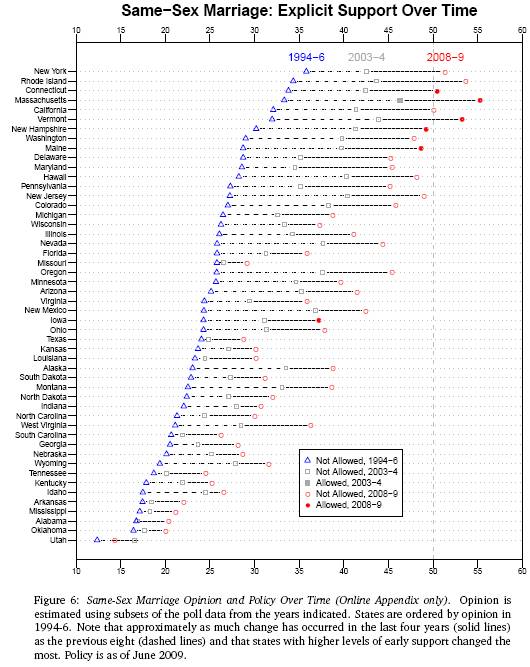
But the chart below may cushion the blow a tiny bit. It’s from a paper by Jeffrey Lax and Justin Phillips, “Gay Rights in the States: Public Opinion and Policy Responsiveness,” recently published in the American Political Science Review (via The Monkey Cage). What you are seeing is support for same-sex marriage in 1994-96, 2003-04, and 2008-09; solid dots indicate that same-sex marriage is equal, hollow dots that it is not.

marriage

Continue reading “Same-Sex Marriage and Time”

Do Smart, Hard-Working People Deserve to Make More Money?

Last weekend Yves Smith posted a story of a family that was down on their luck and struggling with high credit card bills, including plenty of fees. Yesterday she posted a follow-up. Apparently the story triggered a wave of vindictive snobbery from commenters. Here’s one example:

“Sounds like someone doesn’t know how to manage their money. I would bet they are making car payments and eat fast food at least 3 times a week. Probably have cable T.V. and deluxe cell phone plans. They probably get a new car like every two years. What happened to her reenlistment bonuses?”

Here is Yves’s response:

“I think quite a few readers owe her an apology. But I am also sure those readers are so locked into their Calvinist mindset that they will find some basis for criticizing this family. Some people seem constitutionally unable to admit that success and prosperity are not the result of hard work alone.”

Continue reading “Do Smart, Hard-Working People Deserve to Make More Money?”

Note to Congress: You Are Not the People You Serve

From a Washington Post article on proposed legislation to regulate overdraft fees:

“Rep. Spencer Bachus (R-Ala.) said he avoided overdraft fees with a credit line and asked if many of the problems could be eased with consumer education.”

Good on you, Spencer. You have a credit line — which many of your constituents can’t get — and you have it linked to your checking account — which many of your constituents wouldn’t even know how to ask for.

Nessa Feddis of the ever-helpful American Bankers Association added that “most consumers can easily avoid the fees by keeping track of their balances.” (That’s a quote from the Post article describing her testimony, not from her testimony itself.) Hear that everyone? Keep track of your balances, and just in case, get a credit line and link it to your checking account. Problem solved.

The people who are financially sophisticated already know how to track their balances and turn off overdraft protection if they don’t want it. They are not the people that financial regulation is supposed to serve. You can’t discharge your duty as a representative of the people just by wishing that the people were more like you.

By James Kwak

CEO Statements That Should Make You Worry

“Our distinctiveness is we connect the world better than anyone else. We have a great capability of building a business around that. And we are in the process of building a culture around that.”

That’s Vikram Pandit on his company, Citigroup, as reported in The New York Times. What does it mean? Your guess is as good as mine.

Continue reading “CEO Statements That Should Make You Worry”

Paper of the Year

As bankers’ pay, at least for the fortunate ones at Goldman and JPMorgan, returns to pre-crisis heights, a paper by Thomas Philippon and Ariell Reshef is becoming everyone’s favorite citation. The paper, “Wages and Human Capital in the U.S. Financial Industry: 1909-2006,” got a first wave of attention from Paul Krugman, Martin Wolf, and Gillian Tett back in April (see Philippon’s web page for links). It’s also the subject of Justin Fox’s column in Time; see Fox’s blog for links to other discussions. (I also cited the paper in my ramblings provoked by Calvin Trillin.) The earlier references were mainly for Philippon and Reshef’s finding that pay in the financial sector correlated strongly and negatively with the degree of regulation — pay was higher in both the 1920 and in the post-1980 period, and lower under the stricter regulatory system created during the Great Depression. More recent references, including Fox’s column, have focused on the idea that people in finance are overpaid.

Since most articles have just focused on the headlines, I’m sure Philippon and Reshef are going to be misquoted all over the Internet. For example, at least two articles focus on a figure of “30% to 50% of financial-sector pay” in ways that are not quite correct. So I’ll try to lay out what they actually say.

Continue reading “Paper of the Year”

How Big?

You hear a lot these days that banks need to be big to serve their clients. Charles Calomiris said this morning that we can’t run the global economy with “mom-and-pop banks.” Sure, I’m willing to concede that. But how that’s a silly debating tactic. More seriously, how big do they need to be?

Yves Smith, no friend of the mega-banks, says, “The elephant in the room is derivatives. The big players have massive OTC derivatives exposures. You need a really big balance sheet to provide OTC derivatives cost effectively.”

How big?

Continue reading “How Big?”

Paging Jamie Dimon

Surprise, surprise — GMAC needs more money. As you may recall, GMAC was the one institution that got a C- on the stress tests this spring that were impossible to fail. I imagine the analysts at the Fed really wanted to give it an F, but they couldn’t. In any case, it seems that GMAC is too big to fail, because of its importance to the auto industry. Yves Smith says, “The reason for more dough to GMAC is so GM and Chrysler can continue to finance auto purchases, not as a result of greater than expected losses on its existing portfolio. So this is cash for clunkers under another brand name.”

Again, not surprisingly, the government is treating the 50% ownership threshold as some sort of magic line. From the Times article:

“With all three helpings of federal aid, it is possible that the government could wind up owning at least half of the company. But GMAC and Treasury officials are discussing ways to structure the investment in a way that could limit the government’s ownership interests. One possible option would be to also ask some of its private preferred stockholders to convert their investments into common stock.”

Continue reading “Paging Jamie Dimon”

Homebuyer Tax Credit Update

Calculated Risk says there is a deal (bullet points are from his post):

  • Income eligibility for first-time home buyers stays at $75,000 for individuals, and $150,000 for couples.
  • For move-up buyers, income eligibility is $125,000 for individuals and $250,000 for couples.
  • There is a minimum 5 year residency requirement – in their current home – for move-up home buyers.
  • The tax credit is the lesser of $7,290 or 10% of the purchase price.
  • The credit runs from Dec. 1, 2009 to April 30, 2010, with an additional 60 day period to close escrow. (So end of April to sign contract, end of June to close escrow)
  • Expect bill to be signed by Friday, packaged with the unemployment benefit extension.

So my wife and I fit under the $250,000 couples limit. We’ve lived in our house for eight years. So now the government is willing to give me $7,000 to buy a new house? That would be a sale that wouldn’t have happened otherwise — but what good would it do the economy?

As I tried to explain previously, an $8,000 credit for first-time homebuyers will raise prices by less than $8,000 (leaving aside the effect of leverage for simplicity), because demand at any price point only goes up for first-time homebuyers, not all homebuyers. That means that the buyer gets a fair chunk of the subsidy. But vastly expanding eligibility like this (about 67% of households own houses, and probably about half of them have been in the same house for five years) increases the amount by which prices will go up, which lowers the buyer’s share of the subsidy and increases the seller’s share.

By James Kwak