Author: James Kwak

Uncontrolled Lending to Consumers Spawned the Financial Crisis

This guest post was contributed by Norman I. Silber, a Professor of Law at Hofstra Law School, and Jeff Sovern , a Professor of Law at St. John’s University. They were principal drafters of a statement signed by more than eighty-five professors who teach in fields related to banking and consumer law, supporting H. 3126, which would create an independent Consumer Financial Protection Agency.  Some of the research on which this essay is based is drawn from an article by Professor Sovern.

Did under-regulated lending to consumers play a big part in destabilizing the financial system? Many knowledgeable people say yes, but Professor Todd Zywicki disagrees. (“Complex Loans Didn’t Cause the Financial Crisis,” Wall Street Journal, February 19, 2010).  He claims that the present troubles resulted from the “rational behavior of borrowers and lenders responding to misaligned incentives, not fraud or borrower stupidity.”

Professor Zywicki’s argument enjoys, at least, the modest virtue of technical accuracy, because many objectionable misleading sales practices and agreements that lenders used were, and continue to be, unfortunately, quite legal.  Lending practices may have been regularly misleading and confusing and reckless-but fraudulent?  Well, no, usually not unlawful by the remarkably low standards of the day.   But that in itself is an argument for saying consumer protection laws failed.

Continue reading “Uncontrolled Lending to Consumers Spawned the Financial Crisis”

Toxic Finance

By James Kwak

The first generation of financial crisis books was largely blow-by-blow, behind-the-scenes accounts, like David Wessel’s In Fed We Trust and Andrew Ross Sorkin’s Too Big to Fail — long on characters, events, and dramatic suspense (or at least as much dramatic suspense as you can have when writing about something that unfolded on the front pages of the newspaper), but relatively short on analysis. There were also more analytical books, like Justin Fox’s The Myth of the Rational Market and John Cassidy’s How Markets Fail, which seem like books about free market economics that later turned out to be about the crisis. But one thing this crop had in common is that, for the most part, they ended with the near-collapse of the financial system.

The current generation of books is not just about the crisis and what caused it, but also about the response to the crisis, and what went wrong — that is, why the large banks are bigger, more powerful, and more concentrated than ever before and why the unemployment rate is still languishing around 10%. Joseph Stiglitz’s Freefall (which I haven’t finished reading) falls into this category, focusing more on the governmental responses of 2008-2009 than on the causes of the crisis. So does Yves Smith’s ECONned, which just came out this week. (I have the early version that the publisher sent to Simon a while back.)

Continue reading “Toxic Finance”

Is Vikram Pandit in Favor of Real Reform?

Testifying today before the TARP Congressional Oversight Panel, Citigroup CEO Vikram Pandit took pains to strike the right notes. Near the beginning of his prepared testimony, he said, “First, however, I want to thank our Government for providing Citi with TARP funds. For Citi, as for many other institutions, this investment built a bridge over the crisis to a sound footing on the other side, and it came from the American people.” Saying “thank you” may not satisfy many people, but it is a step in the right direction.

More importantly, Pandit said that Citigroup is on the side of the angels — in this case, the side of real financial reform:

“Citi supports prudent and effective reform of the financial regulatory system. America – and our trading partners – need smart, common-sense government regulation to reduce the risk of more bank failures, mortgage foreclosures, lost GDP and taxpayer bailouts. Citi embraces effective, efficient and fair regulation as an essential element in continued economic stability.”

When it comes to the substance, though, I’m not sure how much Pandit had to say that was new, although he took care to say it in the nicest way possible.

Continue reading “Is Vikram Pandit in Favor of Real Reform?”

“No One Made People Buy These Cars . . .”

By James Kwak

The Center for Responsible Lending has a great comic strip titled “If Anti-CFPA Folks Ran Toyota Today?” with classic lines like “Fixing these cars will raise the price of cars in the future, and hurt deserving drivers.” I’m pretty sure it was directly inspired by one of my favorite posts, “If Wall Street Ran the Airlines . . .,” but that’s perfectly fine by me. We have to keep saying the same things over and over because they’re true.

Monopolies Everywhere

By James Kwak

Thomas Frank has a review in the Wall Street Journal (behind a paywall, but Mark Thoma has an excerpt) of Barry Lynn’s new book Cornered, which apparently documents the prevalence and power of monopolies and oligopolies in lots and lots of industries, not just finance. (I guess one response would be that we have been too harsh on the banks, since everyone’s doing it; but I still think banks are special for all sorts of reasons I won’t go into here.)

The problem, as Frank says, is that “the antimonopoly tradition is a museum piece today, and antitrust enforcement has been largely moribund since federal officials during the Reagan Revolution lost interest in this most brutal form of economic intervention.” Antitrust enforcement became a question of measuring predicted changes in consumer welfare, which meant that it became the province of models. More importantly, we are now in at least our fifth consecutive administration that sees big, profitable companies as inherently good, without stopping to question how they extract those profits.

The solution is already there to hand — go back to enforcing the existing antitrust laws. And appoint Supreme Court justices who are interested in enforcing them. But that assumes that the administration cares about the issue. Do they?

(For one thing, I applied for an internship in the DOJ’s antitrust division for this coming summer . . . and I was turned down.)

Dallas Fed President: Break Up Big Banks

By James Kwak

We’ve cited Thomas Hoenig, president of the Kansas City Fed, a number of times on this blog for his calls to be tougher on rescued banks and to break up banks that are too big to fail. This has been a bit unfair to Richard Fisher, president of the Dallas Fed, who has been equally outspoken on the TBTF issue (although we do cite him a couple of times in our book).

Bloomberg reports that Fisher recently called for an international agreement to break up banks that are too big to fail. Here are some quotations, taken from the Bloomberg article (the full speech is here):

“The disagreeable but sound thing to do” for firms regarded as “too big to fail” would be to “dismantle them over time into institutions that can be prudently managed and regulated across borders.”

Continue reading “Dallas Fed President: Break Up Big Banks”

The Importance of Donald Kohn*

By James Kwak

Donald Kohn recently announced that he is resigning as vice chair of the Federal Reserve Board of Governors, after forty years in the Federal Reserve system, most of it in Washington. Articles about Kohn have generally been positive, like this one in The Wall Street Journal. The picture you get is of a dedicated, competent civil servant who has been a crucial player, primarily behind the scenes, in the operation of the Fed.

It’s a bit interesting that Kohn is generally getting the soft touch given that he was the right-hand man of both Alan Greenspan and Ben Bernanke. Here are some passages from the WSJ article:

“‘Don was my first mentor at the Fed,’ Mr. Greenspan says. Mr. Kohn told Mr. Greenspan how to run his first Federal Open Market Committee meeting, the forum at which the Fed sets interest rates. He became one of Mr. Greenspan’s closest advisers and defender of Mr. Greenspan’s policies.”

“Mr. Kohn has spent the past 18 months helping to remake the central bank on the fly as Chairman Ben Bernanke’s loyal No. 2 and primary troubleshooter.”

Continue reading “The Importance of Donald Kohn*”

Krugman: No Bill Is Better Than a Weak Bill

By James Kwak

Paul Krugman begins this morning’s column this way:

“So here’s the situation. We’ve been through the second-worst financial crisis in the history of the world, and we’ve barely begun to recover: 29 million Americans either can’t find jobs or can’t find full-time work. Yet all momentum for serious banking reform has been lost. The question now seems to be whether we’ll get a watered-down bill or no bill at all. And I hate to say this, but the second option is starting to look preferable.”

Krugman says he would be satisfied with the House bill, but that the need to bring moderate Democrats and at least one Republican on board in the Senate could lead to a severely watered-down bill, in particular one without a Consumer Financial Protection Agency. Instead of accepting such a deal, he says:

“In summary, then, it’s time to draw a line in the sand. No reform, coupled with a campaign to name and shame the people responsible, is better than a cosmetic reform that just covers up failure to act.”

Continue reading “Krugman: No Bill Is Better Than a Weak Bill”

“Every Moment Counts”

By James Kwak

No, it’s not a line from a pop song. It’s part of my hopeless, Luddite anti-smart phone campaign. This is from an interview with Tachi Yamada, president of the Bill & Melinda Gates Foundation’s Global Health Program.

“When you actually are with somebody, you’ve got to make that person feel like nobody else in the world matters. I think that’s critical.”So, for example, I don’t have a mobile phone turned on because I’m talking to you. I don’t want the outside world to impinge on the conversation we’re having. I don’t carry a BlackBerry. I do my e-mails regularly, but I do it when I have the time on a computer. I don’t want to be sitting here thinking that I’ve got an e-mail message coming here and I’d better look at that while I’m talking to you. Every moment counts, and that moment is lost if you’re not in that moment 100 percent.”

Yamada is just one person; because he feels this way doesn’t prove that you should, too. But I bet some of you will agree with him, and will start switching your BlackBerrys off when you are talking to other people. But over time, you will find yourself leaving it on, and then you will find yourself surreptitiously checking it under the table. It’s like chocolate ice cream; it’s too hard to say no to.

Financial Innovation, Again

By James Kwak

I’ve had Robert Litan’s recent paper defending most financial innovation (the web page doesn’t tell you much; you need to grab the PDF) on my to-do list for a while now. I wasn’t looking forward to writing about it, since I’m a bit tired of the subject, and I don’t think I have much more to say. So thankfully Mike Konczal beat me to it, in a two-part series. Part I is really brilliant, and has not one but two insights. The first (to simplify) is that we generally think of innovation in products as making them simply better on all dimensions. We don’t realize that, with most new financial products, we are just getting to a new point on the risk-reward spectrum that wasn’t there before. Now, it might be good for the economy as a whole for that new point to exist. But as consumers, we don’t realize that the good properties of a new financial product are almost invariably counterbalanced by some bad properties.

The second insight is that real, good financial innovation does not look like a new product; it looks like a new way of dealing with an existing product. Konczal’s example is TRACE, a recent system for increasing transparency in the market for corporate bonds (you’ll have to read his post for a more complete description). The effect has largely been to make pricing more transparent and reduce spreads, which is good for investors. More broadly, as Felix Salmon said somewhere (probably many times), financial innovation should show up as lower prices for all the bread-and-butter financial products–equity and debt underwriting, interest rate swaps, etc.–not has higher profit margins for dealers.

Konczal’s Part II asks some more general questions about Litan’s results. I have some different questions.

Continue reading “Financial Innovation, Again”

The Art of Selling

By James Kwak

This morning I was listening to an especially brilliant This American Life episode from 1999, titled “Sales.” I spent a lot of the past decade selling — first pitching my startup company to venture capitalists (not very well), then pitching software to potential customers (a bit better). The first segment — Sandra Tsing Loh listening in as a screenwriter pitches his story to two movie producers — absolutely nails the the staging of a sales call, including the forced casualness of pretending that huge amounts of money aren’t at stake, the small talk (is it good for there to be a lot of small talk?) and the water bottles, the seller talking uncomfortably fast when he doesn’t get feedback cues from the buyers, and the uncomfortable close and the confused debrief. (However, Loh and the screenwriter broke one of the cardinal rules we used to follow: don’t say a word about the meeting until you are safely out of the building, not even — especially not — in the bathroom.)

The third segment — in which a reporter reflects on his time as a radio advertising salesman — also perfectly illuminates the interpersonal dynamics and moral ambiguities of being a successful salesperson. Is it right to sell someone a product he doesn’t need and that isn’t actually good for him? Of course it’s legal, but is it right? If he buys it, is it his fault . . . or yours? What do you do when your skill at getting people to like you* causes your potential clients to open up to you in ways that are not in their interests?

Once someone came to our office to give me a sales pitch. By the end of the pitch, I had the feeling that we were good friends. Later, thinking about that, I felt used. How could this person manipulate me into thinking we were friends in just forty-five minutes? Then I realized this was the best salesperson I had ever seen. And we are friends now. (Or at least I think so.)

In between, the second segment is screamingly funny.

* A skill I don’t really have, by the way.

Update: I should say that I don’t actually have the negative opinion of sales and salespeople that some of the comments below seem to assume I have. As I said, I’ve spent a lot of my time selling, and I don’t think I’m a bad person. For one thing, sales is as critical to the economy as design and production. The rituals of sales — particularly high-touch selling of very expensive products, which is what I was involved in — were established before any of us got into the business, and all salespeople have to conform to them, more or less. Many if not most salespeople really believe that most of their customers will be better off if they buy their products. On the other hand, this is one way that salespeople justify pushing at the envelope of truth on occasion — it’s for the customer’s good, after all. (The other big reason for this behavior is that the market for certain products has settled into an equilibrium where all the competitors are exaggerating, and the customer assumes that you are exaggerating, too, and discounting everything you say, so if you don’t play the game you have no chance.)
Brad Miller’s Challenge

Since the peak of the financial crisis, both the Bush and Obama administrations have been trying to rescue both large banks and homeowners, often announcing programs for both in the same press conference. The programs for large banks have gone well, from the beneficiaries’ perspective (but not for small banks); programs for homeowners, not so much. As more people walk away from underwater mortgages, Assistant Treasury Secretary Herb Allison recently said, “We haven’t yet found a way of dealing with this that would, we think, be practical on a large scale.”

The failure of the Obama administration so far to come up with a working solution to the problem of mass defaults and foreclosures may be due to practical barriers, such as lack of capacity among mortgage servicers or legal uncertainties regarding securitization trusts. Alternatively, however, it may simply be that the administration doesn’t care that much. Perhaps the primary goal of homeowner assistance all along was to detoxify the toxic assets on large banks’ balance sheets; now that those banks are off of life support, maybe the mortgages themselves don’t matter that much.

Congressman Brad Miller’s proposal in The New Republic should put that question to the test.*

Continue reading “Brad Miller’s Challenge”

Banking Industry: Sicker, More Concentrated

By James Kwak

The rapid bounce-back of some of the big banks (notably Goldman and JPMorgan) has overshadowed (at least on the front pages of major newspapers) the continued plight of the banking sector as a whole. Calculated Risk highlights the FDIC’s Quarterly Banking Profile, which lists 702 problem banks with over $400 billion in assets — the highest year-end figures on both metrics since 1992, as the savings and loan crisis was tailing off.

Continue reading “Banking Industry: Sicker, More Concentrated”

Everyone Was Doing It

By James Kwak

Gerald Corrigan, a Goldman Sachs executive and a former president of the New York Fed, had a curious defense of the Greece-Goldman interest rate swaps. Here are some direct quotations from the Bloomberg story:

“[The swaps] did produce a rather small, but nevertheless not insignificant reduction, in Greece’s debt-to-GDP ratio,” Gerald Corrigan, chairman of Goldman Sachs’s regulated bank subsidiary, told a panel of U.K. lawmakers today. The swaps were “in conformity with existing rules and procedures.” . . .

“There was nothing inappropriate,” Corrigan told Parliament’s Treasury Committee. “With the benefit of hindsight, it seems to be very clear that the standards of transparency could have, and probably should have been, higher.” . . .

Goldman Sachs was “by no means the only bank involved” in arranging the contracts, Corrigan said. . . .

“Governments on a fairly generalized basis do go to some lengths to try to ‘manage’ their budgetary deficit positions and manage their public debt positions,” Corrigan said. “There is nothing terribly new about this, unfortunately. Certainly, those practices have been around for decades, if not centuries. We have to keep that perspective.”

Continue reading “Everyone Was Doing It”

The PR War

By James Kwak

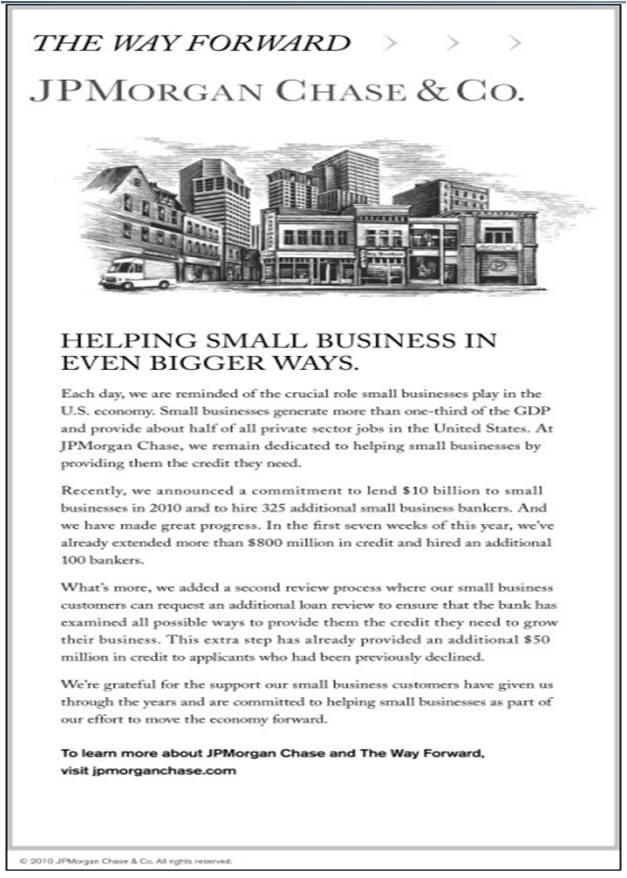
Every major bank other than Goldman Sachs must be ecstatically happy that Goldman exists, soaking up all the attention with its escapades in Greece and Italy. The other banks, by contrast, are trying to make themselves out to be white knights. See, for example, JPMorgan’s ad today in multiple major print newspapers describing its commitment to small business lending:

Like that picture of small-town America?

The main claim is in the second paragraph: a commitment to lend $10 billion to small businesses in 2010. These kinds of marketing claims are difficult to verify. But I gave it a shot.

Continue reading “The PR War”