Author: James Kwak

How Times Change

By James Kwak

For those waiting, the paperback edition of 13 Bankers went on sale on Tuesday to little fanfare. That’s not surprising; all of the crisis books have been dribbling out in paperback, about 8-10 months after the hardcover editions, to little fanfare. It’s a commentary on how quickly times have changed, and also on the fickle nature of the publishing market. While there is still a lot of residual anger and bitterness over the financial crisis — specifically, over the fact that the big banks played a central role in triggering the crisis, then got massive amounts of bailout money, and now have returned to “health” more quickly than the economy as a whole or the typical household — most people seem resigned to a continuation of the pre-crisis status quo, and what energy remains has perversely gone into railing against the national debt.

The whole story also highlights the importance of timing in publishing. Looking back, we couldn’t have gotten any luckier, with the book going on sale during the Senate debate over financial reform and just two weeks before the SEC sued Goldman, which also happened the day that our Bill Moyers appearance aired, which drove our Amazon ranking up to #6. Today we’d be lucky to crack #600.
Continue reading “How Times Change”

Who Benefits from Tax Expenditures?

By James Kwak

Ezra Klein points out a new tax expenditure database from The Pew Charitable Trusts. More attention to tax expenditures — exceptions in the tax code that reduce tax revenue or, put another way, subsidies channeled through the tax system* — is always a good thing. But Klein also says something interesting that I don’t agree with:

“they’re basically the welfare state for the middle class, cleverly arranged such that they don’t look like the welfare state for the middle class. If every year, the government sent every American — from the richest CEO to the greenest public-school teacher — a check covering 30 percent of their health-care costs, we’d think that a bit weird. We’d think it much weirder if we only sent the checks to the workers who happened to be at firms that offered benefits. . . .

“Yet that’s pretty much exactly what we do. We just hide it in the tax code rather than write it on a check.”

I agree with all of that, except the bit about the middle class. Tax expenditures primarily benefit the rich, for a few reasons.

Continue reading “Who Benefits from Tax Expenditures?”

My Daughter Will Be Republican Majority Leader Someday

By James Kwak

Or perhaps a leading candidate for the Republican presidential nomination.

When it comes to deficits and government spending, the strategy of Republicans in Congress is to assert things that are simply not true or that defy economic logic. Ezra Klein nails House Majority Leader Eric Cantor misstating the CBO’s ten-year projection for health care reform so he can make a false claim about its longer-term effects (ignoring the fact that the CBO explicitly said health care reform would be deficit-reducing in the second decade). The same Republican leadership that rails against deficits is introducing rules that will make it easier to increase the deficit, since tax cuts will no longer have to be paired with offsetting spending cuts.

Apparently, the ability to say things that are not true is something that is learned quite early.

Continue reading “My Daughter Will Be Republican Majority Leader Someday”

Tax-Exempt Bonds for Beginners

By James Kwak

Felix Salmon linked to an article by David Kotok on Build America Bonds (BAB), which reminded me that I’ve been meaning to write about them (now that they no longer exist). BAB were introduced in the 2009 stimulus bill. If a state or local government issues BAB, the federal government pays 35 percent of the interest on the bonds; the bondholder pays tax on all the interest, as usual for corporate bonds — but not for traditional state or local government bonds (“munis”). BAB were initially only authorized for two years, and were not extended in the recent tax cut compromise.

The Republican attack line on BAB is that they “subsidize states in more imprudent-type budget and debt scenarios” (Rick Santelli, quoted in Kotok’s article) or they are “a back-door handout for profligate state and local governments, allowing them to borrow more money while shifting some of the resulting interest costs to the federal government” (Daniel Mitchell). Well yes, BAB are a subsidy for state and local borrowing. But to criticize them for that without even mentioning the alternative is either uninformed or irresponsible.

Continue reading “Tax-Exempt Bonds for Beginners”

Disclosure Rules for Economists

By James Kwak

In October, Gerald Epstein and Jessica Carrick-Hagenbarth released a paper documenting potential conflicts of interests among academic economists writing about the financial crisis and financial reform. Focusing on the Squam Lake Working Group on Financial Regulation and the Pew Economic Policy Group Financial Reform Project, they found that a majority of the economists involved had affiliations with private financial institutions, yet few of them disclosed those affiliations even in academic publications (where they do not face the word constraints imposed by print newspaper editors), preferring to identify themselves by their universities and as members of prestigious institutions such as NBER. To be fair, they did not find a strong relationship between economists’ affiliations and their positions on financial reform, perhaps because of the small sample and the limited amount of variation in the positions of members of these groups.

Epstein and Carrick-Hagenbarth called in their paper for economists to disclose any potential conflicts of interest, especially when writing for a general audience. This proposal has picked up some steam, first in the blogs (me; Nancy Folbre in EconomixFelix Salmon (“it’s not going to happen: there’s too much money riding on the continuation of the status quo”); Mark Thoma; Mike Konczal; Planet Money) and, more recently, thanks in part to the movie Inside Job, in the mainstream press. According to Sewell Chan in The New York Times, the AEA claims that it will consider a new ethical code or at least disclosure rules for economists — although, in a forthcoming book, “[George] DeMartino describes concerns dating to the 1920s about the influence of business on economic research, and cites multiple calls within the association for a code of conduct — all of which have been rebuffed.”

Epstein and Carrick-Hagenbarth have drafted a letter to the president of the AEA asking for the adoption of a code that requires economists to avoid conflicts of interest and to disclose ties that could create the appearance of a conflict of interest. If you are an economist and would like to sign on, you can email Debbie Zeidenberg (peri at econs dot umass dot edu) by Sunday evening. The full text follows.

Continue reading “Disclosure Rules for Economists”

The More Things Change …

By James Kwak

As a holiday gift to myself, I’ve actually been reading a real book, on paper — The Worldly Philosophers, by Robert Heilbroner. The book itself was not a gift to myself; I have my sister’s old copy, which is the 1980 edition. The book is a traditional intellectual history of some of the main figures in economics. As the original was written in 1953, it focuses less on the mathematical line of economics, from Walras and Marshall through Arrow-Debreu to the present, and more on what used to be called political economy: Smith, Ricardo, Mill, Marx, Keynes, etc. It’s not a way to learn economics, but a way to learn something about the historical conditions that helped give rise to some important economic ideas.

But some passages seem oddly relevant today. Discussing the conventional economic wisdom of the early nineteenth century (pp. 121-22):

“They lived in a world that was not only harsh and cruel but that rationalized its cruelty under the guise of economic law. . . . It was the world that was cruel, not the people in it. For the world was run by economic laws, and economic laws were nothing with which one could or should trifle; they were simply there, and to rail about whatever injustices might be tossed up as an unfortunate consequence of their working was as foolish as to lament the ebb and flow of the tides.”

Continue reading “The More Things Change …”

Symbols and Substance

By James Kwak

Arnold Kling wins the prize for the most erudite post of the past week, a review of The Symbolic Uses of Politics, by Murray Edelman. Kling cites not only Sigmund Freud and J.D. Salinger, but Theodor Adorno and Seymour Lipset (with specific books, not just names), among others.

In Kling’s summary, Edelman divided the political sphere into insiders and outsiders (Kling’s terms). Insiders are basically special interests: small in number but well organized and with specific goals. Outsiders, or the “unorganized masses,” are the rest of us: we have some interests, but we are poorly organized to pursue them and therefore are generally unsuccessful. In particular, Outsiders suffer from poor and limited information, and therefore are especially susceptible to political symbols. In Kling’s words:

“Given these differences, the Insiders use overt political dramas as symbols that placate the masses while using covert political activity to plunder them. What we would now call rent-seeking succeeds because Outsiders are dazzled by the symbols while Insiders grab the substance.”

Continue reading “Symbols and Substance”

Why Citigroup?

By James Kwak

I think Ezra Klein is probably right about Peter Orszag:

“Citigroup is a really big, really powerful institution. Orszag’s position in it is the sort of position that could one day lead to being president of Citigroup. If you’re him, and you’re trying to figure out an interesting and high-impact way to spend the next 40 years, I can see why it’s appealing. But it’s the power and the job and the opportunity, more than the money, that make it appealing.”

Klein says the problem is that this kind of job transition makes people lose faith in government, and I agree with that. But I think there’s a deeper problem as well.

This is the mindset of the ambitious educational elite: You go to Harvard (or Stanford), maybe to Oxford (or Cambridge) for a Rhodes (or Marshall), then to Goldman (or McKinsey, or TFA), then to Harvard Business School (or Yale Law School), then back to Goldman (or Google), and on and on. You keep doing the thing that is more prestigious, opens more doors, has more (supposed) impact on the world, and eventually will make you more and more famous and powerful. Money is something that happens along the way, but it’s not your primary motivation. Then you get to Peter Orszag’s position, where you can do anything, and you want to go work for Citigroup? Why do our society and culture shape high-achieving people so they want to be executives at big, big companies that are decades past their prime? Why is that the thing people aspire to? Orszag wanting to work at a megabank — instead of starting a new company, or joining a foundation, or joining an NGO, or becoming an executive at a struggling manufacturing company that makes things, or even being a consultant to countries with sovereign debt problems — is the same as an engineer from a top school going to Goldman instead of a real company. It’s not his fault, but it’s a symptom of something that’s bad for our country.

The Obama Renaissance

By James Kwak

President Obama is enjoying something of a political resurgence, at least among the commentariat. Ezra Klein points out that his approval ratings remain higher than those of his Congressional opposition, as opposed to Clinton in 1994 and Bush in 2006. In The New York Times, Michael Shear says the lame-duck session of Congress could be a “big win” for Obama, and Matt Bai hails the tax cut compromise as “responsible governance” and says it could lead to a successful presidency.

Obama is certainly in a decent position politically, and I would bet on him to be reelected comfortably in 2012. First off, his opponents in Congress are deeply irresponsible (admittedly: The single most important thing we want to achieve is for President Obama to be a one-term president.”) and face a huge political problem within their own party: a significant portion of the conservative base really does want lower deficits, yet the only thing the Republican caucus knows how to do is cut taxes. Klein points out that the Republicans will eliminate House rules that spending increases or tax cuts have to be offset elsewhere, and will instead say that “tax cuts don’t have to be paid for, and spending increases can’t be offset by tax increases.” Second, the Tea Party and Sarah Palin mean that Obama is likely to face an opponent who has been pulled dangerously close to the lunatic fringe during the primary (or, even better yet, Palin  herself). And third, there’s triangulation.

Continue reading “The Obama Renaissance”

“Washington and the Regulators Are There To Serve the Banks”

By James Kwak

It is too obvious to bear saying, but I’ll say it anyway.

At the urging of the administration, Congress passed a financial reform bill this past summer that expanded the theoretical powers of regulators, but also gave those regulators the power to write the rules implementing the bill and then to enforce the rules. The bill’s sponsors fended off efforts to write specific constraints, whether size limits or leverage limits, into the statute. Yet the bill did nothing that I am aware of to ensure that regulators do a better job than they did last time around, unless you count the creation of a standalone consumer protection agency. (Yes, this is a hard problem with no easy solutions, but ignoring it doesn’t make it go away.)

Now we will see the results. Via Mark Thoma, Andrew Leonard provides the money quote, from incoming House Financial Services Committee chair Spencer Bachus: “in Washington, the view is that the banks are to be regulated, and my view is that Washington and the regulators are there to serve the banks.”

Of course, having written a book that argued that politics is more important than economics, this doesn’t surprise me. Nor does the decision by the Financial Crisis Inquiry Commission’s Republican appointees to deny that the shadow banking system even exists, or to write a dissenting “primer” whose only possible motivation can be captured in Barry Ritholtz’s post, “Repeat a Lie Enough Times . . .” But what frustrated me about the administration’s position over the spring and summer was the idea that, despite this basic fact, they marched forward as if government regulation is a purely technocratic problem that can be solved by simply finding smart men and women of integrity and conscientiousness.

13 Bankers in Paperback

By James Kwak

Yes, that’s a new book photo in the sidebar to the right. The paperback edition will be available on January 11, 2011. It has a new epilogue taking the story from January 2010 (when we finished the hardcover) to September 2010, covering the financial reform debate in the Senate and the final Dodd-Frank Act.

Enjoy.

The Moderate Republican Stimulus

By James Kwak

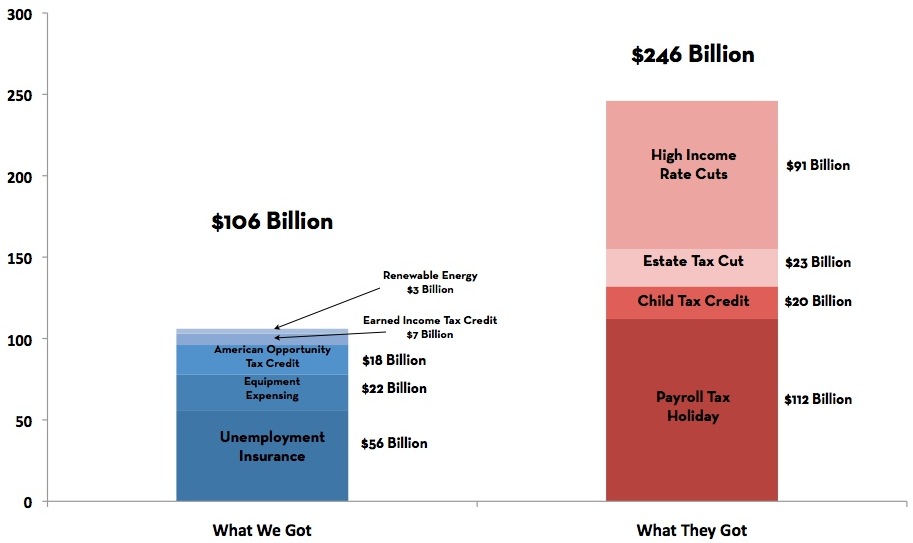
One of the great things about the Internet, as opposed to, say, law school, is that other smart people will do my homework for me. Last week I said that Obama’s position on the tax cuts was a “moderate-Republican line in the sand” and that the tax deal was closer to the Republicans’ ideal outcome than the Democrats’, but the latter argument was based on some guesses about Republican preferences. Now Mike Konczal has done some of the harder argument, uncovering hard evidence that the Republicans would have agreed to the extended child tax credit sweetener anyway and presenting five points for the argument that the Republicans wanted payroll tax cuts – in particular, they wanted them more than Making Work Pay tax credit that they replaced.

Here’s Mike’s version of the administration’s chart:

He calls it the “Moderate Republican Stimulus Package 2.0.”

This American DREAM

By James Kwak

Brad DeLong reminded me that the DREAM Act is being considered by Congress right now and has an outside chance of passage. If you are a Senator on the fence about this issue, or you work for one, you should listen to the last segment of this This American Life episode, starting about forty-six minutes in. It will break your heart.

Oh, and given that opposition has been basically along party lines: aren’t the people who would qualify for citizenship under the act natural Republican voters, anyway? Basically the act would reward people who pull themselves up by their bootstraps, without the benefit of federal aid. Or is that no longer what the Republican Party is about?

Who Wanted What?

By James Kwak

Look, I’m familiar with the argument for the tax cut deal. It’s not a terrible argument. In simple form, it goes, the top priorities are to stimulate the economy and to cushion the impact of unemployment, and a two-year tax cut extension was worth it to get that, especially since we can kill the Bush tax cuts in 2012. Now, no one who wasn’t born yesterday buys that bit about killing the Bush tax cuts in 2012, but you could still make the argument that two years of stimulus is worth making the tax cuts effectively permanent. (I don’t agree, but it’s not a crazy argument.)

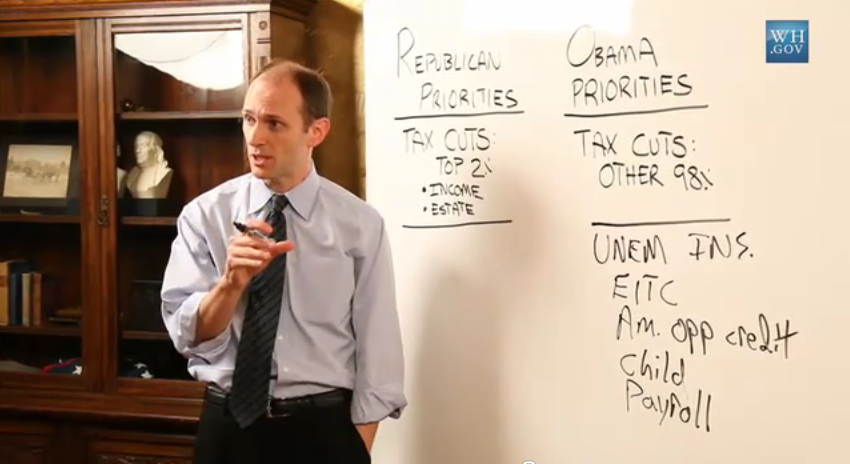
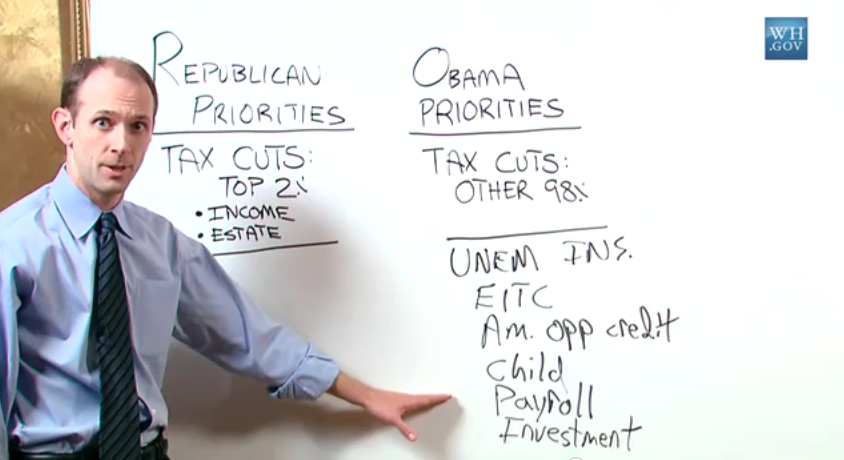
But that’s not Austan Goolsbee’s argument on YouTube.

Here’s his slide:

Continue reading “Who Wanted What?”

More on the Tax Deal

By James Kwak

First, the comic relief. From the Times:

“Senator Jim DeMint, Republican of South Carolina, said that he still wanted the Bush-era rates extended permanently and that the cost of the package was worrisome.”

I got some valid criticisms for my last post on the tax cut deal. In particular, that post may make it seem as if my criticism of President Obama has to do with his negotiating ability. But if Obama really wanted the outcome he ended up with, then he is a master negotiator; where I really differ from him, then, would be in what policy should be.

Continue reading “More on the Tax Deal”