Author: James Kwak

Black Is White

By James Kwak

I wasn’t sure what the Social Security wage base was (it’s $106,800, by the way), so I Googled “payroll tax cap.” The number one hit is a post at a blog modestly called The American Thinker. I wouldn’t ordinarily want to bring more attention to it, but it was the #1 hit, and according to Quantcast it has a million unique visitors per month, so nothing I do will affect it one way or another.

Anyway, the thrust of the argument is that we shouldn’t eliminate the cap on wages subject to the payroll tax because “America simply can’t afford it.”

Such plans for expanding an already-huge entitlement are beyond irresponsible, they’re frightful.  Klein and Weller aren’t serious men.  When reading their ideas for Social Security expansion in this time of trillion-dollar federal deficits, one realizes that progressives are unconcerned about America’s fiscal crisis.

You read that correctly. The argument is that increasing the wage base, which would bring in more revenues and reduce the deficit, is a bad thing—because of our fiscal crisis.

Continue reading “Black Is White”

The Price of Gold in the Year 2160

This piece of fun weekend reading is contributed by StatsGuy, an occasional commenter and guest contributor on this blog.

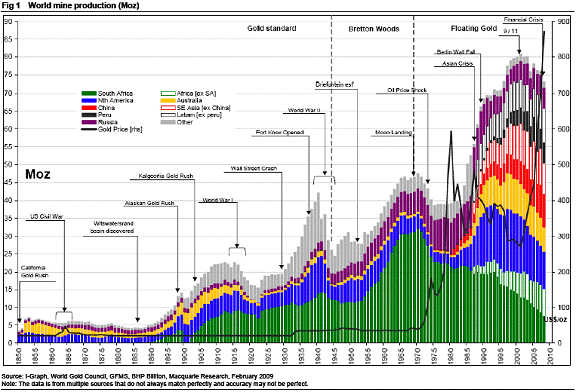
It’s become quite popular to talk about the price of gold . . . in blogs, the press, at dinner parties.  The latest topic of debate is not about the price of gold as a commodity, but about gold as the one and only king money.  The basic argument is that 5,000 years of tradition will overwhelm the tyranny of modern government and the fiat printing press.  The barbaric relic will defeat socialism, fascism, Obama-ism,  and restore liberty to the world, after a terrible economic collapse in which gold-owning visionaries become fabulously wealthy.

Perhaps they are correct—or perhaps not.  I don’t know what will happen in 10 years.  However, unless civilization utterly collapses (which is what gold hoarders seem to want), the gold bubble will collapse.  And I don’t mean the 10 year “bubble” . . . I mean the 5,000 year bubble.

This claim might sound crazy, but it’s quite easy to defend, for the simple reason that there is too darn much gold.  Gold enthusiasts will note that you can’t just print gold like fiat paper.  They will note that high quality mines are failing, and argue that we’ve passed “peak gold”.

The argument for the collapse has little to do with terrestrial mine quality (although massive amounts of money and new technology are flowing into exploration, long term mine development and extending the life of existing mines).  The argument merely requires that gold price ultimately responds to supply.

Continue reading “The Price of Gold in the Year 2160”

Confused?

By James Kwak

Some of the headline numbers for President Obama’s deficit reduction proposal that you hear are the following:

  • $3 trillion in deficit reduction over ten years—more than the $1.2–1.5 trillion expected from the Joint Select Committee (JSC)
  • $4 trillion in deficit reduction, including the discretionary spending caps in the Budget Control Act
  • $1.5 trillion in tax increases
  • $1 trillion in deficit reduction by capping spending on Iraq and Afghanistan

This didn’t make sense to me for a few reasons, notably that any deal that preserves any of the Bush tax cuts should be scored by the CBO as a tax cut, which increases the deficit. The actual numbers are rather more complicated.

Continue reading “Confused?”

Happy Constitution Day

By James Kwak

(Actually, it was on Saturday.) I just read Invisible Hands: The Making of the Conservative Movement from the New Deal to Reagan (W.W. Norton, 2009), by Kim Phillips-Fein. It’s a history of the resistance from the business community to the New Deal and how it gave birth to at least one major strand of the modern conservative movement. One of Phillips-Fein’s major points is that the conservative movement is not just a reaction to the civil rights movement, the 1960s, and the women’s liberation movement (and Roe v. Wade). Those trends gave the conservative movement more energy and support, but business leaders had for decades been trying to build an intellectual and political movement that could reverse the New Deal. And while some of them talked about Christian values, what they really cared about were breaking unions and lower taxes.

Continue reading “Happy Constitution Day”

Does Disclosure Help?

By James Kwak

Following up on yesterday’s column about corporate spending, I saw that John Coates (Harvard Law School) and Taylor Lincoln (Public Citizen) have published a study of the relationship between voluntary disclosure of political spending and company value (summary here). In short, after applying a bunch of controls, they find that companies with voluntary disclosure policies have price-to-book values that are 7.5 percent higher than companies that don’t.

Citing earlier research, they also say, “among the S&P 500 – which accounts for 75 percent of the market capitalization of publicly traded companies in the U.S. – firms active in politics, whether through company-controlled political action committees, registered lobbying, or both, had lower price/book ratios than industry peers that were not politically active.”

Of course, the causality could run either way, and Coates and Lincoln are not claiming that voluntary disclosure in itself makes a company more valuable. Disclosure policies make it less likely the CEO will blow company money on her pet political projects, and so it stands to reason that companies that are better governed in general—and hence more valuable—are more likely to have such policies. But it certainly implies that disclosure policies are not going to bankrupt the Great American Corporation.

Citizens United and Corporate Political Spending

By James Kwak

Today’s Atlantic column is about corporate political spending in the wake of Citizens United and what, if anything, can be done about it. A group of corporate and securities law professors has petitioned the SEC to write rules requiring companies to disclose their political spending, just like they have to disclose their executive compensation today. As usual, I’m not too optimistic about what disclosure can achieve, especially disclosure in SEC filings or proxy statements: who reads those things, anyway? But it’s better than nothing, and with the current makeup of the Supreme Court, nothing is just about what we’ve got now.

Ponzi Schemes for Beginners

By James Kwak

On the theory that the best defense is a good offense, Rick Perry has been insisting to anyone who will listen that Social Security is a Ponzi scheme. Probably hundreds of people have already explained why it isn’t, but I think it’s important to be clear about why Rick Perry thinks it is—or, rather, why his political advisers think he can get away with it.

A Ponzi scheme, classically, is one where you promise high returns to investors but you have no way of actually generating those returns; instead, you plan to pay off old investors by getting new money from new investors. Social Security is obviously not a Ponzi scheme for at least two basic reasons. First, there’s no fraud involved: all of Social Security’s finances are right out in the open for anyone who cares to look, in the annual report of the trustees of the Social Security trust funds. Second, a Ponzi scheme by construction cannot go on forever; no matter how long you can keep it going, at some point you will run out of potential new investors and the whole thing will collapse. I’m sure there are other obvious differences, but that’s enough for now.

Continue reading “Ponzi Schemes for Beginners”

The Importance of Time Off

By James Kwak

I used to be a real productivity nerd. I wrote an earlier post detailing some examples of my compulsion to be as efficient as possible. I worked at a company where efficiency was one of our highest implicit values.

I still care a lot about productivity—my own, that is. For example, after reading Anthony Bourdain’s first book, I became much more attentive to the sequence of movements I make around the kitchen: when you open the refrigerator, take out everything you need; when you walk to the far end of the kitchen to get utensils, get everything you need; and so on. I used to make fancy dinners that could take an hour and a half or two hours to cook. Now that I have a child, I make simpler, multi-course meals in 30–40 minutes.

But I have a more nuanced understanding of productivity now, which is why I liked Derek Thompson’s article on the importance of vacation—and taking breaks—so much.* Part of it is that since I left the business world, most of my work now is creative—not creative in the sense of creating original works of art, but in the more modest sense that it involves thinking about stuff and writing about that stuff. When you’re a manager at a fast-growth, under-staffed company, it’s not hard to spend huge blocks of time just responding to email, reviewing documents, and providing input on various issues. That takes thought, but it’s somewhat mechanical. When I’m writing anything I care about, though, I can’t force myself to crank out another paragraph at will. And if that paragraph isn’t coming, I go kill some zombies, or “clean up outer space” (as my daughter puts it), or weed the lawn.

Continue reading “The Importance of Time Off”

Steve Jobs and Me

By James Kwak

I took a short break from fiscal and monetary policy to write an Atlantic column about Steve Jobs’s retirement and what it means for the eternal debate over whether and when founder CEOs should be replaced by experienced outsiders. Along the way, I read some interesting papers on the relationship between founder CEOs and stock market returns or company valuations.

I should clarify that I’m no Apple fanboy. I use a MacBook Pro, which I consider almost a necessity given how much time I spend with my computer and the abominable state of Windows. But I don’t like the “my way or the highway approach” when it comes to hardware; I wish it had a Backspace key and a deeper keyboard, among other things.

I understand that controlling the hardware ensures a more consistent user experience and less customer dissatisfaction, but allowing hardware manufacturers to compete certainly has its advantages. Look at Android, for example: I use an Android phone, and even if the iPhone is still the best phone for the median customer (a highly debatable point), the proliferation of Android models means that for most people, there is an Android phone that is a better fit. Although I was an early iPad adopter, I’m generally disappointed with it. It’s great for playing Plants vs. Zombies, checking the weather, or watching a TV episode, but it’s too slow and the browser is too weak to do anything serious. And the fact that you can’t swap out the default Apple keyboard (as far as I know) is a classic example of the problem with the Apple approach: the thing doesn’t even have arrow keys (yes, I know how to use the magnifying glass), and every Android keyboard does a better job with special characters.

Still, there’s no question Steve Jobs is a genius, and nothing like the empty suits who parade through the Times‘s Corner Office column who talk about nothing but hiring, motivation, and teamwork.

Update: Sorry, I meant to say Delete key, not Backspace key.

Ben Bernanke Doesn’t Get the Message

By James Kwak

I was on vacation last week (far from Jackson Hole) when Ben Bernanke gave his widely anticipated speech. The media (see the Times, for example) seemed to focus mainly on his criticisms of the political branches and economic policymaking, which were accurate enough. But in my opinion, Bernanke drew the wrong lessons from those observations.

He was very clear that the problem today is unemployment, not inflation:

“Recent data have indicated that economic growth during the first half of this year was considerably slower than the Federal Open Market Committee had been expecting, and that temporary factors can account for only a portion of the economic weakness that we have observed. Consequently, although we expect a moderate recovery to continue and indeed to strengthen over time, the Committee has marked down its outlook for the likely pace of growth over coming quarters. With commodity prices and other import prices moderating and with longer-term inflation expectations remaining stable, we expect inflation to settle, over coming quarters, at levels at or below the rate of 2 percent, or a bit less, that most Committee participants view as being consistent with our dual mandate.”

Continue reading “Ben Bernanke Doesn’t Get the Message”

Is Meritocracy Good?

By James Kwak

Two years ago I wrote a post arguing that smart, well-educated, hard-working people did not deserve to make more money than other people, at least not as a normative (as opposed to a utilitarian) matter.

Last night I was re-reading A Theory of Justice by John Rawls. This is what he has to say on the matter (§ 12, pp. 73–74):

“[The liberal conception of the second principle of justice] still permits the distribution of wealth and income to be determined by the natural distribution of abilities and talents. Within the limits allowed by the background arrangements, distributive shares are decided by the outcome of the natural lottery; and this outcome is arbitrary from a moral perspective. There is no more reason to permit the distribution of income and wealth to be settled by the distribution of natural assets than by historical and social fortune. . . . Even the willingness to make an effort, to try, and so to be deserving in the ordinary sense is itself dependent upon happy family and social circumstances.”

A Foray into Monetary Policy and Tangentially Related Speculations

By James Kwak

Yesterday I wrote an Atlantic column about the bizarre situation that the Federal Reserve is in. Ordinarily, we think central bank independence is important because it permits the bank to take unpopular, anti-growth steps when the political branches of government want popular, pro-growth steps. But today we’re in Bizarro world: the political branches are intent on strangling the economy, so the Fed should be ignoring the political winds and stimulating the economy—especially since it’s clear that fiscal policy is off the table. Rick Perry just provided a last-minute dose of color.

Obviously Perry and the Republicans don’t want the Fed to stimulate the economy because they don’t want the economy to recover before the 2012 elections. But I think there’s something deeper here, which Mike Konczal gets at in this great post. Konczal summarizes the nineteenth-century gold-standard ideology this way: “Paper money decreases the power of the husband over his wife and the father over his family, loosens the natural leadership that serves as the best protection against ‘effeminate’ manners, and gives us a democracy without nobility.”

Continue reading “A Foray into Monetary Policy and Tangentially Related Speculations”

How Big Is the Deficit, Anyway?

By James Kwak

According to its CBO score, the Budget Control Act of 2011 (a.k.a. the debt ceiling agreement) initially reduced aggregate budget deficits over the next ten years (2012–2021) by $917 billion, with a provision that ensures that deficits will be reduced by another $1.2 trillion (either through an agreement in the joint committee that is ratified by Congress, or through automatic spending cuts). The chatter in Washington is that even with the $1.2 trillion, this is still too small, and there is still this massive deficit hanging over our heads. This is true to an extent, but not the way you are being led to believe.

The first question is this: How big is the deficit anyway? The answer is pretty complicated—complicated enough for S&P to mess up (although in my opinion they made a rookie mistake, as I’ll explain later). Warning: lots of numbers ahead, though the only math is addition and subtraction.

Continue reading “How Big Is the Deficit, Anyway?”

Money as the Ultimate Giffen Good

This post is contributed by StatsGuy, an occasional guest contributor and commenter.

Monday August 8 2011 witnessed a truly impressive financial spectacle—a natural experiment of the kind we see only once a century or so.  The S&P downgraded US debt, and the price of US Treasuries skyrocketed.

Many pundits were left scratching their heads.  Professional traders tripped over themselves trying to get out of the way.  Macroeconomists at least had an explanation, arguing that the downgrade meant substantially lower growth, and this forced people to shift into Treasuries since bonds rise when growth projections diminish.

While some macroeconomists have an inkling of what is going on, I suspect they got their causation backwards.  Why would an increase in a risk rating on debt directly lower growth projections?  Usually, the increases in risk ratings cause increases in interest rates, and it’s the rate hikes that harm growth.  But, um, nominal interest rates went down, right?  Shouldn’t that have helped growth?  More sophisticated economists will note that when they talk about rates, they mean the real rate (adjusted for inflation), and that if inflation expectations drop more than nominal interest rates, then real interest rates go up and this will slow growth.  However, this did not happen—real interest rates actually declined about 0.2% along most of  the yield curve between Monday the 8th and Tuesday the 9th.  And if real rates declined, how would this cause lower growth?  Instead, I suspect the decline in real rates was the outcome of lower expected growth.  It’s all very circular and confusing, but at least I’m not alone.  Others seem even more confused.

For example, Dick Bove said:  “We have people buying Treasury securities because they’re worried about the Treasury.  We’ve got people selling banks stocks, taking the cash and putting into the banks for safety. It doesn’t make sense. What you’re seeing is this adjustment is occurring and people are not sure how to react to this adjustment.”

Continue reading “Money as the Ultimate Giffen Good”

Barack Obama and Harry Potter

By James Kwak

Helene Cooper of the New York Times wrote a “news analysis” story saying that the challenge for President Obama is this:

“Is he willing to try to administer the disagreeable medicine that could help the economy mend over the long term, even if that means damaging his chances for re-election?”

The problem, she goes on to say in the next paragraph, is that the economy is in bad shape:

“The Federal Reserve’s finding on Tuesday that there is little prospect for rapid economic growth over the next two years was the latest in a summer of bad economic news.”

Continue reading “Barack Obama and Harry Potter”