Author: James Kwak

A Few Quick Thoughts

By James Kwak

It pains me to see so much blogging fodder passing before my eyes and not have any time to do it justice. But here are a few thoughts:

  • Why does anyone think that anyone cares about what a rating agency has to say about Treasury debt? Credit ratings matter for obscure companies because they represent new information that is not otherwise available to investors. In the case of the U.S. Treasury, all the information you need to know is plastered across the front page of the world’s newspapers, all the time. Your not going to change your opinion because of something that Fitch says.
  • Since the debt ceiling mess started heating up, the yield on the one-month T-bill has increased from about 2 basis points (the rough average for September) to 32 bp. It makes sense to me that, if you absolutely have to get your cash back on October 31, it might make sense to be nervous about a bill coming due on that day. But otherwise, there is no chance that you won’t get your principal back. Does anyone think that the government won’t get its borrowing authority back one of these days or months? And does anyone think the Treasury won’t go back and redeem all the bills that came due during the hiatus? Which is why I’m not particularly worried about my holdings of the Vanguard Short-Term Treasury fund.
  • I am probably one of the few liberals who don’t think the Tea Party caucus is engaged in irresponsible hostage-taking. Sure, I disagree with their policy objectives, and they are risking economic catastrophe by trying to force the government into default. But they are also fighting for a principle, misguided as it may be: Obamacare is evil, and should be stopped. The debt ceiling is an absurdity that should not exist. But since it does exist, it is leverage that conservatives can use to try to achieve their policy goals. The problem is that the debt ceiling exists; given its existence, you can’t blame people for using it for their ends. It’s like the filibuster: you can say that the 60-vote requirement is bad, but you can’t blame people for taking advantage of it. As Norman Ornstein said (quoted in White House Burning, p. 103), “If you hold one-half of one-third of the reins of power in Washington, and are willing to use and maintain that kind of discipline even if you will bring the entire temple down around your head, there is a pretty good chance that you are going to get your way.”
  • Warning: If we get through this crisis alive, it’s because there are just enough Republicans who are just moderate enough to get sixty votes in the Senate, and John Boehner is enough of a realist (or a coward) that he doesn’t want to be known as the man who single-handedly caused a default (by refusing to let a compromise bill come to the floor). One more round of Tea Party elections, and Eric Cantor or Paul Ryan as speaker, and all bets are off.

 

The Wall Street Takeover, Part 2

By James Kwak

Five years later, and things seem marginally better in some areas (the CFPB exists), significantly worse in others (LIBOR, money laundering, London Whale, etc.). There has been some debate recently about whether we have a safer financial system today than before Lehman collapsed. But the fundamental issue, as Simon and I discussed in 13 Bankers, is whether our political system will put the interests of society at large ahead of the interests of large financial institutions. On that score, there is little to be encouraged about.

In 2002, Art Wilmarth wrote a mammoth (262 pages) article titled “The Transformation of the U.S. Financial Services Industry, 1975–2000.” In that article, he identified many of the key trends in the financial sector—consolidation, deregulation, breakdown of Glass-Steagall, complex products, increased risk-taking—that would not only produce a financial crisis but make it so destabilizing for the economy later in the decade. Now he has written a shorter (164 pages) article, “Turning a Blind Eye: Why Washington Keeps Giving into Wall Street,” on the key question: why our government doesn’t do anything about it, even after the financial crisis.

Continue reading “The Wall Street Takeover, Part 2”

How VCs Are like Colleges

By James Kwak

College application essays? They’re all the same. That’s according to Rick Clark, the head of admissions at Georgia Tech, who kicks off this past weekend’s episode of This American Life by, in part, mocking the tired trope of “idealistic teenager goes to Central America to help the people there but becomes transformed by the experience.” Clark, however, is self-aware enough to realize that the colleges are equally bad: the glossy brochures they send out to high school students, trying to attract their application fees if not their tuition checks, are all exactly the same in virtually every respect.

This reminded me of what it’s like trying to raise money from venture capitalists. The number one thing they care about is your sustainable competitive advantage (unless you’ve already started a successful company, in which case they’ll write you a check to deliver peanut butter sandwiches by text message, but you don’t need their money anyway). Why, if your idea is so good, won’t big company X (in our case, SAP or Oracle) just copy you and crush you? It’s like they all took the same class in business school and only paid attention for the first fifteen minutes.

Then, at the end of the meeting (occasionally at the beginning), they talk about themselves and why you should want their money as opposed to the equally green money of the identical-looking, khakis-wearing, bicycle-riding people on the other side of Sand Hill Road. They really focus on improving operations; they sit on a small number of boards; they care about developing entrepreneurs; blah blah blah. They all have exactly the same pitch. But they can get away with it because they have the thing that matters: money. The one VC I liked the most was the only one who said, “Basically, we’re the money, and we try not to mess things up too much.”

(The rest of that TAL episode is a fantastic story about Emir Kamenica and how he made it from being shot at in Bosnia to going to Harvard—so good I almost took the wrong exit on the way to work yesterday.)

Non-Lessons of the Financial Crisis

By James Kwak

As the fifth anniversary of the Lehman bankruptcy approaches, the Internet is filling up with reflections on the financial crisis and the ensuing years. My main feeling, as expressed in my latest Atlantic column, is amazement at how little we seem to have learned. Looking back, the period in late 2008 and early 2009, when it was obvious that the financial sector would have to change in important, structural ways, now seems like a naïve, youthful delusion. Sure, there are some new rules around the margins, but for the most part little has changed—not just in the financial sector itself, but more importantly in the political and ideological landscape that shapes regulatory policy.

Of course, this isn’t simply the product of collective amnesia. It’s the result of the fact that ideas are shaped by money and political power. And that’s where little has changed.

Who Cares About the National Debt?

By James Kwak

Not Greg Mankiw. Or, to be precise, not “Republicans.”

This past weekend Mankiw wrote a column for the Times laying out the arguments for a carbon tax. They are so well known and so obviously correct that I won’t bother repeating them. (A tradable permit system could work equally well, depending on how it is designed.)

In addition, many people think that the national debt is a serious long-term problem. A carbon tax (or a tradable permit system where permits are auctioned off) would obviously bring in revenue. In White House Burning, we estimated this at about 0.7–0.9 percent of GDP by the early 2020s (citing Metcalf, Stavins, and the CBO).

Continue reading “Who Cares About the National Debt?”

A Bit of Obvious Advice

By James Kwak

People occasionally ask me what it takes to succeed in the business world (since they assume at least that I know some successful people). Luck probably belongs at the top of that list. But I have a very clear idea of the most valuable skill to have in business (in part because I don’t really have it): the ability to pick up the phone, call someone, and convince her to do something that is in your interests—even though she has no other reason to do it.

I’m not saying this should be the most valuable skill in business. People like me would prefer it if all decisions were made on the basis of factual evidence and logical reasoning. But they’re not. And the people whom I have seen become very successful are the ones who are hard to say “no” to, whether in person or on the phone. How they do it can vary: some do it with charisma, some with logic, some with sheer stubbornness.  But they can all do it.

Continue reading “A Bit of Obvious Advice”

Regulators Repeat Exactly What They Did During the Last Housing Boom

By James Kwak

The Dodd-Frank Act was supposed to require securitizers to retain 5 percent of the credit risk of the mortgage-backed securities that they issued, in order to reduce the risk of a repeat of the last housing bubble. Today, the federal financial regulators said, “Whatever,” and ignored that requirement. In particular, they created an exemption that would have covered at least 98 percent of all mortgages issued last year.

Why? Because

“adding additional layers of regulation would have contracted credit for first time home buyers and borrowers without large down payments, and prevented private capital from entering the market.”

That’s according to the head of the Mortgage Bankers Association.

This is the exact same argument that was made in favor of deregulation during the two decades prior to the last financial crisis, without the slightest hint of irony. It’s further proof that everyone has either forgotten that the financial crisis happened or is pretending that it didn’t happen because, well, maybe it won’t happen again?

Even leaving aside the specific merits of this decision, the worrying thing is that the intellectual, regulatory, and political climate seems to be basically the same as it was in 2004: no one wants to to anything that might be construed as hurting the economy, and no one wants to offend the housing industry.

Markets Aren’t That Stupid

By James Kwak

In finance, there are rarely battles between good and evil. Instead, you have battles of, say, greedy and corrupt versus greedy and ruthless. This is roughly the case in the debate between entrenched corporate CEOs (and boards) and activist hedge funds.

Activist hedge fund managers, like Daniel Loeb or Bill Ackman, buy large blocks of stock in a target company and agitate for change (new board members, asset sales, dividends or buybacks, etc.). The idea is that either they will get their way, or the company will respond to the pressure by doing a better job for shareholders; either way, the stock goes up, and they sell at a big profit.

Continue reading “Markets Aren’t That Stupid”

The Problem with 401(k) Plans

By James Kwak

Apparently my former professor Ian Ayres has made a lot of people upset, at least judging by the Wall Street Journal article about him (and co-author Quinn Curtis) and indignant responses like this one from various interested parties. What Ayres and Curtis did was point out the losses that investors in 401(k) plans incur because of high fees charged at the plan level and high fees charged by individual mutual funds in those plans. The people who should be upset are the employees who are forced to invest in those plans (or lose out on the tax benefits associated with 401(k) plans.)

In their paper, Ayres and Curtis estimate the total losses caused by limited investment menus (small), fees (large), and poor investment choices (large). Those fees include both the high expense ratios and transaction costs charged by actively managed mutual funds and the plan-level administrative fees charged by 401(k) plans.

Continue reading “The Problem with 401(k) Plans”

The Lame “Uncertainty” Defense

By James Kwak

The indefatigable Brad DeLong has devoted his energies to singlehandedly protecting Larry Summers from the Internet (although, he makes pains to say, he likes Janet Yellen almost as much). Although I’m letting most of the Fed chair sideline debate pass me by, DeLong and others have raised one issue that played an important symbolic role in 13 Bankers and, more generally, the historical background to the financial crisis: Brooksley Born’s proposal to think about regulating OTC derivatives in 1998.

For those who don’t know the story, it basically goes like this. Born, as chair of the CFTC, was worried about the risk posed by OTC derivatives, which were effectively unregulated at the time. On May 7, 1998, the CFTC issued a “concept release”  asking for comments about the regulation of OTC derivatives. Summers, then deputy treasury secretary, along with Treasury Secretary Robert Rubin, Fed Chair Alan Greenspan, and SEC Chair Arthur Levitt, opposed Born, and they issued their own press release on the same day opposing the CFTC. Over the next several months they successfully blocked the CFTC from regulating OTC derivatives, convincing Congress to stop the CFTC from moving forward, a position that was enshrined in statute in the Commodity Futures Modernization Act of 2000.

Continue reading “The Lame “Uncertainty” Defense”

Toxic Trait To Avoid #1

By James Kwak

I generally refuse to be drawn into the Yellen-Summers horse race because (a) everything that can be said, has been said, (b) I have no original information or insight, and (c) it’s all speculation anyway. But I’m going to comment on one parenthesis in Felix Salmon’s good summary post, since it has broader application:

Summers is, to put it mildly, not good at charming those he considers to be his inferiors, but he’s surprisingly excellent at cultivating people with real power.

In my personal experience, especially in the business world, this is absolutely the worst personality trait you can find in anyone you are thinking of hiring. You see it a lot, especially in senior executives. Unfortunately, at the time of hiring, you only see the ability to manage up—not the inability to treat subordinates decently. By the time you figure it out, you’ve already suffered serious organizational damage. (Thanks to my friend Marcus Ryu for identifying this problem so clearly.)

Continue reading “Toxic Trait To Avoid #1”

Wealth Taxes? Don’t Hold Your Breath

By James Kwak

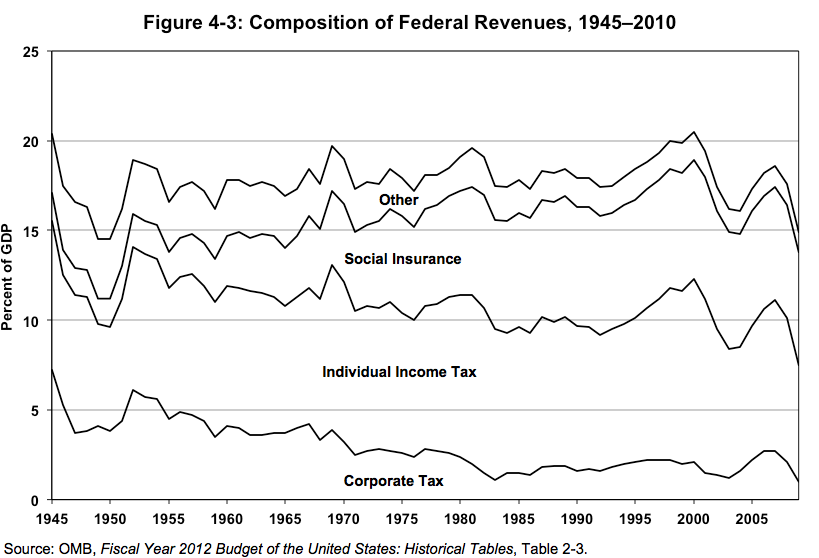
Tyler Cowen thinks that we are entering an age of debates over wealth taxes. If only.

It’s true, as Cowen notes, that national debt everywhere is a relatively small fraction of national wealth and that, therefore, “fiscal problems are best regarded as problems of dysfunctional governance.” One of our central arguments in White House Burning was that the United States obviously, easily has the ability to pay down the national debt, and how it will do so is basically a distributional issue.

Even if wealth taxes make sense, that doesn’t mean they will happen. Cowen claims that “Like the bank robber Willie Sutton, revenue-hungry governments go ‘where the money is.'” But all that is cleverly phrased is not true. Consider this chart from White House Burning:

Screen shot 2013-07-24 at 1.30.09 PM

Continue reading “Wealth Taxes? Don’t Hold Your Breath”

Yes, We Should Worry About Public Pensions

By James Kwak

In the wake of the Detroit bankruptcy, Paul Krugman has a post pooh-poohing concerns about public pensions. His conclusion:

“Nationwide, governments are underfunding their pensions by around 3 percent of $850 billion, or around $25 billion a year.

A $25 billion shortfall in a $16 trillion economy. We’re doomed!”

(Yes, that’s sarcasm.)

I know why Krugman wants to argue that this isn’t a problem. If everyone believes that public pensions are a big problem, then the austerity crew will convert that belief into a push to cut public pensions—just like they have tried to use future shortfalls in the Social Security and Medicare trust funds to insist on privatizing or voucherizing those programs.

Continue reading “Yes, We Should Worry About Public Pensions”