As I wrote a couple of years ago, I don’t post here anymore. I just have a couple of updates for people who subscribe and may be interested in my work.
I have a new book! The Fear of Too Much Justice: Race, Poverty, and the Persistence of Inequality in the Criminal Courts is coming out on June 20 from the New Press. My co-author is Stephen Bright, a legendary death penalty lawyer (with a 4–0 record in Supreme Court cases), longtime director of the Southern Center for Human Rights, and one of my professors at Yale Law School. You can read more at the book website or you can pre-order it via the New Press site (or directly from your favorite retail monopolist, of course).
I used to tweet about everything I wrote, but I may stop doing that as Twitter continues its descent into oblivion. So the best way to keep track of what I write is probably to subscribe to my Medium page here. If you don’t want to give Medium your information, you can get an RSS feed of my stories, or you could bookmark the page itself. Or you could follow me on Facebook. I will try to put a quick post there if I write something that is published someplace else.
I’ve been asked if you can sign up for email notifications when I write stories on Medium. Apparently you can, but the option is a bit buried. (One of the nice things about Medium is the clean interface. One downside of that clean interface is that sometimes you have to go looking for things.)
If you’re on my main page (jamesykwak.medium.com), you have to click on About at the top.
Then you get to this page, and at the bottom there’s a link to an email subscription form.
I’ve decided not to post on The Baseline Scenario anymore. I’ve thought about this on and off during the several years that the site has been mostly dormant, but I never pulled the trigger, mainly because this blog still has thousands of email subscribers and an unknown number of followers on Facebook. But I obviously haven’t been into blogging for a long time now, and it feels weird to continue using a platform whose peak was in 2010 and 2011 (when we were regularly listed, with reason, as one of the most important finance and economics blogs on the Internet). As you’ve probably noticed, Facebook, Twitter, and the consolidation of media platforms (the Times, the Atlantic, Slate, Vox, etc.) has killed off most independent blogging. In addition, while Simon and I rarely disagree on anything, we tend to care and write about different things, as evidenced by our latest books—his on investing in science and technology to create better jobs, mine on partisan politics and expanding the welfare state. Both of us also write about issues that have strayed far from the original focus that drew in our core readers—primarily, the financial crisis and financial regulation. For example, the book I’m working on now is about injustice in the criminal legal system.
I owe this blog a lot. Without the blog, there would have been no “Quiet Coup” and hence no 13 Bankers, which got me fifteen minutes of fame, an academic job, and a new career that has lasted a decade so far. There would not have been the day that Larry Summers sent an email to the National Economic Council staff saying that The Baseline Scenario was required reading. I would not have met some good friends, some of whom have gone on to be far more influential than I ever was.
The blog itself will stay up indefinitely, taking up space on the Internet. Simon may choose to post here in the future, so don’t cancel your email subscription if you have one.
I will continue to write, occasionally at least. The primary place I will post things is Medium; you can find me at https://jamesykwak.medium.com/. For a while I’ve been posting articles in both locations, there and here. I just posted an article about this year’s presidential election that you can read on Medium. I’d be flattered if you decided to follow me there. I also have a Twitter account, of course; I spend little time on Twitter (because it’s awful), but links to things that I write get posted there. I have no plans to use Facebook (because it’s also awful).
One of Congress’s top priorities this week and next is to pass some kind of funding bill that will keep the federal government operating past December 11. There are basically two ways this could happen. Option A is that Congress could pass a continuing resolution that maintains funding at current levels until, say, the end of January—that is, when we’ll have a new Congress and a new administration. Option B is to pass an omnibus fiscal year 2021 spending bill that determines discretionary spending levels through September of next year when the federal government’s fiscal year ends.
The Democratic leadership apparently is pushing for Option B because—well, probably because they think it’s the responsible thing to do and will make them look good with that tiny but all-important segment of voters who know the difference between a continuing resolution and a proper appropriations bill. But, in doing so, they could be throwing away one of the few levers that Democrats will have to actually accomplish anything during the next congressional term.
The point is that government funding measures are must-pass bills. No one likes a government shutdown, and historically Democrats have been able to pin most of the blame for them on Republicans, dating back to 1995, when Bill Clinton successfully portrayed Newt Gingrich as a zealot who was out to slash Medicare (which he was). If Jon Ossoff and Raphael Warnock come through in Georgia on January 5, Democrats will have majorities in both houses of Congress for the first time since 2010—but such razor-thin minorities that Joe Manchin is already rubbing his hands with glee at the prospect of becoming the most important person on Capitol Hill.
In this context, an omnibus budget reconciliation bill could represent one of the Biden administration’s few real chances to pass anything through Congress. Bills passed through reconciliation are not subject to the Senate filibuster (which isn’t going away, regardless of what you think about it), which means they only need a bare majority. The need to avert a government shutdown creates the pressure to bring people (the so-called moderates) to the table to come to a deal. Now, Joe Manchin isn’t suddenly going to become a sponsor of the Green New Deal because the Democrats have a majority in the Senate—he’s going to extract everything he can in exchange for his vote. But there is still a lot that Democrats could accomplish in an omnibus spending bill: money for the DOJ Civil Rights Division, money for the EPA, money for election protection, money for low-income housing, and so on. This is an opportunity to dictate discretionary spending priorities a full eight months earlier than we would otherwise be able to do. And would you rather negotiate with Manchin or with Mitch McConnell?
And yet the Democratic leadership in Congress seems inclined to give up the potential chance to write their own appropriations bill in January in exchange for a bill that they have to negotiate with McConnell and . . . Donald J. Trump. (The vague new COVID-19 stimulus bill that people are talking about is currently being positioned as a separate piece of legislation—which makes sense because it’s toxic to most Republicans.) It’s almost as if they don’t want the opportunity to govern. Sure, Ossoff and Warnock could lose in January, but we would still be in a stronger position than we are now, with Biden in the White House.
During the next two years, we are going to have precious few chances to pass any kind of meaningful legislation. Why are we throwing one of them away?
Today, the Washington Post’s Outlook section published my article on the future of the American economy in the wake of the pandemic. They invited me to write it because of my earlier blog post on “Winners and Losers.” (Hey, despite all appearances, maybe blogs are still worth writing.)
The article is pretty gloomy. The short summary is that the COVID-19 pandemic will accelerate and reinforce the two primary economic trends of our time: consolidation and inequality. At this moment, I believe that more strongly than when I originally drafted the article two months ago. It seems to me that, as a society, we are caught between two unacceptable outcomes: either we reopen elementary schools (at least) so that parents can go to work, adding fuel to the epidemiological fire that is already burning throughout much of the country; or we keep schools closed and millions of predominantly low-income workers lose their jobs because they have to take care of their children. Choosing between your job and your children is not something that should happen in a supposedly rich society, yet there we are.
A few friends have asked me what I think the solution is. Here are the last three paragraphs of my first draft, which ended up on the cutting room floor:
I think it’s highly likely that the dust will clear eventually and that our economy will come back to life at some point in the next two or three years. I know there are certain disaster scenarios that can’t be ruled out, but I think they are unlikely. I’m not going to guess when things will return to a semblance of normal. Really, no one knows.
By some measures, in the short term, COVID-19 will surely reduce inequality of wealth, and probably inequality of income as well. As a purely mechanical matter, the rich have a lot more money to lose when the stock market crashes and most sectors of the economy grind to a halt.
At the same time, however, this pandemic is throwing into stark relief how unequal the lives of Americans are today. Most of the upper-middle class and rich seem to fall into one of two categories. Those without children in the house trade suggestions on how to fill their time: virtual happy hours, virtual yoga, free streaming opera, binge TV-watching, etc. Those with children in the house trade suggestions on how to keep said children occupied so that we can get anything done or have any time to ourselves: educational apps and websites, home science experiments, live streaming from zoos and aquariums, etc.
There are exceptions, of course. Doctors generally make comfortable livings, and many of them are currently facing difficult working conditions and high risk of infection to save as many lives as possible. But the most difficult thing many rich people have to endure is figuring out how to get a Peapod or Instacart delivery slot, or finding a good recipe for canned tuna.
This is the most famous line from the most famous justification of market capitalism. Smith’s point is that it is individual self-interest that drives the economy. In the next paragraph, he goes on to describe how gains from trade explain the division of labor in a modern economy:
“The certainty of being able to exchange all that surplus part of the produce of his own labour, which is over and above his own consumption, for such parts of the produce of other men’s labour as he may have occasion for, encourages every man to apply himself to a particular occupation, and to cultivate and bring to perfection whatever talent or genius he may possess for that particular species of business.”
As I’ve said before, “whenever the butcher, the brewer, the baker, or the invisible hand is invoked, the reader should hear alarm bells going off.” The COVID-19 pandemic provides a particularly stark demonstration of the problems with Smith’s comforting fable and how it is used in contemporary politics.
It seems that social distancing is the primary strategy for slowing the propagation rate of COVID-19. That and widespread testing are the key tools for containing an outbreak, for reasons discussed repeatedly in the media.
But does it work? Or, more to the point, how well do different degrees of social distancing work? How strict does it need to be, and how tightly does it need to be enforced? It seems to me that this is an important and at least theoretically answerable question.
Thanks to ubiquitous commercial and government surveillance, there are staggeringly comprehensive databases of exactly where people are at all times. Google has one, for example. Picture for yourself an enormous aerial picture of some metropolitan area with a dot for every person’s location; then picture those dots moving around as time passes. That’s more or less what is available. (Some people are blocking their location data, and some people don’t have personal surveillance devices smart phones. But there are certainly enough people transmitting their location to do the analysis discussed below.)
The airline industry is trying to hold up the federal government for $29 billion in grants and another $29 billion in loans. They threaten that if they don’t get the grants they will lay off employees, and that if they don’t get the loans they will use their remaining cash on dividends and stock buybacks.
First of all, the second threat is staggering in its audacity. At current course and speed, the airlines will go bankrupt. When you are in financial distress, the last thing you should do is take your scarce cash and hand it to your shareholders. That meets at least the spirit, and perhaps the letter, of a fraudulent conveyance in bankruptcy law. But it represents the pinnacle of the idea of shareholder capitalism: screw the workers, screw the creditors, just take the money and run.
More importantly: the federal government should not give the airline industry a single penny either in grant aid or in sweetheart loans. I understand the economic challenges here. Thousands of workers are at risk of losing their jobs and not being to pay for food or rent in the midst of the greatest crisis of our lifetimes. To the extent we want to help them, the top priority is to give money directly to them.
Our business and household sectors are losing lots of money every day, and will continue to lose money for the foreseeable future. People no longer spend money at restaurants. Restaurant owners can no longer pay the rent or pay back their business loans. Restaurants fire their workers, who lose their paychecks and can no longer pay their rent, or their credit card bills, or their student debt. In an economic crisis like this, the overriding question is: who ultimately bears the losses?
We’ve been through this before. In the 2008 financial crisis, we applied the usual rules of capitalism—unless you were a large bank. Businesses failed and their owners (including shareholders, for corporations) were wiped out. Renters were evicted. Homeowners lost their houses. Investment funds that had bought mortgage-backed securities and collateralized debt obligations lost their money. Workers lost their pensions. Small banks were shut down by the FDIC. Big banks, however, got unlimited cheap credit from the Federal Reserve to stay afloat, thanks the the people we all know.
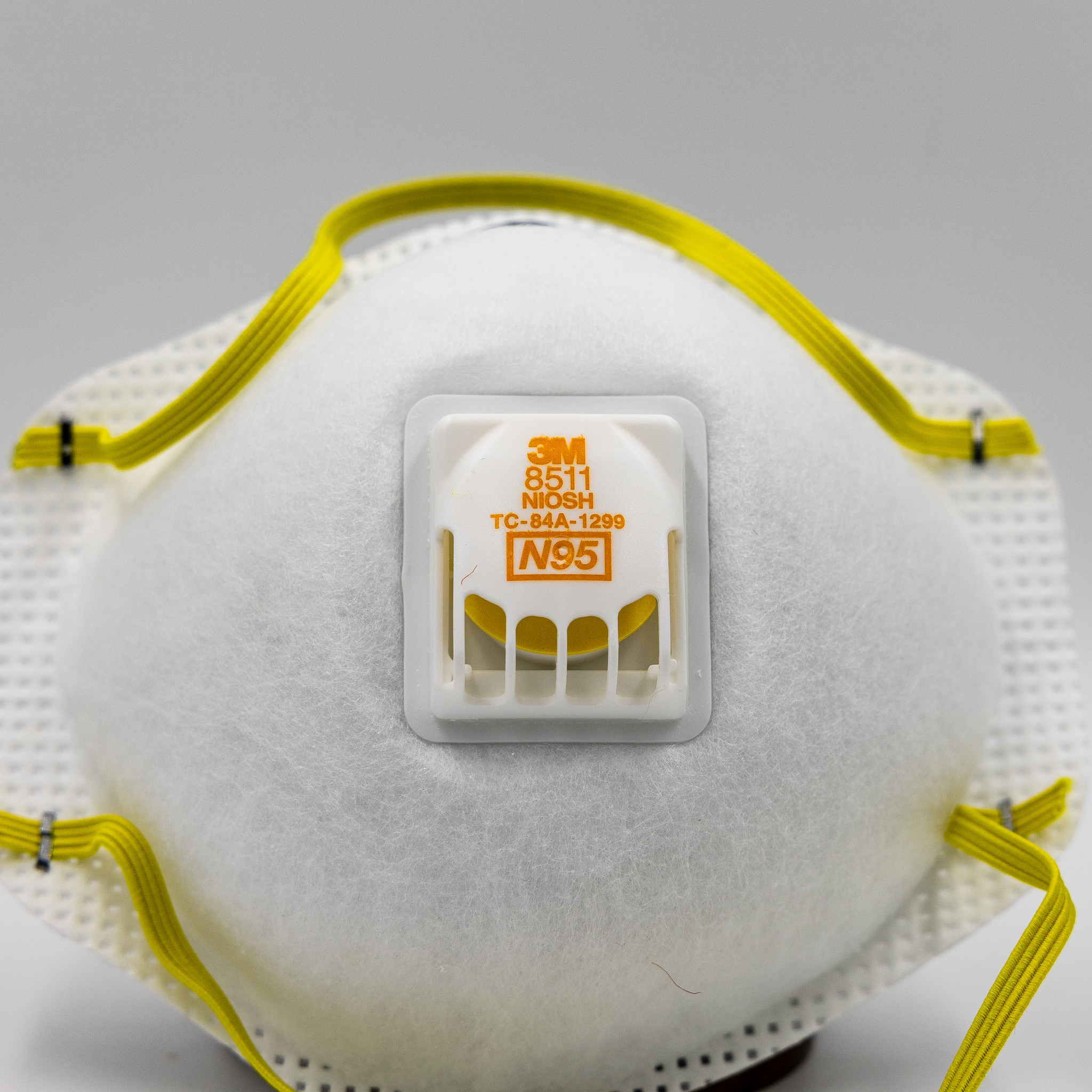
PPE, as we now know, stands for Personal Protective Equipment, like face masks and gloves. Right now there isn’t enough of it, and that’s one of the constraints on being able to test people, which is one of the biggest problems we face.
The only point I want me make here is this: This is how capitalism is supposed to work. If you’re a for-profit healthcare provider—or any kind of provider that is trying to provide the most value, however defined, with limited resources— you are not going to stock up on enough PPE to handle every possible scenario you might face. This is what management consultants and business school professors have been saying for decades. PPE, like inventory, is a form of working capital. If you can reduce the amount of working capital you need, you can translate that dollar-for-dollar into cash for your shareholders—or, if you’re a non-profit, into clinics for poor people, salaries for your executives, or that next gorgeous building you’re going to put up. Excess working capital is pure inefficiency.
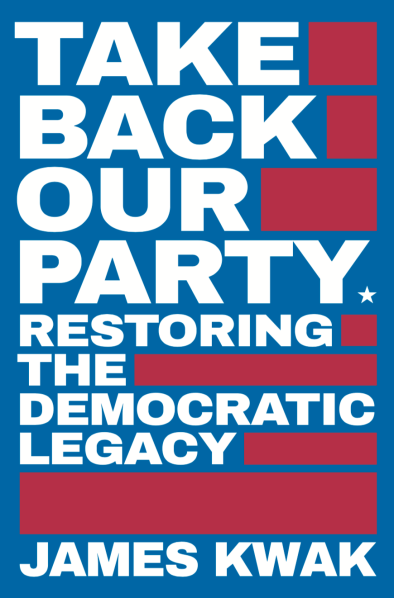
Today is the day of the New Hampshire primary, and, perhaps more importantly, lots of people in California are getting their ballots around now. Before you cast your vote in the Democratic presidential primary, I wish you would read Take Back Our Party, either online (for free) or in print. But I know most of you won’t, so this is what I want to say.
As a preamble, if you are a moderate Democrat—if you think welfare reform and financial deregulation were good ideas; if you think, along with Barack Obama, that more oil production is a good thing; if you think that America’s health care problems can be solved by private health insurance companies—what I am going to say is not for you. Go ahead and vote for Joe Biden, or Pete Buttigieg, or Amy Klobuchar.
I’ve never wanted to write a book as much as I wanted to write Take Back Our Party. And I’ve never wanted people to read one of my books as much as this one—in particular, before the 2020 Democratic primary season ends. For that reason, I bypassed the usual publication route. (As my editor at Pantheon liked to say, the period for turning a manuscript into a book is, for unknown reasons, the same as the gestation period of a human. In his defense, he did get both 13 Bankers and White House Burning out in around 5–6 months.)
Instead, David Dayen, executive editor of The American Prospect, agreed to publish the book online, and it went live here in December. In addition, I wanted there to be a print edition for people (like me) who, well, prefer reading things on paper—and for mailing to people who should read it. Ryan Grim at Strong Arm Press gamely agreed to publish it, knowing that it was already available on the Internet. Jordan Jones did the interior design and Soohee Cho did the cover. The print edition has a small number of corrections, it has real footnotes with accurate page citations (something you can’t do with Internet-style hyperlinking), and it has a descriptive index so you can look up your favorite neoliberal from the past three decades.
You can order a print or ebook copy via the Strong Arm website (or, of course, from your least-favorite monopolist). They should start shipping on Tuesday, and I believe the ebook is available right now. The online version at the Prospect will still be available for the foreseeable future.
I’m pretty sure I’m going to lose money on this, taking the book design costs into account, but that was never the point. The point was for people to read it. So do that now.
David Brancaccio of Marketplace has started a new radio project called Econ Extra Credit: reading a first-year economics textbook, one chapter per week, along with his listeners. Luckily, he chose one of the textbooks produced by the CORE project, a group of economists who set out to rewrite the economics curriculum in the wake of the financial crisis and Great Recession.
David invited me to talk with him about “Economics 101” and the one-sided impression of the world that people often take away from the class—especially those for whom it is their only economics class. This, of course, was the subject of my 2017 book Economism: Bad Economics and the Rise of Inequality.







 Instead, David Dayen, executive editor of The American Prospect, agreed to publish the book online, and it went live
  The Baseline Scenario