Archive for February 2010
Remember Those Stress Tests?
I’m curious to know how banks’ 2009 final results compare to the projections in the stress tests. My suspicion is that JPMorgan and Goldman did better than projected, but Citi may have done worse. Ideally you would compare both the new loan losses recognized over the year and the profits from current operations. But there are a couple of problems with doing this. One is that the stress test results were for 2009-2010 combined, without the separate years split out. The other problem is that it’s not immediately obvious how to map the line items from the stress test results to the line items on a bank’s income statement (or to changes on its balance sheet). I might be able to figure it out with a lot of study, but I might not.
Does anyone know of someone who has already done an analysis along these lines? Or does anyone know how to do the mapping correctly?
By James Kwak
Taxes
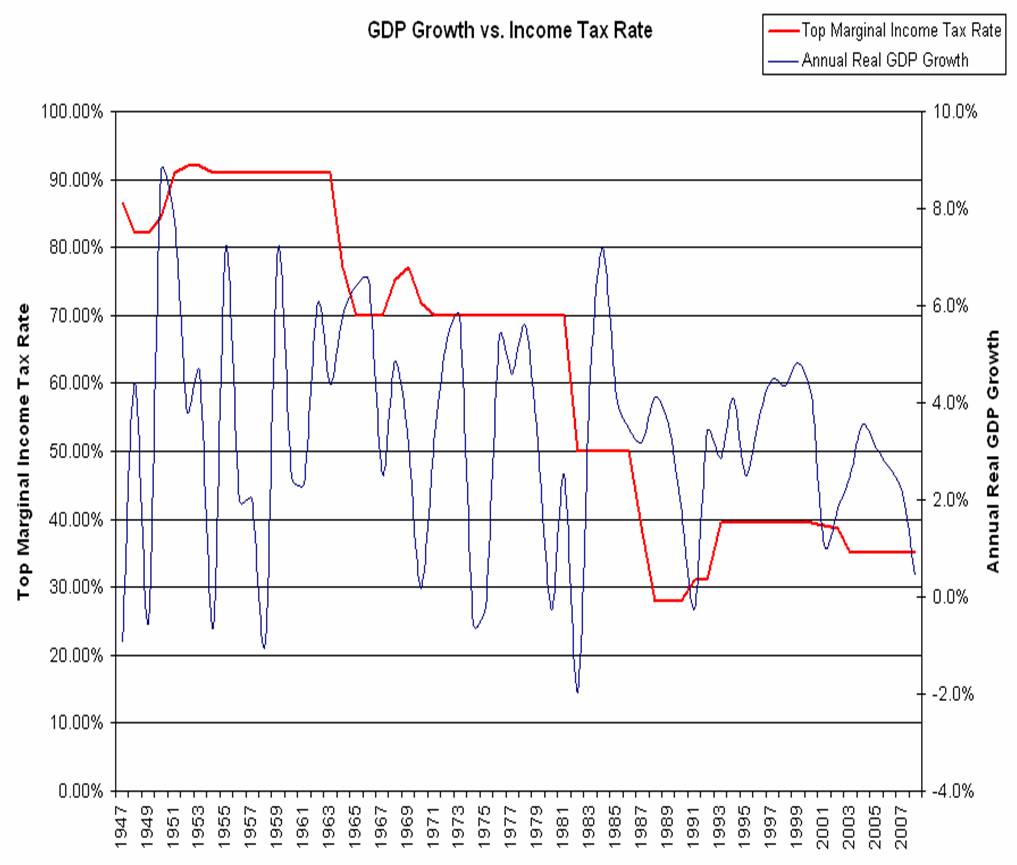
But, I hear you saying (and emailing) after my last few posts, higher taxes are bad for the economy because people don’t work as hard, making the pie smaller for everyone.
Yes, that’s what it says in the textbook. But the issue is more complicated than that. Look at this, for example:
Kevin Warsh: “No Firm Should Be Too Big To Fail”
The debate over Ben Bernanke’s reappointment, and his approach to the financial system, may after all have had some impact. In a speech yesterday, Kevin Warsh – the Federal Reserve Board Governor who liaises between Ben Bernanke and financial markets – signaled a major change in Fed thinking regarding “too big to fail”.
Warsh was much blunter than we have heard from the Fed in a long while: “Moral hazard in the financial system is higher than any of us should countenance”; “eradicating the too-big-to-fail problem should be the predominant policy goal”; and “in the new regime, no firm should be too big to fail.”
At some level, Warsh and his colleagues are finally learning the main lesson of 2008-09.
“We need a system in which insolvent firms fail. Market discipline only works if governments can demonstrably and credibly commit to allow firms to fail. This system isn’t just about giving government officials better options on Sunday nights. It is about making sure that market discipline is operative in the prior months and years to avoid altogether the proverbial Sunday night judgments.”
But there is still a major problem in the Fed’s thinking. Read the rest of this entry »
The Republican Plan, III: Comic Relief
(This is a multi-post series on the Republicans’ Roadmap for America’s Future. Part I was on how it slashes Medicare spending. Part II was on how it shifts risk from the government to individuals.)
The Roadmap brings up the issue that there is little price transparency in the health care market. This is the solution:
“The environment resembles what existed in the securities markets before the stock market crash of 1929. Abuse, fraud, and misinformation about the nature of stocks and the rules governing their purchase were rampant. In response, the Securities and Exchange Commission [SEC] was formed with the main purpose of bringing transparency to the market and restoring consumer confidence.
“With the increasingly rapid transformation of the financial markets and the growing complexity of financial transactions, the private sector began to take a more prominent role in developing accounting guidelines; and eventually the SEC began relying on the private sector to establish the basic standards by which it would be regulated. Since 1973, the SEC has recognized the nongovernment Financial Accounting Standards Board [FASB] as the authoritative standard-setting organization for financial accounting and reporting information. While the SEC has statutory authority to establish such financial standards, it has historically adopted FASB rules. The SEC allows the private sector to establish its own disclosure standards, so long as it demonstrates the ability to fulfill the responsibility in the public interest. The authority to enforce the standards, however, falls solely to the SEC.
“Applying this model to the health care industry will allow all stakeholders to come together, without heavy-handed government intervention, to establish uniform and reliable measures by which to report quality and price information.”
Enron? WorldCom? Self-regulation? FASB, the SEC, and the securities industry are their example?
By James Kwak
The Republican Plan, II: You’re On Your Own
In my previous post on the Roadmap for America’s Future, I discussed how the Republican plan is based on converting Medicare into a voucher program and then slashing the vouchers drastically relative to current Medicare spending projections, leaving seniors without the ability to buy anything close to what they get from Medicare today. In that post, I compared projected Medicare vouchers under the Roadmap to projected Medicare spending under current law. If you assume that, in the Roadmap world, the cost of Medicare-equivalent health insurance will be the same as currently projected Medicare spending, then people will die.
But, Paul Ryan would argue, the Roadmap is going to bring down the cost of health care, so the fact that we’re providing less support won’t matter. Put another way, he might say, Obama’s plan also counts on bringing down the cost of health care, so why can’t I make the same assumption? There are two problems with this argument.
The Republican Plan, I: People Will Die
So the Republicans have a deficit reduction and a health care plan, all wrapped into one, the “Roadmap for America’s Future.” It’s being pushed by Paul Ryan, in part because he’s the ranking member of the House Budget Committee, in part because he’s good-looking and articulate, in part to provide the party plausible deniability if it flops (like Bobby Jindal a year ago). The CBO says that it will balance the budget and even eliminate the national debt by 2080. Ezra Klein and Matt Yglesias have commented on it. Klein says, “I wouldn’t balance the budget in anything like the way Ryan proposes. His solution works by making care less affordable for seniors. . . . But his proposal is among the few I’ve seen that’s willing to propose solutions in proportion to the problem.” Yglesias says “it’s totally unworkable.” But they’re both being much too kind.
Ryan realizes that “the deficit problem is a health-care problem,” which he agreed to in an interview with Klein. That’s good. He realizes that to solve the deficit you have to do something about Medicare. That’s good. He also puts forward a logically coherent conservative position. That’s good in itself and especially refreshing after the Bush era (and the unfunded Medicare prescription drug benefit) and all the recent posturing of the Republicans as defenders of Medicare (Mitch McConnell: “Cutting Medicare is not what Americans want.“) Ryan’s plan is basically to cut Medicare like never imagined before.
But everything else about the plan is such an unmitigated disaster I’m going to devote a whole paragraph at some point to thinking about how to label this plan. It will be a long time before we get there, though, broken into a couple of blog posts, because there are so many problems to go over.
Credit Card Cleverness
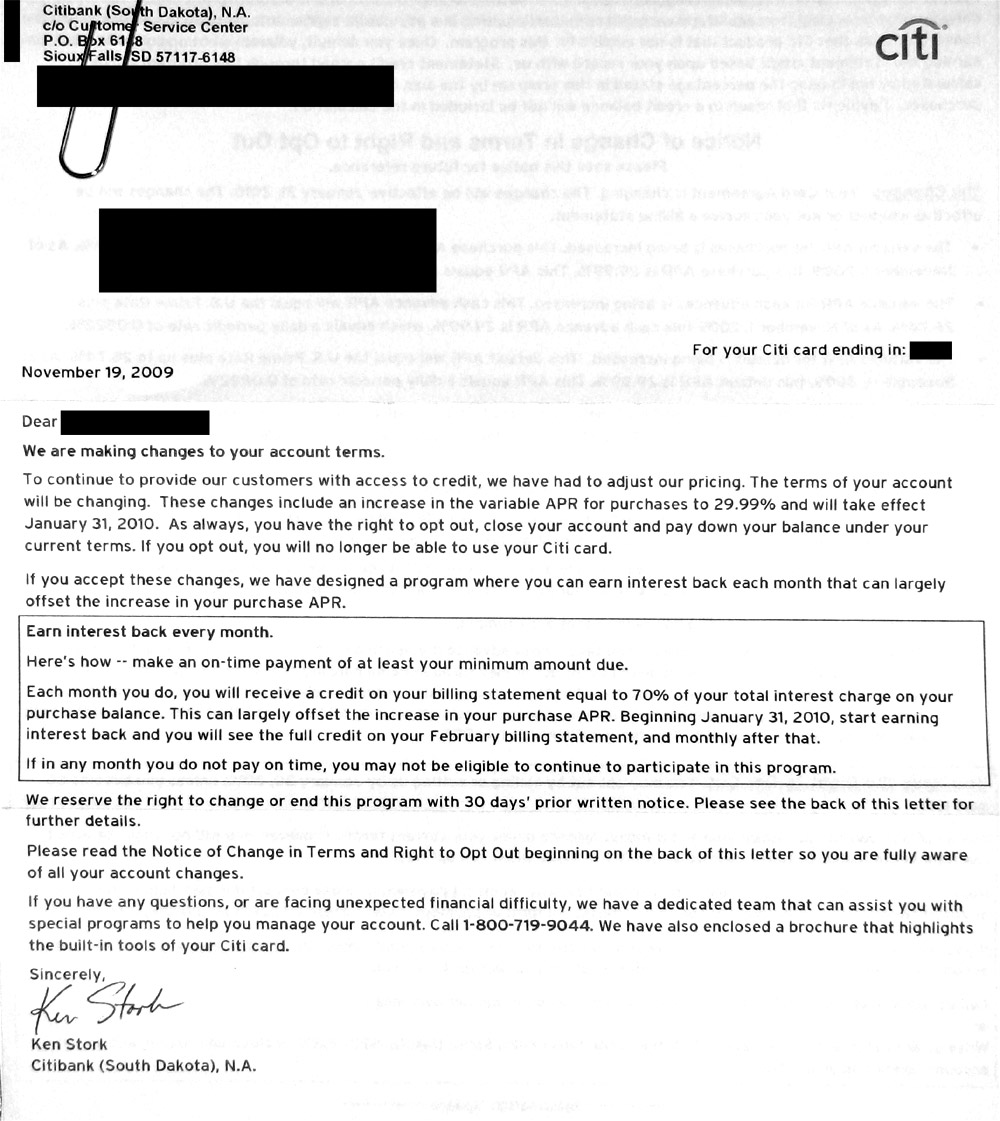
Most of the provisions of the Credit CARD Act of 2009 go into effect on February 22. Card issuers are adapting in various ways. I’ve previously written about the 79.9% APR (used to get around the limit on up-front fees for subprime cards). Now one of our readers has written in about an even more clever gimmick.
Here’s the letter:
Tom Hoenig For Treasury
The White House is floating, ever so gently, the notion that they are open to nominations for the position of “Tim Geithner’s Successor.”
It’s not clear if they mean this job is likely to be advertised formally sometime in 2012 or 20 minutes after the November midterms. Nor is it obvious if this is a real request for proposals – it could be just an effort to make critics “put up or shut up.”
Fortunately, there is an entirely plausible successor already in waiting, ready now or whenever the president finally realizes the need to fundamentally change banking policy. Read the rest of this entry »
Budget Sense and Nonsense
With the submission of the Obama administration’s budget today, fiscal silly season is opening. President Obama already launched an opening salvo last week with his proposed freeze on non-security-related military spending,which amounts to a rounding error on the ten-year budget projections, which are themselves a rounding error on the long-term budget projections– at a time when unemployment is running at 10.0%. Fortunately, there is a partial saving grace, which is that the freeze does not set until until fiscal year 2011 (which begins in October 2010), and in the meantime Obama has proposed $100 billion in tax cuts and government spending to create jobs. (Whether his proposals are the right way to spend $100 billion is a debate for another time.)
The midterm elections are looming already (note: do we have to be satisfied with a political system in which the legislature is preoccupied with upcoming elections half the time?), and the two big themes seem to be jobs and the deficit. With unemployment at levels not seen since the 1980s, it’s obvious why jobs are on the political agenda. With the federal budget deficit at record (nominal) levels, it also seems obvious that the deficit should be on the agenda, but this is really an unfortunate artifact of our political system. A government deficit is the result of insufficient government saving, and a period of high unemployment is absolutely the worst time to increase government saving. The sensible solution would be to use the urgency we currently feel to put in place long-term fiscal solutions, but the political system can’t handle that (see health care reform as Exhibit A). As a result, when deficits go up, we get lots of short-term politicking about the deficit–in Paul Krugman’s words, the “march of the deficit peacocks.”