Tag: technology

Google Buzz and Public Search Results

By James Kwak

Some law school friends and I had trouble figuring this out two nights ago when Buzz was apparently rolled out, so I thought this might be helpful. I think I got it right, but no guarantees. Note that this post is about including your profile in public search results; there is another more important privacy issue discussed here.

Continue reading “Google Buzz and Public Search Results”

Steve Jobs’s Magic

I know that no one out there really wants to hear my thoughts on new personal technology, but no one’s forcing you to read this. So here are my first thoughts on the iPad, Apple’s new 10″ tablet.

The resurgence of Apple in the last decade has been based on its ability to simply design and build better products than anyone else, in part because it does a better job of understanding what consumers actually want than anyone else. They are also extremely good and marketing and selling; who would have imagined that Apple would also turn out to be better at retail than any other electronic company? But I wonder if, with the iPad, the Steve Jobs magic is running low.

Continue reading “Steve Jobs’s Magic”

The Myth of Ariba

(Warning: long post ahead.)

I was minding my own business, reading Past Due by Peter Goodman (I got it from Simon, who I think got it for free), and there on page 43 I ran into Eric Bochner. I thought that name sounded familiar, and then I remembered what it was. Eric Bochner was a vice president of something or other (and then the vice president of something else or other) at Ariba, where I worked from April 2000 until September 2001 (I was also a consultant there from December 1999). Chapter 2 of Goodman’s book is about the Internet bubble, Ariba is his case study, and Bochner is his source.

As far as I know, no one has made Ariba the poster child for the Internet bubble before–people usually go with WebVan, or Pets.com, or something similarly vaporous. Ariba is a more complicated story, but you can make a case that we deserve to be on the poster. At our peak we were bigger than all those pet food companies combined, with a market capitalization over $40 billion (on quarterly revenues of about $100 million at that time). More to the point, if Pets.com is comedy, Ariba is tragedy (well, not really, but you known what I mean): Ariba was a real company with a real product that got swept up in its own hype, with unfortunate consequences (but not fatal ones–Ariba today earns over $300 million in annual revenues and a small profit).

Continue reading “The Myth of Ariba”

Salespeople and Programmers

Tyler Cowen asks why pay across software programmers is not more unequal. He cites John Cook, who argues that differences in programmer productivity are difficult to identify and measure. Since I do know something about this (though not a comprehensive answer), I thought I would comment.

Cook contrasts programmers to salespeople: “In some professions such a difference would be obvious. A salesman who sells 10x as much as his peers will be noticed, and compensated accordingly. Sales are easy to measure, and some salesmen make orders of magnitude more money than others.” Although this is the most-cited example around (except perhaps for traders), I don’t actually think it’s true.

Continue reading “Salespeople and Programmers”

Is It 1999 All Over Again?

The New York Times’ Bits blog has a post on Trefis, a Web 2.0 startup that apparently makes it easy for you to create your own valuation model for public companies. They give you starter models using public information, and you can then tweak the assumptions to come up with your own valuation. The pitch is that this puts the tools used by research analysts and professional investors in the hands of the retail investor. “Perhaps these new tools will put some added pressure on the sell-side professionals – many of whom are notorious for creating overly optimistic takes on the companies they follow.”

Or maybe they will make retail investors think they have an advantage that they really don’t. Advantages in stock valuation have to be based on superior information, which you can get by doing lots of market research (like some old-fashioned hedge funds do) or by having privileged access to company insiders. Superior information can include superior forecasting ability, so if you have some ability to predict the market size for routers better than anyone else, you can make money from it. But neither of these are things you get from models; they are things you plug into models. I’m sure the founders of Trefis don’t see it this way, but this feels to me like a great way to lure people into individual stock-picking, and thereby a boon to stock brokers everywhere.

Continue reading “Is It 1999 All Over Again?”

The Problem with Software

Phillip Longman has an article on health care information systems with the provocative title, “Code Red: How software companies could screw up Obama’s health care reform” (hat tip Ezra Klein). The argument of the article goes something like this. One, the health care cost problem is largely caused by overtreatment. Two, the answer is software: “Almost all experts agree that in order to begin to deal with these problems, the health care industry must step into the twenty-first century and become computerized.” Three, software implementation projects can go horribly, horribly wrong. Four, the solution is open-source software.

I have no argument with point one. And I agree wholeheartedly with point three. Anecdotally (but I have seen a lot of anecdotes), the median large-scale corporate software project goes way over budget, is delivered years late, is just barely functional enough to allow the executives involved to claim they delivered something, and is hated by everyone involved. But I’m not sold on points two and four.

Continue reading “The Problem with Software”

The Future of Computing?

Google announced the Google Chrome “Operating System” a few days ago, and the world I used to live in is abuzz with people talking about the earthquake this represents for the computing industry. TechCrunch says, “Google Drops a Nuclear Bomb on Microsoft.” Leo Babauta of Zen Habits has a more thoughtful response, but also subscribes to the “future of computing” theme: “Google is moving everything online, and I really believe this is the future of computing. The desktop model of computing — the Microsoft era — is coming to an end. It’ll take a few years, but it will happen.”

Continue reading “The Future of Computing?”

Microsoft: Just Another Company

Earlier this week, Microsoft issued long-term debt for the first time in its history, selling $3.75 billion of  5-, 10-, and 30-year bonds. From a corporate finance perspective, I guess this makes sense, since it got to lock in historically low borrowing rates. Treasuries are low, and Microsoft paid only about one percentage point more than the U.S. government, which makes sense since it does have over $20 billion in cash, no other long-term debt, and – let’s not forget – a virtual monopoly on computer operating systems and basic desktop software. (In some ways, Microsoft looks like a safer place to lend mone than the U.S. Treasury, except for the ability of the latter to print its own money.) But it’s still a little sad.

Continue reading “Microsoft: Just Another Company”

70% Off Sale!

There has been a fair amount of hand-wringing along Sand Hill Road in Menlo Park over the lack of “exits” – IPOs and acquisitions – for venture-backed technology companies. Given the way the stock market has behaved recently, it’s pretty near impossible for a young technology company to go public. And the large technology companies that do most of the acquiring have been unusually quiet, presumably because they are watching their cash and avoiding risks given the global economic downturn.

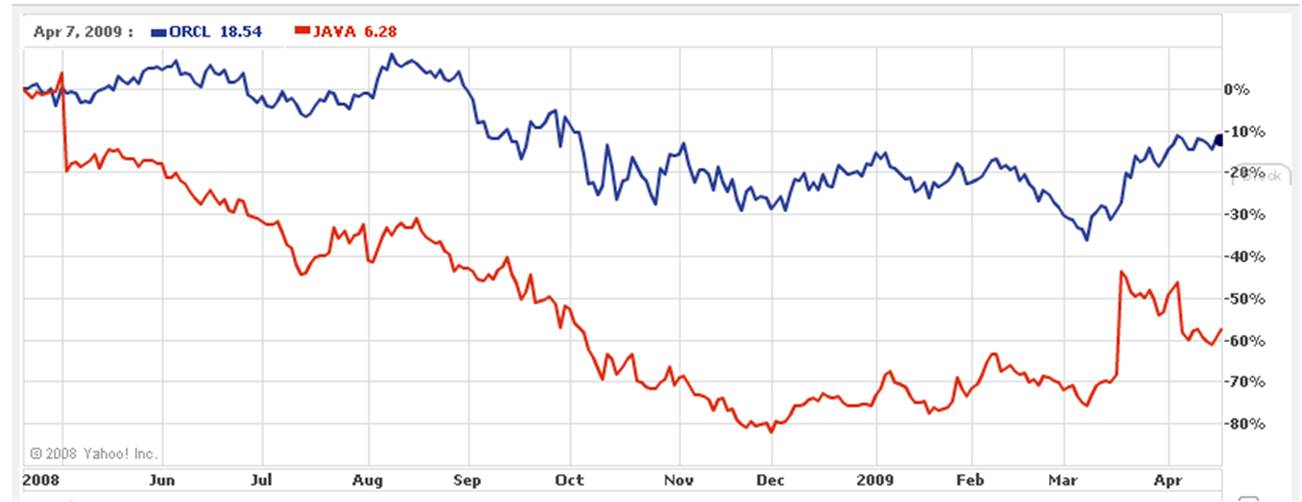
However, there’s one major reason why large technology companies should be buying:

orcl-java

Blue is the share price of Oracle; red is the price of Sun (the spike in March is Sun’s merger negotiations with IBM). At some point, prices fall to the point where people start buying again. While the recession has hurt almost every company, it disproportionately hurts companies that do not have fat profit margins, hordes of repeat customers, and deep cash reserves that they can rely on in hard times. The result is huge changes in the relative values of companies, creating some once-in-a-generation bargains.

I don’t think the Oracle-Sun acquisition is a sign of a bottom or anything dramatic like that. But it shows that at least some companies are doing what they should be doing.

By James Kwak