Tag: taxes

The Incredible, Magically Metamorphosing Taxpayer-Subsidized Executive Perk

By James Kwak

Once upon a time, the story goes, corporate America was fat and happy. Top executives worked in palatial office suites bedecked with flowers, flew everywhere in private jets, and ate every meal at the Four Seasons or Le Bernardin.

Then there was the shareholder value revolution. Michael Jensen and the rest of the Chicago School efficient-market legions showed that shareholder value was the only thing that mattered and stock prices were the only measure of shareholder value. Activist investors demanded an end to executive perks and ushered in the era of pay for performance, in which executives are paid in stock options, so they only make (a lot of) money if shareholders make money. Congress event went along by capping the tax-deductible amount of executives’ base pay, which helped along the shift to stock-based compensation.

Continue reading “The Incredible, Magically Metamorphosing Taxpayer-Subsidized Executive Perk”
New “Debt for Beginners” Section

By James Kwak

I created a new “Debt for Beginners” page on the White House Burning website. It’s a collection of previous articles, mainly written for a general audience, on deficits, the national debt, government spending, taxes, and the politics thereof. It’s intended as a starting point for people who want to get up to speed on these issues.

Loyal readers are probably familiar with all the material already.

Why Do New York Times Columnists Keep Swooning for Paul Ryan?

By James Kwak

After David Brooks last year, now it’s James Stewart who has fallen for Paul Ryan’s rugged good looks. He attempts to defend Ryan’s tax proposals against charges that they favor the rich:

“To me it sounds like a proposal to raise [the wealthy’s] taxes by depriving them of cherished ‘loopholes,’ to use the proposal’s word. . . .

“There’s no getting around the fact that a 25 percent rate on the top earners would nearly double Mr. Romney’s effective rate and more than double it for the 101 of the top 400 taxpayers who pay less than 10 percent, assuming the loopholes are indeed closed.”

Continue reading “Why Do New York Times Columnists Keep Swooning for Paul Ryan?”

The Fetishization of Balance

By James Kwak

I generally don’t bother reading Thomas Friedman. A good friend gave me a copy of The World Is Flat, and I started reading it. Somewhere in the first one hundred pages Friedman has an extended discussion of workflow software (as a key enabler of globalization) and I realized that he knew absolutely nothing about workflow software, so I stopped reading it and gave it away.

Another friend pointed out Friedman’s op-ed in the Times earlier this week in which he argues for “grand bargains” and “balanced” solutions to, well, all of our problems. For example, he says, “We need a proper balance between government spending on nursing homes and nursery schools — on the last six months of life and the first six months of life.” Despite the nice ring, that’s about as empty a statement as you can make about public policy.

But this is the one that really confused me (and my friend):

“The first is a grand bargain to fix our long-term structural deficit by phasing in $1 in tax increases, via tax reform, for every $3 to $4 in cuts to entitlements and defense over the next decade.”

Continue reading “The Fetishization of Balance”

Greg Mankiw’s Contorted Defense of Mitt Romney

By James Kwak

It’s really hard to defend the carried interest exemption (the one that allows private equity and venture capital partners to pay tax on their share of fund profits at capital gains rather than ordinary income rates). You have to give Greg Mankiw a hand: he sure gave it a good shot in the Times this weekend.

Mankiw’s general point makes a lot of sense. He argues that it’s sometimes hard to distinguish returns from labor and returns from investment, using five examples of people who buy a house for $800,000 and later sell it for $1,000,000. For example:

“Carl is a real estate investor and a carpenter. He buys a dilapidated house for $800,000. After spending his weekends fixing it up, he sells it a couple of years later for $1 million. Once again, the profit is $200,000.”

In this case, although some of Carl’s profit is due to his labor, all of it gets treated as capital gains by the tax code. In a perfect theoretical tax world, you would divide Carl into two people, the investor and the carpenter, and the investor would pay the carpenter some amount for his labor; the carpenter would pay ordinary income tax on that amount (and the investor would deduct it from his taxable profits). But that’s not how we do things.

Continue reading “Greg Mankiw’s Contorted Defense of Mitt Romney”

Invisible Handouts and Anti-Government Conservatives

By James Kwak

Ezra Klein wrote a column for Bloomberg discussing research by political scientist Suzanne Mettler and some of her collaborators. Mettler studies what she calls the “submerged state”—the growing tendency of government programs to provide benefits in ways that mask the fact that they come from the government—and its implications for perceptions of government and ultimately for democracy.

There are several important lessons to draw from Mettler’s work. The most obvious, which was highlighted by Bruce Bartlett a year ago (and that I wrote about here), is that Americans are hypocrites: many people benefit from government programs, ranging from the mortgage interest deduction to Medicare, yet deny receiving help from any “government social programs.”*

Continue reading “Invisible Handouts and Anti-Government Conservatives”

How Much Do Taxes Matter?

By James Kwak

Christina and David Romer’s new paper, “The Incentive Effects of Marginal Tax Rates: Evidence from the Interwar Era,” is available as an NBER working paper (if you are so lucky). Given the current debates about taxes, the paper is likely to garner some attention.

In the central section of the paper, Romer and Romer regress reported taxable income against the policy-induced change in marginal after-tax income share. The after-tax income share is the percentage of your gross income that is left after taxes; policy-induced changes are those caused by tax changes rather than be macroeconomic changes. They do this for the top 0.05% of the income distribution, broken down into ten sub-groups by income, because the income tax only affected the very rich during the interwar years.

Their headline finding is that “The estimated impact of a rise in the after-tax share is consistently positive, small, and precisely estimated” pp. 15–16). They find an elasticity of taxable income with respect to changes in the after-tax income share of 0.19.

Continue reading “How Much Do Taxes Matter?”

Denial or Principle?

By James Kwak

I wanted to make a belated return to Binyamin Appelbaum and Robert Gebeloff’s article on reluctant safety net beneficiaries.  Earlier this week I argued that their framing of an expanding safety net that has spread from the poor to the middle class is wrong, but otherwise the themes they discuss are very important.

Many liberals like to point out the apparent hypocrisy of the people featured in the article, who rail against big government, demand lower spending, and simultaneously rake in benefits from the federal government that they hate. The central figure in the article, Ki Gulbranson, works hard yet has barely enough money to support his family, even with the earned income tax credit* and reduced-price school lunches for his kids. His conclusion: the country is going bankrupt, but people don’t make enough money to pay more taxes, so we should have smaller government. He would rather go without his current benefits—but he can’t imagine retiring without Medicare and Social Security.

I don’t think Gulbranson is a hypocrite at all. I don’t think taking a benefit you don’t think should exist makes you a hypocrite, just like I don’t think Warren Buffett should voluntarily pay higher taxes. I think his position is one part magical thinking and one part principle.

Continue reading “Denial or Principle?”

What Expanded Safety Net?

By James Kwak

In general, I think Binyamin Appelbaum and Robert Gebeloff’s article on how the same people oppose government handouts and take government handouts is very good. But I think their framing buys into a piece of conventional wisdom that just isn’t true.

Here it is, without any shortening (but emphasis is mine):

“The problem by now is familiar to most. Politicians have expanded the safety net without a commensurate increase in revenues, a primary reason for the government’s annual deficits and mushrooming debt. In 2000, federal and state governments spent about 37 cents on the safety net from every dollar they collected in revenue, according to a New York Times analysis. A decade later, after one Medicare expansion, two recessions and three rounds of tax cuts, spending on the safety net consumed nearly 66 cents of every dollar of revenue.

“The recent recession increased dependence on government, and stronger economic growth would reduce demand for programs like unemployment benefits. But the long-term trend is clear. Over the next 25 years, as the population ages and medical costs climb, the budget office projects that benefits programs will grow faster than any other part of government, driving the federal debt to dangerous heights.”

Continue reading “What Expanded Safety Net?”

Mark Zuckerberg and Tax Policy

By James Kwak

Some people have been claiming that Marc Zuckerberg is subject to a high tax rate, with Robert Frank even claiming,

“Mr. Zuckerberg’s tax bill will also provide an important counter-point to the notion that the rich pay lower tax rates than the rest of America. That may be true for professional investors and private-equity chiefs, but not for dot-commers and many entrepreneurs.”

Continue reading “Mark Zuckerberg and Tax Policy”

Department of “Duh”

By James Kwak

The Times has a story out today: Surprise, all the Republican candidates’ tax plans increase the national deficit! The numbers (reduction in 2015 tax revenues, from the Tax Policy Center):

  • Romney: $600 billion
  • Gingrich: $1.3 trillion
  • (Late lamented) Perry: $1.0 trillion
  • Santorum: $1.3 trillion

I guess that makes Romney the “fiscally responsible” choice, at least among the Republicans. But President Obama’s tax proposals would only reduce 2015 tax revenues by $222 billion. (That’s $385 billion in Table S-4 less $163 billion in Table S-3.)

Second surprise: The big winners in all of these tax plans are the rich! (That’s not just in dollars, but in percentage increase in after-tax income.)

I don’t mean to be hard on the Times reporters. This is exactly the kind of story they should be writing. Someone has to point out that the same people who are complaining about deficits are proposing to vastly increase those deficits. Especially when their fantastic claims are essentially going unchallenged on the campaign trail.

Who Wants Tax Cuts?

By James Kwak

Yesterday I wrote an Atlantic column about Republican presidential candidates’ fondness for tax plans that transfer massive amounts of money from the poor to the rich. The main question, to my mind, is why people like Herman Cain and Rick Perry talk about transferring massive amounts of money to the rich when polls show that even a majority of Republicans think the rich should pay more in taxes.

Many of the readers here could probably  have written that column themselves, but it does have a wonderful picture of Cain and Perry in all their well-dressed glory.

Confused?

By James Kwak

Some of the headline numbers for President Obama’s deficit reduction proposal that you hear are the following:

  • $3 trillion in deficit reduction over ten years—more than the $1.2–1.5 trillion expected from the Joint Select Committee (JSC)
  • $4 trillion in deficit reduction, including the discretionary spending caps in the Budget Control Act
  • $1.5 trillion in tax increases
  • $1 trillion in deficit reduction by capping spending on Iraq and Afghanistan

This didn’t make sense to me for a few reasons, notably that any deal that preserves any of the Bush tax cuts should be scored by the CBO as a tax cut, which increases the deficit. The actual numbers are rather more complicated.

Continue reading “Confused?”

Hoisted from the Archives

By James Kwak

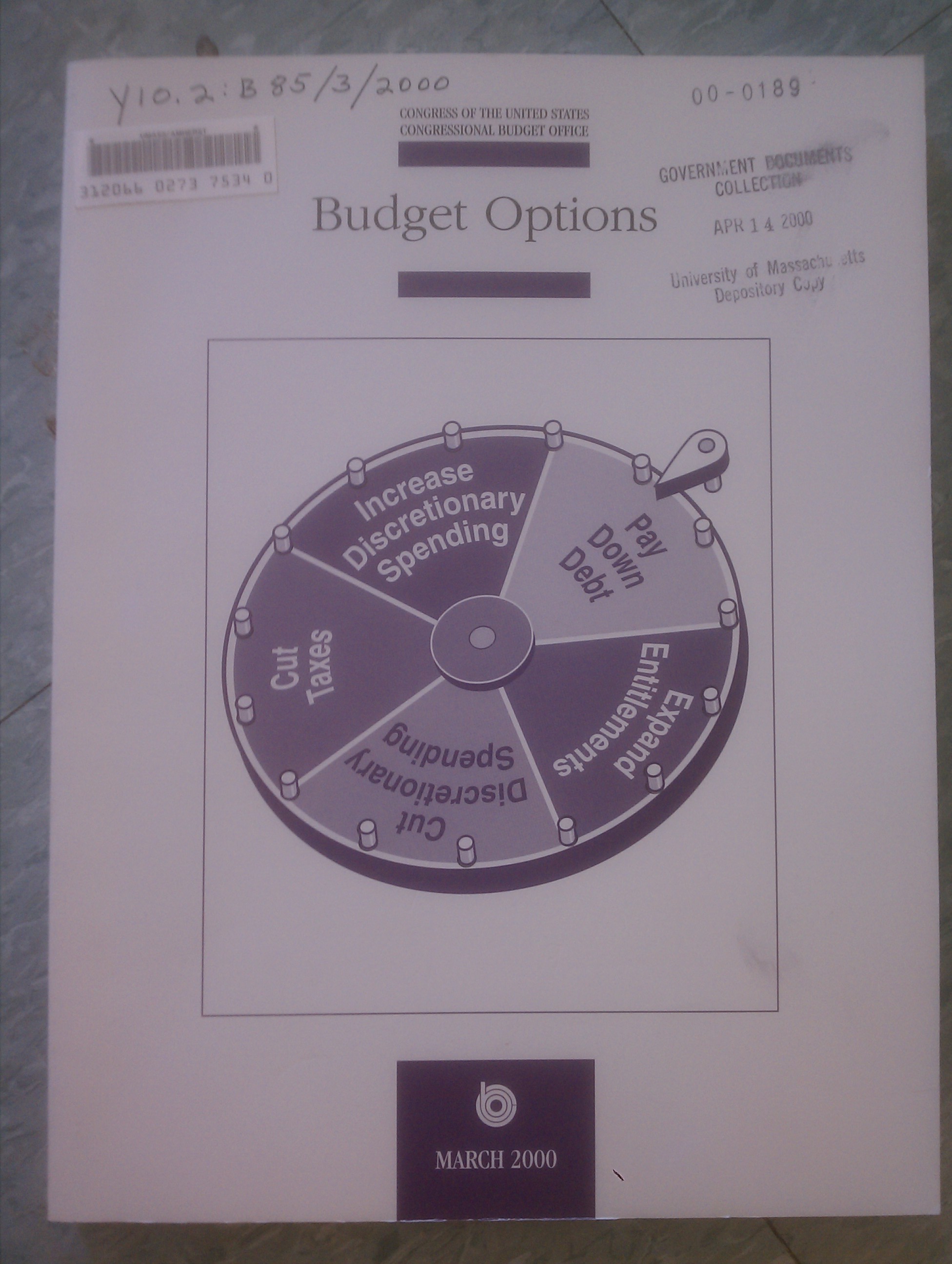
What was the budget debate about eleven years ago?


As you can see, that is the cover of the CBO’s March 2000 Budget Options report. (You can get it online, but without the cover.*) For most of the 1980s and 1990s, this report was called Reducing the Deficit: Spending and Revenue Options; this year’s version has reverted to that title.

The context for the picture above was the budget surpluses of the late 1990s. At the time, the CBO was projecting surpluses for at least the next twenty years, amounting to over $3 trillion in the first decade of the twenty-first century. (See the 2000 Budget and Economic Outlook, Summary Table 1.) And although most of the surpluses were off-budget (surpluses of Social Security payroll tax revenues over benefit payouts), there were supposed to be ten years of on-budget surpluses as well.

We all know what happened next: a (mild) recession, the Bush tax cuts of 2001 and 2003, the Afghanistan and Iraq Wars, and the Medicare prescription drug benefit, among other things. But the question for now is: did those surpluses really exist?

Continue reading “Hoisted from the Archives”

And in This Corner . . .

By James Kwak

Over in the less-prestigious and less-well-paid online section of the Times, Bruce Bartlett has a good column on the comparative tax burden across advanced economies. He makes the point that one reason European taxes look higher is that we provide subsidies through the tax code while they do it through spending programs like family allowances — another example of how aggregate statistics are distorted by calling something a “tax credit” as opposed to “spending.” His other main point is that the main substantive reason why we pay lower taxes is that we pay for less of our health care spending through the government — and that isn’t working out so well for us.