Tag: politics

Symbols and Substance

By James Kwak

Arnold Kling wins the prize for the most erudite post of the past week, a review of The Symbolic Uses of Politics, by Murray Edelman. Kling cites not only Sigmund Freud and J.D. Salinger, but Theodor Adorno and Seymour Lipset (with specific books, not just names), among others.

In Kling’s summary, Edelman divided the political sphere into insiders and outsiders (Kling’s terms). Insiders are basically special interests: small in number but well organized and with specific goals. Outsiders, or the “unorganized masses,” are the rest of us: we have some interests, but we are poorly organized to pursue them and therefore are generally unsuccessful. In particular, Outsiders suffer from poor and limited information, and therefore are especially susceptible to political symbols. In Kling’s words:

“Given these differences, the Insiders use overt political dramas as symbols that placate the masses while using covert political activity to plunder them. What we would now call rent-seeking succeeds because Outsiders are dazzled by the symbols while Insiders grab the substance.”
Continue reading “Symbols and Substance”

The Obama Renaissance

By James Kwak

President Obama is enjoying something of a political resurgence, at least among the commentariat. Ezra Klein points out that his approval ratings remain higher than those of his Congressional opposition, as opposed to Clinton in 1994 and Bush in 2006. In The New York Times, Michael Shear says the lame-duck session of Congress could be a “big win” for Obama, and Matt Bai hails the tax cut compromise as “responsible governance” and says it could lead to a successful presidency.

Obama is certainly in a decent position politically, and I would bet on him to be reelected comfortably in 2012. First off, his opponents in Congress are deeply irresponsible (admittedly: The single most important thing we want to achieve is for President Obama to be a one-term president.”) and face a huge political problem within their own party: a significant portion of the conservative base really does want lower deficits, yet the only thing the Republican caucus knows how to do is cut taxes. Klein points out that the Republicans will eliminate House rules that spending increases or tax cuts have to be offset elsewhere, and will instead say that “tax cuts don’t have to be paid for, and spending increases can’t be offset by tax increases.” Second, the Tea Party and Sarah Palin mean that Obama is likely to face an opponent who has been pulled dangerously close to the lunatic fringe during the primary (or, even better yet, Palin  herself). And third, there’s triangulation.

Continue reading “The Obama Renaissance”

“Washington and the Regulators Are There To Serve the Banks”

By James Kwak

It is too obvious to bear saying, but I’ll say it anyway.

At the urging of the administration, Congress passed a financial reform bill this past summer that expanded the theoretical powers of regulators, but also gave those regulators the power to write the rules implementing the bill and then to enforce the rules. The bill’s sponsors fended off efforts to write specific constraints, whether size limits or leverage limits, into the statute. Yet the bill did nothing that I am aware of to ensure that regulators do a better job than they did last time around, unless you count the creation of a standalone consumer protection agency. (Yes, this is a hard problem with no easy solutions, but ignoring it doesn’t make it go away.)

Now we will see the results. Via Mark Thoma, Andrew Leonard provides the money quote, from incoming House Financial Services Committee chair Spencer Bachus: “in Washington, the view is that the banks are to be regulated, and my view is that Washington and the regulators are there to serve the banks.”

Of course, having written a book that argued that politics is more important than economics, this doesn’t surprise me. Nor does the decision by the Financial Crisis Inquiry Commission’s Republican appointees to deny that the shadow banking system even exists, or to write a dissenting “primer” whose only possible motivation can be captured in Barry Ritholtz’s post, “Repeat a Lie Enough Times . . .” But what frustrated me about the administration’s position over the spring and summer was the idea that, despite this basic fact, they marched forward as if government regulation is a purely technocratic problem that can be solved by simply finding smart men and women of integrity and conscientiousness.

The Moderate Republican Stimulus

By James Kwak

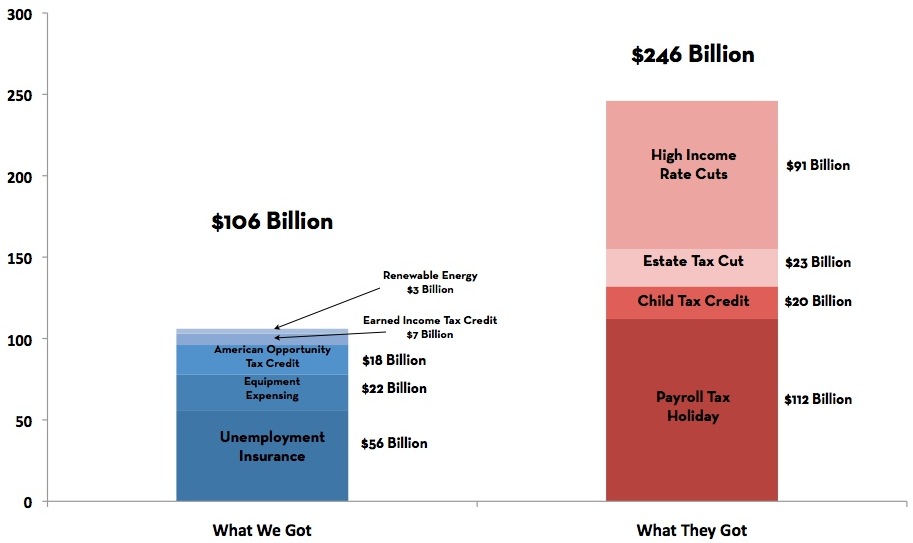
One of the great things about the Internet, as opposed to, say, law school, is that other smart people will do my homework for me. Last week I said that Obama’s position on the tax cuts was a “moderate-Republican line in the sand” and that the tax deal was closer to the Republicans’ ideal outcome than the Democrats’, but the latter argument was based on some guesses about Republican preferences. Now Mike Konczal has done some of the harder argument, uncovering hard evidence that the Republicans would have agreed to the extended child tax credit sweetener anyway and presenting five points for the argument that the Republicans wanted payroll tax cuts – in particular, they wanted them more than Making Work Pay tax credit that they replaced.

Here’s Mike’s version of the administration’s chart:

He calls it the “Moderate Republican Stimulus Package 2.0.”

This American DREAM

By James Kwak

Brad DeLong reminded me that the DREAM Act is being considered by Congress right now and has an outside chance of passage. If you are a Senator on the fence about this issue, or you work for one, you should listen to the last segment of this This American Life episode, starting about forty-six minutes in. It will break your heart.

Oh, and given that opposition has been basically along party lines: aren’t the people who would qualify for citizenship under the act natural Republican voters, anyway? Basically the act would reward people who pull themselves up by their bootstraps, without the benefit of federal aid. Or is that no longer what the Republican Party is about?

Who Wanted What?

By James Kwak

Look, I’m familiar with the argument for the tax cut deal. It’s not a terrible argument. In simple form, it goes, the top priorities are to stimulate the economy and to cushion the impact of unemployment, and a two-year tax cut extension was worth it to get that, especially since we can kill the Bush tax cuts in 2012. Now, no one who wasn’t born yesterday buys that bit about killing the Bush tax cuts in 2012, but you could still make the argument that two years of stimulus is worth making the tax cuts effectively permanent. (I don’t agree, but it’s not a crazy argument.)

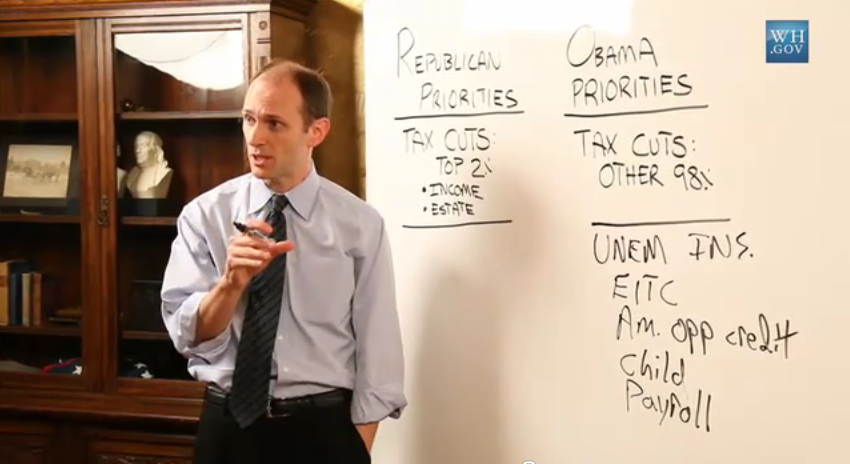
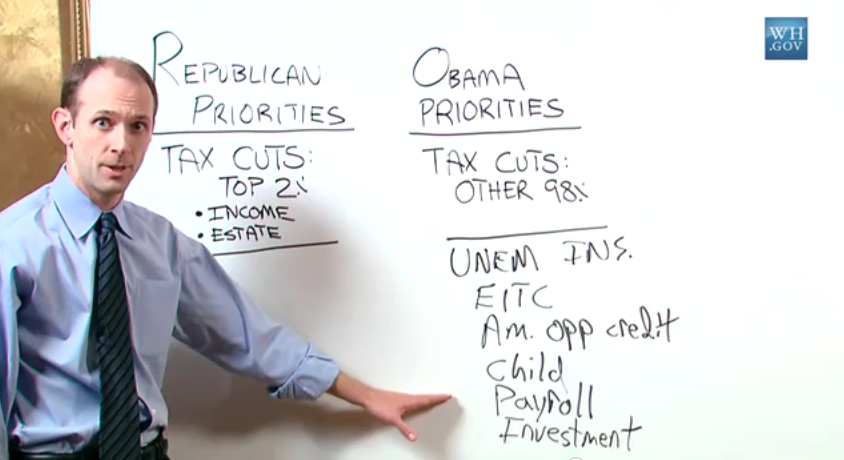
But that’s not Austan Goolsbee’s argument on YouTube.

Here’s his slide:

Continue reading “Who Wanted What?”

Tax Cut Ironies

By James Kwak

From The New York Times:

“Congressional Republicans in recent days have blocked efforts by Democrats to extend the jobless aid, saying they would insist on offsetting the $56 billion cost with spending cuts elsewhere.”

Instead, as it turns out, they agreed to offset the cost with tax cuts elsewhere.

Still, though, I place the blame for this one squarely on the White House. The Republicans are just doing what Republicans do: arguing for lower government spending and lower taxes. The fact that they justify the former by saying it will cut the deficit and the latter by saying it will stimulate the economy (when you could just as easily switch the arguments and make them point the other way) is just a detail.

Continue reading “Tax Cut Ironies”

Dear Mr. President

By James Kwak

There have been (admittedly unclear) indications from your administration that you may accede to the Republicans’ demand to extend the Bush tax cuts for everyone.  I urge you not to do this.

The question is: Is it better to extend the tax cuts for everyone or for no one? The answer is to extend them for no one.

The Bush tax cuts have always overwhelmingly benefited the rich, not the middle class, and that is no less true today than when they were enacted. They were bad policy then and they are bad policy today. Extending the tax cuts would dramatically enrich the wealthy relative to everyone else. 65.5 percent of the total benefit would go to the top quintile by income, 26.8 percent to the top 1 percent, and 14.7 percent to the top 0.1 percent.*

Leaving aside discredited, Reagan-era theories about trickle-down economics, there are two main arguments for extending the tax cuts:

Continue reading “Dear Mr. President”

Is This What You Voted For?

By James Kwak

In What’s the Matter with Kansas? Thomas Frank described how the Republican Party was able to take advantage of the conservative, values-focused, evangelical-driven movement to come to power–and then paid lip service to the priorities of the “base,” instead pursuing policies that helped established business interests and the rich. On a national scale, this was one major reason why conservatives became so disillusioned with George W. Bush.

It’s no surprise to anyone that this is happening again, only substituting “Tea Party” for “evangelical conservatives” and “United States” for “Kansas.”

Spencer Bachus, the likely new chair of the House Financial Services Committee, has announced that he is planning to use whatever powers he can to gut the Dodd-Frank financial reform bill. Why? According to the Financial Times, Bachus “expressed concern that shareholders of Goldman Sachs and JPMorgan Chase will be hurt because the banks will be less profitable.”

So one major effect of the Tea Party movement will be to further enrich Wall Street banks and the bankers who work there. (Which, I guess, is consistent with the common Tea Party insistence on reducing taxes for the rich.)

Is this what you voted for?

(If not, Mike Konczal reminds us that tomorrow is the deadline to submit comments on the implementation of the Volcker Rule.)

The Government Does Have Something To Do with It

This guest post on the relationship of business and government comes to us from Lawrence B. Glickman, chair of the History Department at the University of South Carolina; the author, most recently, of Buying Power: A History of Consumer Activism in America; and an occasional contributor to this blog.

One of the most telling statements of our political era, –made ten years ago this week by Dick Cheney during his Vice Presidential debate with Joe Lieberman on October 5, 2000, –was actually a misstatement that went largely unnoticed. And therein lies an important lesson about the place of government in our political culture.

In response to the Democratic nominee Lieberman’’s jibe that Cheney had profited handsomely from the job he had recently departed as CEO of the Haliburton Corporation, the Republican nominee replied, “”I can tell you, Joe, the government had absolutely nothing to do with it.”” Amid the laughter and applause of the audience, Leiberman chuckled good-naturedly and joked about joining the private sector himself.

Following the debate, media analysts focused on what the New York Times called Cheney’s “avuncular self-confidence” but, like his opponent, they largely passed over the fact that his statement was a whopping lie.  Despite his denial and his antigovernment rhetoric, the company Cheney ran depended on billions of dollars of government contracts and loan guarantees. It would not be an exaggeration to say that government was Haliburton’’s primary source of support.

Continue reading “The Government Does Have Something To Do with It”

The Importance of the 1970s

By James Kwak

It isn’t often that I read two books in a row that both cite Alexis de Tocqueville, probably my favorite Social Studies 10 author (although he was far from my favorite at the time). In Third World America, Arianna Huffington cited Tocqueville’s observation that democracy should promote the interests of “the greatest possible number”; as I pointed out, this is clearly no longer true in America (if it ever was). In Winner-Take-All Politics,* Jacob Hacker and Paul Pierson explain why.

In 13 Bankers, Simon and I argue that the key forces behind the transformation of the financial sector and the resulting financial crisis were political, not simply economic. To this argument, at least two good questions spring to mind: Why finance? And why then? Hacker and Pierson have good answers to both of these questions. Their answer to the latter question is better than (though not inconsistent with) the answer we gave in our book.

Continue reading “The Importance of the 1970s”

Hedge Fund Blindness

By James Kwak

Hedge fund managers may be good at investing money. (Or they may just be the beneficiaries of luck, like successful stock mutual fund managers.) But that doesn’t mean they can think clearly.

Andrew Ross Sorkin comments on the letter by fund manager Daniel Loeb, a former Democratic fundraiser, criticizing the supposed anti-business policies of the Obama administration. The letter includes blather like this:

“As every student of American history knows, this country’s core founding principles included nonpunitive taxation, constitutionally guaranteed protections against persecution of the minority and an inexorable right of self-determination.”

Who, in making a list of America’s founding principles, would put “nonpunitive taxation” first? Oh, right. A hedge fund manager.

Continue reading “Hedge Fund Blindness”

Democracy in America

It appears that Simon beat me to commenting on Third World America, Arianna Huffington’s bleak portrait of many of the things that are wrong with America (crumbling infrastructure, failing schools, extreme inequality, low social mobility, political system captured by special interests, etc.), so I’ll confine myself to a couple of thoughts I had while reading it.*

First, there are these great quotations from Alexis de Tocqueville’s Democracy in America (p. 45 of Huffington’s book):

“Amongst the novel objects that attracted my attention during my stay in the United States, nothing struck me more forcibly than the general equality of condition among the people. . . .

“Democratic laws generally tend to promote the welfare of the greatest possible number; for they emanate from the majority of the citizens, who are subject to error, but who cannot have an interest opposed to their own advantage.”

Continue reading “Democracy in America”

One Paragraph on the Financial Reform Bill

By James Kwak

From Mike Konczal:

“Examples? Off the top of my head, ones with a paper trail: [Treasury] fought the Collins amendment for quality of bank capital, fought leverage requirements like a 15-to-1 cap, fought prefunding the resolution mechanism, fought Section 716 spinning out swap desks, removed foreign exchange swaps and introduced end user exemption from derivative language between the Obama white paper and the House Bill, believed they could have gotten the SAFE Banking Amendment to break up the banks but didn’t try, pushed against the full Audit the Fed and encouraged the Scott Brown deal.”

(By the way, if you’re missing your financial commentary fix during my self-imposed hiatus, I recommend Mike’s blog highly–not that that’s news to anyone anymore.)

Continue reading “One Paragraph on the Financial Reform Bill”