Tag: health care

The Cost of Life

Mark Thoma links to a medical paper that brings up the issue that few people want to talk about: at what point is the cost of medical care to extend life not justified? Like Thoma, I don’t have a great answer, except to point out that in a world of scarce resources, the answer cannot be that any effort to extend life by any small amount is always a good idea. (And as David Leonhardt explained, our health care system is certainly constrained by scarce resources, whether we like it or not.)

I just have one observation and one recommendation.

The observation is that our political and legal systems already put price tags on life routinely. If you die on the job, the workers’ compensation system calculates how much your life was worth; if you are killed as a result of someone else’s negligence, the tort system does the same. In either case, the calculation is primarily based on your expected earnings for the rest of the life; in other words, young high-earners are worth more than old poor people. And for virtually everyone, the number you end up with is much less than the value implied by the cancer treatment discussed in the paper Thoma cites.

I’m no fan of that system. I’m just surprised that as a society we can be so brutal and inegalitarian in one sphere and so touchy in another (health care, where the thought that any life-extending treatment might be too expensive is probably considered morally abhorrent by most people).

The recommendation is that if you are interested in this issue, you should listen to Dr. Robert Martensen on Fresh Air. Martensen is not only a doctor and a bioethicist, but at the time of the interview I believe (my memory might be failing me) he was dealing with the imminent death of one of his parents, and the medical choices involved.

By James Kwak

Debating the Public Plan

Greg Mankiw weighs in directly (as opposed to beating around the bush) on the public plan. Here’s the summary:

Recall a basic lesson of economics: A market participant with a dominant position can influence prices in a way that a small, competitive player cannot. . . .

If the government has a dominant role in buying the services of doctors and other health care providers, it can force prices down. Once the government is virtually the only game in town, health care providers will have little choice but to take whatever they can get. . . .

To be sure, squeezing suppliers would have unpleasant side effects. Over time, society would end up with fewer doctors and other health care workers. The reduced quantity of services would somehow need to be rationed among competing demands. Such rationing is unlikely to work well. . . .

A competitive system of private insurers, lightly regulated to ensure that the market works well, would offer Americans the best health care at the best prices.

Whenever someone uses the phrase “basic lesson of economics” when discussing the U.S. health care system, you should be suspicious. As Paul Krugman says, “the standard competitive market model just doesn’t work for health care: adverse selection and moral hazard are so central to the enterprise that nobody, nobody expects free-market principles to be enough.”

Continue reading “Debating the Public Plan”

Questions about Doctors

Greg Mankiw posts data showing that doctors in the U.S. make much more than doctors elsewhere. From a 1999 paper by Uwe Reinhardt, among others:

As a dollar amount, U.S. per capita spending for physician services was the highest in the OECD in 1999: $988, compared with an OECD median of $342. . . .

In 1996, the most recent year for which data are available for multiple countries, the average U.S. physician income was $199,000. The comparable OECD median physician income was $70,324.* The ratio of the average income of U.S. physicians to average employee compensation for the United States as a whole was about 5.5. Germany’s was the next highest, at only 3.4; Canada, 3.2; Australia, 2.2; Switzerland, 2.1; France, 1.9; Sweden, 1.5; and the United Kingdom, 1.4.

Continue reading “Questions about Doctors”

Modeling Everything, Public Plan Edition

Ezra Klein and Paul Krugman are both highlighting Nate Silver’s analysis of campaign contributions and the public health plan option. The quick summary? Campaign contributions matter – in this case, by about nine senators. Mainly I’m impressed and encouraged that people can use publicly-available data to quickly whip together plausible models answering questions that otherwise we would all just pontificate about.

Coincidentally, I was getting my car inspected this morning and picked up an October 2008 copy of New York Magazine in the waiting room, which had an article about . . . Nate Silver. The article includes a picture of the presidential electoral map as Silver predicted on October 8, in which he called every state correctly except Missouri (which, remember, took a few weeks to figure out whom it had voted for). Most of the article is about how the empirical approach to baseball turns out to be useful in other areas, like politics and public policy.

Update: Mark Thoma points out this counterargument by Brendan Nyhan (who long ago wrote a blog with the brother of one of the best developers at my company). Nyhan says “studies have typically found minimal effects of campaign contributions on roll call votes in Congress,” and cites a Journal of Economic Perspectives paper as backup.

OK, Nyhan may be right. But he may not be.

Continue reading “Modeling Everything, Public Plan Edition”

The McAllen Problem

What is the lesson of McAllen, Texas, the focus of Atul Gawande’s celebrated article (discussed here and here)? This is my attempt at an answer:

Currently, our health care system has high-cost and low-cost areas; the high-cost areas have no better outcomes than the low-cost areas. So theoretically we can solve our health care cost problem by making the high-cost areas behave like the low-cost areas.

However, the market incentives go in the other direction; the economically rational thing for providers (doctors, hospitals, etc.) to do is to run up procedures and thereby costs. It would be better if providers focused more on patient outcomes or organized themselves into accountable care organizations, as Gawande prefers; but there is no economic reason for them to do so. People are not magically going to become more altruistic overnight. Even shame has only a temporary effect on behavior. Here’s Gail Wilensky from a Health Affairs roundtable:

It’s only by being able to offer compelling evidence that it’s the physician that is the outlier relative to his or her peers, that the patients really aren’t different, and in fact they are not having better outcomes, that you are able to pull back physician behavior — although there seems to be a high recidivism rate.

(Emphasis added.)

In some ways McAllen isn’t the aberration; according to the old Chicago economics department, everywhere should be like McAllen.

Remember all the people who said that you can’t blame mortgage brokers and investment bankers for being greedy, because that’s how a capitalist economy works? Well, you could make the same defense for the McAllen doctors. We long ago stopped expecting lawyers and accountants to behave contrary to their economic interests; now we simply expect them to conform to the law and to certain professional codes of conduct, and otherwise make as much money as possible. Why should we expect anything different from doctors?

In a capitalist economy, the thing that is supposed to keep prices in check is the buyers. If someone offers me a product that costs more than it is worth to me, then I won’t buy it. But we can’t count on patients to play this role in health care, because there is no way to make patients internalize all of the costs of their care; they simply don’t have the money. Furthermore, most people don’t understand the health production function (the relationship between treatments and outcomes), so they don’t have the ability to select treatments that provide benefits that are worth their costs. (And, in many cases, it’s not obvious even to professionals that a treatment isn’t worth the cost; it’s only obvious when you look at the data in aggregate.)

What about payers (health insurers?) A “market” solution would be to change the reimbursement rates for different procedures – increase payment for things that doctors should do more of and reduce payment for things that doctors should do less of. Theoretically, payers should be doing this already. However, in the current situation, a private payer who tried to reduce the rates for popular, expensive procedures would find itself unable to attract providers. The only payer with any real negotiating power is Medicare. The private payers have little ability to control costs. Or, if they have the ability, they aren’t exercising it.

In short, prices will only go up. As a result, the cost of health insurance goes up, and the market finally kicks in in the crudest possible form: people who can’t afford it become uninsured. At some point, if we have enough uninsured people, the health care industry will hit a point where it cannot increase revenues anymore, because it has fewer and fewer paying customers.

The proposed public health insurance plan would have the power to negotiate lower rates with providers. That’s why some providers don’t like it. That’s also why private payers don’t like it; they would be at a cost disadvantage to the public plan. (They can live with Medicare because Medicare leaves them the entire under-65 market.) Maybe that’s unfair. But the current situation isn’t working.

By James Kwak
When Market Incentives Lead to Bad Outcomes, Continued

A couple of weeks ago, I wrote a post about Atul Gawande’s New Yorker article about health care spending and outcomes. I didn’t claim to have any particular insight about health care economics; I just thought that people should read his article – which, to summarize greatly, argues that there is no correlation between high spending and good outcomes, because the current system does not motivate doctors to seek good outcomes. (Apparently Barack Obama agreed, since the Times reported that “the article became required reading in the White House.”)

Continue reading “When Market Incentives Lead to Bad Outcomes, Continued”

When Market Incentives Lead to Bad Outcomes

One of our readers recommended a fascinating and important article on health care economics, “The Cost Conundrum,” in The New Yorker. It’s by Atul Gawande, a surgeon and a professor of public health and surgery at Harvard.

Gawande contrasts McAllen, Texas, which has some of the highest health care costs in the country, with El Paso, Texas, a demographically similar city with moderate health care costs, and with low-cost communities such as Rochester, Minnesota (home of the Mayo Clinic) and Grand Junction, Colorado. To simplify greatly, his conclusion is that the medical community in McAllen practices medicine as a business, while the community in Rochester or Grand Junction practices it as a way of improving health. But the aberration isn’t the profit-loving doctors of McAllen; it’s all the doctors who are not out there maximizing profits.

The real puzzle of American health care, I realized on the airplane home, is not why McAllen is different from El Paso. It’s why El Paso isn’t like McAllen. Every incentive in the system is an invitation to go the way McAllen has gone.

And the prognosis is not good:

In the war over the culture of medicine—the war over whether our country’s anchor model will be Mayo or McAllen—the Mayo model is losing. In the sharpest economic downturn that our health system has faced in half a century, many people in medicine don’t see why they should do the hard work of organizing themselves in ways that reduce waste and improve quality if it means sacrificing revenue.

In short, we have a health care system that motivates doctors to behave like businessmen and maximize their revenues from patients. In the long run, those incentives are wearing down whatever ethic of professionalism or feelings of altruism lead doctors to behave differently. But while the pursuit of profit in the free market is supposed to benefit the public – and probably does in most areas – here it has led to an explosion of costs with no measurable improvement in health care outcomes.

Let’s go out on a long excerpt designed to motivate you to read the whole article:

We are witnessing a battle for the soul of American medicine. Somewhere in the United States at this moment, a patient with chest pain, or a tumor, or a cough is seeing a doctor. And the damning question we have to ask is whether the doctor is set up to meet the needs of the patient, first and foremost, or to maximize revenue.

There is no insurance system that will make the two aims match perfectly. But having a system that does so much to misalign them has proved disastrous. As economists have often pointed out, we pay doctors for quantity, not quality. As they point out less often, we also pay them as individuals, rather than as members of a team working together for their patients. Both practices have made for serious problems.

Providing health care is like building a house. The task requires experts, expensive equipment and materials, and a huge amount of coördination. Imagine that, instead of paying a contractor to pull a team together and keep them on track, you paid an electrician for every outlet he recommends, a plumber for every faucet, and a carpenter for every cabinet. Would you be surprised if you got a house with a thousand outlets, faucets, and cabinets, at three times the cost you expected, and the whole thing fell apart a couple of years later? Getting the country’s best electrician on the job (he trained at Harvard, somebody tells you) isn’t going to solve this problem. Nor will changing the person who writes him the check.

By James Kwak

Economics of Sick Days

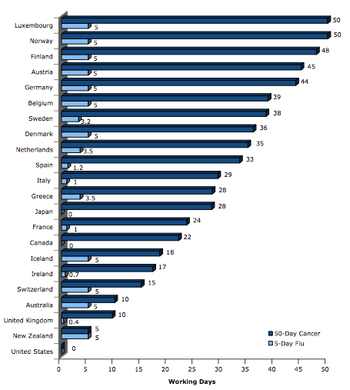
Ezra Klein is one of those bloggers, like Matt Yglesias or Andrew Sullivan, that sometimes make me want to just give up. Yesterday he started a new blog at the Washington Post, and promptly put up fifteen posts on his first day – and not the one line variety, either. Today, he brings us this chart from the Center for Economic and Policy Research:

sickdayschart-thumb-350x390

This is Klein’s explanation:

You’re seeing two things here. The light blue line measures paid sick days. This is what you use if you need to take three days off because you have a fever. The dark blue line is paid sick leave. This is what you use if you need to take three months off because you have cancer. Every other country on the list offers at least one. Most offer both. The United States is alone in guaranteeing neither.

Why does this matter? Because sick people without paid sick days go to work anyway, infecting others and increasing the virulence of epidemics. Or, when it comes to things like the common cold, they simply get more people sick, which sucks for them.

Continue reading “Economics of Sick Days”