Tag: Banking

Guest Post: Too-Big-To-Fail and Three Other Narratives

This guest post is contributed by StatsGuy, one of our regular commenters. I invited him to write the post in response to this comment, but regular readers are sure to have read many of his other contributions. There is a lot here, so I recommend making a cup of tea or coffee before starting to read.

In September, the first Baseline Scenario entered the scene with a frightening portrait of the world economy that focused on systemic risk, self-fulfilling speculative credit runs, and a massive liquidity shock that could rapidly travel globally and cause contagion even in places where economic fundamentals were strong.

Baseline identified the Fed’s response to Lehman as a “dramatic and damaging reversal of policy”, and offered major recommendations that focused on four basic efforts: FDIC insurance, a credible US backstop to major institutions, stimulus (combined with recapitalizing banks), and a housing stabilization plan.

Moral hazard was acknowledged, but not given center stage, with the following conclusion: “In a short-term crisis of this nature, moral hazard is not the preeminent concern.  But we also agree that, in designing the financial system that emerges from the current situation, we should work from the premise that moral hazard will be important in regulated financial institutions.”

Over time, and as the crisis has passed from an acute to a chronic phase, the focus of Baseline has increasingly shifted toward the problem of “Too Big To Fail”.  The arguments behind this narrative are laid out in several places: Big and Small; What Next for Banks; Atlantic Article.

Continue reading “Guest Post: Too-Big-To-Fail and Three Other Narratives”
The Department Of Justice Is On Line Two

I don’t generally overreact to news (from the NYT this morning, on the AIG-Goldman connection that runs through Edward Liddy’s stock ownership), but this has gone far enough. 

Have we completely lost of sense of what is and is not a conflict of interest?  Have we really built a system in which greed fully overshadows responsibility?  Is it not time for a complete rethink of what constitutes acceptable executive behavior?

One of our country’s leading corporate attorneys made a telling point to me on Wednesday night, “the only way to control executive behavior is to criminalize it,” i.e., civil penalties do not change behavior – the prospect of jail time has to be on the table.  His broader point was that antitrust action can make a difference in today’s world, but only if this includes potential criminal charges. Continue reading “The Department Of Justice Is On Line Two”

Bring In The Antitrust Division (On Banking)

In early February I suggested there was a showdown underway between the US Treasury and the country’s largest banks.  Treasury (with the Fed and other regulators) is responsible for the safety and soundness of the financial system, the banks are mostly looking out for their own executives, and the tension between these goals is – by now – quite evident.

As we’ve been arguing since the beginning of the year, saving the banking system – at reasonable cost to the taxpayer – implies standing up to the bankers.  You can do this in various ways, through recapitalization if you are willing to commit more taxpayer money or pre-packaged bankruptcy if you want to try it with less, but any sensible way forward involves Treasury being tough on the biggest banks.

The Administration seems to prefer “forbearance”, meaning you just ignore the problem, hope the economy recovers anyway, and wait for time or global economic events to wash away banking insolvency concerns.  But this strategy is increasingly being undermined by the banks themselves – their actions threaten financial system stability, will likely force even greater costs on the taxpayer, and demonstrate fundamentally anticompetitive practices that inflict massive financial damage on ordinary citizens. Continue reading “Bring In The Antitrust Division (On Banking)”

Calling All Shareholders

If you cast your mind back to when executive compensation and bonus limits first reached the mainstream debate, you may recall people saying these would be ineffective and the issue is a red herring.

These points do not now seem compelling.  People who work at the big banks are quite irked by what they see as unjustified limits on their bonuses.  Some of the “talent” is jumping ship.  Big bank leadership is lobbying hard to remove the restrictions or, failing that, for the right to pay back government TARP funds in order to escape the bonus cap – leading firms, such as Goldman Sachs, seem poised to raise new capital to that end.

This is a remarkable moment.  Excessive risk taking in large firms was based on inappropriate bonus structures (take risk and get compensated now; face the consequences of that risk down the road), facilitated by a deep failure to understand/control risk inside these organizations and probably made possible by the implicit put option from being too big or too complex to fail (i.e., Wall Street insiders own the upside; taxpayer owns the downside).  We have all focused of late on the costs for taxpayers, which of course are horrible, and going forward – with the implicit option now explicit – who can believe this will lead to anything other than further massive bailouts?

But think about this arrangement from the perspective of shareholders.  Are we looking at the greatest tunneling scheme in the history of organized finance? Continue reading “Calling All Shareholders”

What Next For Banks?

The case for keeping banks in something close to their current structure begins to take shape.  It’s not about traditional claims that big banks are more efficient, or Lloyd Blankfein’s argument that this is the only way to encourage risk-taking, or even the House Financial Services Committee view that immediate resumption of credit flows is essential for preserving jobs. 

Rather, the argument is: those opposed to banks and bankers are angry populists who, if unchecked, would do great damage.  Bankers should therefore agree to some mild reforms and more socially acceptable behavior in the short-run; in return, the centrists who control economic policymaking will protect them against the building backlash.  This is a version of Jamie Dimon’s line: “if you let them vilify us too much, the economic recovery will be greatly delayed.”

There are three problems with this argument: it is wrong, it won’t work, and it doesn’t move the reform process at all in the right direction. Continue reading “What Next For Banks?”

What the IMF Would Tell the United States, If It Could

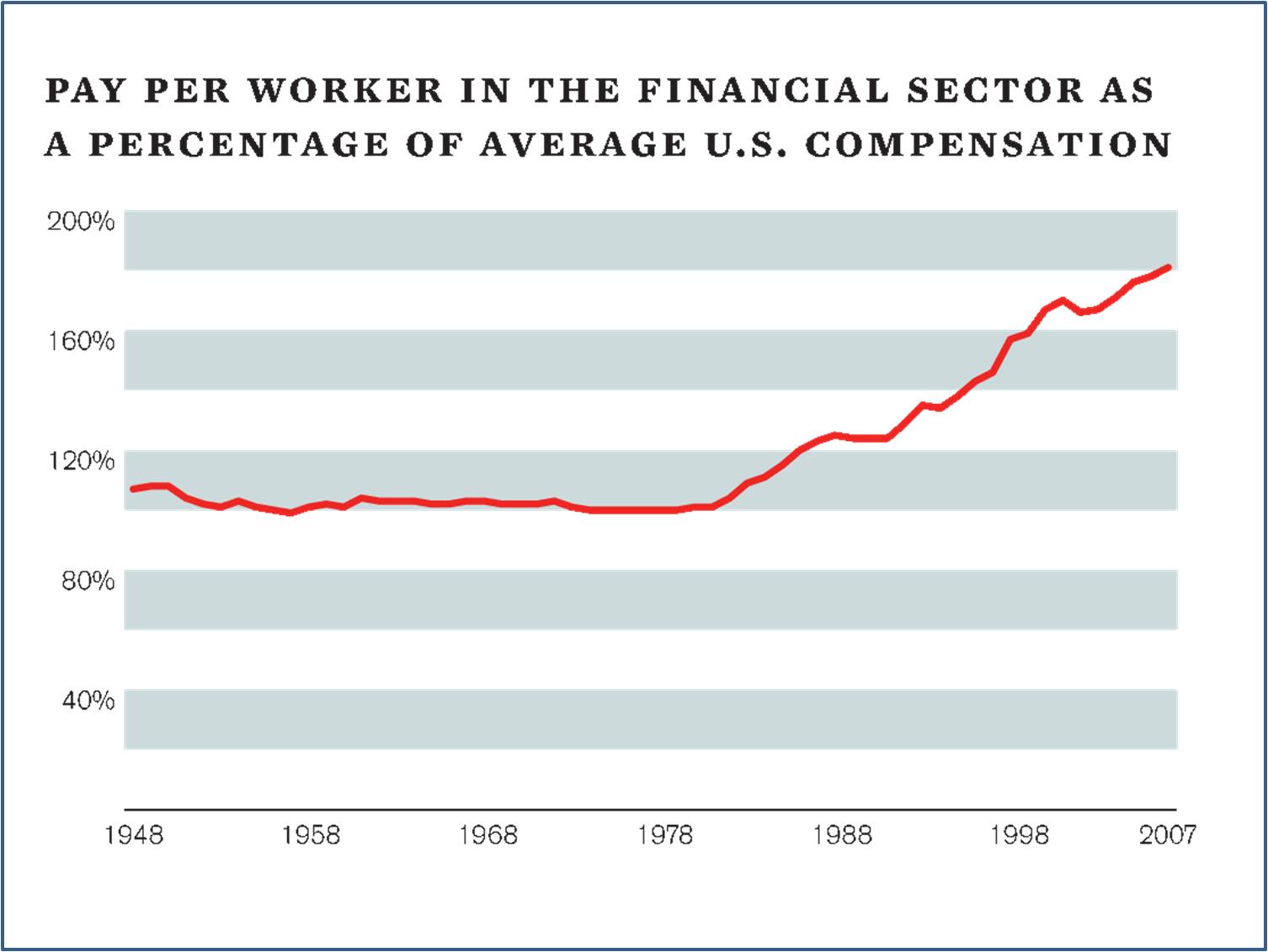
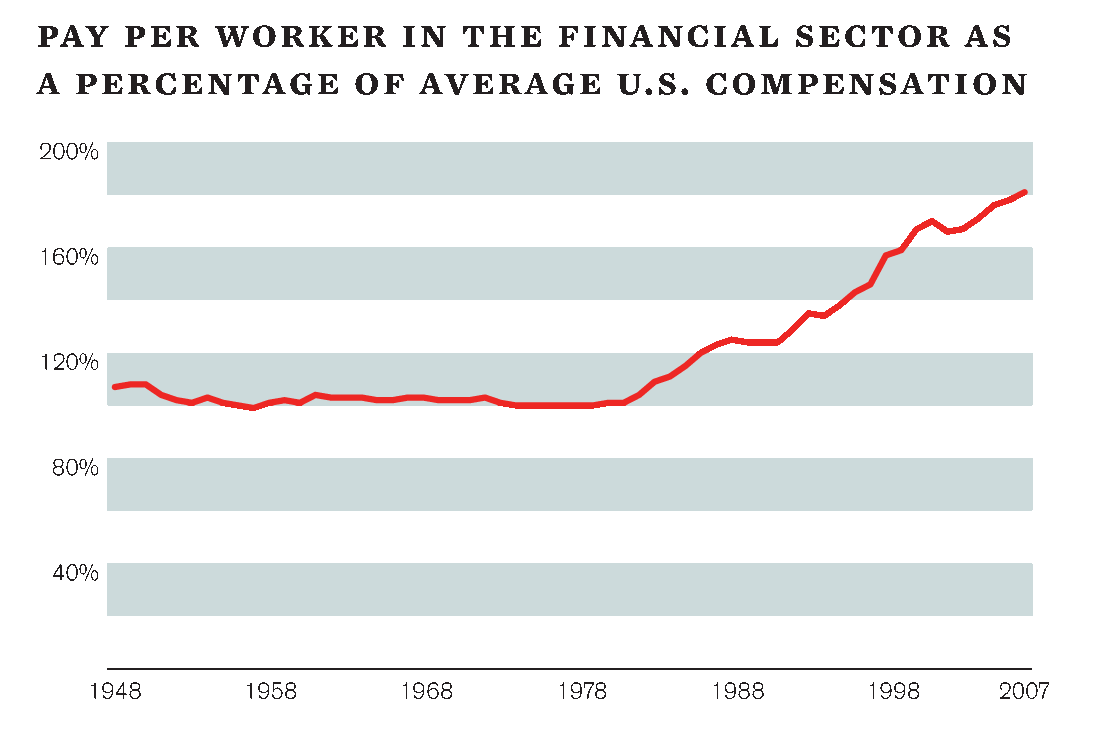
From 1945 until around 1980, the financial sector was one industry among many in the United States. Then something happened.

compensation4

People in finance started making more money,* jobs in finance became more desirable, financial institutions became more influential, and the linkages between the financial sector and the political establishment became stronger. At the same time that our financial sector became more leveraged and more risky, it also became more powerful. The result was a confluence of interests between Wall Street and Washington – one more normally found behind the scenes of emerging market crises, the kind the IMF is called on to resolve.

Simon and I tell this story – and the story of what happened next – in “The Quiet Coup,” an article in the May issue of The Atlantic. (Many thanks to The Atlantic for putting the online copy up as early as they did.) The working title of the article was, “What the IMF Would Tell the United States, If It Could.” Enjoy.

* The data in that chart are from Table 6.6 of the National Income and Product Accounts tables available from the Bureau of Economic Analysis.

Update: Henry Seggerman recently sent us an article he wrote in 2007, comparing the Korean crisis of 2007 to the then-current situation in the United States. He discusses not only the economic similarities, but also some of the political ones.

Update 2: A reader sent us an article about Mark Patterson, formerly Goldman’s chief lobbyist and now Tim Geithner’s chief of staff. Unfortunately, the article was published too late for us to use any of it in our Atlantic article.

By James Kwak

Political Will: Bernanke On The True Cost Of Banking

Stabilization programs in emerging markets often come down to this: the government needs to do something unpopular, e.g., reduce some subsidies, privatize an industry, or eliminate the crazy credit that goes to oligarchs – no one likes oligarchs, but their factories employ a lot of people.  There is naturally resistance – pushback from legislators, riots in the streets, or oligarchs calling their friends in the US foreign policy establishment.  The question becomes: does the government have the “political will” to get the job done?

In fall 1997, a key issue for Indonesia’s IMF program was whether the government could close the banking operations belonging to one of President Suharto’s sons.  There was an epic and fascinating struggle and, in the end, the government did not have sufficient political will or power.  The subsequent loss of US support, and further currency and economic collapse is (messy and painful for many) history.

It is striking that Ben Bernanke now asks whether the United States today has sufficient political will. Continue reading “Political Will: Bernanke On The True Cost Of Banking”

Everyone Has a Banking Plan Now

Another day, another banking plan, this one from two senior partners at McKinsey and Company, which may be the most influential company you may never have heard of.

The authors recognize the toxic-asset pricing problem: If the government buys them at market value, the banks become insolvent instantly; if the government pays book value, it is paying a massive subsidy. They also recognize the rough scale of the problem, predicting another $1 trillion in writedowns. And here’s the proposal:

[W]e propose that the government step in and establish a voluntary program to create a real market price and terms for the sale of bad assets. Rather than use modeling for valuation, the program would set discounts from either of the two basic approaches to accounting value [fair value and “hold-to-maturity,” which isn’t quite accurate, but that doesn’t matter], based on some recent past date (for instance, December 31, 2008). A reasonable level might be 10 percent off for securities already marked to fair value and 20 percent off for loans being held to maturity. Upon their sale to the government, existing shareholders would absorb the loss taken on the discount, and that loss of common stock value would be replaced by converting TARP preferred stock to nonvoting common (which would be vested with voting rights if sold to private parties).

Continue reading “Everyone Has a Banking Plan Now”

Whatever Did The CDS Market Mean By That?

The credit default swap market is a modern Delphic Oracle.  It speaks loudly and profoundly – these days at regular intervals – albeit using somewhat arcane terminology.  And after major statements such as yesterday (or perhaps this week in general), it’s worth pausing to reflect on, and argue about, what it really means.

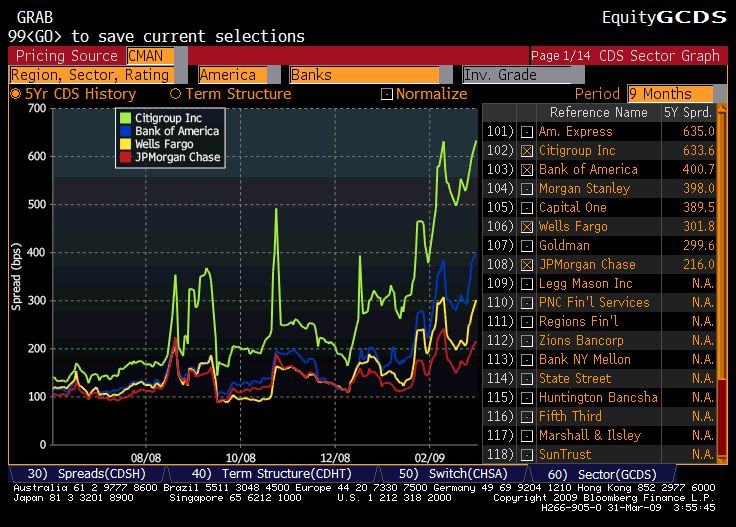
Thursday’s statement, to me, was about US banks (graph).

The risk of default for US banks, according to this market, is rising back towards levels not seen since mid-October.  That is striking enough – but remember what has changed since then: (1) the G7 promised not to let any more systemic banks fail, (2) Treasury has provided repeated recapitalization funds on generous terms, and (3) the Fed offers massive, nontransparent funding to anyone in distress.  How can it be that the credit market still or again feels the risk of default rising so sharply and to such high levels? Continue reading “Whatever Did The CDS Market Mean By That?”

Confusion, Tunneling, And Looting

Emerging market crises are marked by an increase in tunneling – i.e., borderline legal/illegal smuggling of value out of businesses.  As time horizons become shorter, employees have less incentive to protect shareholder value and are more inclined to help out friends or prepare a soft exit for themselves.

Boris Fyodorov, the late Russian Minister of Finance who struggled for many years against corruption and the abuse of authority, could be blunt.  Confusion helps the powerful, he argued.  When there are complicated government bailout schemes, multiple exchange rates, or high inflation, it is very hard to keep track of market prices and to protect the value of firms.  The result, if taken to an extreme, is looting: the collapse of banks, industrial firms, and other entities because the insiders take the money (or other valuables) and run.

This is the prospect now faced by the United States. Continue reading “Confusion, Tunneling, And Looting”

The Smell Of Coffee

The late Rudi Dornbsuch of MIT had a way of cutting to the chase, preferably in public and with a minister of finance present.  He knew a huge amount about financial crisis, and could distill a lifetime of study and involvement in collapses succinctly: “it always takes longer than you think; but when it happens, it always happens faster than you can imagine.”

The latest credit default swap data for European banks bring Rudi’s perspective to mind – for the United States.  We’ve debated this week what to do about U.S. banks, arguing about which unappealing options are less bad.  In my view, the choice is not “nationalize vs. don’t nationalize,” but rather “keep our current partial nationalization/bottomless pit subsidy system vs. start down the road to reprivatization.”

But, honestly, this entire debate may be overtaken by events.  Continue reading “The Smell Of Coffee”

Listening To The Secretary

Secretary Geithner spoke with NPR’s Adam Davidson today and the result, on the Planet Money podcast, is a helpful guide to official thinking.

The Secretary’s best line, at around the 18 minute mark is, “If you underestimate the problem; if you do too little, too late; if you don’t move aggressively enough; if you are not open and honest in trying to assess the true cost of this; then you will face a deeper long (sic) lasting crisis.”  Continue reading “Listening To The Secretary”