Filling the Financial Regulatory Void

This guest post was contributed by Bond Girl, a frequent commenter on this site and author of The Bond Tangent, a very good blog on the esoteric but important world of municipal bonds. I invited her to write it after reading her comments on the topic of financial regulation on this post.

In June, the Obama administration released a report outlining various financial regulatory reforms. The proposed reforms are intended to meet five objectives, essentially: (1) to eliminate regulators’ tunnel vision; (2) to regulate certain financial products and market participants that have so far evaded supervision; (3) to protect consumers from unfair and deceptive sales practices; (4) to provide a framework for responding to financial crises and the failure of major financial institutions; and (5) to promote these efforts globally. Much of the subsequent policy debate has been focused on whether or not the reforms detailed in the report address these objectives. This is a political triumph for the administration because it distracts from the report’s one glaring omission – how to address a culture of sustained affinity between the supervisors and the supervised.

The administration’s proposal appears to portray the financial crisis as nothing more than an accident of reasoning. Because financial regulation in our country evolved in a fragmented manner, regulators’ perceptions of risk were determined by their respective niches when a holistic understanding of risk was required to predict a market failure of this magnitude. It logically follows then that the administration’s preference would be to create a meta-regulator (in this case, by extending the powers of the Federal Reserve and establishing an advisory council) to oversee the supervisory project as a whole and seek out system-wide threats.

Continue reading “Filling the Financial Regulatory Void”

The Problem That Won’t Go Away

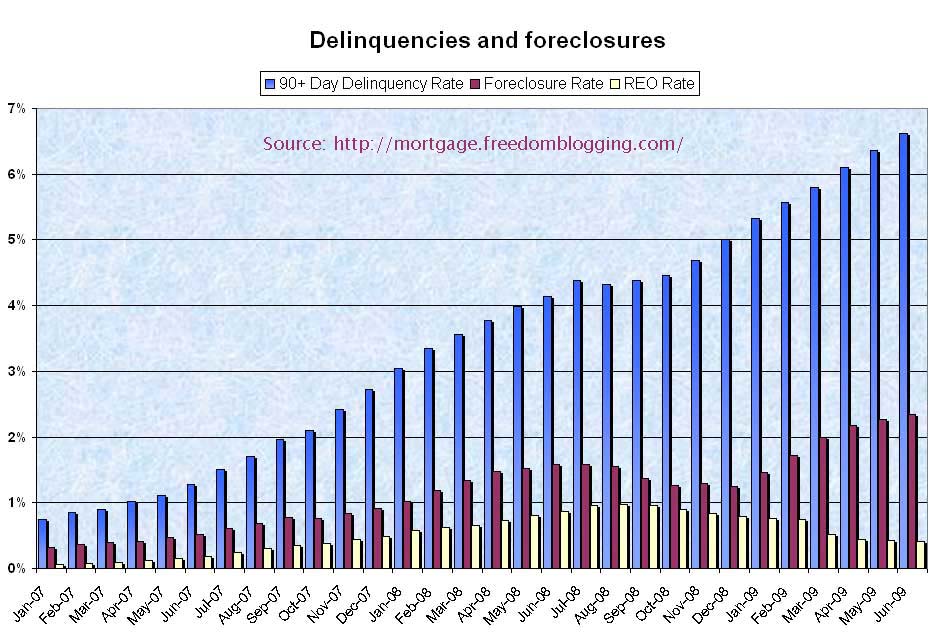
With everyone hoping for positive GDP growth in Q3 and Goldman Sachs analyst Jan Hatzius now predicting growth at an annual rate of three percent in the second half of the year, the banks, investors, and politicians are all hoping that that nasty problem of foreclosures would just go away already. Unfortunately for everyone – especially the people losing their houses – there’s no reason for it to go away.

Unemployment is always a lagging indicator, and given the record low number of average hours worked, it will turn around especially slowly this time. Until then, people will continue to lose their jobs and wages will remain flat, and any small rebound in housing prices is unlikely to help more than a few people refinance their way out of unaffordable mortgages. So unless the other part of the equation – monthly payments – changes, the number of foreclosures should just continue to rise.

Calculated Risk provides this great chart from Matt Padilla (see the CR post for definitions of the categories):

90-day-chart-big

Continue reading “The Problem That Won’t Go Away”

How To Blow A Bubble

Matt Taibbi has rightly directed our attention towards the talent, organization, and power that together produce damaging (for us) yet profitable (for a few) bubbles.  Most of Taibbi’s best points are about market microstructure – not the technological variety usually studied in mainstream finance, but more the politics of how you construct a multi-billion dollar opportunity so that you can get in, pull others after you, and then get out before it all collapses.  (This is also, by the way, how things work in Pakistan.)

In addition, of course, all good bubble-blowing needs ideology.  Someone needs to persuade policymakers and the investing public that we are looking at a change in fundamentals, rather than an unsustainable and dangerous surge in the price of some assets.

It used to be that the Federal Reserve was the bubble-maker-in-chief. In the Big Housing Boom/Bust, Alan Greenspan was ably assisted by Ben Bernanke – culminating in the latter’s argument to cut interest rates to zero in August 2003 and to state that interest rates would be held low for “a considerable period”.  (David Wessel’s new book is very good on this period and the Bernanke-Greenspan relationship.)

Now it seems the ideological initiative may be shifting towards Goldman Sachs. Continue reading “How To Blow A Bubble”

Larry Summers, Economic Recovery, And Ben Bernanke

In a memo to Congress on Tuesday, Larry Summers – the head of the White House National Economic Council – laid out his view of where we are and what is likely to happen next in our economic recovery.

His tone was more upbeat than we’ve heard in recent utterances, although he has been heading in this direction for a while – contrast this April speech with this appearance in July.

What is beginning to turn the economy around?  Summers claims great effects from the fiscal stimulus Recovery Act, but much of that money has not yet been spent. 

He also puts weight on “an aggressive effort to tackle the foreclosure crisis.”  There have been sensible steps in that direction, but so far the effects have been decidedly modest.

The main explanation has to be that the administration prevented the financial system from collapsing.  In an economy as large and diverse as that of the United States – with much more government spending than at the time of the Great Depression – as long as the entire provision of credit does not disintegrate, we will recover.

Summers refers to “A Financial Stabilization Plan”, but this is ex post grandiosity.  In fact, the government simply demonstrated unflinching support for all big financial firms as currently constituted.  We the taxpayer effectively guaranteed all these firms debts, unconditionally.  Once the market figured out that the Treasury, Federal Reserve and other officials could pull this off, the panic was over.

But this victory brings also real danger. Continue reading “Larry Summers, Economic Recovery, And Ben Bernanke”

You Do Not Have Health Insurance

Right now, it appears that the biggest barrier to health care reform is people who think that it will hurt them. According to a New York Times poll, “69 percent of respondents in the poll said they were concerned that the quality of their own care would decline if the government created a program that covers everyone.” Since most Americans currently have health insurance, they see reform as a poverty program – something that helps poor people and hurts them. If that’s what you think, then this post is for you.

You do not have health insurance. Let me repeat that. You do not have health insurance. (Unless you are over 65, in which case you do have health insurance. I’ll come back to that later.)

Continue reading “You Do Not Have Health Insurance”

My Dog, and Your Next Dog

Economics bloggers have their side interests. Felix Salmon has cycling. Tyler Cowen has restaurants. Yves Smith has cute pictures of animals (see the “antidote du jour” in any Links post). Mine is dogs.

047_22

My dog died on Wednesday last week at the age of sixteen. We loved him like a child, which I know to be true now that I have a child. He made me a better, happier, more generous person.

My wife and I adopted Dauber at the age of eight, after his first family gave him up because they didn’t have time for him. He was what you would call “hard to place” – besides being relatively old, he barked a lot, hated other dogs, and didn’t particularly like people. He also had many medical problems, beginning with bladder stones and damaged vertebrae (when we got him) through pancreatitis and congestive heart disease. I think it’s highly likely that if we hadn’t adopted him he would have been euthanized eight years ago.

But the lesson, and the reason for this post, is that Dauber gave us as much joy as any being could have given us. So the next time you are looking for a dog (or other animal companion), please visit an animal shelter and see if you could adopt a dog who has been given up and needs a home, rather than going to a breeder and increasing demand for puppies when so many dogs already need families. And please consider adopting a dog who is hard to place, maybe one who is getting on in years and isn’t as cute as a newborn puppy.

In our area, we like and are making a donation to the Dakin Pioneer Valley Humane Society. There are also various sanctuaries and shelters throughout the country for animals who have trouble finding families, but I don’t know any well enough to recommend them; you could contact the Humane Society of the United States and ask if they have suggestions.

Thanks for reading.

By James Kwak

John Dugan: Consumer Advocate Or Bank Defender?

In a quote potentially for the ages, John C. Dugan, Comptroller of the Currency since 2005, told the Senate Banking Committee yesterday, enforcement of consumer protection laws “should stay with the bank regulators, where it works well.”

This is a bold statement.  Does Mr. Dugan have any evidence to support the idea that consumer protection vis-à-vis financial products currently works well?  A close reading of his written testimony to the Senate Banking committee reveals none.

In fact, his whole testimony sounds like it comes from a parallel universe – one that did not just experience the biggest banking crisis in world history. Continue reading “John Dugan: Consumer Advocate Or Bank Defender?”

Piling On

As every major economics blog has already reported, Brad Setser is walking away from his blog to work for the National Economic Council. Setser’s blog was one of the best at actually providing original information and analysis (data, even) you couldn’t get anyplace else; the only other competitor in that category that springs to mind is Econbrowser. It was the first place I looked when I had a question about the trade deficit, the Chinese-American economic relationship, or foreign currency reserves. We’ll all be worse off as bloggers, hopefully better off as citizens of the United States.

By James Kwak

The Republican Consumer Financial Protection Plan

Last week, Simon criticized Jeb Hensarling’s article on the Republican approach to consumer financial protection, saying “the only tools they propose are those that have been tried and failed, repeatedly, in the recent past.” However, Simon couldn’t get a copy of the Republican plan at the time, so he asked for help. Sean West of the Eurasia Group helpfully tracked down the latest copies of the documents, which were in the public domain: section-by-section summary; draft bill.

And … there’s nothing there.

Continue reading “The Republican Consumer Financial Protection Plan”

Community Banks, Part Three

This morning, Simon asked why community banks seem to be opposing the Consumer Financial Protection Agency. Felix Salmon agrees that community banks should be in favor of the CFPA, for three reasons: (1) the CFPA should increase the cost of complexity, not the “boring banking” that community banks are typically thought to do; (2) the CFPA should level the playing field with predatory lenders, saving community banks from the choice of losing market share or becoming predatory lenders themselves; and (3) the CFPA should shift competition from finding hidden ways to gouge customers to traditional underwriting, which should be a community bank strength. He later adds (4) the big banks’ big advantage is in deceiving customers, which the CFPA should be able to rein in.

Salmon thinks there are still two reasons why community banks may be afraid of the CFPA:

I think it’s a combination of fear of the unknown, on the one hand, and fear of the big banks, on the other. Since every regulator to date has been successfully captured by Wall Street, it’s reasonable to assume that the CFPA might end up being captured by Wall Street too. In which case the burdens of the CFPA might end up being borne disproportionately by smaller community banks.

Continue reading “Community Banks, Part Three”

Who Should Hide Behind the Regulatory Shield?

This guest post was contributed by Ilya Podolyako, a recent graduate of the Yale Law School, where he was co-chair of the Progressive Law and Economic Policy reading group with James Kwak.

The development of the news coverage of high-frequency trading has been quite interesting. The story started out with a criminal complaint that Goldman Sachs lodged against Sergey Aleynikov, a former employee who allegedly stole some secret computer code from the Goldman network before departing for a new job in Chicago. Incidentally, Mr. Aleynikov appeared to be headed to Teza Technologies, a company recently started by Mikhail Malyshev, who had previously been in charge of high frequency and algorithmic trading at Citadel, a Chicago-based hybrid fund. Immediately after the report leaked, Citadel began investigating Mr. Malyshev’s departure and filed a lawsuit to prevent him from getting his nascent business off the ground. From these facts, some reporters inferred that the surprisingly public maneuvers of two notoriously secretive finance giants vis-à-vis seemingly routine personnel matters showed that Aleynikov had tapped into the gold mine of precious proprietary trading software.

That was two weeks ago. At this point, the story has crescendoed. The New York Times ran a report on high frequency trading. The Economist published a piece on the same topic. Senator Schumer (D-NY) requested that the SEC investigate the matter and the agency acquiesced.

The cynical perspective on these events is that both Schumer’s and Mary Schapiro’s moves with respect to algorithmic trading show that the issue is a red herring. As the argument goes, neither of these actors would touch the practice if it actually underpinned Goldman’s record profits or Citadel’s outstanding performance in 2004-2006. If, however, banning the practice would eliminate a few small hedge funds and create the appearance of revising market frameworks without threatening the big players (a regulatory brush fire of sorts), high-frequency trading would form the perfect political target.

Continue reading “Who Should Hide Behind the Regulatory Shield?”

Why Don’t The Community Banks Get It?

The continuing ability of Big Finance to play our elected representatives, and thus the taxpayer, should surprise no one.  This is about organized money against relative diffuse public interests.  It’s Mancur Olson’s Logic of Collective Action meets sophisticated media managers with experience in emerging market crises – they know that as long as you can look confident and pump in money, everything turns around and people forget (and then you can re-run the show).

More puzzling is the reluctance of other well-organized interest groups to act against Big Finance.  In particular, powerful business groups – like Independent Community Bankers of America – understand very well what happened and the way in which are largest banks were responsible.  Yet they refuse to push for regulatory reform, either in broad terms or with regard to consumer protection (e.g., see their policy statements; recent testimony).

Their reasoning is fascinating but completely wrong. Continue reading “Why Don’t The Community Banks Get It?”

Who Is Too Big To Fail? (Weekend Comment Competition)

In 2004, Brookings  published “Too Big To Fail: The Hazards of Bank Bailouts” by Gary Stern and Ron Feldman (paperback edition 2009).  There is a great deal of sensible thinking in this book, as well as much that now seems prescient – particularly as they have been presenting and publicly debating these ideas at least since 2000.

Some of it also seems a bit dated, but in an interesting way that tells us a great deal about how far we have come.

On the basis of their qualitative assessment, reading of the regulatory tea leaves, and a deep understanding of the available data, Stern and Feldman construct several lists of banks that may be considered (in 2004) Too Big To Fail.  The most interesting names and numbers are in Box 4-1 (scroll to p.39 in this Google Books link) (update: or look at this pdf version), entitled Organizations Potentially Considered Large Complex Banking Organizations.

Here’s this weekend’s competition. Continue reading “Who Is Too Big To Fail? (Weekend Comment Competition)”

Telecom “Innovation”

NewYork Times technology columnist David Pogue is mounting a campaign against those canned messages that cellular carriers play after the greeting on your mobile phone voicemail (hat tip Mark Thoma’s son) – you know, the ones that say “to leave a voice message, wait for the beep,” only they take 30 seconds doing so, for th sole purpose of chewing up the mobile phone minutes of the person calling you. (According to Pogue, multiple carrier executives have admitted that the sole purpose of these value-destroying messages is to maximize airtime and hence revenue.)

This is exactly the same kind of “innovation” that we’ve seen in financial services and in health insurance. In each case, it’s what you get when you have too much concentration, so that a small group of oligopolists can effectively agree on the same business practice that generates profits at the consumer’s expense.

Continue reading “Telecom “Innovation””

The Value of (Not Having) the Public Plan

This guest post was written by Arindrajit Dube, an economist at UC Berkeley Institute for Research on Labor and Employment who is joining the Department of Economics at the University of Massachusetts, Amherst. His work focuses on labor and health economics topics, as well as political economy.

Why have pivotal members of the Congress been reluctant to allow individuals the choice to buy into a public health insurance option? A political-economic reason is that the “bipartisan” group of six senators responds more to the interests of health insurance companies than public opinion, including the median voter. While this is hard to assess directly (although we do know they receive substantial campaign finance from insurance companies), we can however observe the effects of (a somewhat unanticipated) decision they made on those who stand to privately benefit from that decision.

Here is how the share prices of three major insurance companies (Cigna, United Healthcare Group, Aetna) responded on Tuesday, July 28 to the Monday night announcement that the group of six senators is going to eliminate the public option from their version of the health care reform legislation [graph produced using Yahoo Finance]. We have basically an 8-10 percent gain for these companies from the Senate announcement. And as the graph below shows, the S&P 500 index (yellow) was essentially flat. The market caps of these three companies together are around $53 billion, which suggests a $4-5 billion value from the announcement by the group of 6.

publicplan

Continue reading “The Value of (Not Having) the Public Plan”