Krugman: No Bill Is Better Than a Weak Bill

By James Kwak

Paul Krugman begins this morning’s column this way:

“So here’s the situation. We’ve been through the second-worst financial crisis in the history of the world, and we’ve barely begun to recover: 29 million Americans either can’t find jobs or can’t find full-time work. Yet all momentum for serious banking reform has been lost. The question now seems to be whether we’ll get a watered-down bill or no bill at all. And I hate to say this, but the second option is starting to look preferable.”

Krugman says he would be satisfied with the House bill, but that the need to bring moderate Democrats and at least one Republican on board in the Senate could lead to a severely watered-down bill, in particular one without a Consumer Financial Protection Agency. Instead of accepting such a deal, he says:

“In summary, then, it’s time to draw a line in the sand. No reform, coupled with a campaign to name and shame the people responsible, is better than a cosmetic reform that just covers up failure to act.”

Continue reading “Krugman: No Bill Is Better Than a Weak Bill”

An Underfunded Program For Greece

By Peter Boone and Simon Johnson

The EU, led by France and Germany, appears to have some sort of financing package in the works for Greece (probably still without a major role for the IMF).  But the main goal seems to be to buy time – hoping for better global outcomes – rather than dealing with the issues at any more fundamental level.

Greece needs 30-35bn euros to cover its funding needs for the rest of this year.  But under their current fiscal plan, we are looking at something like 60bn euros in refinancing per year over the next several years – taking their debt level to 150 percent of GDP; hardly a sustainable medium-term fiscal framework.

A fully credible package would need around 200bn euros, to cover three years.  But the moral hazard involved in such a deal would be immense – there is no way the German government can sell that to voters (or find that much money through an off-government balance sheet operation). Continue reading “An Underfunded Program For Greece”

“Every Moment Counts”

By James Kwak

No, it’s not a line from a pop song. It’s part of my hopeless, Luddite anti-smart phone campaign. This is from an interview with Tachi Yamada, president of the Bill & Melinda Gates Foundation’s Global Health Program.

“When you actually are with somebody, you’ve got to make that person feel like nobody else in the world matters. I think that’s critical.”So, for example, I don’t have a mobile phone turned on because I’m talking to you. I don’t want the outside world to impinge on the conversation we’re having. I don’t carry a BlackBerry. I do my e-mails regularly, but I do it when I have the time on a computer. I don’t want to be sitting here thinking that I’ve got an e-mail message coming here and I’d better look at that while I’m talking to you. Every moment counts, and that moment is lost if you’re not in that moment 100 percent.”

Yamada is just one person; because he feels this way doesn’t prove that you should, too. But I bet some of you will agree with him, and will start switching your BlackBerrys off when you are talking to other people. But over time, you will find yourself leaving it on, and then you will find yourself surreptitiously checking it under the table. It’s like chocolate ice cream; it’s too hard to say no to.

Financial Innovation, Again

By James Kwak

I’ve had Robert Litan’s recent paper defending most financial innovation (the web page doesn’t tell you much; you need to grab the PDF) on my to-do list for a while now. I wasn’t looking forward to writing about it, since I’m a bit tired of the subject, and I don’t think I have much more to say. So thankfully Mike Konczal beat me to it, in a two-part series. Part I is really brilliant, and has not one but two insights. The first (to simplify) is that we generally think of innovation in products as making them simply better on all dimensions. We don’t realize that, with most new financial products, we are just getting to a new point on the risk-reward spectrum that wasn’t there before. Now, it might be good for the economy as a whole for that new point to exist. But as consumers, we don’t realize that the good properties of a new financial product are almost invariably counterbalanced by some bad properties.

The second insight is that real, good financial innovation does not look like a new product; it looks like a new way of dealing with an existing product. Konczal’s example is TRACE, a recent system for increasing transparency in the market for corporate bonds (you’ll have to read his post for a more complete description). The effect has largely been to make pricing more transparent and reduce spreads, which is good for investors. More broadly, as Felix Salmon said somewhere (probably many times), financial innovation should show up as lower prices for all the bread-and-butter financial products–equity and debt underwriting, interest rate swaps, etc.–not has higher profit margins for dealers.

Konczal’s Part II asks some more general questions about Litan’s results. I have some different questions.

Continue reading “Financial Innovation, Again”

What Will We Know And When Will We Know It?

By Simon Johnson

One of the most basic questions in economics is: Which countries are rich and which are relatively poor?  Or, if you prefer a highly relevant question for today’s global situation, who recovers faster and sustains higher growth?

The simplest answer, of course, would be just to compare incomes – i.e., which country’s residents earn the most money, on average, at a point in time and how does that change over time? 

But prices differ dramatically across countries, so $1,000 in the United States will generally buy fewer goods and services than would the same $1,000 in Guinea-Bissau (although this immediately raises issues regarding consumer’s preferences, the availability of goods, and the quality of goods in very different places.)

The standard approach developed by economists and statisticians, working with great care and attention to detail on a project over the past 40 years known as the “Penn World Tables”, is to calculate a set of “international prices” for goods – and then to use these to calculate measures of output and income in “purchasing power parity terms.”  For countries with lower market prices for goods and services, this will increase their measured income relative to countries with higher market prices (with Gross Domestic Product, GDP, per capita being the standard precise definition, but components and variations are also calculated along the way).

Some of the limitations inherent in the Penn Tables are well known.  But it turns out there are other, quite serious issues, that should have a big effect on how we handle these data – and how doubtful we are when anyone claims that a particular country has grown fast or slow relative to other countries.

Continue reading “What Will We Know And When Will We Know It?”

Should China Fear Us?

By Simon Johnson

Writing partly in response to “Should We Fear China?“, Robert Salomon of NYU makes some good points – about how rapid appreciation of the renminbi could hurt China and argues:

Although I agree that it is in the best long-term interest of the U.S. and other countries throughout the globe for China to revalue its currency, it isn’t entirely clear to me that such a maneuver is in the near-term interests of China, …or maybe even the global economy.

Robert’s concerns are focused on the effects of a sudden revaluation – a movement in the exchange rate that would be disruptive to Chinese production and plunge that country into recession.  But that scenario hardly seems likely. Continue reading “Should China Fear Us?”

The Art of Selling

By James Kwak

This morning I was listening to an especially brilliant This American Life episode from 1999, titled “Sales.” I spent a lot of the past decade selling — first pitching my startup company to venture capitalists (not very well), then pitching software to potential customers (a bit better). The first segment — Sandra Tsing Loh listening in as a screenwriter pitches his story to two movie producers — absolutely nails the the staging of a sales call, including the forced casualness of pretending that huge amounts of money aren’t at stake, the small talk (is it good for there to be a lot of small talk?) and the water bottles, the seller talking uncomfortably fast when he doesn’t get feedback cues from the buyers, and the uncomfortable close and the confused debrief. (However, Loh and the screenwriter broke one of the cardinal rules we used to follow: don’t say a word about the meeting until you are safely out of the building, not even — especially not — in the bathroom.)

The third segment — in which a reporter reflects on his time as a radio advertising salesman — also perfectly illuminates the interpersonal dynamics and moral ambiguities of being a successful salesperson. Is it right to sell someone a product he doesn’t need and that isn’t actually good for him? Of course it’s legal, but is it right? If he buys it, is it his fault . . . or yours? What do you do when your skill at getting people to like you* causes your potential clients to open up to you in ways that are not in their interests?

Once someone came to our office to give me a sales pitch. By the end of the pitch, I had the feeling that we were good friends. Later, thinking about that, I felt used. How could this person manipulate me into thinking we were friends in just forty-five minutes? Then I realized this was the best salesperson I had ever seen. And we are friends now. (Or at least I think so.)

In between, the second segment is screamingly funny.

* A skill I don’t really have, by the way.

Update: I should say that I don’t actually have the negative opinion of sales and salespeople that some of the comments below seem to assume I have. As I said, I’ve spent a lot of my time selling, and I don’t think I’m a bad person. For one thing, sales is as critical to the economy as design and production. The rituals of sales — particularly high-touch selling of very expensive products, which is what I was involved in — were established before any of us got into the business, and all salespeople have to conform to them, more or less. Many if not most salespeople really believe that most of their customers will be better off if they buy their products. On the other hand, this is one way that salespeople justify pushing at the envelope of truth on occasion — it’s for the customer’s good, after all. (The other big reason for this behavior is that the market for certain products has settled into an equilibrium where all the competitors are exaggerating, and the customer assumes that you are exaggerating, too, and discounting everything you say, so if you don’t play the game you have no chance.)
Should We Fear China?

By Simon Johnson.  This post is taken from testimony submitted to U.S.-China Economic & Security Review Commission hearing on “US Debt to China: Implications and Repercussions” – Panel I: China’s Lending Activities and the US Debt, Thursday, February 25, 2010.  (Caution: this is a long post, around 1500 words; a summary of some key points will appear on the NYT’s Economix this morning.)

China is the largest holder of official foreign currency reserves in the world, currently estimated to be worth around $2.4 trillion – an increase of nearly $500 billion in the course of 2009 (on the back of a current account surplus of just under $300 billion, i.e., 5.8 percent of China’s GDP, and a capital account surplus of around $100 billion).  These reserves are accumulated through arguably the largest ever sustained intervention in a foreign exchange market – i.e., through The People’s Bank of China buying dollars and selling renminbi, and thus keeping the renminbi-dollar exchange rate more depreciated than it would be otherwise. 

China is also currently the second largest holder of US Treasury Securities – at the end of December 2009, it held $755.4 billion – just behind Japan (which had $768.8 billion).

The US Treasury data almost certainly understate Chinese holdings of our government debt because they do not reveal the ultimate country of ownership when instruments are held through an intermediary in another jurisdiction.

Continue reading “Should We Fear China?”

Brad Miller’s Challenge

Since the peak of the financial crisis, both the Bush and Obama administrations have been trying to rescue both large banks and homeowners, often announcing programs for both in the same press conference. The programs for large banks have gone well, from the beneficiaries’ perspective (but not for small banks); programs for homeowners, not so much. As more people walk away from underwater mortgages, Assistant Treasury Secretary Herb Allison recently said, “We haven’t yet found a way of dealing with this that would, we think, be practical on a large scale.”

The failure of the Obama administration so far to come up with a working solution to the problem of mass defaults and foreclosures may be due to practical barriers, such as lack of capacity among mortgage servicers or legal uncertainties regarding securitization trusts. Alternatively, however, it may simply be that the administration doesn’t care that much. Perhaps the primary goal of homeowner assistance all along was to detoxify the toxic assets on large banks’ balance sheets; now that those banks are off of life support, maybe the mortgages themselves don’t matter that much.

Congressman Brad Miller’s proposal in The New Republic should put that question to the test.*

Continue reading “Brad Miller’s Challenge”

The IMF Cannot Help Greece

This guest post is by Carlo Bastasin, a visiting fellow at the Peterson Institute for International Economics.  An economist and a journalist, Carlo is a leading commentator for the Italian daily Il Sole-24 Ore and for German newspapers.  He reacts here to recent proposals that Greece should bring in the IMF.

The Greek crisis has at least two different dimensions.  One is a fiscal deficit, aggravated by Athens’ mismanagement and deception; the other is the protracted loss of competitiveness, especially within the Eurozone, leading to a large current account deficit.

The IMF can be very effective in tackling the problems of solvency and liquidity arising from the fiscal emergency – and it has probably more expertise than the European Union (EU) or the European Central Bank (ECB) in this regard.  But the Fund is much less able to address the problem of restoring equilibrium in current account balances within the Eurozone. Continue reading “The IMF Cannot Help Greece”

Volcker Rules?

By Simon Johnson

Bloomberg reports this morning that Treasury is gently letting the Volcker Rule (limiting proprietary trading for big banks) slip – Secretary Geithner would grant greater discretion to regulators which, in today’s context, most likely means not make the restriction effective.

This step is consistent with the broader assessment of the Volcker Rules that Peter Boone and I have in The New Republic (print and on-line): the underlying principles are sound, but the Rules have not been well-designed, and top people in the administration show little sign of wanting to make them effective.  This dimension of financial reform does not appear to be headed anywhere meaningful – and the main issues (bank size, capital, and derivatives) are not yet seriously on the table. Continue reading “Volcker Rules?”

Banking Industry: Sicker, More Concentrated

By James Kwak

The rapid bounce-back of some of the big banks (notably Goldman and JPMorgan) has overshadowed (at least on the front pages of major newspapers) the continued plight of the banking sector as a whole. Calculated Risk highlights the FDIC’s Quarterly Banking Profile, which lists 702 problem banks with over $400 billion in assets — the highest year-end figures on both metrics since 1992, as the savings and loan crisis was tailing off.

Continue reading “Banking Industry: Sicker, More Concentrated”

Everyone Was Doing It

By James Kwak

Gerald Corrigan, a Goldman Sachs executive and a former president of the New York Fed, had a curious defense of the Greece-Goldman interest rate swaps. Here are some direct quotations from the Bloomberg story:

“[The swaps] did produce a rather small, but nevertheless not insignificant reduction, in Greece’s debt-to-GDP ratio,” Gerald Corrigan, chairman of Goldman Sachs’s regulated bank subsidiary, told a panel of U.K. lawmakers today. The swaps were “in conformity with existing rules and procedures.” . . .

“There was nothing inappropriate,” Corrigan told Parliament’s Treasury Committee. “With the benefit of hindsight, it seems to be very clear that the standards of transparency could have, and probably should have been, higher.” . . .

Goldman Sachs was “by no means the only bank involved” in arranging the contracts, Corrigan said. . . .

“Governments on a fairly generalized basis do go to some lengths to try to ‘manage’ their budgetary deficit positions and manage their public debt positions,” Corrigan said. “There is nothing terribly new about this, unfortunately. Certainly, those practices have been around for decades, if not centuries. We have to keep that perspective.”

Continue reading “Everyone Was Doing It”

The PR War

By James Kwak

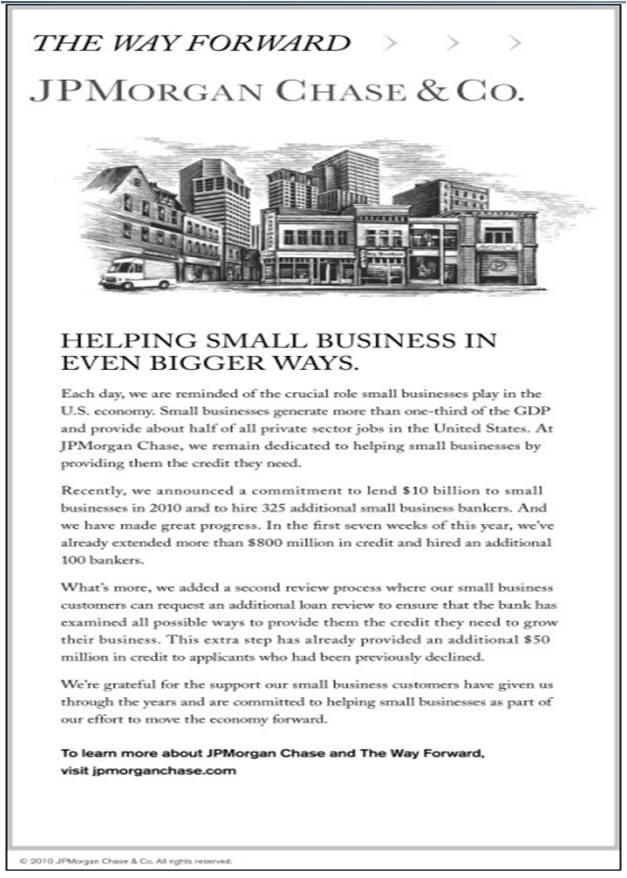
Every major bank other than Goldman Sachs must be ecstatically happy that Goldman exists, soaking up all the attention with its escapades in Greece and Italy. The other banks, by contrast, are trying to make themselves out to be white knights. See, for example, JPMorgan’s ad today in multiple major print newspapers describing its commitment to small business lending:

Like that picture of small-town America?

The main claim is in the second paragraph: a commitment to lend $10 billion to small businesses in 2010. These kinds of marketing claims are difficult to verify. But I gave it a shot.

Continue reading “The PR War”

Prospects For Financial Reform

By Simon Johnson

The best opportunity for immediate reform of our financial sector was missed at the start of the Obama administration.  As Larry Summers and Tim Geithner know very well – e.g., from their extensive experience around the world during the 1990s (see Summers’s 2000 Ely lecture) – when a financial system is in deep crisis, you have an opportunity to fix the most egregious problems.  Major financial sector players are always good at blocking reform – except when they are on the ropes.  (Look again at Paul Blustein’s The Chastening for more detail on what Geithner-Summers, with David Lipton and others, got right when they sided with reformers in Korea.)

Congratulations to the Treasury PR people for placing such a warm and fuzzy article about Secretary Geithner in Vogue (not available on-line, but definitely worth finding; nice photos).  But what exactly was the point – unless Mr. Geithner is planning to run for the Senate in Massachusetts?  Mr. Geithner comes through as someone who, against much advice, decided to stick with exactly the financial sector that got us into such deep trouble – despite the fact that this is exactly what he and his colleagues (at Treasury, at the IMF, and at the NY Fed) have always, and with good reason, strongly urged other countries not to do. Continue reading “Prospects For Financial Reform”