A Bit About Me

By James Kwak

As loyal readers know, I spent the summer working and mainly not-blogging. I’m back in school now, but this semester will be busier than previous ones. I’m taking two clinics, and I have to make up for phoning it in last fall when I was writing 13 Bankers. (Simon and I wrote it in four months while I was in school and he was teaching three classes.) Also, I only have one more year of school left in my life, I’m paying more than $45,000 for it, and I’d like to take it seriously.

So the blog is going to be a somewhat lower priority in the past.* I’m hoping to post a few times a week this semester, if I have enough original ideas. I hope you will keep reading; I assume most people get the blog via email or an RSS reader, so frequency shouldn’t be an issue for you.

It’s possible that after school I will go back to more serious blogging; I do think it’s a valuable and potentially powerful medium, and certainly a lot more gratifying than writing academic papers.

Thanks again for reading.

* In my defense, most of the high-volume economics bloggers are either tenured professors (Cowen, Thoma, DeLong, Krugman) or people whose job is to blog (Salmon, Klein). (Yves Smith is an exception; how she finds the time I don’t know.)
Irish Worries For The Global Economy

By Peter Boone and Simon Johnson

Is the global economic recovery still on track? The mainstream view is: yes, without a doubt. But increasingly, there are reasons to fear another financial disruption – particularly given the latest developments in Ireland.

The consensus among officials and most of the international banking community is that the global economy has stabilized and is now well down the road to recovery. The speed of this recovery is proving disappointing – as seen in the revised second-quarter growth estimate for gross domestic product in the United States, with annualized growth down to 1.6 percent. But, according to this view, easy monetary policy and still-loose fiscal policy around the world will keep sufficient momentum going.

Never mind that Japan, the United States and most of Europe are running unsustainable fiscal policies, while the Federal Reserve chairman Ben Bernanke is fretting over how to prevent deflation with a limited toolbox, and Jean-Claude Trichet, president of the European Central Bank, is calling for more fiscal tightening. To enjoy this rosy global picture, we are also told to ignore the plight of heavily indebted peripheral euro-zone nations still suffering from uncompetitive wages and prices, and concerns over default, that strangle their credit markets and growth. Continue reading “Irish Worries For The Global Economy”

Hedge Fund Blindness

By James Kwak

Hedge fund managers may be good at investing money. (Or they may just be the beneficiaries of luck, like successful stock mutual fund managers.) But that doesn’t mean they can think clearly.

Andrew Ross Sorkin comments on the letter by fund manager Daniel Loeb, a former Democratic fundraiser, criticizing the supposed anti-business policies of the Obama administration. The letter includes blather like this:

“As every student of American history knows, this country’s core founding principles included nonpunitive taxation, constitutionally guaranteed protections against persecution of the minority and an inexorable right of self-determination.”

Who, in making a list of America’s founding principles, would put “nonpunitive taxation” first? Oh, right. A hedge fund manager.

Continue reading “Hedge Fund Blindness”

Central Clearing and Systemic Risk

This guest post is by Ilya Podolyako, member of the Yale Law School Class of 2009 and a friend of mine. Ilya led the Progressive Economic Policy reading group with me and served as an adjunct professor of law at DePaul University this past spring.

One of the key provisions of the Dodd-Frank Act is Title VII, which requires all non-exempt derivatives transactions to go through a central clearinghouse (this report provides a good summary). As James and Simon have explained, the Dodd-Frank Act uses the term “swap” as a big basket that captures most financial products that we would normally call derivatives: options, repos, credit default swaps, currency swaps, interest rate swaps, etc.

Prior to the passage of the Act, most of these products were sold over-the-counter by certain large institutions. That is, in form, a transaction where you wanted to buy a credit default swap triggered by some event (say, the bankruptcy of Ford Automotive) resembled a trip to the car dealership. The dealer had inventory on the lot; this inventory was split into several different models / types of product; individual instances of a given model were relatively homogenous and varied mostly by color and minor adornments (spoilers, leather seats, etc.). If you were looking for a car of a given make and model that had certain extra features, a dealer might be able to get one custom-built for you at the factory, but you’d have to wait for the item and pay extra. Of course, the salesperson would not be able to accommodate all requests – if you show up to your average Chevy dealership and ask to buy a jet-powered car, you are likely to leave empty-handed no matter how much money you have, even though a few other individuals have been able to procure said exotic item.

Continue reading “Central Clearing and Systemic Risk”

Democracy in America

It appears that Simon beat me to commenting on Third World America, Arianna Huffington’s bleak portrait of many of the things that are wrong with America (crumbling infrastructure, failing schools, extreme inequality, low social mobility, political system captured by special interests, etc.), so I’ll confine myself to a couple of thoughts I had while reading it.*

First, there are these great quotations from Alexis de Tocqueville’s Democracy in America (p. 45 of Huffington’s book):

“Amongst the novel objects that attracted my attention during my stay in the United States, nothing struck me more forcibly than the general equality of condition among the people. . . .

“Democratic laws generally tend to promote the welfare of the greatest possible number; for they emanate from the majority of the citizens, who are subject to error, but who cannot have an interest opposed to their own advantage.”

Continue reading “Democracy in America”

Fiscal Austerity and “Third World America”

By Simon Johnson.  My testimony to the Senate Budget Committee on these issues is available here: https://baselinescenario.com/2010/08/05/its-hard-to-take-the-fiscal-hawks-seriously/.

There are three main views of the financial crisis and recession of 2008-9.  In the first two views, the debate over the fiscal deficit is quite separate from what happened in the crisis.  But in the third view, the financial crisis and likelihood of fiscal austerity are closely linked.

The first is that something went wrong with the financial plumbing central to the world’s economy. Failed plumbing is a serious business, of course – great real estate can be ruined by a burst pipe. But it’s a technical issue; nothing deeper is at stake.

The Dodd-Frank financial reform legislation ended up addressing a myriad of technical issues.  Clearly, “fix the plumbing” is Treasury Secretary Timothy Geithner’s interpretation of what we need to do – he insists that making the system safer just requires “capital, capital, capital.”

The second view is that the financial system is more deeply broken. Opinions vary in terms of the relative importance of various elements, including too-big-to-fail incentive problems that encourage banks to take on excessive risks – and to be supported by the credit markets when they do.

The first and second views are mutually exclusive – either our financial system is badly broken,  or it is not and technical fixes will suffice. Both focus primarily on the nature of the financial system, somewhat in isolation from the rest of the economy.  But a third view is increasingly emerging that implies both the first two views are too narrow. Continue reading “Fiscal Austerity and “Third World America””

Housing in Ten Words

By James Kwak

“Housing Fades as a Means to Build Wealth, Analysts Say.” That’s the title of a New York Times article by David Streitfeld. Here’s most of the lead:

“Many real estate experts now believe that home ownership will never again yield rewards like those enjoyed in the second half of the 20th century, when houses not only provided shelter but also a plump nest egg.

“The wealth generated by housing in those decades, particularly on the coasts, did more than assure the owners a comfortable retirement. It powered the economy, paying for the education of children and grandchildren, keeping the cruise ships and golf courses full and the restaurants humming.

“More than likely, that era is gone for good.”

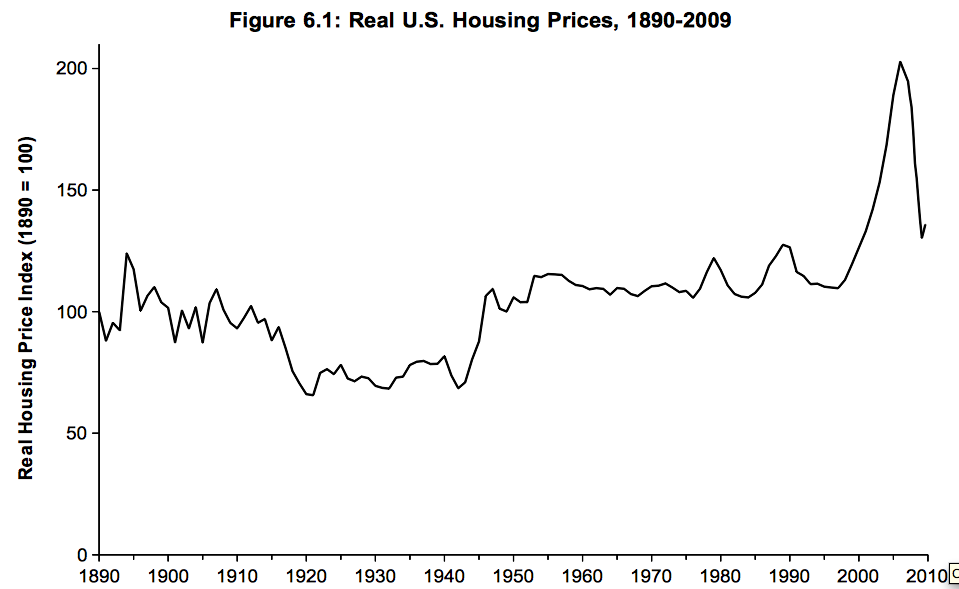
I’ve been telling my friends for a decade that housing is a bad investment. These are real housing prices over the past century, based on data collected by Robert Shiller:

Housing is generally a worse investment than either stocks or simple U.S. Treasury bonds. Then why do so many people think it’s such a great investment?

  1. Continue reading “Housing in Ten Words”

Management Consulting Myths

By James Kwak

Two people forwarded me Johann Hari’s Huffington Post article about management consultants, provocatively titled “The Great Management Consultancy Scam — and How it Could Be Coming for Your Job.” It seems that someone is once again bashing management consultants as witch doctors and scam artists, and I, improbably, must come to their defense. “Improbably” because I am generally critical of management consulting, and I have spent many hours with former McKinsey colleagues talking about how little we knew back when we were consultants. I am frequently asked by other students whether they should become consultants, and my general answer is, in a nutshell, “It’s a lousy job, and not nearly as exciting as the recruiting pitch makes it out to be, but it’s a good thing for your resume if you actually want to be in the business world.” (If you know me and are actually considering becoming a consultant, feel free to call me.)

Hari’s article is largely based on books by former consultants, primarily David Craig’s “brave” memoir (written five years ago; David Craig is a pseudonym). Here’s a quote from Craig: “We were proud of the way we used to make things up as we went along. . . . It’s like robbing a bank but legal. We could take somebody straight off the street, teach them a few simple tricks in a couple of hours and easily charge them out to our clients for more than £7000 per week.” According to Craig (according to Hari), all of management consulting boils down to recommending that the client lay off thirty percent of its staff, after one week of observation and analysis.

Continue reading “Management Consulting Myths”

AFL-CIO: Stronger Financial Reform Would Have Saved Jobs

By Simon Johnson

The Brown-Kaufman SAFE Banking Amendment proposed a hard size cap on our largest banks, limiting their assets to a very small fraction of the size of our economy.  The premise was simple – and could fit on a bumper sticker (or in a campaign flyer for November) – “too big to fail” is too big to exist.

But this proposal to modify the Dodd-Frank financial reform bill failed in the Senate in early May, by a vote of 33-61, with 27 Democrats voting against the idea.  Since that time, Democratic supporters have been asking their representatives the obvious question: Why did you vote against Brown-Kaufman?

Interestingly, no senators yet have replied – at least on the record – that the power of the megabanks was too great to be overcome.  Instead, there are three main arguments going the rounds. Continue reading “AFL-CIO: Stronger Financial Reform Would Have Saved Jobs”

More Telecom Hell

By James Kwak

So, I wanted to transfer phone and DSL from one house to another. I went to Verizon’s web site, clicked on the promisingly named “Moving to a New Home” link, and walked through the step-by-step wizard. It said I could have unlimited domestic calling and 3 MB DSL for $55 per month, which was a better deal than I was currently getting, so I signed up. The only issue was that the scheduling calendar only allowed install dates in the next month and I wanted a date six weeks out, but the live chat representative said I could just call in later and change the install date.

A few days later I went online to check on the order status in their online system and saw that my DSL order was nowhere to be  found. So I called up and, after much misunderstanding and aggravation, I figured out that my order had been canceled by their back-end system. Even though the front-end (web) system knew that I was an existing customer (remember, I clicked on “Moving to a New Home”) and offered me a discounted bundle, the back-end (probably mainframe system) didn’t want to give discounts to existing customers and wouldn’t allow the order to be processed.* After a little arguing, the representative said that she would manually book the order at the higher price and then go in and give me the originally promised discount.

The next time I checked my order status I saw that I had three different DSL orders in their system, which made me nervous, but there was nothing to do but wait.

Continue reading “More Telecom Hell”

Monopoly and Taxes

By James Kwak

A couple of weeks ago, Planet Money did a podcast based on a game of Monopoly. One of the participants was Russell Roberts, who professes to hate monopoly because it teaches the wrong lessons about business and the economy. At one point, Roberts said he would prefer the game if it had a progressive income tax with transfer payments to poor players. “As a result of that, you could get kids to resent taxes at an even earlier age.”

But Daniel Hamermesh, who likes Monopoly, called him on it. Hamermesh pointed out that if you had a transparent system of taxing the rich and transferring the money to the poor, players in the aggregate would be neutral, and might even understand the whole point of taxes and government spending.

Continue reading “Monopoly and Taxes”

Why Won’t “Fiscal Hawks” Discuss The Real Issues?

By Simon Johnson and James Kwak

During this hot summer of fitful economic growth, high unemployment and an oil slick visible from space, Washington is obsessed with…deficits. The resurgence of this periodic fascination is not entirely surprising, given our historically large current deficits. According to the Congressional Budget Office, the 2010 deficit will come in at $1.3 trillion, almost 10 percent of our gross domestic product and, along with the deficit of 2009, the highest level since World War II.

Imminent fiscal collapse has even become a theme for literary novelists – in Gary Shteyngart’s “Super Sad True Love Story,” American fiscal policy has become a bad joke and the Chinese threaten to stop buying our government debt. And the overextension of government is again a big theme; sales of Ayn Rand’s “Atlas Shrugged” are up sharply, although the book was first published more than 50 years ago (it is in and out of the Top 100 list on Amazon).

Deficit fears do have a real foundation. But it is not, as some assume, simply that government spending is out of control. Our current deficits result from the recent financial crisis and recession, and they will recede as the economy recovers. But the federal government also faces a long-term, structural gap between its revenues and its spending commitments – a gap due to policies established decades ago. Continue reading “Why Won’t “Fiscal Hawks” Discuss The Real Issues?”

It’s Hard To Take The Fiscal Hawks Seriously: Testimony To The Senate Budget Committee

By Simon Johnson

Most of the discussion of federal budget issues today is misdirected.  The shorter run issues are dominated by the likelihood of another financial crisis – and the implications that would have for the budget deficit – but no “fiscal hawks” even want to acknowledge the issue.  It is very hard to take anyone seriously if they refuse to look at these (uncontroversial) numbers.  Medium term, we obviously need tax reform.  The good news, in a sense, is that the US has an antiquated and inefficient tax system; it would not be hard to improve how this operates, raising revenue and actually reducing distortion.  Longer term, Medicare is obviously a tough problem with no easy solutions yet in sight.  But the argument “just cut entitlements” cannot be taken seriously.

Below is my testimony this week to the Senate Budget Committee on these issues.  (This link is to a pdf version; also see this page for my testimony to congressional committees over the past 2 years). Continue reading “It’s Hard To Take The Fiscal Hawks Seriously: Testimony To The Senate Budget Committee”

The Treasury Position – On The Volcker Rule

Former Secretary of State George Shultz famously quipped about Washington: “Nothing ever gets settled in this town. You have to keep fighting, every inch of the way.” This is proving just as true for banking reform as for other aspects of American government policy.

For example, Senators Carl Levin of Michigan and Jeff Merkley of Oregon, after considerable effort, were able to place strong language in the Dodd-Frank financial-sector legislation – enacting a version of the “Volcker Rule” that would require big banks to become significantly less risky. While this idea originated with Paul Volcker, the former Fed chairman and senior adviser to President Obama, and was announced with great fanfare by the president himself in January, it was clear – from the beginning and throughout the detailed negotiations this spring – that the Treasury Department was less than fully enthusiastic about this approach.

Treasury’s position – ranging from lukewarm support to outright opposition at times – created an uphill task for Senators Levin and Merkley. And now that they have reached the top of the Dodd-Frank hill, what do they see? Another even steeper climb awaits, because the Treasury Department is digging in publicly against the drafting of detailed regulatory rules that would actually make Volcker-Levin-Merkley effective. Continue reading “The Treasury Position – On The Volcker Rule”

Health Care Non-Solutions

By James Kwak

Ezra Klein makes an important point about our nation’s health care problem: it’s not just a government deficit problem. The underlying problem is that health care costs are not only growing faster than prices (inflation), but also faster than GDP (economic growth), and as a result the amount of stuff we as a nation will be able to afford, other than health care, will start to go down at some point in the future. (Picture originally from Joseph Newhouse in Health Affairs.)

This means that proposals to solve the long-term budget deficit problem by cutting Medicare benefits are not solutions: they simply shift the problem from the government to individuals–which means they shift the problem from us as taxpayers to us as old people or us as family members of old people.* If, for example, we increase the eligibility age for Medicare from 65 to 67, the government saves money, but only because people who are 65 and 66 lose money–or, alternatively, all of us lose money because their employers now have to pay more for health care.

Continue reading “Health Care Non-Solutions”