“Washington and the Regulators Are There To Serve the Banks”

By James Kwak

It is too obvious to bear saying, but I’ll say it anyway.

At the urging of the administration, Congress passed a financial reform bill this past summer that expanded the theoretical powers of regulators, but also gave those regulators the power to write the rules implementing the bill and then to enforce the rules. The bill’s sponsors fended off efforts to write specific constraints, whether size limits or leverage limits, into the statute. Yet the bill did nothing that I am aware of to ensure that regulators do a better job than they did last time around, unless you count the creation of a standalone consumer protection agency. (Yes, this is a hard problem with no easy solutions, but ignoring it doesn’t make it go away.)

Now we will see the results. Via Mark Thoma, Andrew Leonard provides the money quote, from incoming House Financial Services Committee chair Spencer Bachus: “in Washington, the view is that the banks are to be regulated, and my view is that Washington and the regulators are there to serve the banks.”

Of course, having written a book that argued that politics is more important than economics, this doesn’t surprise me. Nor does the decision by the Financial Crisis Inquiry Commission’s Republican appointees to deny that the shadow banking system even exists, or to write a dissenting “primer” whose only possible motivation can be captured in Barry Ritholtz’s post, “Repeat a Lie Enough Times . . .” But what frustrated me about the administration’s position over the spring and summer was the idea that, despite this basic fact, they marched forward as if government regulation is a purely technocratic problem that can be solved by simply finding smart men and women of integrity and conscientiousness.
Delusions Of Fiscal Grandeur

By Simon Johnson

If you honestly believe that investors will happily buy up any amount of US government debt (at low interest rates) for the indefinite future, then relax.  The tax deal passed yesterday should make you happy.

But if you fear that the US will soon be tested by financial markets – just as the eurozone is being tested today – then please read my column,”Voodoo Economics Revisited“, which is now on the Project Syndicate website.  There is a well-established tradition in the Republican Party of thinking that tax cuts cure all ills; many in the Democratic leadership have apparently now fallen into line.  We need to think hard about what our fiscal crisis will look like – and who will end up being hurt the most.

Another link to the column: http://www.project-syndicate.org/commentary/johnson15/English

Republican Splits, Fiscal Opportunity

By Simon Johnson

An informative and potentially productive political debate has broken out over fiscal policy.  Ironically, this is not between Democrats and Republicans – the leadership on both sides of the aisle is trying hard to agree that a moderate stimulus is worth increasing the national debt by nearly $900 billion.  And the new debate is not particularly due to the Bowles-Simpson bipartisan commission or other serious efforts to put the real math on the table; those technical discussions have so far been brushed aside.

Rather the intensifying and illuminating debate is within the Republican Party – particularly between people who are reasonably presumed interested in running for the presidency in 2012.  Continue reading “Republican Splits, Fiscal Opportunity”

13 Bankers in Paperback

By James Kwak

Yes, that’s a new book photo in the sidebar to the right. The paperback edition will be available on January 11, 2011. It has a new epilogue taking the story from January 2010 (when we finished the hardcover) to September 2010, covering the financial reform debate in the Senate and the final Dodd-Frank Act.

Enjoy.

The Moderate Republican Stimulus

By James Kwak

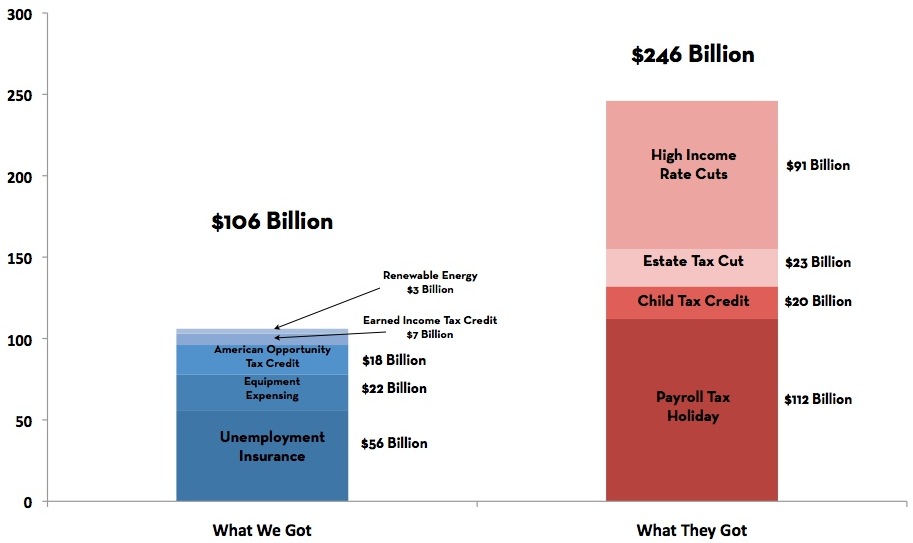
One of the great things about the Internet, as opposed to, say, law school, is that other smart people will do my homework for me. Last week I said that Obama’s position on the tax cuts was a “moderate-Republican line in the sand” and that the tax deal was closer to the Republicans’ ideal outcome than the Democrats’, but the latter argument was based on some guesses about Republican preferences. Now Mike Konczal has done some of the harder argument, uncovering hard evidence that the Republicans would have agreed to the extended child tax credit sweetener anyway and presenting five points for the argument that the Republicans wanted payroll tax cuts – in particular, they wanted them more than Making Work Pay tax credit that they replaced.

Here’s Mike’s version of the administration’s chart:

He calls it the “Moderate Republican Stimulus Package 2.0.”

This American DREAM

By James Kwak

Brad DeLong reminded me that the DREAM Act is being considered by Congress right now and has an outside chance of passage. If you are a Senator on the fence about this issue, or you work for one, you should listen to the last segment of this This American Life episode, starting about forty-six minutes in. It will break your heart.

Oh, and given that opposition has been basically along party lines: aren’t the people who would qualify for citizenship under the act natural Republican voters, anyway? Basically the act would reward people who pull themselves up by their bootstraps, without the benefit of federal aid. Or is that no longer what the Republican Party is about?

Who Wanted What?

By James Kwak

Look, I’m familiar with the argument for the tax cut deal. It’s not a terrible argument. In simple form, it goes, the top priorities are to stimulate the economy and to cushion the impact of unemployment, and a two-year tax cut extension was worth it to get that, especially since we can kill the Bush tax cuts in 2012. Now, no one who wasn’t born yesterday buys that bit about killing the Bush tax cuts in 2012, but you could still make the argument that two years of stimulus is worth making the tax cuts effectively permanent. (I don’t agree, but it’s not a crazy argument.)

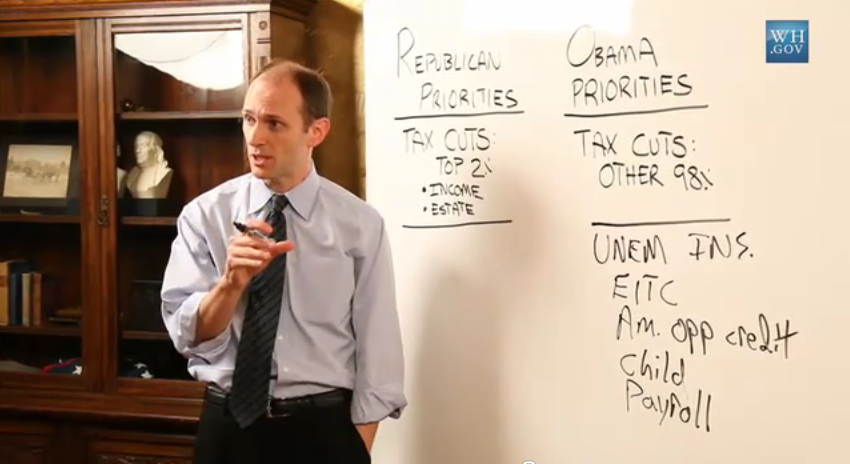
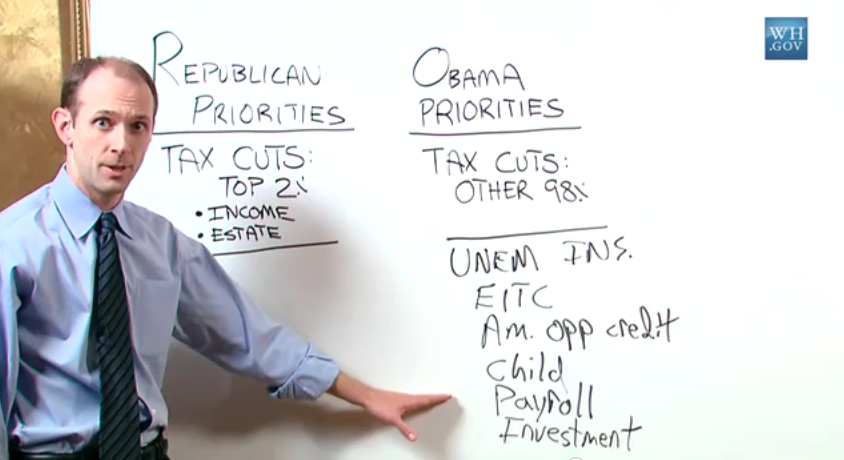
But that’s not Austan Goolsbee’s argument on YouTube.

Here’s his slide:

Continue reading “Who Wanted What?”

What Is Wrong With Cutting Taxes?

By Simon Johnson

The president and congressional Republicans have reached a deal that would cut taxes “for all Americans.” Their argument is that this package will stimulate the economy, create jobs and help lead to economic recovery and sustained growth.

This proposal, which seems likely to pass Congress, is not a good idea. Why? (To see me explain these points in a five-minute video, click here.) Vice President Dick Cheney said, loud and clear, in 2002: “Reagan proved deficits don’t matter.”

He was right that Ronald Reagan showed the Republican Party that you can get away with running significant deficits as a result of tax cuts – exactly the strategy of President George W. Bush.

But Mr. Cheney was completely wrong with regard to the implication that there are no economic consequences of sustained fiscal deficits. Continue reading “What Is Wrong With Cutting Taxes?”

More on the Tax Deal

By James Kwak

First, the comic relief. From the Times:

“Senator Jim DeMint, Republican of South Carolina, said that he still wanted the Bush-era rates extended permanently and that the cost of the package was worrisome.”

I got some valid criticisms for my last post on the tax cut deal. In particular, that post may make it seem as if my criticism of President Obama has to do with his negotiating ability. But if Obama really wanted the outcome he ended up with, then he is a master negotiator; where I really differ from him, then, would be in what policy should be.

Continue reading “More on the Tax Deal”

Should Megabanks Be Broken Apart? (NYT Room For Debate)

By Simon Johnson.  This material was prepared as part of the New York Times’ Room for Debate on “Should Mega-Banks Be Broken Apart“?  I strongly recommend the post by Anat Admati.

Writing in the Washington Post, in November 2009, Jamie Dimon, chief executive of JP Morgan Chase, argued:

“Creating the structures to allow for the orderly failure of a large financial institution starts with giving regulators the authority to facilitate failures when they occur. Under such a system, a failed bank’s shareholders should lose their value; unsecured creditors should be at risk and, if necessary, wiped out. A regulator should be able to terminate management and boards and liquidate assets. Those who benefited from mismanaging risks or taking on inappropriate risk should feel the pain.”

But the Dodd-Frank financial reform legislation does not create a “resolution mechanism” that can deal with cross-border megabanks; this point is admitted by all involved. And there is nothing in the G20 process or underway with any other international forum that would make a difference in this regard. Continue reading “Should Megabanks Be Broken Apart? (NYT Room For Debate)”

Tax Cut Ironies

By James Kwak

From The New York Times:

“Congressional Republicans in recent days have blocked efforts by Democrats to extend the jobless aid, saying they would insist on offsetting the $56 billion cost with spending cuts elsewhere.”

Instead, as it turns out, they agreed to offset the cost with tax cuts elsewhere.

Still, though, I place the blame for this one squarely on the White House. The Republicans are just doing what Republicans do: arguing for lower government spending and lower taxes. The fact that they justify the former by saying it will cut the deficit and the latter by saying it will stimulate the economy (when you could just as easily switch the arguments and make them point the other way) is just a detail.

Continue reading “Tax Cut Ironies”

What Jamie Dimon Won’t Tell You: His Big Bank Would Be Dangerously Leveraged

By Anat Admati, Professor of Finance and Economics at Stanford Graduate School of Business.  To see her explain these issues in person, watch this Bloomberg interview.  This is a long post, about 3,500 words.

The debate is raging about banks and their size, financial regulation, and the international capital standards known as “Basel”.  Jamie Dimon of JP Morgan Chase, in his New York Times magazine profile, expresses admiration for the Basel committee and says,

“… they are asking the questions that, in theory, bankers ask of themselves: how much capital do banks need to withstand the inevitable downturn, and what is an acceptable level of risk?”

There is one problem, however. Basel may have asked the right question, but it did not come up with the right answers, mainly because it allows banks to remain dangerously leveraged, setting equity requirements way too low. This fact is not understood because the debate on capital regulation has been mired with a cloud of confusion, and filled with un-substantiated assertions by bankers and others. As a result, the issues appear much more mysterious and complicated than they actually are.

After a massive and incredibly costly financial crisis, we seem to have financial system that is a more consolidated, more powerful, more profitable and, yes, as fragile and dangerous as we had before the crisis. How did this happen and what can we do?

Here are some questions on which the confusion is staggering. Continue reading “What Jamie Dimon Won’t Tell You: His Big Bank Would Be Dangerously Leveraged”

Jamie Dimon: Becoming Too Big To Save – Creating Fiscal Disaster

By Simon Johnson

In Sunday’s New York Times magazine, Roger Lowenstein profiles Jamie Dimon, head of JP Morgan Chase.  The piece, titled “Jamie Dimon: America’s Least-Hated Banker,” is generally sympathetic, but in every significant detail it confirms that Mr. Dimon is now – without question – our most dangerous banker.

Mr. Dimon is not dangerous because he is in any narrow sense incompetent.  On the contrary, Mr. Dimon is very good at getting what he wants.  And now he wants to run a bigger, more interconnected, and more global bank that – if it were to fail – would cause great chaos around the world.  Lowenstein writes,

“Dimon has always been unusually blunt, and he told me that not only are big banks like JP Morgan (it has $2 trillion in assets) not too big, but that they should be allowed to grow bigger.” Continue reading “Jamie Dimon: Becoming Too Big To Save – Creating Fiscal Disaster”

Imminent Eurozone Default: How Likely?

By Simon Johnson

The big question of the week in Europe is deceptively simple – will any countries that share the euro as their currency default on their government or bank debts in the foreseeable future?  The answer to this question determines how you regard bonds from countries such as Portugal, Spain, Italy, and Belgium.

Answering this question is not as simple as it seems, however, because it involves taking a view on three intricate issues: What exactly is the eurozone policy now on bailouts, can big eurozone countries really be bailed out if needed, and what happens to the politics of these countries and of the eurozone has a whole as pressure from the financial markets mounts?

The prevailing consensus – and definite official spin – is that over the weekend European leaders backed away from the German proposal to impose losses on creditors as a condition of future bailouts, i.e., from 2013.  The markets, in this view, should and likely will calm now; there is no immediate prospect of any kind of sovereign default or (more politely) “reprofiling” on debt, including the obligations of big banks.

But a close reading of the Eurogroup ministers’ statement from Sunday suggests quite a different interpretation.  It’s a straightforward text, just 2 ½ pages long, but it has potentially momentous consequences – as it envisages dividing future eurozone crises into two kinds. Continue reading “Imminent Eurozone Default: How Likely?”

The Economics and Politics of Elizabeth Warren

By Simon Johnson

Congressional Republicans are apparently intent on a big showdown with Elizabeth Warren, who is currently building up the new Consumer Financial Protection Bureau (CFPB).

This is very good news for the White House, if they use this opportunity wisely.

Some Republicans seem to think that Ms. Warren is about “big government” or “intrusive regulation”.  But this is not the case – Elizabeth Warren’s approach is much more appealing and already popular with almost everyone on right and left: Transparency. Continue reading “The Economics and Politics of Elizabeth Warren”