My Medicare Deficit Solution

By James Kwak

David Brooks, perhaps realizing that it was a bad idea to swallow a politician’s PR bullet points whole, is now backpedaling. The Ryan Plan, which he originally hailed as “the most comprehensive and most courageous budget reform proposal any of us have seen in our lifetimes,” now has the principal virtue of existing: “Because he had the courage to take the initiative, Paul Ryan’s budget plan will be the starting point for future discussions.”

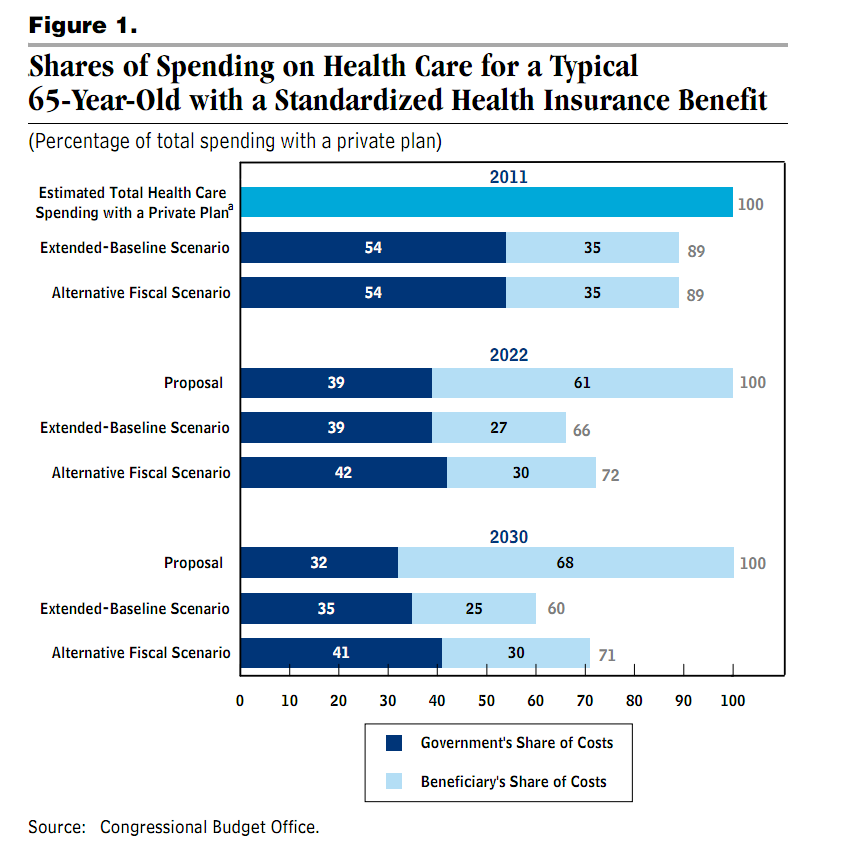
As I’ve discussed before, the Ryan Plan is just one bad idea dressed up with the false precision of lots of numbers: changing Medicare from a health insurance program to a cash redistribution program that gives up on managing health care costs. Here’s the key chart from the CBO report:

Continue reading “My Medicare Deficit Solution”

Who Wants a Voucher?

By James Kwak

In yesterday’s post, I compared two ways of solving the long-term Medicare deficit: (a) increasing payroll taxes and keeping Medicare’s current structure or (b) keeping payroll taxes where they are and converting Medicare into a voucher program. As a person who will need health insurance in retirement, I prefer (a), but others could differ.

Today I want to ask a different question. Let’s say Medicare does become a voucher program along the lines proposed by Paul Ryan. So workers pay 2.9 percent of their wages and in retirement they get a voucher. According to the CBO, if you turn 65 in 2030, that voucher will pay for 32 percent of your total health care costs, including private insurance premiums and out-of-pocket expenses (see pp. 22-23). Would you rather have that deal or nothing at all?

Continue reading “Who Wants a Voucher?”

The Vickers Commission Report On Banking

By Simon Johnson

Will the Vickers Commission report on UK banking – with a preliminary report released today – have a major positive impact?  Not likely in our assessment – see today’s Daily Telegraph.

The fight to reform the banking system in the US and more broadly is largely over – and the bankers won.  A number of sensible ideas were put forward – including on creating a resolution authority, reducing the scale and scope of big banks, and significantly increasing capital requirements.  As reviewed by Peter Boone and me in this morning’s Financial Times, all of these initiatives have essentially failed.

Medicare for Beginners

By James Kwak

This isn’t a post explaining how Medicare works in detail. It’s a post about why Medicare matters to you.

The basic “problem” with Medicare is that its liabilities are projected to grow faster than its revenues indefinitely because health care costs are growing faster than GDP (and Medicare’s revenues are a function of wages).* The “solution” proposed by Paul Ryan is to convert Medicare from an insurance program, which pays most of your health care expenses, to a voucher program, which gives you a certain amount of money that you can try to use to buy health insurance. I’ve described the main problems with this approach already: it transforms a large future government deficit into an even larger future household deficit, and on top of that it shifts risks from the government to individual households. Today I want to look at this from a different angle.

Continue reading “Medicare for Beginners”

Taxes and Spending for Beginners

By James Kwak

Over the long term, we are projected to have large and growing federal budget deficits. Assuming that is a problem, which most people do, there seem to be two ways to solve this problem: raising taxes and cutting spending. Today, the political class seems united around the idea that spending cuts are the solution, not tax increases. That’s a given for Republicans; Paul Ryan even proposes to reduce the deficit by cutting taxes. But as Ezra Klein points out, President Obama and Harry Reid are falling over themselves praising (and even seeming to claim credit for) the spending cuts in Thursday night’s deal. And let’s not forget the bipartisan, $900 billion tax cut passed and signed in December.

The problem here isn’t simply the assumption that we can’t raise taxes. The underlying problem is the belief that “tax increases” and “spending cuts” are two distinct categories to begin with. In many cases, tax increases and spending cuts are equivalent — except for the crucial issue of who gets hurt by them.*

Continue reading “Taxes and Spending for Beginners”

Big Banks Have A Powerful New Opponent

By Simon Johnson

As a lobby group, the largest U.S. banks have been dominant throughout the latest boom-bust-bailout cycle – capturing the hearts and minds of the Bush and Obama administrations, as well as the support of most elected representatives on Capitol Hill.  Their reign, however, is finally being seriously challenged by another potentially powerful group – an alliance of retailers, big and small – now running TV ads (http://youtu.be/9IUt-lY-XgM, by Americans for Job Security), web content (http://www.youtube.com/watch?v=DiKoFzS_lXs, by American Family Voices), and this very effective powerful radio spot directly attacking “too big to fail” banks: http://www.savejobs.org/audio18.html.

The immediate issue is the so-called Durbin Amendment – a requirement in the Dodd-Frank financial reform legislation that would lower the interchange fees that banks collect when anyone buys anything with a debit card.  Retailers pay the fees but these are then reflected in the prices faced by consumers.

The US has very high debit card “swipe” fees – 44 cents on average but up to 98 cents for some kinds of cards.  These fees are per transaction – representing a significant percent of many purchases but posing a particular problem for smaller merchants. This is estimated to be around $16-17 billion in annual revenue.

Other countries, such as Australia and members of the European Union, have already taken action to reduce interchange fees – because the cost of such transactions is actually quite low (think about it: the “interchange fee” for checks, which also draw directly on bank deposits, is exactly zero).  The United States severely lags behind comparable countries in terms of how consumers are treated by banks in this regard. Continue reading “Big Banks Have A Powerful New Opponent”

Moment of Blather

By James Kwak

David Brooks’s commentary on Paul Ryan’s “budget proposal” is entitled “Moment of Truth.” Brooks falls over himself gushing about his new man-crush, calling it “the most comprehensive and most courageous budget reform proposal any of us have seen in our lifetimes.” “Ryan is expected to leap into the vacuum left by the president’s passivity,” he continues.

Gag me.

Continue reading “Moment of Blather”

“It’s All Relative”

By James Kwak

I finally saw Inside Job at a friend’s house tonight. I don’t have anything original to say about it. I thought it was a very, very good movie. There were lots of little things that weren’t quite right (many of which were probably conscious decisions to simplify details for the sake of comprehension), but I don’t think any of them were substantively misleading. I wouldn’t have made some emphases or drawn some connections that Ferguson did. For example, the parallel between the rise of finance and the decline of manufacturing at the end felt a little shallow to me, not because they’re not related, but because the causality could run down any number of paths. But everyone would tell the story a little differently. Overall I thought it was both a relatively accurate narrative of what happened and a compelling explanation of why it happened.

My favorite scene was when the interviewer (Ferguson, I assume) asked Scott Talbott, the chief lobbyist for the Financial Services Roundtable, about the “very high” compensation in the financial sector. Talbott said something like (I may not have the words quite right), “I wouldn’t agree with ‘very high.’ It’s all relative.”

Made-Up Definitions

By James Kwak

Many commentators who want to blame Fannie and Freddie for the financial crisis base their arguments on analysis done by Edward Pinto. (Peter Wallison bases some of his dissent from the FCIC report on Pinto; even Raghuram Rajan cites Pinto on this point.) According to Pinto’s numbers, about half of all mortgages in the U.S. were “subprime” or “high risk,” and about two-thirds of those were owned by Fannie or Freddie. Last year I pointed out that Pinto’s definition of “subprime” was one he made up himself and that most of the “subprime” loans held by Fannie/Freddie were really prime loans to borrowers with low FICO scores. Unfortunately, I made that point in an update to a post on the somewhat obscure 13 Bankers blog that was mainly explaining what went wrong with a footnote in that book.

Fortunately, there’s a much more comprehensive treatment of the issue by David Min. One issue I was agnostic about was whether prime loans to people with low (<660) FICO scores should have been called “subprime,” following Pinto, or not, following the common definition. Min shows (p. 8) that prime loans to <660 borrowers had a delinquency rate of 10 percent, compared to 7 percent for conforming loans and 28 percent for subprime loans, implying that calling them the moral equivalent of subprime is a bit of a stretch. Min also shows that most of the Fannie/Freddie loans that Pinto classifies as subprime or high-risk didn’t meet the Fannie/Freddie affordable housing goals anyway — so to the extent that Fannie/Freddie were investing in riskier mortgages, it was because of the profit motive, not because of the affordable housing mandate imposed by the government.

Min also analyzes Pinto’s claim that the Community Reinvestment Act led to 2.2 million risky mortgages and points out that, as with “subprime” loans, this number includes loans made by institutions that were not subject to the CRA in the first place. Of course, the CRA claim is ridiculous on its face (compared to the Fannie/Freddie claim, which I would say is not ridiculous on its face) for a number of reasons, including the facts that only banks are subject to the CRA (not nonbank mortgages originators) and most risky loans were made in middle-income areas where the CRA is essentially irrelevant.

Mainly, though, I’m just glad that someone has dug into this in more detail than I did.

Institute Of International Finance Wins Two Nobel Prizes

By Simon Johnson

In a surprise announcement early this morning, the 2011 Nobel Peace Prize and the Nobel Prize for Economics (strictly speaking: “The Sveriges Riksbank Prize in Economic Sciences in Memory of Alfred Nobel”) were simultaneously awarded to the Institute of International Finance (IIF), “the world’s only global association of financial institutions”.

This is the first time the Economics Prize has been awarded to an organization – although the Peace Prize has been received by various institutions (including the Intergovernmental Panel on Climate Change, the International Atomic Energy Agency, and Lord Boyd Orr – in part for his work with the Food and Agriculture Organization).

In its citation for the economics prize, the Royal Swedish Academy of Sciences said the IIF won for its work on capital requirements for banks, which proved that requiring banks to fund themselves with positive equity – and therefore have any kind of buffer against insolvency – would limit credit, be very bad for economic growth, and generally make all consumers less happy.  Based on this single remarkable paper, the IIF earned the prize for its: Continue reading “Institute Of International Finance Wins Two Nobel Prizes”

The Myth Of The Resolution Authority

By Simon Johnson

Back when it really mattered – last spring, during the Dodd-Frank financial reform debate – Senator Ted Kaufman of Delaware emphasized repeatedly on the Senate floor that the proposed “resolution authority” was an illusion.  His point was that extending the established Federal Deposit Insurance Corporation (FDIC) powers for “resolving” (jargon for “closing down”) financial institutions to include global megabanks simply could not work. 

At the time, Senator Kaufman’s objections were dismissed by “experts” both from the official sector and from the private sector.  Now these same people (or their close colleagues) are falling over themselves to argue resolution cannot work for the country’s giant bank holding companies.  The implication, which these officials and bankers still cannot grasp, is that we need much higher capital requirements for systemically important financial institutions.

Writing in the March 29, 2011 edition of the National Journal, Michael Hirsch quotes a “senior Federal Reserve Board regulator” as saying: Continue reading “The Myth Of The Resolution Authority”

Lessons from the Oracle

By James Kwak

[I wrote this post a month ago but just realized I never clicked “Publish.” It’s about a book that was published more than two years ago, though, so it shouldn’t have gotten any more stale.]

I recently finished reading Snowball, Alice Schroeder’s 2008 biography of Warren Buffett. It wasn’t a bad read, although at over eight hundred pages it was on the long side and began to seem repetitive; the impression I got was that Buffett had the same kinds of relationships with his family and friends for a long time, and not much changed over the decades.

The big question about Buffett for people like me — people who invest in low-cost index funds, that is — is whether he is smart or lucky. After all, since Burton Malkiel’s Random Walk Down Wall Street, the main argument against stock-picking skill has been that in a coin-flipping tournament featuring thousands of players (and with survivorship bias), someone is bound to win time after time after time.

The answer, at least the one from the book, is that Buffett is smart. And that shouldn’t be too surprising. I recently read a pile of papers about active mutual fund management, mainly from the Journal of Finance, and I’d say that while there’s no consensus per se, the general trend has been that there are some mutual fund managers who can beat the indexes and can more than cover their costs.* There aren’t many of them, they are outnumbered by the ones who do worse than the indexes, and they are probably hard for you and me to find, but they exist. And I say this despite the fact I didn’t want it to be true.

Continue reading “Lessons from the Oracle”

Comment Unthreading

By James Kwak

I’m sorry to those who liked it, but I decided to turn off threaded comments. There were just too many examples of people “responding” to the first comment with something that, while perhaps related to the original post, was not related to that comment, apparently to get their input up to the top of the comment list. I decided this was a simpler solution than trying to block those people.

Update: Many people use the “@” symbol to show that they are replying to a previous comment. So if you want to reply specifically to a comment by “agreenspan,” for example, put “@agreenspan:” at the beginning of your comment.

What Is Spencer Bachus’s Game?

By Simon Johnson

Representative Spencer Bachus, Republican chair of the House Financial Services Committee, famously remarked in December,

“in Washington, the view is that the banks are to be regulated, and my view is that Washington and the regulators are there to serve the banks.”

With regard to the Consumer Financial Protection Bureau (CFPB), this apparently now implies that Mr. Bachus will use any means possible to change the topic away from substance – how banks treat their customers – to imagined procedural issues.

Specifically, Mr. Bachus is wrongly accusing Elizabeth Warren of misleading Congress with regard to the role of the CFPB in the negotiations over how to settle allegations that mortgage foreclosure practices have been abusive (see also this news coverage). Continue reading “What Is Spencer Bachus’s Game?”

Not with a Bang

By James Kwak

In the Times, Neil Barofsky, Special Inspector General for TARP, performed the admirable feat of fitting a clear, comprehensive, sober critique of how TARP was implemented and what its long-term impact will be in fewer than 1,000 words. It’s a perspective I mainly agree with,* and it highlights the different priorities that the administration put on aid to large banks and aid to homeowners, even though both were goals of the bill.

Back in late 2008 and early 2009, there was a lot of talk about how a true solution for the problems of the banking system would require a solution for the problems of homeowners, since the banks’ losses were largely the result of mortgage defaults. One of the major technical achievements of the administration was showing that it was possible to stabilize the financial system and restore the banks to short-term profitability without doing much for homeowners. As Barofsky says, and as the Times reports in yet another article today, the administration’s programs to help homeowners obtain loan modifications had little impact on the behavior of the banks that service mortgages and foreclosures continue unabated. Real housing prices have fallen below the previous lows of 2009 and now look likely to overcorrect on the downside.**

Housing modifications are admittedly more difficult than bailing out banks. It’s administratively easier to write a few $25 billion checks and create unlimited low-interest credit lines for a few of the Federal Reserve’s existing customers than to intervene in millions of mortgages. But the financial crisis was a time of bold action on other fronts. Treasury and the Federal Reserve were willing to push the limits of the law, for example in J.P. Morgan’s takeover of Bear Stearns. (See the chapter in Steven Davidoff’s book Gods at War for the details.) Henry Paulson threatened to declare the nation’s largest banks insolvent if they didn’t agree to sell preferred stock to the government. By contrast, as law professor Katherine Porter says in the Times article, “The banks were so despised, and TARP was so front and center, you could have actually done something. In the midst of real boldness in bailing out the banks, we get this timid, soft, voluntary conditional program.”

The lesson we learned learned is that homeowners were only a priority insofar as their health mattered to the banks’ health. When those two things became unmoored, the administration was willing to declare victory.

* The main thing I don’t agree with is Barofsky’s implied criticism of the Bush administration for using TARP money to buy preferred stock from banks rather than buying mortgage-backed securities directly. While I have often criticized various aspects of the preferred stock purchases, I think it was a more direct way to stop the panic of September-October 2008, and at that point a program to purchase MBS would probably have been an even more blatant transfer to the banks.

** I’m all for prices falling from bubble levels, but the policy goal should have been preventing them from falling through the long-term trend.