Will The United States Default?

By Simon Johnson

There are three views on whether the US will default on its government debts.  The first is: Hopefully yes, and this August offers a good opportunity.  The second is: Possibly yes, but this would be bad – so we need some form of fiscal austerity.  The third is: Under no circumstances, and any talk of a need for austerity is a hoax.

The first view is mistaken.  The second view hides a dangerous contradiction. And the third view borders on complacency.  How can we find our way to fiscal responsibility?  We need tax reform.

People in the first camp think that the US government has become too big and the only way to cut it down to size is to limit its ability to borrow.  A constitutional amendment to limit the size of government relative to GDP or to require a balanced budget could work – but experience suggests there are always ways for a future Congress to escape any such constraint. Continue reading “Will The United States Default?”
Hoisted from the Archives

By James Kwak

What was the budget debate about eleven years ago?


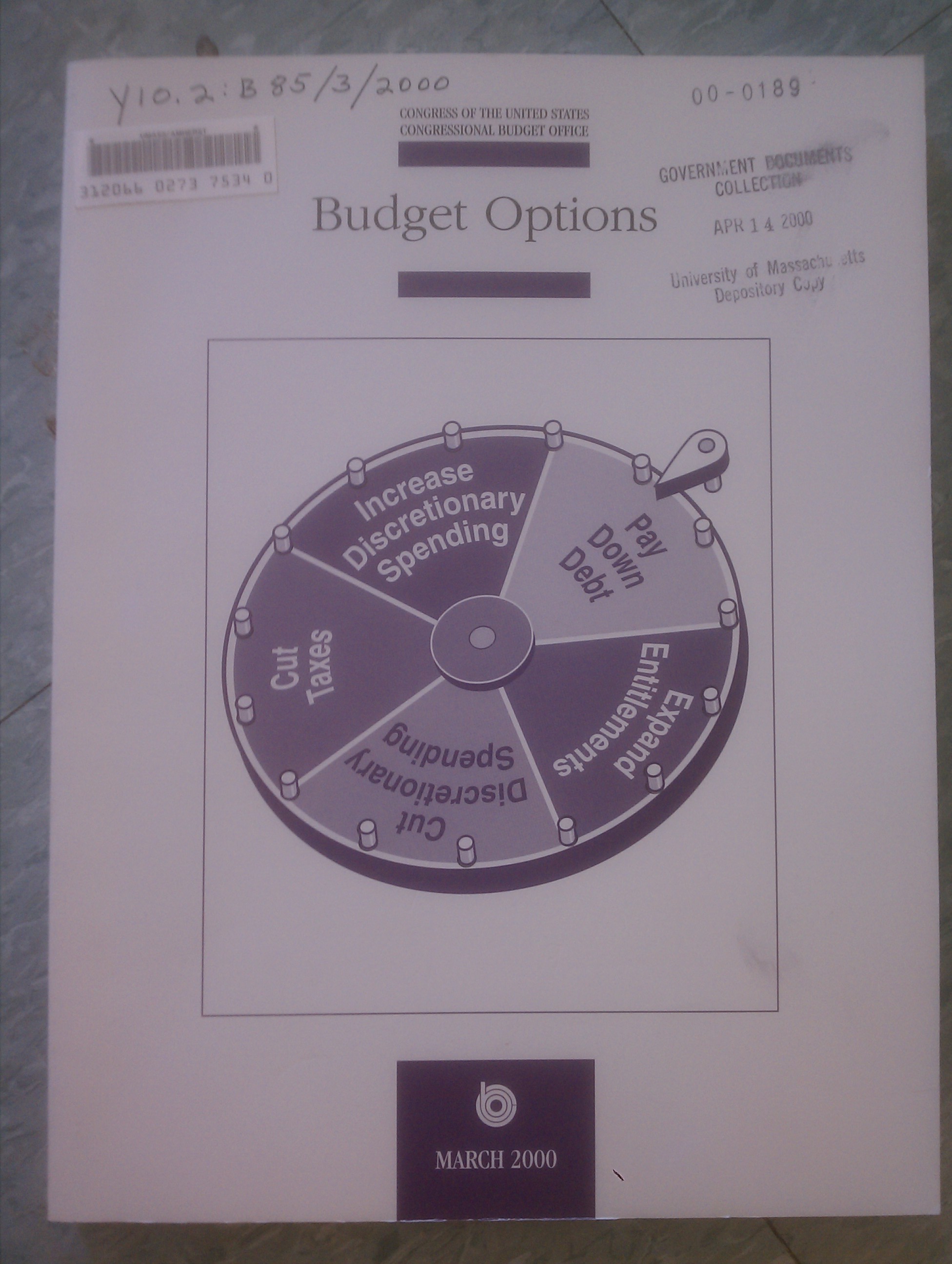
As you can see, that is the cover of the CBO’s March 2000 Budget Options report. (You can get it online, but without the cover.*) For most of the 1980s and 1990s, this report was called Reducing the Deficit: Spending and Revenue Options; this year’s version has reverted to that title.

The context for the picture above was the budget surpluses of the late 1990s. At the time, the CBO was projecting surpluses for at least the next twenty years, amounting to over $3 trillion in the first decade of the twenty-first century. (See the 2000 Budget and Economic Outlook, Summary Table 1.) And although most of the surpluses were off-budget (surpluses of Social Security payroll tax revenues over benefit payouts), there were supposed to be ten years of on-budget surpluses as well.

We all know what happened next: a (mild) recession, the Bush tax cuts of 2001 and 2003, the Afghanistan and Iraq Wars, and the Medicare prescription drug benefit, among other things. But the question for now is: did those surpluses really exist?

Continue reading “Hoisted from the Archives”

Long-Term Budget Forecasts for Beginners

By James Kwak

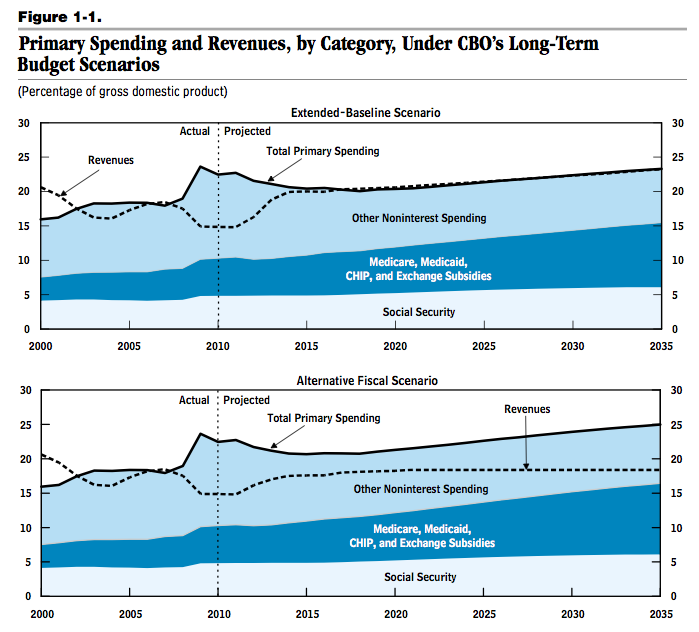
In this season of debate over long-term deficits, this is ground zero:

That’s the key chart from the Congressional Budget Office’s Long-Term Budget Outlook, published just last month, which I read from cover to cover. The CBO is generally considered the authoritative source of budget projections, and CBO “scoring” has been an important aspect of legislative debates over the past few years. Although politicians from both sides criticize the CBO when they don’t like its results, I think it’s fair to say that it is generally both respected and nonpartisan.

Now, when people say that the federal government faces a long-term budget gap, they (including me) are generally starting from the bottom half of this picture: the CBO’s “alternative fiscal scenario.” The alternative scenario is widely considered the most likely path the budget will follow under current policy (although the CBO itself makes no such claim*). That’s probably a close enough approximation for most purposes. But if you’re going to think hard about long-term budgetary paths, you need to be a bit more careful about what it means.

Continue reading “Long-Term Budget Forecasts for Beginners”

Italy And Systemic Risk In The United States

By Simon Johnson

In recent days, Greece’s parliament adopted new austerity measures and Europe’s finance ministers approved another round of Greek loans. So the European debt crisis is under control, right?

Probably not. One obvious reason is Standard & Poor’s July 4 threat to declare a default if banks roll over Greek government bonds coming due over the next year. That could force everyone back to the drawing board.

Less obvious, but no less worrisome, is Italy. With a precarious fiscal picture, it could be the next to come under pressure. And this time, U.S. banks are in the line of fire, with about $35 billion in loans to Italy and potentially more exposure to risk through derivatives markets.

U.S. regulators should call for a new round of stress tests that assume sovereign-debt restructurings in Europe and take a realistic view of counter-party risks in opaque markets such as foreign exchange swaps. Based on those tests, the biggest banks probably need to suspend dividends and raise more capital as a buffer against losses.

To read the rest of this post, click here (this link is to the full article on Bloomberg: http://www.bloomberg.com/news/2011-07-05/could-italy-be-next-european-domino-to-fall-commentary-by-simon-johnson.html)

Are Subsidized Student Loans Worth the Price?

By James Kwak

Previous guest blogger Anastasia Wilson has written a post on her own blog comparing the student loan racket (for-profit colleges help people take out lots of federally guaranteed student loans to pay for their tuition, then do a lousy job educating them, walking away with the money and leaving students to default) to the subprime loan racket. The flagbearer for this parallel is Steve Eisman, who has gone from shorting subprime mortgages to now shorting for-profit colleges.

In theory, for-profit colleges should not be able to do this. If too many of their former students go into default, the Department of Education is supposed to prevent their new students from taking out federally subsidized loans. (Since the government is ultimately underwriting these loans, it should have the power to make sure that the loans are being used to buy an education that will help borrowers pay back those loans.) But colleges have so far been able to get around the rules by pushing defaults outside the time period that matters for regulatory purposes, as described by the Chronicle of Higher Education.

Continue reading “Are Subsidized Student Loans Worth the Price?”

Christine Lagarde And The Demand For Dollars

By Simon Johnson

After receiving US support at the critical moment, Christine Lagarde was named Tuesday as the next managing director of the International Monetary Fund.  In campaigning for the job, Ms. Lagarde – the French finance minister – made various promises to emerging markets with regard to improving their relationships with the IMF.  But such promises count for little and the main impact of her appointment will be to encourage countries such as South Korea, Brazil, India, and Russia to back away from the IMF and to further “self-insure” by accumulating larger stockpiles of foreign exchange reserves – the strategy that has been followed by China for most of the past decade.

Seen from an individual country perspective, having large amounts of dollar reserves held by your central bank or in a so-called sovereign wealth fund makes a great deal of sense; this is a rainy day fund in a global economy prone to serious financial floods.  But from the perspective of the global economy, such actions represent a major risk going forward – because it will further push down US interest rates, feed a renewed build up in private sector dollar-denominated debt, and make it even harder to get policymakers focused on a genuine fix to our long-term budget problems. Continue reading “Christine Lagarde And The Demand For Dollars”

What Is This “Washington”?

By James Kwak

(Warning: Very elementary post ahead. Most of you probably know all this already.)

Mitch McConnell, Senate Republican Leader, quoted in Bloomberg: “We have seen the consequences of giving Washington a blank check. My message to the president is simple: It’s time for Washington to focus on fixing itself. It’s time Washington take the hit, not the taxpayers.”

That sounds good (if you don’t like “Washington,” that is), but what does it mean? McConnell wants people to think that their tax dollars go to feed some animal named “Washington,” and therefore our budget problems can be solved by simply feeding Washington less — without “taxpayers” taking the hit.

That might be true if “Washington” simply consumed money for its own sake, but the problem is that most of the federal budget isn’t consumed by the federal government.

Continue reading “What Is This “Washington”?”

Straight Talk

By James Kwak

Gary Gensler, chair of the Commodity Futures Trading Commission, has gotten a fair amount of credit for being one of the good guys when it comes to financial regulation after the financial crisis. Kambiz Foroohar has a very favorable portrayal of Gensler in Bloomberg Magazine. It’s pretty much the usual, but I appreciated Gensler’s bluntness when it comes to his past positions on derivatives (as an official in the Rubin-Summers Treasury):

“As a Goldman Sachs Group Inc. (GS) partner and then Treasury undersecretary, Gensler had lined up with the hands-off- derivatives crowd behind the $601 trillion global market.

“He says the near-collapse of the world’s financial system changed his mind about regulation.

“’My thinking has evolved,’ Gensler says in his ninth- floor Washington office, which is decorated with artwork by his three daughters. ‘I was part of the consensus view on derivatives, and it’s fair to say that the consensus missed it. We should have done more to protect the American people.'”

That’s about the closest thing to an apology you’ll hear from anyone involved in creating the financial crisis.

Could The US Have An “Expansionary Fiscal Contraction”?

By Simon Johnson.  My full written testimony to Tuesday’s hearing of the Joint Economic Committee of Congress is available here.

The US has a large budget deficit and a debt-to-GDP ratio that, in most projections, continues to rise over time.  Some House and Senate Republicans are arguing strongly that this situation calls for large and immediate cuts to government spending, for example as part of any agreement to increase the federal government’s debt ceiling.  

The Joint Economic Committee of Congress held a hearing on Tuesday to discuss whether such spending cuts would be “contractionary” or “expansionary” for the economy in the short-run.  My assessment, after participating as a witness at the hearing, is that large immediate spending cuts would tend to slow the economy (a webcast of the hearing is here).  Continue reading “Could The US Have An “Expansionary Fiscal Contraction”?”

China and the Saving of Europe

By Simon Johnson

The Greek government owes more than it can afford to pay, now or in the near future, at market interest rates.  There are two options: reduce the payments through some form of restructuring, or move the debt into the hands of people who are willing to charge below market rates for the foreseeable future.

In this decision, the International Monetary Fund has relatively little say – this is really a political decision to be made by the European Union, with discrete backing from the US and China. Continue reading “China and the Saving of Europe”

“The Elderly” for Beginners

By James Kwak

As the AARP says that it is open to modest cuts in Social Security benefits, it’s worthwhile asking a more fundamental question: are Social Security and Medicare programs that benefit the elderly?

The answer may seem obvious. After all, the bulk of Social Security Old Age and Survivors Insurance benefits go to people over 62, and almost all Medicare beneficiaries are over 65. So it’s often observed in passing that our long-range budget issues are the product of transfers to the elderly. For example, in Restoring Fiscal Sanity 2005, Alice Rivlin and Isabel Sawhill write, “These big programs, which benefit primarily the elderly, will drive increases in federal spending in the longer run” (p. 36). Other commentators have occasionally argued that the problem is that the elderly have become too powerful and therefore claim too large a share of government spending, especially compared to the very young.* When you add to that the frequent complaint that, by running budget deficits, we are imposing burdens on our grandchildren, this age-based inequity seems even greater.

But the problem with this framing is that “the elderly” change every year. There’s nothing inherently wrong or unfair with a program in which you pay insurance premiums while you work and collect benefits when you retire. Saying such a program benefits the elderly is like saying that life insurance doesn’t benefit the insured, only the beneficiaries: it’s true in a trivial sense, but people still want and buy life insurance anyway.

Continue reading ““The Elderly” for Beginners”

Basel, Tomato, And Mozzarella

By Simon Johnson

The bank lobbyists have a problem.  Last week, they lost a major battle on Capitol Hill with the failure to suspend implementation of the new cap on debit card fees.  Despite the combined efforts of big and small banks, the Corker-Tester bill attracted only 54 votes in the Senate – when it needed 60

On debit cards, the retail lobby proved a surprisingly effective counterweight to the financial sector.  On the next big issue, the bankers have a different problem: it’s highly technical, more within the purview of regulators than legislators, and often perceived as boring.  Or, as one bank executive put it to Reuters, speaking of the capital requirements agreed between countries in the so-called Basel III framework,

“When you do mention Basel, your average member of Congress thinks ‘that pairs well with tomato and mozzarella.’” Continue reading “Basel, Tomato, And Mozzarella”

Jamie Dimon’s New Math

By Simon Johnson

On Tuesday, June 7, Jamie Dimon (CEO of JPMorgan Chase) pressed Fed Chair Ben Bernanke on the costs of bank regulation after the financial crisis of 2008.  Could this be what is slowing the economic recovery?  Bernanke was very polite in his response, but the question – as posed – made no sense at all.  (The full tape of his question is here,)

Most of what Jamie Dimon lists under the heading of changes are just symptoms of the crisis itself, e.g., badly run firms and crazy products disappeared.  His substantive issue appears – from his question – to be just about capital requirements. 

But the implication of Dimon’s question – that higher capital requirements will slow growth – is simply wrong.  I explain this in a column now running on Bloomberg.  Here’s the link: http://www.bloomberg.com/news/2011-06-09/the-missing-math-in-dimon-s-economic-argument-simon-johnson.html.

The Banking Emperor Has No Clothes

By Simon Johnson

In a major speech earlier this week to an American Bankers Association conference, Treasury Secretary Tim Geithner laid out his view of what went wrong in the financial sector prior to 2008, how the crisis was handled 2008-10, and what is now needed with regard to implementation of reforms.  As chair of the Financial Stability Oversight Council and the only senior member of President Obama’s original economic team remaining in place, Mr. Geithner’s influence with regard to the banking system is second to none.

Unfortunately, there are three major mistakes in Mr. Geithner’s speech: his history is completely wrong; his logic is deeply flawed; and his interpretation of the Dodd-Frank reform does not mesh with the legal facts regarding how the failure of a global megabank could be handled.  Added together, this suggests one of our most powerful policymakers is headed very much in the wrong direction. Continue reading “The Banking Emperor Has No Clothes”

And in This Corner . . .

By James Kwak

Over in the less-prestigious and less-well-paid online section of the Times, Bruce Bartlett has a good column on the comparative tax burden across advanced economies. He makes the point that one reason European taxes look higher is that we provide subsidies through the tax code while they do it through spending programs like family allowances — another example of how aggregate statistics are distorted by calling something a “tax credit” as opposed to “spending.” His other main point is that the main substantive reason why we pay lower taxes is that we pay for less of our health care spending through the government — and that isn’t working out so well for us.