How Big Is the Long-Term Debt Problem?

By James Kwak

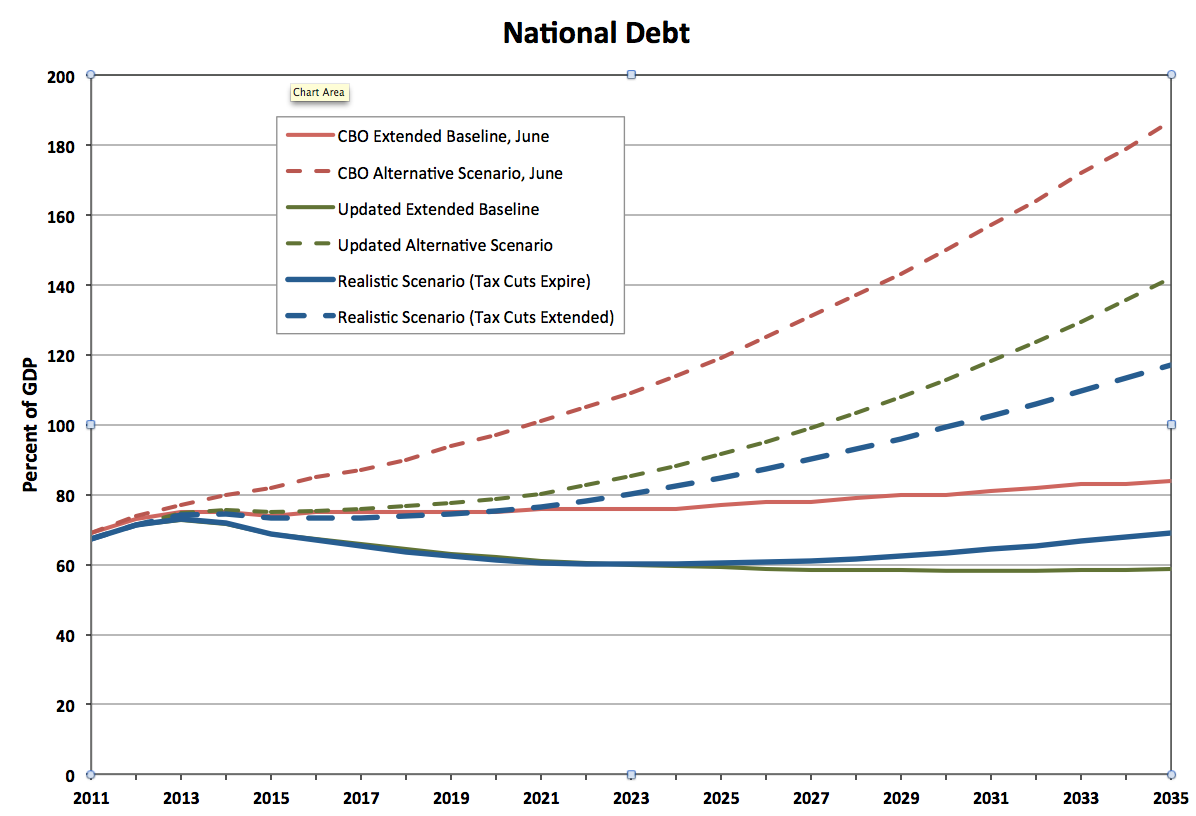
Articles about the deficits and the national debt generally talk about unsustainable long-term deficits that will drive the national debt up to a level where scary things happen. Sensible commentators usually acknowledge that our current deficits are a sideshow and the real problems happen in the 2020s and 2030s due to modestly increasing Social Security outlays and rapidly increasing health care spending. I admit that this has generally been my line as well; for example, in a previous post I said that the ten-year deficit problem is entirely a product of extending the Bush tax cuts, but that even if we let them expire things will get worse over the next two decades.

But looking at the numbers, it’s not clear that the long-term picture is really that bad. Here I’ll lay out the numbers, and then, as they say on Fox News, you can decide. The summary is the chart above; the details are below.

Continue reading “How Big Is the Long-Term Debt Problem?”

What Would It Take To Save Europe?

By Simon Johnson

Last weekend official Washington was gripped by euphoria, at least briefly, as people attending the IMF annual meetings began to talk about how much money it would take to stabilize the situation in Europe.  At least one eminence grise suggested that 1.5 trillion euros should do the trick, while others were more inclined to err on the side of caution – 4 trillion euros was the highest estimate I heard.

This is a lot of money: Germany’s annual Gross Domestic Product (GDP) is only about 2.5 trillion euros, and the combined GDP of the entire eurozone is about 9.5 trillion euros.  The idea is that providing a massive package of financial support would “awe” the markets “into submission” – meaning that people would stop selling their holdings of Italian or Spanish debt and thus stop pushing up interest rates.  Ideally, investors would also give Greece and Portugal some time to find their way to back to growth.

But this is the wrong way to think about the problem.  The issue is not money in the form of external financial support – provided by the IMF or other countries to parts of the European Union.  The real questions are: will Italy get complete and unfettered access to the European Central Bank, and when will we know this? Continue reading “What Would It Take To Save Europe?”

Edmund Burke and American Conservatism

By James Kwak

It has become a truism that modern American conservatism is revolutionary in the sense that it seeks to overturn the established order rather than to preserve it. “Reagan Revolution,” “Tea Party”—the very names for the movement announce that is about more than defending the status quo. In the conservative worldview, America (or “Washington,” or the “mainstream media,” or some other powerful stratum) is dominated by a liberal-intellectual-academic-bureaucratic-socialist-internationalist (pick two or more) elite that must be overthrown. So in at least a mythical sense, conservatism is about restoration, which is something very different from “conserving” what exists today.

When did this happen? According to one view of the world, to which I have been partial in the past, there was once an ideology called conservatism that really was conservative in the narrow sense: that is, it counseled maintaining existing institutions on the grounds that radical change was dangerous. The Rights of Man and the Citizen may be great, but soon enough you have the Committee of Public Safety and the guillotine. On this reading of history, conservatism became radical sometime after World War Two, when it gave up accommodation with the New Deal in favor of rolling the whole thing back, ideally all the way through the Sixteenth Amendment.

In The Reactionary Mind,* however, Corey Robin has a different take: conservatism, all the way back to Edmund Burke, has always been about counterrevolution, motivated by the success of left-wing radicals and consciously copying their tactics in an attempt to seize power back from them. Conservative thinkers were always conscious of the nature of modern politics, which required mobilization of the masses long before Nixon’s silent majority or contemporary Tea Party populism. The challenge is “to make privilege popular, to transform a tottering old regime into a dynamic, ideologically coherent movement of the masses” (p. 43). And the way to do that is to strengthen and defend privilege and hierarchy within all the sub-units of society (master over slave, husband over wife, employer over worker).

Continue reading “Edmund Burke and American Conservatism”

Anti-American Bankers

By Simon Johnson.  An edited version of this short post appeared today on the NYT.com’s Room for Debate: “Are Global Banking Rules Anti-American?”

Jamie Dimon claims that the new rules on bank capital “anti-American” because they somehow discriminate against American banks and American bankers.  This framing of the issues is misleading at best.

The term “bank capital” is often poorly explained in the debate on this issue.  It is just a synonym for equity – meaning the amount of a bank’s activities that are financed with shareholder equity, rather than debt.  The advantage of equity is that it is “loss absorbing,” meaning that it takes losses and must be wiped out in full before any losses fall on creditors.

More capital means that a bank is safer, both from the perspective of shareholders and for creditors.  Bankruptcy has become less likely. Continue reading “Anti-American Bankers”

Should Social Security Be Progressive?

By James Kwak

My earlier rant on the Social Security wage base made me think of a more important question (actually, I was already thinking of it, hence the need to Google the earnings cap): Should Social Security be more progressive than it already is? The most common ways liberals want to make it more progressive are (a) eliminating the cap on taxable earnings altogether and (b) reducing benefits for high earners. For part of my brain the automatic answer is “yes,” but I think there is a reasonable argument for leaving things roughly the way they are.

First, there’s a straight-up political argument. Social Security is popular because people feel like they earn their benefits. If people thought it was a covert redistribution program, then the high earners would definitely be against it, and most of the middle class probably would be too because of the American allergy to welfare. In fact, there are certainly people who think it is “pure welfare”, like the author of the post I criticized last time around. But it isn’t:

Continue reading “Should Social Security Be Progressive?”

Black Is White

By James Kwak

I wasn’t sure what the Social Security wage base was (it’s $106,800, by the way), so I Googled “payroll tax cap.” The number one hit is a post at a blog modestly called The American Thinker. I wouldn’t ordinarily want to bring more attention to it, but it was the #1 hit, and according to Quantcast it has a million unique visitors per month, so nothing I do will affect it one way or another.

Anyway, the thrust of the argument is that we shouldn’t eliminate the cap on wages subject to the payroll tax because “America simply can’t afford it.”

Such plans for expanding an already-huge entitlement are beyond irresponsible, they’re frightful.  Klein and Weller aren’t serious men.  When reading their ideas for Social Security expansion in this time of trillion-dollar federal deficits, one realizes that progressives are unconcerned about America’s fiscal crisis.

You read that correctly. The argument is that increasing the wage base, which would bring in more revenues and reduce the deficit, is a bad thing—because of our fiscal crisis.

Continue reading “Black Is White”

Will The IMF Save The World?

By Simon Johnson

The finance ministers and central bank governors of the world gathered this weekend in Washington for the annual meeting of countries that are shareholders in the International Monetary Fund.  As financial turmoil continues unabated around the world and with the IMF’s newly lowered growth forecasts to concentrate the mind, perhaps this is a good time for the Fund – or someone – to save the world.

There are three problems with this way of thinking.  The world does not really need saving, at least in a short-term macroeconomic sense.  If the problems do escalate, the IMF does not have enough money to make a difference.  And the big dangers are primarily European — the European Union and key eurozone members have to work out some difficult political issues and their delays are hurting the global economy.  But, as this weekend’s discussions illustrate, there is very little that anyone can do to push them in the right direction. Continue reading “Will The IMF Save The World?”

The Price of Gold in the Year 2160

This piece of fun weekend reading is contributed by StatsGuy, an occasional commenter and guest contributor on this blog.

It’s become quite popular to talk about the price of gold . . . in blogs, the press, at dinner parties.  The latest topic of debate is not about the price of gold as a commodity, but about gold as the one and only king money.  The basic argument is that 5,000 years of tradition will overwhelm the tyranny of modern government and the fiat printing press.  The barbaric relic will defeat socialism, fascism, Obama-ism,  and restore liberty to the world, after a terrible economic collapse in which gold-owning visionaries become fabulously wealthy.

Perhaps they are correct—or perhaps not.  I don’t know what will happen in 10 years.  However, unless civilization utterly collapses (which is what gold hoarders seem to want), the gold bubble will collapse.  And I don’t mean the 10 year “bubble” . . . I mean the 5,000 year bubble.

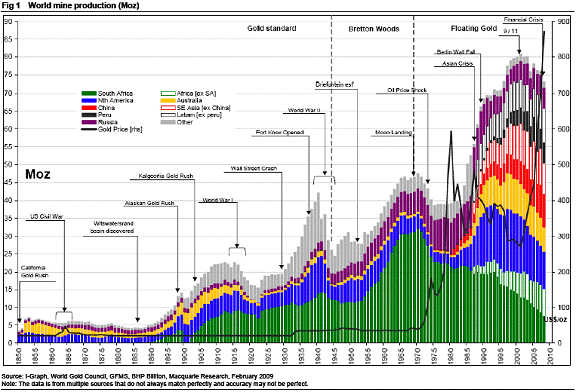
This claim might sound crazy, but it’s quite easy to defend, for the simple reason that there is too darn much gold.  Gold enthusiasts will note that you can’t just print gold like fiat paper.  They will note that high quality mines are failing, and argue that we’ve passed “peak gold”.

The argument for the collapse has little to do with terrestrial mine quality (although massive amounts of money and new technology are flowing into exploration, long term mine development and extending the life of existing mines).  The argument merely requires that gold price ultimately responds to supply.

Continue reading “The Price of Gold in the Year 2160”

Confused?

By James Kwak

Some of the headline numbers for President Obama’s deficit reduction proposal that you hear are the following:

  • $3 trillion in deficit reduction over ten years—more than the $1.2–1.5 trillion expected from the Joint Select Committee (JSC)
  • $4 trillion in deficit reduction, including the discretionary spending caps in the Budget Control Act
  • $1.5 trillion in tax increases
  • $1 trillion in deficit reduction by capping spending on Iraq and Afghanistan

This didn’t make sense to me for a few reasons, notably that any deal that preserves any of the Bush tax cuts should be scored by the CBO as a tax cut, which increases the deficit. The actual numbers are rather more complicated.

Continue reading “Confused?”

Happy Constitution Day

By James Kwak

(Actually, it was on Saturday.) I just read Invisible Hands: The Making of the Conservative Movement from the New Deal to Reagan (W.W. Norton, 2009), by Kim Phillips-Fein. It’s a history of the resistance from the business community to the New Deal and how it gave birth to at least one major strand of the modern conservative movement. One of Phillips-Fein’s major points is that the conservative movement is not just a reaction to the civil rights movement, the 1960s, and the women’s liberation movement (and Roe v. Wade). Those trends gave the conservative movement more energy and support, but business leaders had for decades been trying to build an intellectual and political movement that could reverse the New Deal. And while some of them talked about Christian values, what they really cared about were breaking unions and lower taxes.

Continue reading “Happy Constitution Day”

What Next For Greece And For Europe?

By Peter Boone and Simon Johnson

Uncertainty about potential loan losses in Europe continues to roil markets around the world.  For many investors, taxpayers, and ordinary citizens there is no clarity on the exact current situation – let alone a stable view about what could happen next.  What should any friends of Europe — the US, G20, IMF, perhaps even China — strongly suggest that they do?

A good start would involve being honest on four points.  There is nothing pleasant about the truth in such crisis situations, but continued denial increasingly becomes dangerous to all involved.

Greece is on the front burner.  Currently on offer is a debt swap for private sector lenders that, once it goes through, will effectively guarantee 33 cents for every 1 euro in bonds that they currently hold.  The downside protection here is attractive to banks – made possible by the fact they will now get hard collateral in the restructured deal (meaning that Greece buys the bonds of safe EU countries, like Germany, and holds these where creditors could get at them).

The first brutal truth is that this is a default by Greece and all attempts to deny this or use another word just muddy the waters. Continue reading “What Next For Greece And For Europe?”

Does Disclosure Help?

By James Kwak

Following up on yesterday’s column about corporate spending, I saw that John Coates (Harvard Law School) and Taylor Lincoln (Public Citizen) have published a study of the relationship between voluntary disclosure of political spending and company value (summary here). In short, after applying a bunch of controls, they find that companies with voluntary disclosure policies have price-to-book values that are 7.5 percent higher than companies that don’t.

Citing earlier research, they also say, “among the S&P 500 – which accounts for 75 percent of the market capitalization of publicly traded companies in the U.S. – firms active in politics, whether through company-controlled political action committees, registered lobbying, or both, had lower price/book ratios than industry peers that were not politically active.”

Of course, the causality could run either way, and Coates and Lincoln are not claiming that voluntary disclosure in itself makes a company more valuable. Disclosure policies make it less likely the CEO will blow company money on her pet political projects, and so it stands to reason that companies that are better governed in general—and hence more valuable—are more likely to have such policies. But it certainly implies that disclosure policies are not going to bankrupt the Great American Corporation.

Citizens United and Corporate Political Spending

By James Kwak

Today’s Atlantic column is about corporate political spending in the wake of Citizens United and what, if anything, can be done about it. A group of corporate and securities law professors has petitioned the SEC to write rules requiring companies to disclose their political spending, just like they have to disclose their executive compensation today. As usual, I’m not too optimistic about what disclosure can achieve, especially disclosure in SEC filings or proxy statements: who reads those things, anyway? But it’s better than nothing, and with the current makeup of the Supreme Court, nothing is just about what we’ve got now.

Ponzi Schemes for Beginners

By James Kwak

On the theory that the best defense is a good offense, Rick Perry has been insisting to anyone who will listen that Social Security is a Ponzi scheme. Probably hundreds of people have already explained why it isn’t, but I think it’s important to be clear about why Rick Perry thinks it is—or, rather, why his political advisers think he can get away with it.

A Ponzi scheme, classically, is one where you promise high returns to investors but you have no way of actually generating those returns; instead, you plan to pay off old investors by getting new money from new investors. Social Security is obviously not a Ponzi scheme for at least two basic reasons. First, there’s no fraud involved: all of Social Security’s finances are right out in the open for anyone who cares to look, in the annual report of the trustees of the Social Security trust funds. Second, a Ponzi scheme by construction cannot go on forever; no matter how long you can keep it going, at some point you will run out of potential new investors and the whole thing will collapse. I’m sure there are other obvious differences, but that’s enough for now.

Continue reading “Ponzi Schemes for Beginners”

The Importance of Time Off

By James Kwak

I used to be a real productivity nerd. I wrote an earlier post detailing some examples of my compulsion to be as efficient as possible. I worked at a company where efficiency was one of our highest implicit values.

I still care a lot about productivity—my own, that is. For example, after reading Anthony Bourdain’s first book, I became much more attentive to the sequence of movements I make around the kitchen: when you open the refrigerator, take out everything you need; when you walk to the far end of the kitchen to get utensils, get everything you need; and so on. I used to make fancy dinners that could take an hour and a half or two hours to cook. Now that I have a child, I make simpler, multi-course meals in 30–40 minutes.

But I have a more nuanced understanding of productivity now, which is why I liked Derek Thompson’s article on the importance of vacation—and taking breaks—so much.* Part of it is that since I left the business world, most of my work now is creative—not creative in the sense of creating original works of art, but in the more modest sense that it involves thinking about stuff and writing about that stuff. When you’re a manager at a fast-growth, under-staffed company, it’s not hard to spend huge blocks of time just responding to email, reviewing documents, and providing input on various issues. That takes thought, but it’s somewhat mechanical. When I’m writing anything I care about, though, I can’t force myself to crank out another paragraph at will. And if that paragraph isn’t coming, I go kill some zombies, or “clean up outer space” (as my daughter puts it), or weed the lawn.

Continue reading “The Importance of Time Off”