Making Banks Small Enough And Simple Enough To Fail

By Simon Johnson

Almost exactly two years ago, at the height of the Senate debate on financial reform, a serious attempt was made to impose a binding size constraint on our largest banks. That effort – sometimes referred to as the Brown-Kaufman amendment – received the support of 33 senators and failed on the floor of the Senate. (Here is some of my Economix coverage from the time.)

On Wednesday, Senator Sherrod Brown, Democrat of Ohio, introduced the Safe, Accountable, Fair and Efficient Banking Act, or SAFE, which would force the largest four banks in the country to shrink. (Details of this proposal, similar in name to the original Brown-Kaufman plan, are in this briefing memo for a Senate banking subcommittee hearing on Wednesday, available through Politico; see also these press release materials).

His proposal, while not likely to immediately become law, is garnering support from across the political spectrum – and more support than essentially the same ideas received two years ago.  This week’s debacle at JP Morgan only strengthens the case for this kind of legislative action in the near future. Continue reading “Making Banks Small Enough And Simple Enough To Fail”

JP Morgan Debacle Reveals Fatal Flaw In Federal Reserve Thinking

By Simon Johnson

Experienced Wall Street executives and traders concede, in private, that Bank of America is not well run and that Citigroup has long been a recipe for disaster.  But they always insist that attempts to re-regulate Wall Street are misguided because risk-management has become more sophisticated – everyone, in this view, has become more like Jamie Dimon, head of JP Morgan Chase, with his legendary attention to detail and concern about quantifying the downside.

In the light of JP Morgan’s stunning losses on derivatives, announced yesterday but with the full scope of total potential losses still not yet clear (and not yet determined), Jamie Dimon and his company do not look like any kind of appealing role model.  But the real losers in this turn of events are the Board of Governors of the Federal Reserve System and the New York Fed, whose approach to bank capital is now demonstrated to be deeply flawed. Continue reading “JP Morgan Debacle Reveals Fatal Flaw In Federal Reserve Thinking”

Bad Dividend Math

By James Kwak

While working on a new Atlantic column, I came across this article by Donald Luskin (hat tip Felix Salmon/Ben Walsh) arguing that “Taxmageddon” (the expiration of the Bush tax cuts at the end of the year) will cause the stock market to fall by 30 percent.* His argument is basically this: if the marginal tax rate on dividends increases from 15 percent to 43.4 percent, the after-tax yield falls by 33.4 percent, so stock prices should fall by about the same amount.

Ordinarily I don’t bother with faulty claims like this—there are only so many hours in the day—but it bothered me so much it cost me some sleep last night.

The first problem is the only one that Luskin acknowledges: lots of investors don’t pay taxes on dividends. He mentions pension funds; there are also non-profits and anyone with a 401(k) or IRA. According to Luskin, only about one-quarter of dividends are received by people who will pay the top rate. Maybe they are the marginal investors who set prices, he speculates. Well, maybe. But an increase in the tax rate will make dividend-paying stocks more expensive for them but the same price as before for non-taxpaying investors—so as long as we’re going to stick to theory, the former should sell their stocks to the latter for some price between the two.

More important, the price of a stock (in theory, again) is the discounted present value of its future dividend stream aggregated over an infinite horizon. So we need to know what the tax rates will be in all future years. That’s clearly unknowable. If the tax rate goes up on January 1, 2013, that will give us no information about the tax rate in 2113. On the other hand, it will give us very good information about the tax rate in 2013. And it will give us a little bit of information about the tax rate in 2023. In other words, the informational value of a change in tax rates only affects a small part of the summation you have to do if you want to value a stock by its dividend stream. If a company is going to shut down in 2013, liquidate its assets, and return one massive dividend to shareholders, it affects most of the value. If a company is Facebook and is unlikely to pay dividends for a long time, it affects very little of the value. So the impact of such a change on stock prices will be a lot less than the theoretical 33.4 percent that Luskin calculates.

Then there’s the little matter of markets. Luskin’s article chides the “stock market” for ignoring the upcoming change in tax rates on dividends. How does he know? Did he ask the market? More likely, the market is pricing in the possibility of a change in tax policy. In theory, market prices today should reflect the expected future tax level, which is somewhere between 15 percent and 43.4 percent—closer to which one, we don’t know. This is another reason why the actual impact of a tax increase will be smaller than 33.4 percent; the latter assumes that every single investor today is blindly assuming that the tax rate will remain at 15 percent.  (Actually, since the Medicare surtax is already law, every single investor knows that the tax rate will be at least 18.8 percent, not 15 percent.)

But this is all theory. There is actually a way to test these things. To the extent that a change in the dividend tax rate affects stock prices, it should affect high-dividend stocks more than low-dividend stocks. Even on the theory that the value of a stock is the discounted value of its future dividend stream, for a high-dividend stock, much of that value comes from dividends in the next decade, which are likely to be affected by a change in the tax rate. By contrast, for a company that doesn’t pay dividends, the value of its dividend stream is located far out in the future, where a change in today’s tax rate has little expected impact. So if Luskin is right, the 2003 tax cut (which established the 15 percent rate for dividends) should have caused not only a sharp increase in stock prices but also a sharp increase in the price of value stocks relative to growth stocks.
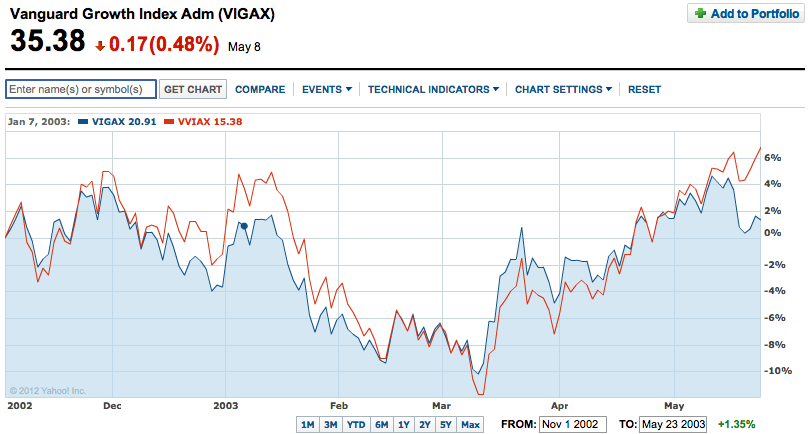
So, courtesy of Yahoo! Finance, here are the closing prices of the Vanguard Value Index (red), which includes high-dividend stocks, and the Vanguard Growth Index (blue), which includes low-dividend stocks, for November 2002 through May 23 2003, the day the final bill was passed by both houses. The question, though, is when the 2003 tax cut would have affected stock prices. There’s no separation between value and growth stocks around November 5, the day the Republicans won the midterm elections.  (Remember, the Democrats had a Senate majority in 2002.) There’s none around January 28, when President Bush called for tax preferences for dividends in his State of the Union address. There’s no reaction around February 27, when the bill that would cut taxes on dividends was introduced.

Now, there is a separation around May 15, when the Senate version initially  passed. (Passage in the House was assured because of the Republican majority there.) This implies that there was significant uncertainty about whether the bill would pass; when the uncertainty cleared, high-dividend stocks gained relative to low-dividend stocks. Score one for Luskin!

But if there was uncertainty that cleared on May 15, and Luskin is right, then two things should have happened: high-dividend stocks should have gained relative to low-dividend stocks, and all stock prices should have shot up. But that’s not what happened. High-dividend stocks went up; low-dividend stocks went down. Investors’ overall appetite for U.S. stocks didn’t change; at the margin, some realized that after-tax dividend yields had just gone up, so they switched from low-dividend to high-dividend stocks.

By May 23, the last date on that chart, passage was a certainty, so the impact of the tax change should have been 100 percent priced in. Do you see a 30 percent increase? I don’t.

Want more evidence? Here are the same two index funds for December 1 through December 17, 2010, when the dividend tax cut was extended for two years. The extension was in serious doubt until December 6, when Democrats and Republicans reached a compromise agreement. Again, you can see an increase in the price of high-dividend stocks relative to the price of low-dividend stocks, starting around December 6. This indicates that the market was reacting to a significant change in the probability of an extension. But there’s no sharp, 30 percent increase in the overall level of stock prices.

So the tax rate on dividends does seem to have a small but visible impact on the relative price of high- and low-dividend stocks. And it may have a small impact on the overall price level, which would make sense. But 30 percent, or anything close to it, is pure fantasy.

So why all this hysteria about a collapse in the stock market on January 1? Well, here’s one hint, from Luskin’s article:

“If there’s a bargaining failure and the scheduled tax hikes on dividends aren’t stopped, we’ll be sorry we’re spending so much political energy now debating about the ‘1%’ and their supposed privileges. It’s the 30% down in the stock market we ought be worrying about.”

This is just another attempt to mask the blatant unfairness of the Bush tax cuts by arguing by arguing that that they are good for all of us (well, at least all of us who own stocks, but that’s a matter for another post). They’re not.

* Luskin also talks about “trillions more in new tax hikes under ObamaCare.” Huh? The revenue provisions of the Affordable Care Act are projected to bring in $520 billion over the next decade; even if you include the revenue-increasing coverage provisions (like the excise tax on high-cost health plans), you only get up to $813 billion. That’s not “trillions,” unless you’re talking about an undiscounted infinite horizon.
Who Pays for Facts?

By James Kwak

The Internet has made possible a golden age of commentary. Anyone with a computer and an Internet connection can create a blog and comment to her heart’s content.

Yet as one of those commenters with a free blog, I am painfully aware that this hypertrophy of analysis has not been matched by corresponding growth in the stuff that we analyze: facts. There is no way we could have written White House Burning, with its one hundred pages of endnotes, without someone else to do the primary research: either the journalistic kind, calling around to sources in Washington to figure out what’s going on, or the data-gathering kind, visiting grocery stores in Brooklyn to track prices and calculate the inflation rate.

So I would just like to second what Menzie Chinn said about the importance of government statistical organizations, which are (along with most of the rest of the government) under attack from Paul Ryan and his troops. Even if you don’t agree with what I say, if you like reading economics blogs, you should realize that they couldn’t really exist without the BEA, BLS, Census Bureau, etc.

Of course, if your economic policy prescriptions are based entirely on pure theory, then I guess you can do without data.

Mitt Romney And Paul Ryan’s Budget

By Simon Johnson

The conventional wisdom in American presidential politics is that once a candidate has secured a party’s nomination, he tends to move away from articulating the views of the party faithful toward the political center. This makes sense as a way to win votes in the general election, and there has been a presumption that Mitt Romney will head in that direction.

However, in a panel discussion on Tuesday, Vin Weber, a senior adviser to Mr. Romney, indicated that the campaign may be moving toward positions on fiscal policy that are close to those proposed by Representative Paul D. Ryan of Wisconsin and his Republican colleagues on the House Budget Committee. Continue reading “Mitt Romney And Paul Ryan’s Budget”

Stephen King Weighs In

Great article by Stephen King (hat tip Felix Salmon/Ben Walsh). Excerpt:

“The Mitch McConnells and John Boehners and Eric Cantors just can’t seem to help themselves. These guys and their right-wing supporters regard deep pockets like Christy Walton and Sheldon Adelson the way little girls regard Justin Bieber … which is to say, with wide eyes, slack jaws, and the drool of adoration dripping from their chins.”

Like me, King wants his tax bill to go up.

My Daughter Will Be CEO of the World’s Most Valuable Company Someday

By James Kwak

At least, that’s the impression I get from reading Walter Isaacson’s biography of Steve Jobs, which I finally finished this weekend. It’s not a particularly compelling read; it basically marches through the stages of his professional life, which is already the subject of legend, so there isn’t much suspense. I fear that it will inspire a new generation of corporate executives to imitate all of Jobs’s personal shortcomings—but without his genius.

The picture you get from the book is basically that Steve Jobs acted like a five-year-old for his whole life. He could be wrong about some basic, uncontroversial fact yet insist stubbornly that he was right. He divided the world into things that were great and things that were terrible, and his classifications could be arbitrary. He was an obnoxiously picky eater, constantly complaining about his food and sending it back. He threw epic tantrums that only a CEO (or a five-year-old) could get away with.

Continue reading “My Daughter Will Be CEO of the World’s Most Valuable Company Someday”

American Taxpayer Liabilities Just Went Up, Again – Why Isn’t Congress Paying Attention?

By Simon Johnson

Most Americans paid no attention this weekend when the International Monetary Fund announced it was well on its way to roughly doubling the money that it can lend to troubled countries – what the organization calls a $430 billion increase in the “global firewall.”

The United States declined to participate in this round of fund-raising, so the I.M.F. has instead sought commitments from Europe, Japan, India and other larger emerging markets.

At first glance, this might seem like a free pass for the United States. The additional I.M.F. lending capacity is available to euro-zone countries that now face pressure, such as Spain or Italy, so it might seem that global financial stability is increased without any cost to the American taxpayer.

But such an interpretation mistakes what is really happening – and actually represents a much broader problem with our budgetary thinking. The I.M.F. represents a contingent liability to taxpayer sin the United States – much as the Federal National Mortgage Association (known as Fannie Mae) and Freddie Mac (formerly the Federal Home Loan Mortgage Corporation) have in the past — and as too-big-to-fail mega-banks do now. Continue reading “American Taxpayer Liabilities Just Went Up, Again – Why Isn’t Congress Paying Attention?”

About That State and Local Tax Deduction

By James Kwak

A couple of days ago I criticized Mitt Romney for thinking that eliminating the deductions for mortgages on second homes and for state and local taxes would pay for his 20 percent rate cuts. But there’s a more important general point to be made.

The deduction for state and local taxes is a subsidy from the federal government to state and local governments. This is how it works: If you’re in the 35 percent tax bracket, for every $100 of taxes you pay to state and local governments, the federal government gives you $35. In other words, for every $100 of taxes levied, you pay $65 and Barack Obama pays $35. That’s called a subsidy. Without it, the state and local governments would only get $65—or they would have to raise taxes by over 50 percent, which would make you mad.

Continue reading “About That State and Local Tax Deduction”

Margaret Atwood And Tax Reform

Writing recently in The Financial Times, the renowned novelist Margaret Atwood nailed the lasting effects of the recent – and some would say continuing – global financial crisis. “Those at the top were irresponsible and greedy,” she wrote; consequently and with good reason, very few people now trust our banking elite or the system they operate.  Even Cam Fine, president of Independent Community Bankers of America, is now calling for the country’s largest banks to be broken up.

But the distrust goes deeper and further, just as Ms. Atwood implies. Many people understand perfectly well that the government let the bankers take excessive risk. There was a high degree of group think among prominent officials in the United States and top banking executives in the run-up to the crisis of 2008. As chief economist at the International Monetary Fund from March 2007 through August 2008, I observed some of this first hand.

And politicians are also tarnished. They appointed the officials who failed to regulate effectively. And in 2007-8 the politicians decided to save the big banks – and most of their managers, boards of directors and shareholders – both under President George W. Bush and under President Obama. Now attention turns toward the federal government’s fiscal problems, including the complicated mess that is our tax system. Politicians say they want “tax reform,” but can you trust them to do this in a responsible manner, without falling captive to particular special interests or to otherwise undermine the general social interest? Continue reading “Margaret Atwood And Tax Reform”

Mitt Romney Still Can’t Do Arithmetic

By James Kwak

From his closed-door fundraiser yesterday, courtesy of NBC:

“I’m going to probably eliminate for high income people the second home mortgage deduction,” Romney said, adding that he would also likely eliminate deductions for state income and property taxes as well.

“By virtue of doing that, we’ll get the same tax revenue, but we’ll have lower rates,” Romney explained.

Let’s check Romney’s arithmetic.

Continue reading “Mitt Romney Still Can’t Do Arithmetic”

The Buffett Rule Is A Good Idea

By Simon Johnson

Some high income Americans pay a lot of tax; others do not.  If you have right tax advice and if most of your income can be structured as some form of “capital gains”, your marginal rate – what you pay on the your last dollar of income – may be very low.  The highest marginal income tax rate currently is 35 percent, while long-term (over a year) capital gains are taxed at 15 percent at most.

The Buffett Rule is a proposal is establish a minimum tax rate for “millionaires” – people earning more than $1 million per year – and the Senate is likely to vote on a version this week.  The exact amount of revenue that this would bring in depends on the details, but there is no question that it is small relative to the country’s need to control the federal budget.  (The Joint Committee on Taxation scored one version of this proposal as generating about $30 billion over ten years; the annual budget deficit will remain over $1 trillion in the near term even under the most optimistic projections.)

The biggest sticking point for any reasonable strategy to control the US federal budget is that one side – the Republicans – steadfastly refuse to raise taxes, at all and on anyone. Continue reading “The Buffett Rule Is A Good Idea”

Jim Yong Kim For The World Bank

By Simon Johnson, co-author of White House Burning

A decision on choosing the next president of the World Bank is expected this week – perhaps as early as Monday.  The Obama administration nominated Jim Yong Kim, president of Dartmouth College and a noted public health expert.  The reaction to this nomination from development economists and people experienced in the business of lending to poor countries has been overwhelmingly negative.

They are making a big mistake.  Mr. Kim would make an excellent World Bank president. Continue reading “Jim Yong Kim For The World Bank”

The Conventional Wisdom of Tax Reform

By James Kwak

In the Times this weekend, David Leonhardt has a generally good overview of the tax policy showdown that is scheduled for later this year, as the Bush tax cuts approach expiration on January 1. He outlines several of the central issues we face: “hypothetical solutions are a lot more popular than actual ones”; everyone says she wants tax reform, but the tax expenditures that would have to be eliminated are very popular; and any significant deficit solution will directly affect vast numbers of Americans.

I have a few differences with Leonhardt, however. First, after his colleagues David Brooks and James Stewart, he seems to have fallen briefly under the spell of Paul Ryan: “Mr. Ryan’s plan would cut the top rate to 25 percent, from 35 percent, and still leave overall tax collection roughly where it has been, by eliminating tax breaks.”

Continue reading “The Conventional Wisdom of Tax Reform”