Does The US Still Face An Emerging Market-Type Crisis?

The US has developed some features more typically seen in an emerging market, including disproportionate power and system-threatening activities in the finance sector.  In fall 2007, the US (and the world) experienced the kind of precipitous fall in credit, output, and employment that was, in modern times, seen only in “emerging market crises”.  Our first Baseline Scenario was controversial and largely dismissed when it first appeared on September 29, 2008, but many of its arguments and policy recommendations have now been absorbed into official thinking (at least in the US).

Is the US out of the emerging market-type woods?  Can we now rule out the possibility of a great depression?  Such a severe economic outcome is not currently our baseline view (e.g., as discussed in this NBR interview), but it is still a downside scenario that needs to be taken seriously – and, at least in our interpretation – this is also the view of Bernanke’s Fed (see our piece on Sunday and the profile in yesterday’s Washington Post.)

Why is a depression scenario still on the table? Continue reading “Does The US Still Face An Emerging Market-Type Crisis?”

What Next For Banks?

The case for keeping banks in something close to their current structure begins to take shape.  It’s not about traditional claims that big banks are more efficient, or Lloyd Blankfein’s argument that this is the only way to encourage risk-taking, or even the House Financial Services Committee view that immediate resumption of credit flows is essential for preserving jobs. 

Rather, the argument is: those opposed to banks and bankers are angry populists who, if unchecked, would do great damage.  Bankers should therefore agree to some mild reforms and more socially acceptable behavior in the short-run; in return, the centrists who control economic policymaking will protect them against the building backlash.  This is a version of Jamie Dimon’s line: “if you let them vilify us too much, the economic recovery will be greatly delayed.”

There are three problems with this argument: it is wrong, it won’t work, and it doesn’t move the reform process at all in the right direction. Continue reading “What Next For Banks?”

Inflation Expectations for Beginners

For a complete list of Beginners articles, see Financial Crisis for Beginners.

Only a few years ago, the accepted remedy for a recession was for the Federal Reserve to lower interest rates – namely, the Federal funds rate. Now, however, the economy has been stuck in recession for over fifteen months and the Federal funds rate has spent the last several months at zero. (The Fed funds rate cannot ordinarily be negative, because one bank won’t lend $100 to another bank and accept less than $100 in return; it always has the option of just holding onto its $100.) As a result, the Fed has resorted to other policy tools, most notably large-scale purchases of agency and Treasury securities, funded by creating money. (Here’s James Hamilton’s analysis.)

As the Fed’s monetary policy plays a more prominent role in the response to the economic crisis, there will be more talk of inflation or, more accurately, inflation expectations. While inflation is what affects the purchasing power of the money in your wallet, inflation expectations are what affect people’s behavior in ways that have a long-term economic impact. Take the case of wage negotiations, for example: a union that believes inflation will average 5% over the life of a contract will demand higher wage increases than a union that believes inflation will average only 1%. Once those higher wages are built into the contract, the employer is forced to raise prices in order to cover those wage increases, and inflation begins to ripple through the economy.

Continue reading “Inflation Expectations for Beginners”

Is It a V?

Yesterday, at the Peterson Institute for International Economics, Mike Mussa and I discussed – and debated – the likely shape of the US and global economic recovery.  Mike has great experience and an outstanding track record as an economic forecaster.  His view is that the entire post-war experience of the US indicates there will be a sharp rebound.  Victor Zarnowitz apparently stressed to Mike, a long time ago, “deep recessions are almost always followed by steep recoveries.”

I completely accept the idea that a slow or L-shaped recovery for the US and at the global level would be something outside the realm of experience over the past 50 years.  I would also suggest that the financial crisis in fall 2008, the speed of decline in the US, and the synchronicity of the slowndown around the world over the past 6 months has also surprised everyone (including most officials) who think that we are always destined to re-run some version of the post-1945 data. Continue reading “Is It a V?”

Baseline Scenario, April 7, 2009

Baseline Scenario for 4/7/2009 (9am): Post-G20 Edition

Peter Boone, Simon Johnson, and James Kwak, copyright of the authors.

This long-overdue (and hopefully widely-awaited) version of our Baseline Scenario focuses largely on the United States, both because of the volume of activity in the U.S. in the last two months, and also because the U.S. will almost certainly have to be at the forefront of any global economic recovery, especially given the wait-and-see attitude prevalent in Europe.

Global Economic Outlook

The global economy remains weak across the board, with no significant signs of improvement since our last baseline. The one positive sign is that some forecasters are beginning to recognize that growth in 2010 is not a foregone conclusion. The OECD, for example, now forecasts contraction of 4.3% in 2009 for the OECD area as a whole – and 0.1% contraction in 2010.  This is broadly with our previous “L-shaped” recovery view.

Even that forecast, however, expects quarter-over-quarter growth rates to be positive beginning in Q1 2010. (This is not a contradiction: if growth is sharply negative in early 2009, then quarterly rates can be positive throughout 2010, without total output for 2010 reaching average 2009 levels.) While most forecasters expect positive growth in most parts of the world in 2010, those forecasts seem to reflect expected reversion to the mean rather than any identified mechanism for economic recovery. The underlying assumption is that at some point economic weakness becomes its own cure, as falling prices finally prompt consumers to consume and businesses to invest. But given the unprecedented nature of the current situation, it seems by no means certain that that assumption will hold. In particular, with demand low around the globe, the typical mechanism by which an isolated country in recession can recover – exports – cannot work for everyone.

Continue reading “Baseline Scenario, April 7, 2009”

Inflation Prospects In An Emerging Market, Like The U.S.

There are two ways to think about inflation in today’s economy.  The first, suggested by conventional macroeconomic frameworks for the US, is that, with rising unemployment and actual output sinking further below “potential” output, inflation will stay low – and we could actually experience the dangers of falling wages and prices (think what happens to mortgage defaults in that scenario).  This is the view, for example, expressed by Fed Vice Chair Don Kohn last week, and the Obama Administration seems to be on exactly the same page – talking already about a further very large fiscal stimulus.

Some people in this camp do see a danger of inflation, down the road, as the economy recovers – and resumes its potential level (or growth rate).  As a result, many of them stress that the Fed will need to start “withdrawing” its support for credit and raising interest rates as soon as the economy turns the corner.  One informed insider’s reaction to our piece on Ben Bernanke in the Washington Post on Sunday was that we were too easy on Bernanke for failing to tighten monetary conditions as the economy began to recover after the last big easing earlier this decade (specifically, our correspondent argues that Bernanke provided the intellectual underpinnings for what Greenspan wanted to do.)

In today’s post-G20 summit situation, some of my former IMF colleagues are worried that further monetary easing around the world will create inflationary pressure in middle-income emerging markets, where inflation is often harder to control than in richer “industrial countries.”  But if you think the broader political and economic dynamics of the United States have become more like those of emerging markets, e.g., the concentrated power of the financial elite and their ability to access corporate welfare, doesn’t that also have potential implications for inflation?

Continue reading “Inflation Prospects In An Emerging Market, Like The U.S.”

Kindle and Facebook

1. I submitted the blog to Amazon for publication on the Kindle. Their form says they have a backlog, so we’ll see if it ever happens. If you have any pull at Amazon, put in a word for us.

2. We now have a Facebook page called The Baseline Scenario. If that link doesn’t work for you you should be able to search for it and then become a fan. The page imports the RSS feed from the blog, so you can read the blog without leaving Facebook, if that’s your cup of tea. There is also a Wall that you can post things to as usual. In the future, we may figure out more things to do on Facebook, but that’s it for now.*

We do these things (Twitter, too) because we want to make things easier for our readers. It’s a generally correct rule in business that it is a good thing to make life easier for your customers. I believe that if you want people to read your stuff, you have to go where they are – and if that’s Twitter, or Facebook, or Kindle, then that’s where you should be.

* Incidentally, I don’t understand the Facebook model. They seem to be trying to get people to use and enjoy the Internet within the tight confines of Facebook. This reminds me of the old days of CompuServe and AOL. Ordinarily when I work I have about 10-12 tabs open on my browser, and at most one of them is Facebook. There is so much stuff on the Internet, why would you limit yourself to the stuff your friends posted? Besides, I find their user interface non-intuitive, and with each iteration they make it less powerful – and I used to work at a software company.

Two Things That Have Nothing To Do with Each Other

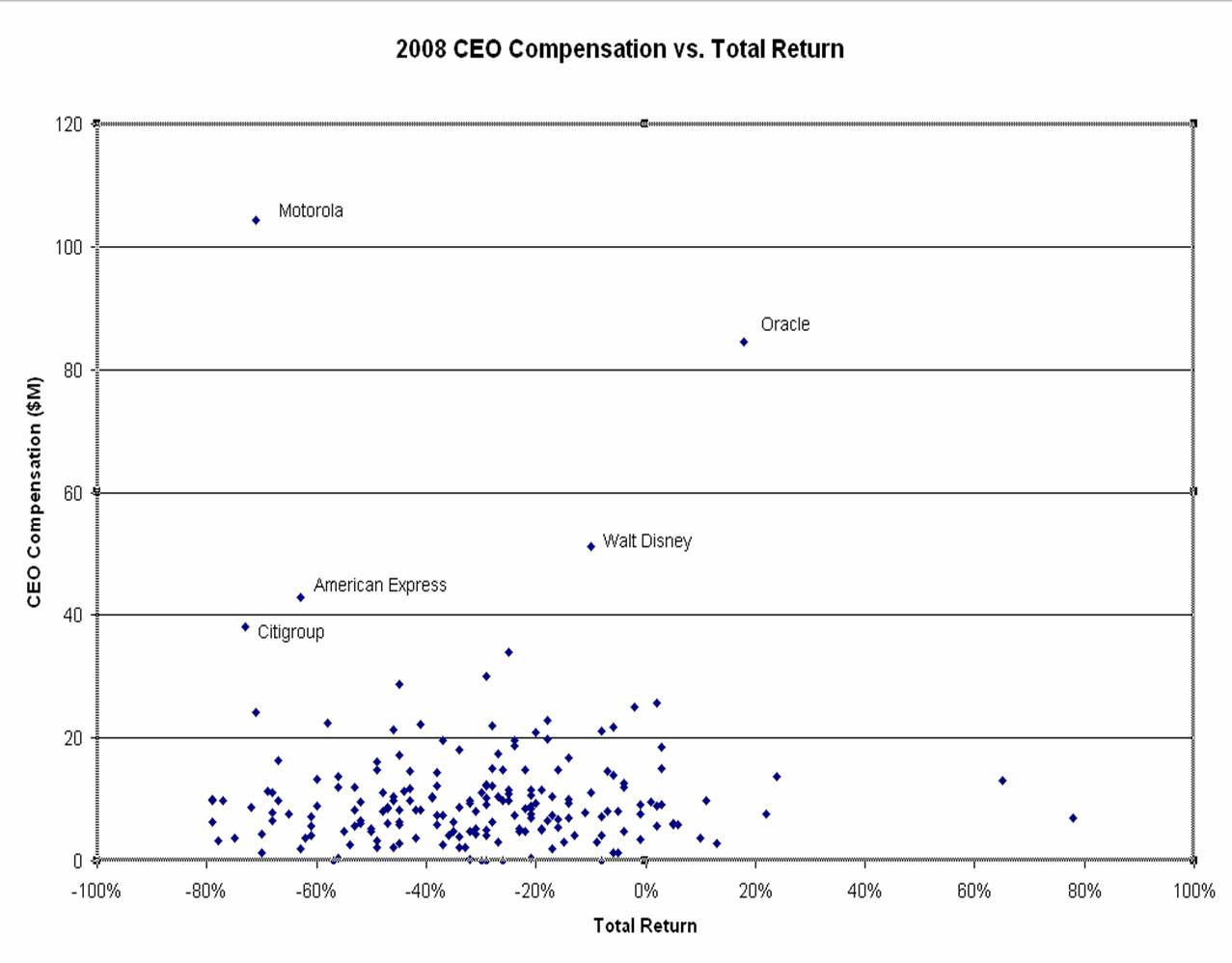
Data from Equilar (methodology), published by The New York Times:

compensation

I know this is simplistic, but I just couldn’t resist.

Some caveats:

  • Stock total return is a poor way to measure CEO performance – yet it’s the one that CEOs and boards commonly point to to justify compensation.
  • A CEO may have been granted a large stock award in 2008 as a reward for “good performance” in 2007. This could explain the combination of high compensation and poor 2008 performance. However, just think about what that means for a second.
  • Most of the large compensation awards are largely restricted stock or stock options. These were valued as of the data of the grant, so if the company’s stock price later fell, the CEO is unlikely to realize the calculated value of the award. But imagine if the stock price had gone up instead: the CEO and the board would be insisting that the award should be valued as of the grant date, not the later exercise date (when it would be worth much more).

Also, I excluded a company called Mosaic, because it’s total return was 257%, so it packed all the other companies into one side of the chart. Mosaic’s CEO earned $6 million.

Continue reading “Two Things That Have Nothing To Do with Each Other”

Mandelson Moment

If you want an unusual insight into our potential future, take a look at Channel 4’s interview on Thursday with Peter Mandelson (UK’s Business Secretary, very close to Gordon Brown and a key person around the G20 summit).

In this clip, Mandelson comes on around the 12:48 mark (after Peer Steinbruck, the German finance minister, provides some complacent sound bites.)

But the surprising statement comes after the short interview with me (I start at 17:40 approx; Mandelson comes back around 21:38).  I have no idea if Mandelson knew this could happen, but Jon Snow (the anchor) goes back to him and asks if he agrees with me that the UK could borrow from the IMF. Continue reading “Mandelson Moment”

Making Creditors Suffer

Tyler Cowen, co-author of a prominent independent economics blog, has an article in The New York Times explaining “Why Creditors Should Suffer, Too.”

What the banking system needs is creditors who monitor risk and cut their exposure when that risk is too high. Unlike regulators, creditors and counterparties know the details of a deal and have their own money on the line.

But in both the bailouts and in the new proposals [for financial regulation], the government is effectively neutralizing creditors as a force for financial safety.

I couldn’t agree more (except for the bit about the regulatory proposals, and that’s just because I haven’t read them closely). We need creditors who will pull their money or demand tougher terms from financial institutions that are doing things that are either too risky or just plain stupid; that’s theoretically a more efficient and cheaper enforcement mechanism than regulatory bodies.

Continue reading “Making Creditors Suffer”

Be Nice

Comments are an important part of this blog, and I’m sure that many of you read the blog as much for the comments as for the posts. I’m also very proud of the knowledge, intelligence, and writing ability of our commenters. Simon and I write about a wide range of topics, and so it is never a surprise to me to find comments from people who know any particular topic far better than I do. Looking at other economics blogs, I think we have one of the best discussion communities around, with both a large number and a high average quality of comments.

However, there has been a recent increase in the number of comments that can be construed as offensive in one way or another. While most hardened Internet commenters can probably take a personal  attack now and then, I’m afraid this will intimidate some people and deter them from joining the discussion. So we are creating some guidelines for comments, which are really nothing more than what you should have learned in kindergarten.

1. No profanity.

2. No attacks or insults aimed at other commenters. Calling a public official an idiot is one thing; calling someone who just wrote a comment an idiot is another.

3. No attacks or insults aimed at entire categories of people based on race, gender, religion, national origin or identity, or something similar.

If I see comments falling into these categories, I will delete them. I am also adding filters on a few words to flag comments for moderation. I expect most of those comments will be approved. For example, if you use the word “moronic,” I just want to check that you are referring to, say, the Commodity Futures Modernization Act, not a previous comment.

Thank you for all of your comments. For those of you who do not comment, thank you for reading the blog. It’s no exaggeration to say that Simon and I would not be doing this if it were not for all of you.

By James Kwak
Ben Bernanke: More Important Than The G20 Summit

It may strike you as extraordinary that the G20 summit barely touched on what is, arguably, the key policy issue going forward – what will central banks do, including the detailed when and how of avoiding falling wages and prices (deflation).  Fiscal stimulus is already almost fully in play around the world, regulatory reform will at best be slow and not relevant to the recovery, and “we promise to avoid an irresponsible protectionist trade war” is nice but more about not making things worse rather than getting our economies going again.  Funding and leadership model change for the IMF can help prevent emerging markets from cratering, but in terms of impact on global growth or unemployment, it’s second order relative to the macro policies of the world’s largest countries.

The real issue is monetary policy, including interest rate cuts where there is still room for these – to me the biggest news of the week was actually that the European Central Bank cut rates by less than expected (its main interest rate stands at 1.25 percent).  This confirms the ECB still does not see deflation as a clear and present danger.  Look at all the downward pressures in the European economy, from East European collapses (and associated West European banking problems) to property market declines in the UK, Ireland and Spain (and what that means for banking) and export industry stress (and they have bankers too).  The ECB is taking an extraordinary and – to my mind – incorrect position.  If they truly wait until deflation is “fully in the data” (central bank jargon), it will be too late.

The dramatic trans-Atlantic, or at least eurozone-dollar, contrast is in terms of monetary policy, not fiscal stimulus or attitudes towards future regulation.  In our piece in the Washinton Post Outlook section on Sunday (already online), we provide an updated back story on how exactly the Fed and its chair got to the point of taking bold and unprecedented moves towards expansionary monetary and credit policy.  Continue reading “Ben Bernanke: More Important Than The G20 Summit”

Obama Wins At G20: Europeans Lose Control of IMF

The big news at the G20 was obviously about the IMF, with the Americans pulling out an impressive deal on funding (compare with our predictions…). But the money is not the biggest achivement. The big move was in terms of who will run the IMF in the near future – as I explain my NYT.com column this morning, there is an implicit and almost immediate shift towards emerging markets.

President Obama had just the right tone yesterday.  Admittedly, he was helped by the fact that we no longer have anything to be arrogant about, but still the way he reached out to other countries – while also pointing out that they made big mistakes and are currently in trouble – conveyed exactly the right message.  The US will do much better if it lets emerging markets and developing countries have a serious and permanent place at the big table. 

Among other things, this will fundamentally change the way the IMF operates.  As a symbol and for its potential impact on the international economy moving forward, yesterday’s final loss of European control over the IMF really matters.

By Simon Johnson

The Mark-to-Market Myth

Today the Financial Accounting Standards Board voted – by one vote – to relax accounting standards for certain types of securities, giving banks greater discretion in determining what price to carry them at on their balance sheets. The new rules were sought by the American Bankers Association, and not surprisingly will allow banks to increase their reported profits and strengthen their balance sheets by allowing them to increase the reported values of their toxic assets.

This makes no sense, for three reasons.

1. Investors and regulators are not idiots. They know what the accounting rules are. If banks claim they were forced to mark their assets down to “fire-sale” prices, investors can look at the facts themselves and apply any upward corrections they want. Now that banks will be able to mark their assets up to prices based solely on their own models, investors will the downward corrections they want. It’s a little like what happened when companies were forced to account for stock option compensation as expenses; nothing happened to stock prices, because anyone who wanted to could already read the footnotes and do the calculations himself.

Continue reading “The Mark-to-Market Myth”