Category: Commentary

Mean-Spirited, Bad Economics

By Simon Johnson

The principle behind unemployment insurance is simple. Since the 1930s, employers – and in some states employees — have paid insurance premiums (in the form of payroll taxes, levied on wages) to the government. If people are laid off through no fault of their own, they can claim this insurance – just like you file a claim on your homeowner’s or renter’s policy if your home burns down.

Fire insurance is mostly sold by the private sector; unemployment insurance is “sold” by the government – because the private sector never performed this role adequately. The original legislative intent, reaffirmed over the years, is clear: Help people to help themselves in the face of shocks beyond their control.

But the severity and depth of our current recession raise an issue on a scale that we have literally not had to confront since the 1930s. What should we do when large numbers of people run out of standard unemployment benefits, much of which are provided at the state level, but still cannot find a job? At the moment, the federal government steps in to provide extended benefits.

In negotiations currently under way, House Republicans propose to cut back dramatically on these benefits, asserting that this will push people back to work and speed the recovery. Does this make sense, or is it bad economics, as well as being mean-spirited? Continue reading “Mean-Spirited, Bad Economics”

Facebook and Mark Zuckerberg

By James Kwak

I must admit that I find Facebook’s impending glory a bit awkward, as it touches on two themes I have written about previously. One is that I just don’t like Facebook. And, I confess, I don’t really understand it. I sort of understand why people like it, but I don’t really understand why it’s going to be the most valuable technology company on the planet in a few years. I don’t understand why anyone would ever click on an ad within Facebook (or why anyone would even see them, since you could just use AdBlock), since I don’t understand why you would want your shopping choices to be dictated by who is willing to spend the most money for your attention. (When I want to buy something, I prefer using organic Google search results, since at least they aren’t affected by ad spending.) Maybe I’m just too old.

At the same time, it’s pretty clear by now that Facebook does whatever it is that it does pretty well. $1 billion in annual profits is impressive, and it’s also considered a pretty good place to work. And who is the CEO of Facebook? A twenty-seven-year-old kid with no other work experience. So while, as a customer (“user,” in software industry parlance), I’m less than thrilled, I can’t deny that Zuckerberg is doing something right as a CEO. Which is further evidence that the myth of the experienced CEO and the cult of the generalist manager are just a myth and a cult, as I’ve written about before. According to Reuters, Zuckerberg will soon be the fourth-richest person in America, after Bill Gates, Warren Buffett, and Larry Ellison. Which means that, like Gates and Ellison, it’s a good thing he never let anyone convince him that his company needed an experienced CEO.

Private Equity and “Job Creation”

By James Kwak

The phrase “job creation” always makes me a little queasy. The personal computer has probably contributed to the elimination of tens of millions of clerical jobs, yet I think most of us feel that computers are a good thing: they make people more productive, meaning more goods and services for everyone . . . and hopefully the people who lost those jobs will find work doing something else. In boom periods, like the 1990s, it seems to work, at least for most people, but I doubt that there’s any proof that productivity-increasing innovation always increases employment. But this line of thinking quickly leads to questions like whether the invention of the automatic toll booth is a good thing (because it eliminates what must be a pretty unpleasant job) or a bad thing (because it results in the layoff of people who may not have good alternatives), and those questions are above my pay grade.

Anyway, job creation these days usually refers to growing companies, making stuff people want, which tend to hire new workers—leaving aside the question of whether the products they make are causing other people to lose their jobs. This is the kind of job creation that Mitt Romney (and the private equity industry, at least publicly) wants to be associated with.

Continue reading “Private Equity and “Job Creation””

What Did the SEC Really Do in 2004?

By James Kwak

Andrew Lo’s review of twenty-one financial crisis books has been getting a fair amount of attention, including a recent mention in The Economist. Simply reading twenty-one books about the financial crisis is a demonstration of stamina that exceeds mine. I should also say at this point that I have no arguments with Lo’s description of 13 Bankers.

Lo’s main point, which he makes near the end of his article, is that it is important to get the facts straight. Too often people accept and repeat other people’s assertions—especially when they are published in reputable sources, and especially especially when those assertions back up their preexisting beliefs. This is a sentiment with which I could not agree more. One of the things I was struck by when writing 13 Bankers was learning that nonfiction books are not routinely fact-checked (Simon and I hire and pay for fact-checkers ourselves). As technology and the Internet produce a vast increase in the amount of writing on any particular subject, the base of actual facts on which all that writing rests remains the same (or even diminishes, as newspapers cut back on their staffs of journalists).

I’m not entirely convinced by Lo’s example, however. He focuses on a 2004 rule change by the SEC. According to Lo, in 2008, Lee Pickard claimed that “a rule change by the SEC in 2004 allowed broker-dealers to greatly increase their leverage, contributing to the financial crisis” (p. 33). That is Lo’s summary, not Pickard’s original. This claim was picked up by other outlets, notably The New York Times, and combined with the observation that investment bank leverage ratios increased from 2004 to 2007, leading to the belief that the SEC’s rule change was a crucial factor behind the fragility of the financial system and hence the crisis.

Continue reading “What Did the SEC Really Do in 2004?”

What Is Private Equity?

By James Kwak

Recently, a lot of the political debate has been about whether private equity—and by extension Mitt Romney—is good or bad. The argument on one side is that private equity firms are vultures who destroy firms to make money; on the other, that private equity is just capitalism at work, creates value, and creates jobs.

A private equity firm is an asset management company. It creates investment funds that raise most of their money from outside investors (pension funds, insurance companies, rich people, etc.), and then manages those funds. As opposed to a mutual fund, however, instead of buying individual stocks, these funds usually make large investments either in private companies or in public companies that they “take private” (more on that in a minute). While mutual funds and most hedge funds try to make money by guessing where securities prices will go in the future, private equity funds try to make money by taking control of companies and actively managing them. (There is a bit of a spectrum here, since mutual funds and hedge funds can exercise pressure on company management and private equity funds do take minority positions, but that’s the ideal-typical distinction.)

Continue reading “What Is Private Equity?”

Breakthrough: Eric Schneiderman To Chair Mortgage Crisis Unit

By Simon Johnson

As reported first in the Huffington Post, President Obama is creating “a special unit to investigate misconduct and illegalities that contributed to both the financial collapse and the mortgage crisis”.  This will be chaired by Eric Schneiderman, the New York attorney general.

For more background on why this makes sense and could represent a major policy breakthrough, please see this column: http://www.politico.com/news/stories/0112/71788.html.


Should We Trust Paid Experts On The Volcker Rule?

By Simon Johnson

On Wednesday morning, two subcommittees of the House Financial Services Committee held a joint hearing on the Volcker Rule.  The Rule, named for former Fed chair Paul Volcker, is aimed at restricting certain kinds of “proprietary trading” activities by big banks – with the goal of making it harder for these institutions to blow themselves up and inflict another deep recession on the rest of us.

The Volcker Rule was passed as part of the Dodd-Frank financial reform legislation (it is Section 619) and regulators are currently in the process of requesting comments on their proposed draft rules to implement.  Part of the issue currently is claims made by some members of the financial services industry that the Volcker Rule will restrict liquidity in markets, pushing up interest rates on corporate debt in particular and therefore slowing economic growth.

This argument rests in part on a report produced by Oliver Wyman, a financial consulting company.  Oliver Wyman has a strong technical reputation and is most definitely capable of producing high quality work.  But their work on this issue is not convincing.  (The points below are adapted from my written testimony and verbal exchanges at the hearing; the testimony is available here.) Continue reading “Should We Trust Paid Experts On The Volcker Rule?”

Department of “Duh”

By James Kwak

The Times has a story out today: Surprise, all the Republican candidates’ tax plans increase the national deficit! The numbers (reduction in 2015 tax revenues, from the Tax Policy Center):

  • Romney: $600 billion
  • Gingrich: $1.3 trillion
  • (Late lamented) Perry: $1.0 trillion
  • Santorum: $1.3 trillion

I guess that makes Romney the “fiscally responsible” choice, at least among the Republicans. But President Obama’s tax proposals would only reduce 2015 tax revenues by $222 billion. (That’s $385 billion in Table S-4 less $163 billion in Table S-3.)

Second surprise: The big winners in all of these tax plans are the rich! (That’s not just in dollars, but in percentage increase in after-tax income.)

I don’t mean to be hard on the Times reporters. This is exactly the kind of story they should be writing. Someone has to point out that the same people who are complaining about deficits are proposing to vastly increase those deficits. Especially when their fantastic claims are essentially going unchallenged on the campaign trail.

The Price of Apple

By James Kwak

Last week, This American Life ran a story about the Chinese factories that produce Apple products (and a lot of the other electronic devices that fill our lives). It featured Mike Daisey, a writer and performer who traveled to Shenzhen, China, to visit the enormous factories (more than 400,000 people work at Foxconn’s, according to the story*) where electronic products are churned out using huge amounts of manual labor.

I’m sure that most of us already realized, on an intellectual level, that the stuff we buy is made by people overseas who, in general, have much less than we do and work harder than we do, under tougher working conditions. It’s harder to ignore, however, listening to Daisey talk about the long shifts (up to thirty-four hours, apparently), the crippling injuries due to repetitive stress or hazardous chemicals, the crammed dormitories, and the authoritarian rules. At one point an interviewee produces a document, produced by the Labor Relations Board (with the name of the Board on it): it’s a list of “troublemakers” who should be fired at once.

Continue reading “The Price of Apple”

Correlation, Causation

By James Kwak

XKCD (blacked out until tomorrow).

Economix has a table listing undergraduate majors by the percentage of graduates in each major that are in the “1 percent” (by income, which I think is less important than by wealth). The data are interesting, but I don’t think it’s correct to say that “the majors that give you the best chance of reaching the 1 percent are pre-med, economics, biochemistry, zoology and, yes, biology, in that order.”

All of the pre-med/life sciences majors (numbers 1, 3, 5, 8, and 11 on the list) do arguably increase your chances of making the 1% because they help you become a doctor, and many specialists are in the 1%. Of course, since many science majors are considered more difficult by undergraduates, you could argue that the inherent traits people bring to college are just as important as the majors they choose. Economics is #2, but that’s in part because many of the people who want to be in the 1 percent major in economics.

But the interesting cases are art history (#9), area studies (#12), history (#14), and philosophy (#17), all of which are disproportionately represented in the 1%. (History, for example, ranks right behind finance.) I don’t think anyone would argue that knowledge of art history is likely to earn you a high income; there just aren’t that many executives at Sotheby’s and Christie’s. I think what’s going on is that these are the kinds of things that people study at elite schools—in particular, if you’re not that worried about what you’re going to do after graduation. These are not the things that most people at normal schools study. In 2009, for example, art history didn’t even show up on the list of majors (it’s probably tucked into “liberal arts and sciences, general studies, and humanities,” which came in 11th), area studies was one of the least popular majors, and so was philosophy.

So there are two possible reasons why these people make the top 1 percent. One is that they are talented, hardworking people who succeed (financially) despite what they majored in—but then why are talented, hardworking people overrepresented in these majors? The other is that they are children of the elite who go to elite schools, study whatever they feel like, and succeed because of their upbringing and connections. (The reasons are not mutually exclusive.) Given the increasing evidence that America, the land of opportunity, is actually one of limited social mobility, I think we can’t overlook the latter explanation.

The End of the Blog?

By James Kwak

As you may have noticed by now, Wikipedia’s English-language site is (mostly) down for the day to protest SOPA and PIPA, two draconian anti-copyright infringement laws moving through Congress, and Google’s home page looks like this:

Under existing law (the DMCA), if someone posts copyrighted material in a comment on this blog, the copyright holder is supposed to send me a takedown notice, after which point I am supposed to take the material down (if it is in fact copyrighted).

SOPA and PIPA are bills in the House and Senate, respectively, that make it much easier for “copyright holders” (like the big media companies that back the bill—or, come to think of it, authors like me) to take action not only against “bad” web sites that make copyrighted material available (against the wishes of the copyright holders), but also against web sites that simply link to such “bad” web sites. For example, the copyright holder can require payment network providers (PayPal, credit card networks) to block payments to such web sites (in either category above) and can require search engines to stop providing advertising for such web sites—simply by sending them a letter. That’s SOPA § 103(b).*

Continue reading “The End of the Blog?”

Refusing To Take Yes For An Answer On Bank Reform

By Simon Johnson

The debate over megabanks and – in the aftermath of the 2008 financial crisis – how to deal with all the problems associated with “too big to fail” in the financial sector has not been easy for many politicians.  The problems and potential real solutions do not map readily into the standard left vs. right divide in American politics.

The left generally wants the state to do more, and these days most of the right usually wants the state to do much less.  But in this space regulators are “captured”, meaning that too many of them are effectively working to promote the interests of the big banks rather than to limit the dangers to the rest of us – so “more regulation” does not make much sense.  And these big banks have a strong incentive to get even bigger – it’s their size that gives them economic and political power.  If you leave these banks to their own devices, they will become even bigger and blow themselves up at greater cost to ordinary citizens (see Western Europe for details).  So “no regulation” is also not an appealing proposition.

As a matter of presidential year politics, there is a remarkable convergence between President Obama and Mitt Romney, the Republican frontrunner.  Both think that we can tweak the rules to keep the banks from becoming dangerous.  The Obama administration calls their approach “smart regulation”, while Mr. Romney has spoken of repealing the Dodd-Frank financial reform legislation (although his website is devoid of any further specifics).  But as far as anyone can see, their proposed approaches for the next four years are very similar – relying on the state to play a particular oversight role that has not gone well in recent decades.  They are both “statist” in this very particular sense. Continue reading “Refusing To Take Yes For An Answer On Bank Reform”

Ron Paul And The Banks

By Simon Johnson

We should take Ron Paul seriously. The Texas Congressman had an impressive showing in the Iowa caucuses on Tuesday and his poll numbers elsewhere are resilient – he is running a strong third nationally, but looks like to come in second in New Hampshire.  He may well become the Republican politician with populist momentum and energy in the weeks ahead.

Mr. Paul also has a clearly articulated view on the American banking system, laid out forcefully in his 2009 book, End the Fed.  This book and its bottom line recommendation that we should return to the gold standard – and abolish the Federal Reserve system – tends to be dismissed out of hand by many.  That’s a mistake, because Mr. Paul makes many sensible and well-informed points.

But there is a curious disconnect between his diagnosis and his proposed cure.  This disconnect tells us a great deal about why this version of populism from the right is unlikely to make much progress in its current form. Continue reading “Ron Paul And The Banks”

Correction to Long-Term Debt Projections

By James Kwak

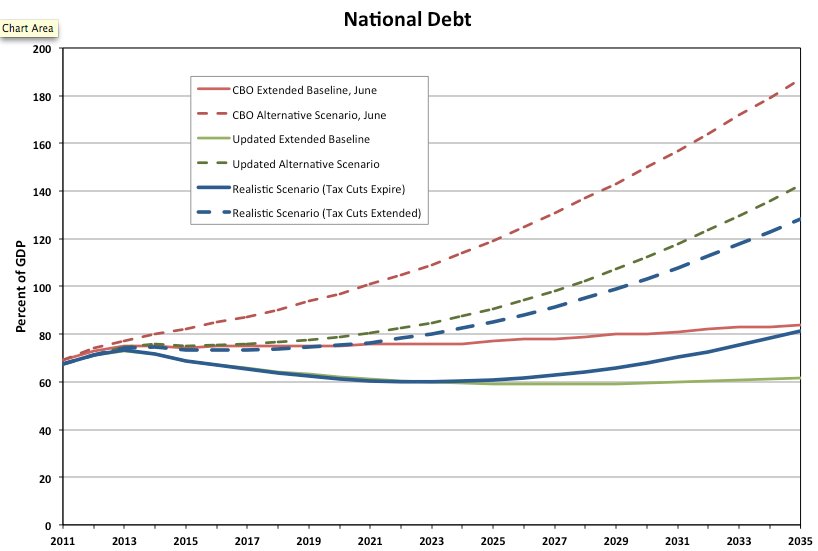
Back in October, I wrote a post laying out my long-term projections for the national debt, which were basically an adjustment to existing CBO projections. Peter Berezin recently pointed out a misleading ambiguity in that post. There, I used the same long-term growth rate of tax revenues in both my extended-baseline scenario and in my “realistic” scenarios. I got that long-term growth rate from the CBO’s extended baseline scenario in its 2011 Long-Term Budget Outlook, which assumes that current law remains unchanged.

In my realistic scenarios, I assumed that the AMT would be adjusted through 2021 but that the long-term growth rate would apply thereafter. I didn’t say anything explicitly about the AMT after 2021, but by using the long-term growth rate from the extended baseline, I was implicitly assuming that the AMT would not be indexed after 2021.

Continue reading “Correction to Long-Term Debt Projections”