Category: Commentary

Bad Advice

By James Kwak

I’m starting teaching at the UConn law school this fall, so I got a folder of information in the mail about my retirement plan. UConn professors have a choice between a defined benefit plan (SERS, in which I would be a Tier III member) and a defined contribution plan called the Alternate Retirement Program, or ARP. (There’s also a Hybrid Plan that seems to be the defined benefit plan plus a cash-out option at retirement.)

I chose the Alternate Retirement Program for reasons that are complicated (I used a spreadsheet) and that I may get into another time. The main benefit of defined benefit plans is that they do a pretty good job of protecting you from investment risk and inflation risk, since the state bears most of it. The main downside is that if you will work either for a short time or a very long time at your employer, they have a lower expected value, even given conservative return assumptions. The other downside is counterparty risk.

Anyway, the ARP is a pretty good plan. The administrative costs are a flat 10 basis points.  It includes a reasonable number of index funds (although there are also actively-managed funds—more on that later). And the plan had the sense to ask for institutional share classes with low fees. For example, the S&P 500 index fund is the Vanguard Institutional Index Fund – Institutional Plus Shares, which has an expense ratio of 2 basis points. Adding the 10 bp of administrative fees, that’s still only 12 bp.* (Contrast this with Wal-Mart, for example, which, despite being the largest private-sector employer in the country, stuck its employees with retail fees in its 401(k) plan.)

But despite that, the plan then goes and encourages people to put money into expensive, actively-managed funds. I got a brochure subtitled “A Guide to Helping You Choose an Investment Portfolio” that was almost certainly written by ING, the plan administrator. It has the usual stuff about the importance of asset allocation and your tolerance for risk, and then provides “model portfolios” for various investor types.

Continue reading “Bad Advice”

When It Pays To Be Wrong

By James Kwak

Last week I wrote an Atlantic column about the fundamental reasons why big banks are always screwing up. In particular, given the effects of leverage and the short-term incentive structure, it pays to have lousy risk management systems, and it pays for frontline traders to evade those systems—even for the CEO, in the short term.

Today the Wall Street Journal reports evidence that the London Whale was told by his boss to boost the valuations of his trades; according to inside sources, “the favorable valuations might have been aimed at giving the losing trades time to recover and avoid setting off potential alarms at the bank.”

This is clear evidence for the too big to manage hypothesis: not only traders but heads of trading desks manipulating marks to take risks that the bank as a whole might crack down on. But we’ve known for decades that rogue traders (Nick Leeson, Jérôme Kerviel) are out there. The question is why bank managers don’t do a better job putting in place systems and processes to detect them. The most plausible answer is that they don’t want to because, in the short term, they have the exact same incentives as those traders: they like the risk and the higher expected returns it generates. It’s only when things blow up that they act all shocked.

Big Banks Fall Back On Three Myths

By Simon Johnson

Global megabanks have had a tough summer.  Jamie Dimon, vociferous opponent of restrictions on reckless risk-taking by big banks, presided over large losses due to exactly such behavior in the London office of JP Morgan Chase.  HSBC, which prided itself on running a uniquely decentralized management model, was found to have violated – massively, over many years, and in a uniquely decentralized manner – US money laundering and other laws; the head of global compliance resigned while on the witness stand during a Senate hearing in July.  And Barclays – which had bulked up on the strength of its capital market activities – conceded that traders from that part of the company had conspired to rig Libor, a key benchmark for global interest rates; in the ensuing public outcry, the top two executives were forced out.

And last week Sandy Weill, who amassed a vast fortune building Citigroup and pushing to dismantle the constraints on such megabanks’ activities, concedes that the entire exercise was a mistake.

“I’m suggesting that they be broken up so that the taxpayer will never be at risk, the depositors won’t be at risk, the leverage of the banks will be something reasonable,..”

According to American Banker, former top executives calling for the biggest banks to be broken up now include Phil Purcell, former chief executive of Morgan Stanley; John Reed, former chairman of Citigroup; and David Komansky, former chief executive of Merrill Lynch.  (I am asking American Banker to bring their slide show on this issue out from behind their paywall.)

Backed into a corner, representatives of these Too Big To Fail banks and their allies are forced to fall back on perpetuating three myths. Continue reading “Big Banks Fall Back On Three Myths”

When Did The Economist Become Comically Stupid?

By James Kwak

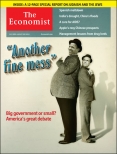
I recently got around to looking at my latest issue of The Economist.  Here’s the cover:

If you can’t make it out, that’s a huge Barack Obama, a small Mitt Romney, and the following caption: “Big government or small? America’s great debate.”

Now, how you could draw a contrast between two men who passed structurally identical health care plans—in which government regulation is used to incent people to buy insurance from private companies—baffled me. The caption, if anything, should have been “Small government or tiny?” So I peeked inside, where things get worse.

Continue reading “When Did The Economist Become Comically Stupid?”

The One-Sided Deficit Debate

By James Kwak

Michael Hiltzik (hat tip Mark Thoma) wrote a column lamenting the domination of the government deficit debate by the wealthy. He clearly has a point. The fact that Simpson-Bowles—which uses its mandate of deficit reduction to call for . . . lower tax rates?—has become widely perceived as a centrist starting-point for discussion is clear evidence of how far to the right the inside-the-Beltway discourse has shifted, both over time and relative to the preferences of the population as a whole.

What’s more, the “consensus” of the self-styled “centrists” is what now makes the Bush tax cuts of 2001 and 2003 seem positively reasonable. With Simpson-Bowles and Domenici-Rivlin both calling for tax rates below those established in 2001, George W. Bush now looks like a moderate; even many Democrats now endorse the Bush tax cuts for families making up to $250,000 per year, which is still a lot of money (for most people, at least).

Continue reading “The One-Sided Deficit Debate”

Things That Don’t Make Sense

By James Kwak

From Sebastian Mallaby’s review of Robert Shiller’s new book:

Psychologists have established that the key to happiness lies not in riches but in social esteem; therefore, Shiller says, financiers face powerful emotional incentives to balance profit seeking with a social conscience. “The futility of conquest in business mirrors the futility of conquest in war,” he writes. Just as it is impossible to extract much wealth from conquered countries, so it is impossible to extract much happiness from wealth earned unscrupulously.

Does anyone actually think that Wall Street traders and Greenwich fund managers, in general, temper their profit seeking because they want to be seen as doing good for society?

(Besides, the first clause above is simply wrong as a matter of fact: psychologists have established that happiness is a complicated thing, and “social esteem” is only one part of it. See Haidt, Kahneman, Gilbert, etc.)

Fed Governor Speaks Out For Stronger Rules

By Simon Johnson

A powerful new voice for financial reform emerged this week – Sarah Bloom Raskin, a governor of the Federal Reserve System. In a speech on Tuesday, she laid out a clear and compelling vision for why the financial system should focus on providing old-fashioned but essential intermediation between savers and borrowers in the nonfinancial sector.

Sadly, she also explained that she is a dissenting voice within the Board of Governors on an essential piece of financial reform, the Volcker Rule. Her colleagues, according to Ms. Raskin, supported a proposed rule that is weaker, i.e., more favorable to the banks; she voted against it in October.

At least on this dimension, financial reform is not fully on track. Continue reading “Fed Governor Speaks Out For Stronger Rules”

Lump Sum or Annuity?

By James Kwak

Usually the New York Times gives reasonably good financial advice—or, at least it avoids giving really bad advice. Today, however, Paul Sullivan’s column borders on the latter. The question is whether to take a pension payout as a lump sum or as an annuity (a guaranteed, fixed amount per year until you die).

Sullivan’s column isn’t all bad. He talks about the importance of being able to manage your money and the need to be comfortable with risk if you take the lump sum. He also points out the annuity (in this case, based on what GM workers are being offered) isn’t indexed to inflation, which is an important consideration. And he doesn’t come down on one side or the other, although he says he would take the lump sum because, he says, “I would rather control the money myself.”

Continue reading “Lump Sum or Annuity?”

Can Financial Regulation Be Fixed?

By James Kwak

The tragicomic events of the past few months—the London Whale (what are we up to now, $6 billion), Barclays-Libor, HSBC laundering money have prompted renewed interest in better, stronger regulation of the financial sector. Not that it’s going to go anywhere: it’s an election year, the Republicans have a blocking majority in the House and a blocking minority in the Senate, and they are only going to gain Senate seats in November.

But we’ve been here before. Remember the financial crisis? The Obama administration’s response, codified in the Dodd-Frank Act, could be summed up as “better, stronger regulation”—instead of substantive changes to the industry itself. This misses the basic problem with our regulatory structure, as described by John Kay:

“Regulation that is at once extensive and intrusive, yet ineffective and largely captured by financial sector interests.

“Such capture is sometimes crudely corrupt, as in the US where politics is in thrall to Wall Street money. The European position is better described as intellectual capture. Regulators come to see the industry through the eyes of market participants rather than the end users they exist to serve, because market participants are the only source of the detailed information and expertise this type of regulation requires. This complexity has created a financial regulation industry – an army of compliance officers, regulators, consultants and advisers – with a vested interest in the regulation industry’s expansion.”

The Federal Reserve And The Libor Scandal

By Simon Johnson

On June 1, 2008, Timothy F. Geithner – then president of the Federal Reserve Bank of New York – sent an e-mail to Mervyn A. King and Paul Tucker, then respectively governor and executive director of markets at the Bank of England. In his note, Mr. Geithner transmitted recommendations (dated May 27, 2008) from the New York Fed’s “Markets and Research and Statistics Groups” regarding “Recommendations for Enhancing the Credibility of Libor,” the London Interbank Offered Rate.

The recommendations accurately summarized the problems with procedures surrounding the construction of Libor – the most important reference interest rate in the world – and proposed some sensible alternative approaches.

This New York Fed memo stands out as a model of clear thinking about the deep governance problems that allowed Libor to become rigged.

At the same time, the timing and content of the memo raises troubling questions regarding the Fed’s own involvement in the Libor scandal – both then and now. Continue reading “The Federal Reserve And The Libor Scandal”

The Market Has Spoken – And It Is Rigged

By Simon Johnson

In the aftermath of the Barclays rate-fixing scandal, the most surprising reaction has been from people in the financial sector who fully understand the awfulness of what has happened. Rather than seeing this as an issue of law and order, some well-informed people have been drawn toward arguments that excuse or justify the behavior of the Barclays employees.

This is a big mistake, in terms of both the economics at stake and the likely political impact.

The behavior at Barclays has all the hallmarks of fraud, pure and simple – intentional deception for personal gain, causing significant damage to others. Continue reading “The Market Has Spoken – And It Is Rigged”

Lie-More As A Business Model

By Simon Johnson.  For more discussion of these issues, listen to NPR’s All Things Considered, July 7, 2012.

On Monday, Bob Diamond – the CEO of Barclays, one of the largest banks in the world – was supposedly the indispensable man, with his supporters claiming he was the only person who could see that global megabank through a growing scandal.  On Tuesday morning Mr. Diamond resigned and the stock market barely blinked – in fact, Barclays’ stock was up 0.3 percent.  As Charles de Gaulle supposedly remarked, “the cemeteries are full of indispensable men.”

Mr. Diamond’s fall was spectacular and complete.  It was also entirely appropriate.

Dennis Kelleher of Better Markets – a financial reform advocacy group – summarized the situation nicely in an interview with the BBC World Service on Tuesday.  The controversy that brought down Mr. Diamond had to do with deliberate and now acknowledged deception by Barclays’ staff with regard to the data they reported for Libor – the London Interbank Offered Rate (with the abbreviation pronounced Lie-Bore).  Mr. Kelleher was blunt: the issue in question is “Lie More” not Libor.  (See also this post on his blog, making the point that this impacts credit transactions with a face value of at least $800 trillion.) Continue reading “Lie-More As A Business Model”

The ObamaCare Tax on the Middle Class

By James Kwak

So the new Republican argument (which Mitt Romney was against before he was in favor of it) is that the individual mandate is an oppressive tax on the middle class. Cute, isn’t it, adopting John Roberts’s argument?

First of all, there’s the little matter that the word “tax” in legal doctrine means something different from the word “tax” in ordinary English. And there’s nothing wrong with that. Plenty of words have precise legal meanings that would be foreign to ordinary English speakers, like “negligent,” “reckless,” “material,” and so on, and billions of dollars turn on those precise legal meanings. But that’s not going to sway many people, so let’s go to the numbers.

Continue reading “The ObamaCare Tax on the Middle Class”