Category: Commentary

Bipartisan Trouble Ahead

By Simon Johnson

In Washington today, “bipartisan” is a loaded term. The traditional usage of bipartisan is an agreement across the usual political divide – sometimes a good idea and in many cases the only way to get things done. But a darker meaning applies all too frequently – a group in which the members, irrespective of party affiliation, are very close to special interests and work to advance an agenda that helps a few powerful people while hurting the rest of us.

Financial deregulation in the 1980s and 1990s was pushed by both Democrats and Republicans. It reached its apogee when Alan Greenspan, a Republican, was chairman of the Federal Reserve and Robert Rubin, a Democrat, was Treasury secretary. Bill Clinton was president; Newt Gingrich was speaker of the House.

This is probably why President Obama and Mitt Romney shied away this fall from the issue of who was responsible for the financial crisis that brought us the deep recession and slow recovery of the last five years. Both political parties share culpability for allowing parts of the financial sector to take excessive risk while financing themselves with a great deal of debt and relatively little equity.

In this context, the new Financial Regulatory Reform Initiative of the Bipartisan Policy Center seems eerily familiar. Continue reading “Bipartisan Trouble Ahead”

Financial Lobby: Stupid or Disingenuous? You Decide

By James Kwak

Courtesy of Matt Yglesias, from the Financial Services Forum:

“We write today to urge you to work together to reach a bipartisan agreement to avoid the approaching ‘fiscal cliff,’ and take concrete steps to restore the United States’ long-term fiscal footing.”

And later:

“But merely avoiding the fiscal cliff is not enough. We further urge you and your colleagues to enact legislation that truly restores the nation’s long-term fiscal soundness.”

It’s too obvious to waste more than a sentence spelling out what’s wrong here, so here it is: “Going over” the “fiscal cliff” is the single best thing we could do to “restore the United States’ long-term fiscal footing.” The CEOs of every big bank (who signed the letter) must know that. Right?

There are valid arguments against going over the fiscal cliff, but the national debt is not one of them. Going over the cliff would do more to address the long-term debt than anything any politician has proposed. And, as Yglesias points out, “If you care about inequality, jumping off the cliff offers by far the best chance for addressing it,” since it is the only plausible way to significantly increase taxes on the wealthy.

Why Reading the Front Page of the Newspaper Makes You Stupider

By James Kwak

At least when it comes to statistical issues:

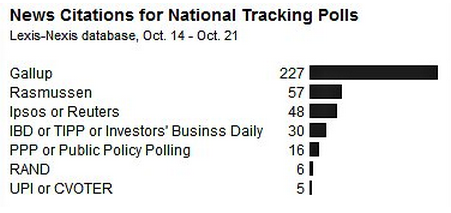
(Courtesy of Nate Silver.) Gallup is the huge outlier among the tracking polls, which shows Romney leading by 6–7 points. (On average, the national polls show an exactly tied race.)

This news is a few days old, but the general principle it illustrates is timeless. Reporting tends toward the dramatic and the surprising. In some cases, that’s probably fine—like if you read the paper for entertainment. When it comes to statistics that suffer from measurement error, it’s journalistic malpractice.

Bobbing and Weaving

By James Kwak

Mitt Romney’s latest attempt to make his tax plan seem plausible (that is to say, not a pack of blatant lies) is the idea of capping deductions at some level, like $17,000 or $25,000. Of course, as we all know, it doesn’t add up; Dylan Matthews provides a quick summary. If you cap deductions and you cut rates by 20 percent, everyone’s taxes go down, and the very rich (but not the super-super-rich) benefit the most.

This shouldn’t be news to anyone, because this problem has already been solved in its general form: there’s no way his numbers add up, because you could eliminate all the tax breaks for the rich and still not pay for a 20 percent rate cut. I confess I have some attachment to this issue because I think I was one of the first people to point out the mathematical impossibility of the Romney tax plan (the day after he announced the 20 percent rate cut).

Unfortunately, of course, this is all about politics, and arithmetic coherence is not the bar Romney needs to clear. He just needs to get enough undecided voters (stop and think for a second about what it means to be undecided right now) to think that his tax plan isn’t a complete fraud and to think that all of us self-appointed defenders-of-math are just Obama hacks. And this latest cap on deductions is probably enough to clear that much lower bar.

Read This Book, Win The Election

By Simon Johnson

With the presidential election looming and both sides looking for a knockout blow in the vice-presidential debate on Thursday evening, now is a good time for both Democrats and Republicans to look for one more defining issue. The new book by Sheila Bair, “Bull by the Horns: Fighting to Save Main Street From Wall Street and Wall Street From Itself,” offers exactly that – to whichever party is smart enough and fast enough to take up the opportunity.

Ms. Bair lays out a compelling vision for both financial-sector reform and for dealing with the continuing mess around mortgages. Neither presidential campaign is likely to endorse her ideas in all their specifics. But if a candidate signaled that he had read and understood the main messages in this book, this would have great appeal both with undecided centrist votes and – importantly – with their respective bases. Continue reading “Read This Book, Win The Election”

43.4 = 30.9?

By James Kwak

Adam Davidson wrote his latest New York Times Magazine column about how Barack Obama and Mitt Romney largely agree on economic questions. This is a classic example of how to mislead through deceptively selective citation.

Here’s the core assertion:

For someone who lived in the first 150 years or so of this country, it might be hard to see what’s so different about the economic policies of Barack Obama and Mitt Romney. Romney seeks a 25 percent top corporate tax rate, and Obama is proposing 28 percent. Romney wants to eliminate capital-gains taxes for the typical investor and leave the rate at 15 percent for higher earners. Obama wants to increase it to 20 percent. They differ on how to tax the highest incomes. But for most Americans, the distinctions might be mistaken for a rounding error. Both men strongly support expanding free trade and maintaining close to the same level of Social Security and welfare benefits.

As anyone who follows fiscal policy knows, the corporate tax rate is a sideshow. It’s the individual income tax and payroll taxes that bring in the big dollars, and it’s the individual income tax that has the real impact (or not) on inequality.

Continue reading “43.4 = 30.9?”

The Problems with Software Patents

By James Kwak

Charles Duhigg and Steve Lohr have a long article in the Times about the problems with the software patent “system.” There isn’t much that’s new, which isn’t really a fault of the article. Everyone in the industry knows about the problems—companies getting ridiculously broad patents and then using them to extort settlements or put small companies out of business—so all you have to do is talk to any random group of software engineers. And it’s not as much fun as the This American Life story on software patents, “When Patents Attack!” But it’s still good that they highlight the issues for a larger audience.

The article does have a nice example of examiner shopping: Apple filed essentially the same patent ten times until it was approved on the tenth try. So now Apple has a patent on a universal search box that searches across multiple sources. That’s something that Google and other companies have been doing for years, although perhaps not before 2004, when Apple first applied. There’s another kind of examiner shopping, where you file multiple, similar patents on the same day and hope that they go to different examiners, one of whom is likely to grant the patent.

Continue reading “The Problems with Software Patents”

Capital Gains Tax Rates and Savings

By James Kwak

Earlier this week, I  wrote my own “job creator’s” manifesto for The Atlantic, in response to Steven Pearlstein’s great parody. You can read it if you are interested in knowing what one “job creator” thinks our country needs.

There’s something I forgot to add, however. (Literally: while I was away from my computer I decided to add it, but then I forgot to do so before sending it to my editor.) As I’ve said before, the capital gains tax rate had no impact on my decision to start a company. It couldn’t have had any impact, because I didn’t know what it was.

Continue reading “Capital Gains Tax Rates and Savings”

Fiscal Confrontation And The Declining Influence Of The United States

By Simon Johnson

It is axiomatic among most of our Washington elite that the United States cannot lose its preeminent global role, at least not in the foreseeable future. This assumption is implicit in all our economic policy discussions, including how politicians on both sides regard the leading international role of the United States dollar. In this view, the United States is likely to remain the world’s financial safe haven for international investors, irrespective of what we say and do.

Expressing concerns about the trajectory of our federal government debt has of course become fashionable during this election cycle; this is a signature item for both the Tea Party movement in general and vice presidential candidate Paul D. Ryan in particular.

But the tactics of fiscal confrontation – primarily from the right of the political spectrum – only makes sense if the relevant politicians, advisers and donors firmly believe that the American financial position in the world is unassailable. Continue reading “Fiscal Confrontation And The Declining Influence Of The United States”

One-Hit Wonders

By James Kwak

Meg Whitman is what is known as a superstar CEO. She became CEO of eBay in 1998 and took it public; during her reign, eBay became one of the most successful, most valuable Internet companies in existence (and Whitman became a billionaire). She used her celebrity to mount a high-profile, expensive, and ultimately unsuccessful campaign to become governor of California (losing to career politician Jerry Brown) before being named CEO of HP, the iconic Silicon Valley company.

Why did HP, one of the largest information technology companies in existence, hire Whitman, who preceded her stint at eBay (auction house for random stuff from people’s attics) with jobs at Disney, a shoe company, a flower delivery service, and a toy company? Because of the idea of the superstar CEO, with transferable general management skills, who can transform any organization.

Continue reading “One-Hit Wonders”

Scott Brown: ATM For The Big Banks

By Simon Johnson

During the Dodd-Frank financial reform debate in early 2010, newly elected Senator Scott Brown of Massachusetts was referred to as an ATM for the bankers – meaning that whenever they needed some more cash, they would stop by his office.  It was not paper money he was handing out, of course, it was something much more valuable – rule changes that conferred a greater ability to take on reckless risk, damage consumers, and impose higher future costs on the taxpayer.

Mr. Brown had this ability because he represented the final vote needed to pass Dodd-Frank through the Senate.  He could have asked for many things – including greater consumer protection, a more thorough investigation into mortgage practices, and reforms that would have cleaned up unscrupulous lenders.  He asked for none of those changes – or anything else that would have made the financial system safer and fairer.

Instead, Senator Brown’s requests were designed to undermine the Volcker Rule – i.e., he was opposing sensible attempts to limit the ability of big banks to place highly dangerous bets (and to blow themselves up at great cost to the rest of us).  Mr. Brown seems to have been particularly keen to allow big banks to invest in hedge funds of various kinds – and the Boston Globe reported recently that he has continued to push in this direction behind the scenes.  Continue reading “Scott Brown: ATM For The Big Banks”

Thomas Hoenig Read All of Basel III . . .

By James Kwak

. . . and doesn’t like what he sees. In a post for the Harvard Law School Forum on Corporate Governance and Financial Regulation, the former president of the Kansas City Federal Reserve Bank echoes some of the issues raised by Andrew Haldane, which I discussed earlier. The core problem, for Hoenig, is that Basel III “promises precision far beyond what can be achieved for a system as complex and varied as that of U.S. banking.” Banks were able to arbitrage the risk-weighted capital requirements of Basel II? Well, we’ll close all of those loopholes, one by one. But this cannot be done, given the incentives and power imbalances at work: “Directors and managers . . . will delegate the task of compliance to technical experts, and the most brazen and connected banks with the smartest experts will game the system.”

Continue reading “Thomas Hoenig Read All of Basel III . . .”

Restoring The Legitimacy Of The Federal Reserve

By Simon Johnson

The Federal Reserve has a legitimacy problem. Fortunately, a potential policy shift is available that offers both the right thing for the Fed to do and a way to please sensible people on both sides of the political spectrum: raise capital requirements for megabanks.

As the election season progresses, Republican politicians are increasingly criticizing the monetary policy of Ben Bernanke and his colleagues on the grounds that they are exceeding their authority, particularly by buying assets and trying to lower interest rates in what is known as “quantitative easing.”

There is growing concern in Republican circles that the Fed is tipping the election toward President Obama, and Mitt Romney repeated unambiguously in August that he would not reappoint Mr. Bernanke (a Republican originally appointed by President George W. Bush).

At the same time, a significant number of people on the left of American politics are concerned about how the Fed acted in the period leading up to the crisis of 2008 – blaming it for a significant failure of regulation and supervision – and about how much support it currently provides to big banks. Continue reading “Restoring The Legitimacy Of The Federal Reserve”

Masters or Trend-Followers of the Universe?

By James Kwak

There is an image that underlies the theory of efficient markets. The image is of a pack of hyper-intelligent, hyper-competitive, voracious traders (working at hedge funds, at bank prop trading desks, in their basements, whatever), relentless scouring the markets for pricing inefficiencies and pouncing on them, trading them out of existence before moving on to the next one. The archetype is the quantitative trading desk at Salomon Brothers in the late 1980s, led by John Meriweather, exploiting arbitrage opportunities between on-the-run and off-the-run Treasury bonds. In finance theory, these sharks are contrasted with the “noise traders” who don’t know what they’re doing, and the question is whether the noise traders are enough to upset market efficiency.

But how good are the sharks anyway? That’s the question that came to my mind on reading the Economist‘s summary of a paper by Lauren Cohen, Christopher Malloy, and Karl Diether on stock market responses to legislation affecting specific industries. They found that you could make money by buying stocks of companies likely to be helped by new bills, and you could identify those companies from the voting records of senators and the incidence of keywords in the bill text.

“The mystery,” according to the Economist, “is why the broader market is so slow to recognise the effect of legislation.” That’s the classic way of thinking about the problem. Shouldn’t the hedges have figured this out already? But this isn’t the only case. A recent column by Lucian Bebchuk reminded me of another example: Up until the 1990s, you could have made money by buying stocks of companies with good corporate governance practices and shorting those of companies with poor practices.

These are patterns that were discovered by academics, who have limited research budgets and little financial incentive involved. (Academic prestige counts for something, but, according to theory at least, not as much as the billions of dollars in fees brought in by top hedge funds.) How come they were discovered by Bridgewater and Renaissance and all of those guys who have huge piles of money to invest in research?

One possibility is that Renaissance has discovered this and other trading strategies and has figured out a way to milk them without making the arbitrage opportunity go away entirely. The other possibility is that the sharks really aren’t so terrifying and ruthless as popularly believed, and instead they just stumble around copying each other to try to reduce their variance from the competition.

Or more likely it’s some combination of the two. A handful of firms come up with their own superior trading strategies, but most simply copy whatever they hear other people are doing. That’s why the corporate governance anomaly seems to have been traded away, and why everyone is doing high-frequency trading these days. The problem is that most investors’ money is going to the followers, which is why they are getting low returns and high costs. But it’s good for the entire industry that laypeople are in such undeserved awe of hedge fund managers as a class.
Voters: Not So Stupid?

By James Kwak

In July, a New York Times article on Priorities USA Action mentioned a focus group in which participants refused to believe that any presidential candidate could be in favor of “ending Medicare as we know it” (replacing guaranteed coverage with vouchers that will pay for an unknown percentage of guaranteed coverage) and tax cuts for the rich. At the time, I called this no less than “the problem with American politics.” 

But perhaps the problem isn’t so bad. Here are some results from recent Times/Quinnipiac polls of swing states (click on the image for a bigger version):


Continue reading “Voters: Not So Stupid?”