Author: Simon Johnson

Bring In The Antitrust Division (On Banking)

In early February I suggested there was a showdown underway between the US Treasury and the country’s largest banks.  Treasury (with the Fed and other regulators) is responsible for the safety and soundness of the financial system, the banks are mostly looking out for their own executives, and the tension between these goals is – by now – quite evident.

As we’ve been arguing since the beginning of the year, saving the banking system – at reasonable cost to the taxpayer – implies standing up to the bankers.  You can do this in various ways, through recapitalization if you are willing to commit more taxpayer money or pre-packaged bankruptcy if you want to try it with less, but any sensible way forward involves Treasury being tough on the biggest banks.

The Administration seems to prefer “forbearance”, meaning you just ignore the problem, hope the economy recovers anyway, and wait for time or global economic events to wash away banking insolvency concerns.  But this strategy is increasingly being undermined by the banks themselves – their actions threaten financial system stability, will likely force even greater costs on the taxpayer, and demonstrate fundamentally anticompetitive practices that inflict massive financial damage on ordinary citizens. Continue reading “Bring In The Antitrust Division (On Banking)”
The Bank Run Next Time (Frankenstein’s Monster)

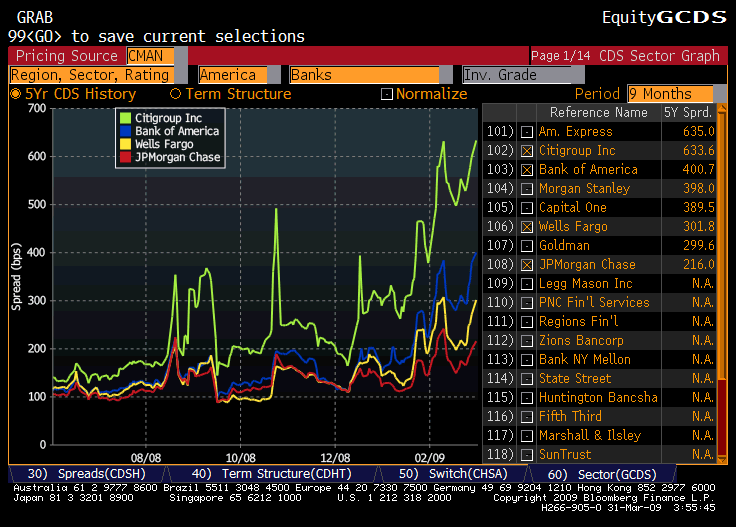
Think about the current and potential future pressure on our largest banks like this.  The underlying problems are deep, but the “run” comes from the credit default swap market, and presumably from experienced professional investors – many of whom used to work in the largest banks. 

The big banks helped set up these markets.  They trained many of the people who are now engaged in speculative attacks on these banks.  And the excessive bonuses of yesterday form the capital base for many hedge funds that now lead the attack.

In my Economix column at NYT.com this morning, I explore the ironies and emphasize the dangers.  The system may have a tendency to self-destruct, but don’t think that the costs to the rest of us will be anything less than huge.

Calling All Shareholders

If you cast your mind back to when executive compensation and bonus limits first reached the mainstream debate, you may recall people saying these would be ineffective and the issue is a red herring.

These points do not now seem compelling.  People who work at the big banks are quite irked by what they see as unjustified limits on their bonuses.  Some of the “talent” is jumping ship.  Big bank leadership is lobbying hard to remove the restrictions or, failing that, for the right to pay back government TARP funds in order to escape the bonus cap – leading firms, such as Goldman Sachs, seem poised to raise new capital to that end.

This is a remarkable moment.  Excessive risk taking in large firms was based on inappropriate bonus structures (take risk and get compensated now; face the consequences of that risk down the road), facilitated by a deep failure to understand/control risk inside these organizations and probably made possible by the implicit put option from being too big or too complex to fail (i.e., Wall Street insiders own the upside; taxpayer owns the downside).  We have all focused of late on the costs for taxpayers, which of course are horrible, and going forward – with the implicit option now explicit – who can believe this will lead to anything other than further massive bailouts?

But think about this arrangement from the perspective of shareholders.  Are we looking at the greatest tunneling scheme in the history of organized finance? Continue reading “Calling All Shareholders”

Does The US Still Face An Emerging Market-Type Crisis?

The US has developed some features more typically seen in an emerging market, including disproportionate power and system-threatening activities in the finance sector.  In fall 2007, the US (and the world) experienced the kind of precipitous fall in credit, output, and employment that was, in modern times, seen only in “emerging market crises”.  Our first Baseline Scenario was controversial and largely dismissed when it first appeared on September 29, 2008, but many of its arguments and policy recommendations have now been absorbed into official thinking (at least in the US).

Is the US out of the emerging market-type woods?  Can we now rule out the possibility of a great depression?  Such a severe economic outcome is not currently our baseline view (e.g., as discussed in this NBR interview), but it is still a downside scenario that needs to be taken seriously – and, at least in our interpretation – this is also the view of Bernanke’s Fed (see our piece on Sunday and the profile in yesterday’s Washington Post.)

Why is a depression scenario still on the table? Continue reading “Does The US Still Face An Emerging Market-Type Crisis?”

What Next For Banks?

The case for keeping banks in something close to their current structure begins to take shape.  It’s not about traditional claims that big banks are more efficient, or Lloyd Blankfein’s argument that this is the only way to encourage risk-taking, or even the House Financial Services Committee view that immediate resumption of credit flows is essential for preserving jobs. 

Rather, the argument is: those opposed to banks and bankers are angry populists who, if unchecked, would do great damage.  Bankers should therefore agree to some mild reforms and more socially acceptable behavior in the short-run; in return, the centrists who control economic policymaking will protect them against the building backlash.  This is a version of Jamie Dimon’s line: “if you let them vilify us too much, the economic recovery will be greatly delayed.”

There are three problems with this argument: it is wrong, it won’t work, and it doesn’t move the reform process at all in the right direction. Continue reading “What Next For Banks?”

Is It a V?

Yesterday, at the Peterson Institute for International Economics, Mike Mussa and I discussed – and debated – the likely shape of the US and global economic recovery.  Mike has great experience and an outstanding track record as an economic forecaster.  His view is that the entire post-war experience of the US indicates there will be a sharp rebound.  Victor Zarnowitz apparently stressed to Mike, a long time ago, “deep recessions are almost always followed by steep recoveries.”

I completely accept the idea that a slow or L-shaped recovery for the US and at the global level would be something outside the realm of experience over the past 50 years.  I would also suggest that the financial crisis in fall 2008, the speed of decline in the US, and the synchronicity of the slowndown around the world over the past 6 months has also surprised everyone (including most officials) who think that we are always destined to re-run some version of the post-1945 data. Continue reading “Is It a V?”

Inflation Prospects In An Emerging Market, Like The U.S.

There are two ways to think about inflation in today’s economy.  The first, suggested by conventional macroeconomic frameworks for the US, is that, with rising unemployment and actual output sinking further below “potential” output, inflation will stay low – and we could actually experience the dangers of falling wages and prices (think what happens to mortgage defaults in that scenario).  This is the view, for example, expressed by Fed Vice Chair Don Kohn last week, and the Obama Administration seems to be on exactly the same page – talking already about a further very large fiscal stimulus.

Some people in this camp do see a danger of inflation, down the road, as the economy recovers – and resumes its potential level (or growth rate).  As a result, many of them stress that the Fed will need to start “withdrawing” its support for credit and raising interest rates as soon as the economy turns the corner.  One informed insider’s reaction to our piece on Ben Bernanke in the Washington Post on Sunday was that we were too easy on Bernanke for failing to tighten monetary conditions as the economy began to recover after the last big easing earlier this decade (specifically, our correspondent argues that Bernanke provided the intellectual underpinnings for what Greenspan wanted to do.)

In today’s post-G20 summit situation, some of my former IMF colleagues are worried that further monetary easing around the world will create inflationary pressure in middle-income emerging markets, where inflation is often harder to control than in richer “industrial countries.”  But if you think the broader political and economic dynamics of the United States have become more like those of emerging markets, e.g., the concentrated power of the financial elite and their ability to access corporate welfare, doesn’t that also have potential implications for inflation?

Continue reading “Inflation Prospects In An Emerging Market, Like The U.S.”

Mandelson Moment

If you want an unusual insight into our potential future, take a look at Channel 4’s interview on Thursday with Peter Mandelson (UK’s Business Secretary, very close to Gordon Brown and a key person around the G20 summit).

In this clip, Mandelson comes on around the 12:48 mark (after Peer Steinbruck, the German finance minister, provides some complacent sound bites.)

But the surprising statement comes after the short interview with me (I start at 17:40 approx; Mandelson comes back around 21:38).  I have no idea if Mandelson knew this could happen, but Jon Snow (the anchor) goes back to him and asks if he agrees with me that the UK could borrow from the IMF. Continue reading “Mandelson Moment”

Ben Bernanke: More Important Than The G20 Summit

It may strike you as extraordinary that the G20 summit barely touched on what is, arguably, the key policy issue going forward – what will central banks do, including the detailed when and how of avoiding falling wages and prices (deflation).  Fiscal stimulus is already almost fully in play around the world, regulatory reform will at best be slow and not relevant to the recovery, and “we promise to avoid an irresponsible protectionist trade war” is nice but more about not making things worse rather than getting our economies going again.  Funding and leadership model change for the IMF can help prevent emerging markets from cratering, but in terms of impact on global growth or unemployment, it’s second order relative to the macro policies of the world’s largest countries.

The real issue is monetary policy, including interest rate cuts where there is still room for these – to me the biggest news of the week was actually that the European Central Bank cut rates by less than expected (its main interest rate stands at 1.25 percent).  This confirms the ECB still does not see deflation as a clear and present danger.  Look at all the downward pressures in the European economy, from East European collapses (and associated West European banking problems) to property market declines in the UK, Ireland and Spain (and what that means for banking) and export industry stress (and they have bankers too).  The ECB is taking an extraordinary and – to my mind – incorrect position.  If they truly wait until deflation is “fully in the data” (central bank jargon), it will be too late.

The dramatic trans-Atlantic, or at least eurozone-dollar, contrast is in terms of monetary policy, not fiscal stimulus or attitudes towards future regulation.  In our piece in the Washinton Post Outlook section on Sunday (already online), we provide an updated back story on how exactly the Fed and its chair got to the point of taking bold and unprecedented moves towards expansionary monetary and credit policy.  Continue reading “Ben Bernanke: More Important Than The G20 Summit”

Obama Wins At G20: Europeans Lose Control of IMF

The big news at the G20 was obviously about the IMF, with the Americans pulling out an impressive deal on funding (compare with our predictions…). But the money is not the biggest achivement. The big move was in terms of who will run the IMF in the near future – as I explain my NYT.com column this morning, there is an implicit and almost immediate shift towards emerging markets.

President Obama had just the right tone yesterday.  Admittedly, he was helped by the fact that we no longer have anything to be arrogant about, but still the way he reached out to other countries – while also pointing out that they made big mistakes and are currently in trouble – conveyed exactly the right message.  The US will do much better if it lets emerging markets and developing countries have a serious and permanent place at the big table. 

Among other things, this will fundamentally change the way the IMF operates.  As a symbol and for its potential impact on the international economy moving forward, yesterday’s final loss of European control over the IMF really matters.

By Simon Johnson

Obama Takes The Lead: G20 Viewer’s Guide

With our myriad banking problems, rapidly rising unemployment, looming political battles over the budget and much more on the pressing domestic agenda, is the G20 summit in London (dinner Wednesday and meeting Thursday) really worth all the time and effort that the President and his team have devoted to it?  And, granted that President Obama has to attend this heads of government meeting for protocol reasons, is there much that this summit can realistically achieve – i.e., are there actions that will be taken as a result of the summit that would not otherwise have happened and that can really make a difference to the parlous state of our economy?

These are all reasonable questions.  And the answer is simple: in terms of the obvious major issues of the day, this summit is unlikely to achieve much.

But every global economic recovery has to start somewhere and it probably has to begin small.  And there are some slight glimmers of hope because (a) President Obama is taking a global leadership role, (b) he is doing this in a creative way that might seem surprising, but which should reduce the chance of a further global meltdown. Continue reading “Obama Takes The Lead: G20 Viewer’s Guide”

The G20 Communique: A Viewer’s Guide

The draft G20 communique, as published on the FT’s website, is not encouraging. To be sure, there are humorous moments, such as:

each of us commits to candid, even-handed, and independent IMF surveillance of our economies and financial sectors, of the impact of our policies on others, and of risks facing the global economy;

Major countries have never allowed this and never will, despite a long tradition of such statements (e.g., ask about whether Gordon Brown welcomed frank assessments of the UK economy during the time he was chair of a ministerial committee that oversees the IMF).  Asserting something blandly in a communique does not make it true, but it does – amazingly – often convince much of the media to applaud politely.  Watching the spinmeisters at work is always entertaining although, under these circumstances, also more than a little scary.

On the real substance, the G20 punts on most of the big issues – as predicted, the language on monetary policy and fiscal policy is completely vacuous (paragraphs 3 and 4; the Europeans won big and the US lost on these issues), and the “regulatory reform” initiative amounts to building more ornate structures (we’re to get a new Financial Stability Board?!?) on the same weak foundations that got us into trouble.  There is simply nothing substantive here that would not have happened without the G20 process; under current dire circumstances, window dressing is not a good reason to hold a summit.

Only three interesting points are apparently still open for discussion, all about some dimension of the IMF. Continue reading “The G20 Communique: A Viewer’s Guide”

Obama Against The Odds

The G20 summit is headed for disaster.  The Europeans have circled their wagons and determined that no sensible policy proposal shall pass.  The background briefings indicate (a) the US has given up on global fiscal stimulus (“declare victory and retreat” springs to mind), (b) and the manifest failures of financial regulators will be addressed through, well, a manifest of failed regulators.

None of the important issues are on the table or even allowed in the building: changing the European Central Bank’s monetary policy, persuading European politicians to acknowledge they were and largely still are asleep at the wheel, and the future of big banks everywhere.

The summit will begin with dinner on April Fool’s Day.  The organizers have clearly not thought much about the symbolism. Continue reading “Obama Against The Odds”