Author: James Kwak

Holiday Season Takedown

Alan Greenspan has gotten innumerable takedowns, most notably in person by Henry Waxman. Binyamin Appelbaum and David Cho of the Washington Post are working on Ben Bernanke. Appelbaum and Ellen Nakashima already got James Gilleran (and, of course, there is the Photo). Now Zach Carter has nailed John Dugan. Some of the guns aren’t as smoking as one might like–Dugan only became head of the OCC in 2005, meaning he had less time to do serious damage, although he had established his bank-loving credentials long before. But he did what he could, such as preventing state regulators from gathering information (information!) from federally-chartered banks. Now, of course, he is lobbying Congress to protect his turf and kill the CFPA.

Why the Obama administration even acknowledges his existence is a mystery. I mean, Geithner is a centrist technocrat; I may disagree with him, but I see why he’s there. Dugan seems like the Stephen Johnson of banking regulation.

And to all a good night.

By James Kwak

Salespeople and Programmers

Tyler Cowen asks why pay across software programmers is not more unequal. He cites John Cook, who argues that differences in programmer productivity are difficult to identify and measure. Since I do know something about this (though not a comprehensive answer), I thought I would comment.

Cook contrasts programmers to salespeople: “In some professions such a difference would be obvious. A salesman who sells 10x as much as his peers will be noticed, and compensated accordingly. Sales are easy to measure, and some salesmen make orders of magnitude more money than others.” Although this is the most-cited example around (except perhaps for traders), I don’t actually think it’s true.

Continue reading “Salespeople and Programmers”

Whence the Deficit?

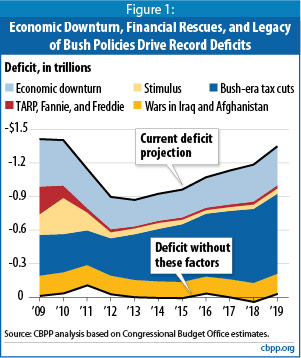
A couple of weeks ago I did a a basic calculation to see why the medium-term national debt picture has gotten so much worse in the last two years. There’s no new data I created; it’s just the difference between the January 2008 and August 2009 Congressional Budget Office projections. Here’s the chart, once again:

The Center on Budget and Policy Priorities (hat tip Ezra Klein) has done a similar exercise using CBO data, except they are looking at the annual deficit, not the aggregate deficit over a decade. Here is their chart:

Continue reading “Whence the Deficit?”

If Wall Street Ran the Airlines …

New York Times headline: “U.S. Limits Tarmac Waits for Passengers to 3 Hours.” Just imagine …

***

Representatives of industry associations reacted negatively to the government action, warning that over-regulation would stifle innovation and harm the competitiveness of U.S. firms. “Requiring each plane to stock up on 0.5-ounce bags of pretzels and peanuts will only hurt passengers,” said Sam Tapscott of the Airline Roundtable. “Airlines will have no choice but to pass the higher costs on to consumers, who will see the price of excessive government intervention in every ticket they buy.”

More worryingly, some industry analysts warned of dire consequences for the U.S. economy. “Forcing airplanes to return to the terminal after three hours will reduce the efficiency of the entire air travel system,” said David Dell’amore, professor of flight operations at Harvard University. “Modern flight management algorithms minimize aggregate wait times and ensure the perfect balance of customer comfort and economic value-added.”

Continue reading “If Wall Street Ran the Airlines …”

More Details

The financial reform bill that passed the House recently is full of surprises, not all of them bad. A contact pointed me toward an amendment introduced in committee by Brad Miler and Ed Perlmutter; it’s number 61 on this list. Basically, the amendment gives the Federal Reserve (“Board” in the text refers to the Board of Governors of the Fed) the power to prohibit a financial institution from engaging in proprietary trading not only if it decides that proprietary trading threatens of the soundness of the institution itself, but also if the Board of Governors decides that it threatens the financial stability of the country.

While this may seem overzealous, the point is to prevent a large financial institution with a government guarantee (of any kind) from putting most of its capital to work on its proprietary trading desks and taking lots of risks that might require a government bailout. The amendment does have exceptions allowing firms to, for example, make a market in securities that they underwrite, so securities underwriting is not in question here.

Continue reading “More Details”

A Few Books

It’s holiday season again, which means that I have time to read books again, and you may be looking for last-minute gifts. (If you haven’t used it yet, you can get a free 30-day membership to Amazon Prime, which gives you free two-day shipping; you do have to manually cancel before the thirty days are up or you will get charged. Or you could go to a bookstore.) There have obviously been many books about the financial crisis, and I have only read a few of them, and I’m only going to mention a few of those here. You shouldn’t think of this as a “best of” list, just four books that different people may enjoy.

Continue reading “A Few Books”

Small Steps and Health Care Costs

Hey all you deficit hawks out there. Atul Gawande, the person of the year when it comes to health care, has a long article on the cost-cutting proposals in the health care reform bill (hat tip Ezra Klein). Gawande’s main point is that the long list of pilot programs and other initiatives in the bill are probably the best possible way to reduce costs in the health care system (which, if you missed the implication, is the only way to control long-term government spending–that or eliminating Medicare).

Indeed, it’s hard to see what else the bill could have done. Remember, we have a largely private-sector health care system (both insurance and delivery), which means the government cannot simply order providers to charge less. A single-payer system might be able to take such draconian steps, but Mitch McConnell, who claims, “Two thousand seventy-four pages and trillions of dollars later, this bill doesn’t even meet the basic goal that the American people had in mind and what they thought this debate was all about: to lower costs,” is the last person who would vote for single payer. And the Republicans are similarly against anything that allows the government to use the one big lever it does have–Medicare–to force lower cost levels.

Continue reading “Small Steps and Health Care Costs”

Move Over, Bernanke

Ben Bernanke is Person of the Year. Matt Yglesias has criticism, although he does say it was an appropriate choice. Now, the Time award is meant to recognize newsworthiness, not necessarily exceptional conduct, and it’s hard to deny that Bernanke has been newsworthy. But I think that 2008 was Bernanke’s year, not 2009–that was the year of the real battle to prevent the collapse of the financial system. As far as the crisis is concerned, I would say the face of 2009 has been Tim Geithner–PPIP, stress tests (largely conducted by the Fed, but Geithner was the front man), Saturday Night Live, regulatory “reform,” and so on. But I can see why Time didn’t want to go there. Besides, I’m not sure that the financial crisis was the story of 2009; what about the recession? They’re related, obviously, but they’re not the same thing.

But in real news, Simon was named Public Intellectual of the Year by Prospect Magazine (UK). (This year they seem to have restricted themselves to financial crisis figures; David Petraeus won in 2008.) Over Ben Bernanke, among others. (Conversely, Simon didn’t make Time‘s list of “25 people who mattered”–but Jon and Kate Gosselin did, so that’s no surprise.) The article says that Simon “has also done more than any academic to popularise his case: writing articles, a must-read blog, and appearing tirelessly on television,” which sounds about right to me.

Prospect got one thing wrong, though. The article has a cartoon of Simon holding a sledgehammer and towering over a Citigroup in ruins. But no matter how many times you keep taking whacks at Citigroup, it refuses to die. One hundred years from now, maybe people will still be saying there are two common ingredients in all U.S. financial crisis: excess borrowing … and Citibank.

Update: I should have made clear that I prefer my award.

By James Kwak

The Myth of Dick Fuld

Wall Street critics often say that compensation should be in long-term restricted stock so that managers and employees do not have the incentive to take excessive risk, make big money in good years, deposit the cash in their bank account, and then escape to their private islands when their bets blow up the next year. Wall Street defenders like to point to Dick Fuld, who supposedly lost $1 billion by holding on to Lehman Brothers stock that eventually became worthless. You don’t get more of a long-term incentive than that, the argument goes.

Lucian Bebchuk, Alma Cohen, and Holger Spamann have exploded this myth in a Financial Times op-ed and a new paper. They look at the CEOs and the other top-five executives of Bear Stearns and Lehman Brothers. (All numbers are adjusted to January 2009 dollars.) From 2000 through 2008, these ten people received $491 million in cash bonuses (Table 1) and sold $1,966 million in stock (Table 2); on average, each person took out $246 million in cash. (Both Lehman and Bear had rules that prevented top executives from cashing out equity bonuses for five years from the award date–see p. 16 n. 33.)

Continue reading “The Myth of Dick Fuld”

What’s Up with Citigroup?

On Monday, Citigroup received permission from its regulators to buy back the remaining $20 billion in preferred shares held by Treasury because of its investments under TARP. (Treasury invested $25 billion in October 2008 and another $20 billion November 2008; however, $25 billion worth of preferred shares were converted into common shares earlier this year, giving the government about a 34% ownership stake in the bank.) The stock then fell by 6%. What’s going on?

This is another example of a bank doing something stupid in order to say that it is no longer receiving TARP money, and probably more importantly so it can escape executive compensation restrictions. As Citigroup CEO Vikram Pandit himself said last October, TARP capital is really cheap (quoted in David Wessel, In Fed We Trust). Instead of paying an 8% interest rate* on $20 billion in preferred shares, Citigroup chose to issue $17 billion of new common shares while its share price is below $4/share. Citigroup’s cost of equity is certainly more than 8%, so it just increased its overall cost of capital. The stock price fell because existing shareholders are guessing that the dilution they suffered (because new shares were issued) will more than compensate for the fact that Citi no longer has to pay dividends to Treasury.

Continue reading “What’s Up with Citigroup?”

New Deal for U.S. Climate Policy?

This guest post was submitted by James K. Boyce, an economist at the University of Massachusetts, Amherst. He has been a proponent of a “cap-and-dividend” policy to curb global warming while protecting the incomes of American families.

Last Friday, Senators Maria Cantwell (D-WA) and Susan Collins (R-ME) unveiled the CLEAR (Carbon Limits and Energy for America’s Renewal) Act, which could break the impasse in the debate over U.S. policy on climate change (McClatchy coverage is here.)

CLEAR has won a favorable reception from a broad swath of the political spectrum, ranging from ExxonMobil to Friends of the Earth. The scroll of supportive statements on Cantwell’s website includes praise from the AARP, the American Enterprise Institute, former U.S. Labor Secretary Robert Reich, Alaska’s Republican Senator Lisa Murkowski, and MoveOn.org.

Continue reading “New Deal for U.S. Climate Policy?”

The Remarkable Ms. Warren

She’s probably already said this before, but I just saw this in an interview by Tim Fernholz, which I completely agree with:

“There are a lot of ways to regulate ‘too big to fail’ financial institutions: break them up, regulate them more closely, tax them more aggressively, insure them, and so on. And I’m totally in favor of increased regulatory scrutiny of these banks. But those are all regulatory tools. Regulations, over time, fail. I want to see Congress focus more on a credible system for liquidating the banks that are considered too big to fail.”

But what really caught my eye was this: “I’m teaching my classes, doing my research, and helping out where I can.” I always assumed she took a leave from Harvard Law School when she became chair of the TARP Congressional Oversight Panel. Now that is remarkable.

By James Kwak

Yet Another Loophole?

Read for yourself. Basically Ed Perlmutter and Barney Frank introduced a colloquy into the record that seems to say that the legislative intent of the reform bill is that the CFPA should delegate its examination powers over a given bank (which have already been limited to banks with over $10 billion in assets) to other regulatory agencies if those other agencies deem that the bank has a strong consumer compliance record. As loopholes go, I don’t think this is anywhere near the most toxic. (I guess the justification for this would be that it allows the CFPA to focus its resources on the largest banks, rather than banks with $11 billion in assets.)

But my favorite part of the article was this:

“[Perlmutter’s communications director Leslie] Oliver said there was no connection between the campaign contributions and Perlmutter’s actions. ‘He is campaigning. He accepts campaign contributions. Look at the totality of his campaign contributions,’ she said.”Of the $28,500 committees donated to his campaign in October, more than two-thirds came from the financial services industry.”

For the current election cycle, he has received the most money from the finance/insurance/real estate sector ($160,000), with lawyers and lobbyists second ($88,000). Labor is third at $75,000.

By James Kwak

A Few Words on Health Care Reform and Medicare Buy-In

From Ezra Klein:

“[Doctors] should be forced to work in a way that doesn’t hurt society. That, after all, is the guiding principle behind the insurance reforms: Insurers will have to live with a market that society can live with. Similarly, providers will have to live within a market that society can afford. That will mean a strict budget, at least within the federal programs (and over time, as the private programs become unaffordable, they will probably come on budget as well). …

“It’s that or national bankruptcy. And the problem, if left untreated, will only get worse, and the eventual correction, when it comes, will only be more severe. That, however, is exactly what they’re asking Snowe, and the rest of Congress, to permit. The fear with Medicare buy-in is that Medicare pays somewhat lower rates than private insurers because it tries to live within a budget, even if it fails. But like it or not, that’s the future, or one variant of it.”

Am I being hypocritical in allowing Ezra Klein to use the words “national bankruptcy?”

Continue reading “A Few Words on Health Care Reform and Medicare Buy-In”