Author: James Kwak

So This Is What an Election Is Like

Martha Coakley just called me for, oh, the fifteenth time over the long weekend. I get multiple fliers in my mailbox every day. People from other states are calling me and asking me to volunteer. I’m sure I would be seeing nonstop ads on TV, except I don’t watch TV. All this started within the last week when, as many news outlets have noted, the Democrats woke up and realized they might actually lose Ted Kennedy’s Senate seat.

We’re not used to competitive elections here in Massachusetts, certainly not competitive elections with national implications. But this one is huge. The Republicans have been admirably or distressingly able, depending on your perspective, to hold forty votes against more or less anything the Democrats and President Obama want to accomplish, including health care reform. I think it’s a fairly easy bet that if Coakley loses, health care reform is dead until 2013 at the earliest, since there is no chance the Republicans will allow anything that looks like an accomplishment to occur if they can possibly help it. So if you live in Massachusetts, and you care about health care reform one way or the other, you should take the time to vote tomorrow.

Update: A friend emailed to point out that should Brown win, the House Democrats could pass the Senate bill, which presumably would not then have to go back to the Senate to be voted on again. (If the conference committee modifies the Senate bill, then it would have to go back.) Then some provisions could be modified through the budget reconciliation process, which only requires 51 votes. So a Coakley defeat might not be the end.

As for the comment about whether the Democrats could have negotiated with the Republicans to pick off one or two votes, they tried that for months–first via the Baucus Group of Six, then later directly with Snowe. Snowe ended up pulling out saying that the Democrats were rushing the bill, when they had spent several months talking to her specifically.

By James Kwak
The Myth of Ariba

(Warning: long post ahead.)

I was minding my own business, reading Past Due by Peter Goodman (I got it from Simon, who I think got it for free), and there on page 43 I ran into Eric Bochner. I thought that name sounded familiar, and then I remembered what it was. Eric Bochner was a vice president of something or other (and then the vice president of something else or other) at Ariba, where I worked from April 2000 until September 2001 (I was also a consultant there from December 1999). Chapter 2 of Goodman’s book is about the Internet bubble, Ariba is his case study, and Bochner is his source.

As far as I know, no one has made Ariba the poster child for the Internet bubble before–people usually go with WebVan, or Pets.com, or something similarly vaporous. Ariba is a more complicated story, but you can make a case that we deserve to be on the poster. At our peak we were bigger than all those pet food companies combined, with a market capitalization over $40 billion (on quarterly revenues of about $100 million at that time). More to the point, if Pets.com is comedy, Ariba is tragedy (well, not really, but you known what I mean): Ariba was a real company with a real product that got swept up in its own hype, with unfortunate consequences (but not fatal ones–Ariba today earns over $300 million in annual revenues and a small profit).

Continue reading “The Myth of Ariba”

Baseline Scenario Catches Up to Last Year’s Technology

I finally bothered to figure out how to push new posts (well, links to new posts) into the status messages of our Facebook page. This means that if you are or become a fan of that page, links to new posts will magically appear on your Facebook home page (which they keep redesigning–does anyone besides me find it annoying when Web 2.0 companies keep changing their user interfaces around and forcing you to figure out how they work every couple months?).

I’m doing it this way: Blog -> RSS -> Twitterfeed -> Twitter -> Selective Tweets Facebook application -> Facebook page. So if you follow the Twitter feed you won’t miss anything that’s on Facebook.

Alternatively, if you use Facebook and want to stay within Facebook, you can go to our Facebook page and click on the RSS/Blog tab to read full posts.

As for me, I stopped using Facebook many months ago.

By James Kwak

Entrepreneurs and Risk

I planned to write about Malcolm Gladwell in this post a couple of days  ago, but I had rambled on long enough, so I deferred it until later. Well, Felix Salmon beat me to the punch, which is all for the best anyway, since the connection was going to be John Paulson, and Felix knows much more about hedge funds than I do.

The topic is Gladwell’s still-subscription-only article, “The Sure Thing: How Entrepreneurs Really Succeed,” in which Paulson plays a starring role. The sub-sub-head in the table of contents says, “The myth of the daredevil entrepreneur,” so even though I expected Gladwell to be annoyingly contrarian again, for once I expected to agree with him. The conventional wisdom, in this case, is that successful entrepreneurs get that way by taking big risks.

Continue reading “Entrepreneurs and Risk”

Design or Incompetence?

Or both?

In late summer or early fall, Citibank was running a promotion: if you opened a new account or moved a certain amount of money to your bank account, you would get a $200 bonus within three months. Someone I know took advantage of this promotion, but as of Monday he still hadn’t gotten the $200 bonus, so he visited a branch.

“I was given the ridiculous explanation that I didn’t surrender the promotion letter and  that the promotion code NP55 was not linked (?) in the application. I told them that: (1) the letter is not a coupon to be surrendered, (2) I should not have to tell the customer service rep how to process the promotion, (3) there was no requirement that the letter even  be presented (just go to a financial center, it states), and (4) the code only needed to be mentioned if applying by phone. They called me back in the afternoon and asked me to come back this morning. They first offered me some ‘thank you’ points, but I stood my ground.  After calling several places they finally reached a Texas office that would further research my problem. “

Continue reading “Design or Incompetence?”

Another Path to Cap-and-Trade

There’s been a lot of talk about California’s budget crisis and its dysfunctional political system–a wound that was entirely self-inflicted by the anti-tax brigade, which made it possible for one-third of one house of the legislature to block any increase in taxes. (See Ezra Klein for more.) But there’s another area where California is putting Washington to shame: climate change.

The Economic and Allocation Advisory Committee to the California Air Resources Board recently released its recommendations for how emission permits under the state’s cap-and-trade system should be allocated (summary here). The basic principles are that most of the allocations should be auctioned off, and about three-quarters of the proceeds should be given back to households in the form of tax cuts or dividend checks, allowing families to cope with any increases in energy prices that result from emissions caps. This, of course, is a far cry from Waxman-Markey, which starts off by giving most allocations to polluting industries, but is closer to the bill introduced by Maria Cantwell and Susan Collins in the Senate.

The difference seems to be that in California, the Global Warming Solutions Act of 2006 mandated the creation of a cap-and-trade system (to get California to 1990 emissions levels by 2020) and handed the implementation details to the California Air Resources Board, which commissioned a panel of economists, public policy people, and businessmen to work out the details. (The Board is not bound to accept their recommendation, however.) So this is a contrast between letting regulators set rules and having Congressmen set rules. (In our current Congress, the latter gives coal-state Democrats an effective veto, since the Republicans will not provide significant votes to any Obama administration proposal.) In other contexts I’ve argued that regulators should not have too much discretion, but here it may turn out to be a better approach.

By James Kwak

What Goes Around . . .

“The user fee is a partial payment for the implicit guarantee it receives from Uncle Sam. The rationale behind such a fee is that since taxpayers are bearing an implicit risk on [the institution’s] activities, it is reasonable that the federal government recoup fees to pay for that assumption of risk. The main advantage of such a fee is that it would help level the playing field between [the institution] and its fully private competitors.”

What is “[the institution]”? It’s Fannie Mae, and that’s Stephen Moore of the Cato Institute testifying before Congress in 2000 in support of “a ‘user fee’ of 10 to 20 basis points on [Fannie’s and Freddie’s] debt to level the playing field between Fannie and competitors.”

Continue reading “What Goes Around . . .”

Thoughts on the Bank Tax

I’m in favor of the bank tax; what’s not to like about extracting $117 billion from large banks to pay for the net costs of TARP? But it’s by no means enough.

Simon covered the main points earlier this morning, so I’ll just add three comments.

1. Why $117 billion? Because that’s the current projected cost of TARP. But everyone realizes that TARP was only a small part of the government response to the financial crisis, and the main budgetary impact of the crisis is not TARP, but the collapse in tax revenues that created our current and projected deficits. So why not raise a lot more?

Continue reading “Thoughts on the Bank Tax”

United States Health Care Spending

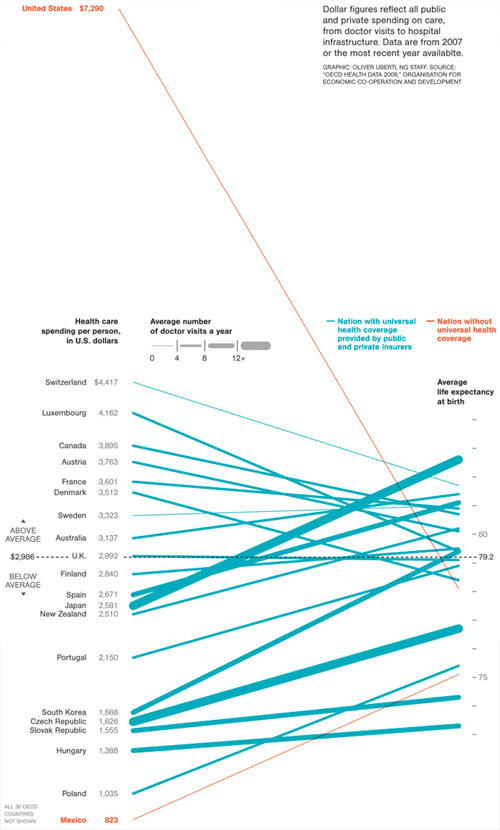
The vast discrepancy between what we spend on health care and what every other prosperous (or not-so-prosperous) country spends on health care–and the little good it does us–is so well-known that it’s not going to change any minds when it comes to health care reform. Opponents of reform have come up with their rationalizations (more spending on technology, someone has to subsidize cheap drugs for the rest of the world, etc.), some of which contain grains of truth. But even if people aren’t listening any more, that doesn’t make it any less true.

Ezra Klein brings us the latest reminders. Here’s the most amazing graph from National Geographic:

That’s a clever trick, putting the outlier above the title of the chart. I’ll have to try it sometime.

By James Kwak

“Appalled, Disgusted, Ashamed and Hugely Embarrassed”

No, that’s not someone talking about the banking industry. That’s Howard Wheeldon of BGC Partners (a brokerage firm) responding to Adair Turner’s statement last September that “Some financial activities which proliferated over the last 10 years were socially useless, and some parts of the system were swollen beyond their optimal size.” (Turner is head of the FSA, the United Kingdom’s primary bank regulator.) That’s from a recent profile of Turner on Bloomberg.

“‘How dare he?’ Wheeldon now says. ‘Markets will decide if something is too big or too small. It’s not for an individual, however powerful, to slam and damn nearly 1 million people.'”

Do we really need to point out that markets don’t always make the right decisions? Markets didn’t break up Standard Oil or AT&T–people did. And how is it wrong for public figures to be publicly stating their beliefs about what the objectives of public policy should be?

But the point of this post isn’t to single out another free-market zealot who apparently doesn’t think about the words he is saying. It’s to talk about John Paulson and Malcolm Gladwell.

Continue reading ““Appalled, Disgusted, Ashamed and Hugely Embarrassed””

More from “The Lion”

In the short days between Christmas and New Year’s, BusinessWeek published an interview with Paul Volcker conducted by Charlie Rose headlined “The Lion Lets Loose.” Rose asked him why the U.S. economy has fallen behind in some areas, such as manufacturing. Here’s the segment:

“How did that happen?
“What happened is our best and brightest got attracted to Wall Street. You’ve read about those big bonuses. These are generalizations, but I do think that the pull of Wall Street on bright young people, ambitious young people, has been tremendous.”

Continue reading “More from “The Lion””

Feed Problems?

I’ve gotten a few messages that our feed is not working properly. And, it occurs to me that I haven’t been getting email updates for the past couple of days.

The default feed produced by WordPress (https://baselinescenario.com/feed/) is working fine, and I can read the blog fine in Google Reader. But the Feedburner version (http://feeds.feedburner.com/BaselineScenario), which generates the emails, is stuck at January 8. I’ll look into it, but if you have any diagnostic details or suggestions let me know below.

(I suspect it is related to my having changed the number of items that go into the feed from 15 to 200; I was trying to figure out a better way to convert the blog to PDF, and that was one of the steps. I reset it this morning, so that may fix it.)

Update: Forcing Feedburner to ping the default feed worked; the Feedburner feed is up to date now. I’ll watch it to see if it picks up the next post or not.

Update 2: It did. I’m guessing that email subscribers will get an email tonight. (Of course, most of you aren’t here to read this.)

By James Kwak

My Last Post on Ben Bernanke

His confirmation, that is. I summarized most of my position in Foreign Policy, which asked me to lay out the anti-confirmation argument. My reasons overlap with Simon’s but are not identical–I think Simon worries about cheap money and asset bubbles more than I do. I was originally not particularly motivated by the anti-Bernanke campaign, because I didn’t think Obama would appoint anyone better, but as Russ pointed out, whether Bernanke should be confirmed and what the alternative is are two separate questions.

Whom would I pick? I certainly don’t know the candidates well enough to make a good choice. But the first thing I would say is that the Federal Reserve chair does not need to be Superman. The Federal Reserve Board of Governors is a board, and while the chair is important, he or she should really be the first among equals. You want someone who will push the Board in a certain direction, but the chair can draw on the experience and skills of the other board members and the staff, who are technically very competent. The idea that the chair must be Superman seems to be a product of the Greenspan era, and we project it back onto Volcker because of his success in fighting inflation in the early 1980s. And it’s a bad idea, just like searching for a savior CEO. In this context, I think it’s limiting to insist that the nominee have experience on the board, or have government experience, or be a prominent academic, or anything in particular.

Continue reading “My Last Post on Ben Bernanke”

Leading Indicator of Me

If I ever go to another school, you should run away from it as fast as you can. That is the practical implication of Felix Salmon’s post a few days ago rounding up arguments for why you should not get a Ph.D. in the humanities or go to law school.

Thomas Benton’s article, “Graduate School in the Humanities: Just Don’t Go,” nails the basic reasons why I went to UC Berkeley nineteen years ago: excitement in the subject, a history of high grades, the comforting structure of academia, romanticization of university life, and no practical application of academic skills. (See the six bullets halfway down the article.) When I left Berkeley in 1997, I could not get an academic job that I wanted … and the rest is history, I guess. If you do get a Ph.D. in the humanities these days, the numbers are even more heavily against you than they were then. First, American universities as a whole are shifting from tenure-track jobs to untenured adjunct positions; second, within universities, the jobs are shifting from the humanities into vocational fields like accounting and nursing. The ongoing bloodbath in state finances is only making things worse, since most of the good universities in the country are public.

Continue reading “Leading Indicator of Me”

Obama and FDR

Kevin Drum found a great quotation from FDR and what he thought of bankers, monopolists, and speculators. It’s so good he deserves to have you go there and read it.

Drum’s point is that while health care may have required conciliation and moderation, “When it comes to financial regulatory reform, Obama needs to let us know whose side he’s on.” So far Obama has played the peacemaker, the reasonable man in the middle, the man who bridges divides. “My administration is the only thing between you and the pitchforks,” he said last March; note that he brought up the pitchforks, but positioned himself as the center, holding back the crazies.

Continue reading “Obama and FDR”