Author: James Kwak

A Bit About Me

By James Kwak

As loyal readers know, I spent the summer working and mainly not-blogging. I’m back in school now, but this semester will be busier than previous ones. I’m taking two clinics, and I have to make up for phoning it in last fall when I was writing 13 Bankers. (Simon and I wrote it in four months while I was in school and he was teaching three classes.) Also, I only have one more year of school left in my life, I’m paying more than $45,000 for it, and I’d like to take it seriously.

So the blog is going to be a somewhat lower priority in the past.* I’m hoping to post a few times a week this semester, if I have enough original ideas. I hope you will keep reading; I assume most people get the blog via email or an RSS reader, so frequency shouldn’t be an issue for you.

It’s possible that after school I will go back to more serious blogging; I do think it’s a valuable and potentially powerful medium, and certainly a lot more gratifying than writing academic papers.

Thanks again for reading.

* In my defense, most of the high-volume economics bloggers are either tenured professors (Cowen, Thoma, DeLong, Krugman) or people whose job is to blog (Salmon, Klein). (Yves Smith is an exception; how she finds the time I don’t know.)
Hedge Fund Blindness

By James Kwak

Hedge fund managers may be good at investing money. (Or they may just be the beneficiaries of luck, like successful stock mutual fund managers.) But that doesn’t mean they can think clearly.

Andrew Ross Sorkin comments on the letter by fund manager Daniel Loeb, a former Democratic fundraiser, criticizing the supposed anti-business policies of the Obama administration. The letter includes blather like this:

“As every student of American history knows, this country’s core founding principles included nonpunitive taxation, constitutionally guaranteed protections against persecution of the minority and an inexorable right of self-determination.”

Who, in making a list of America’s founding principles, would put “nonpunitive taxation” first? Oh, right. A hedge fund manager.

Continue reading “Hedge Fund Blindness”

Central Clearing and Systemic Risk

This guest post is by Ilya Podolyako, member of the Yale Law School Class of 2009 and a friend of mine. Ilya led the Progressive Economic Policy reading group with me and served as an adjunct professor of law at DePaul University this past spring.

One of the key provisions of the Dodd-Frank Act is Title VII, which requires all non-exempt derivatives transactions to go through a central clearinghouse (this report provides a good summary). As James and Simon have explained, the Dodd-Frank Act uses the term “swap” as a big basket that captures most financial products that we would normally call derivatives: options, repos, credit default swaps, currency swaps, interest rate swaps, etc.

Prior to the passage of the Act, most of these products were sold over-the-counter by certain large institutions. That is, in form, a transaction where you wanted to buy a credit default swap triggered by some event (say, the bankruptcy of Ford Automotive) resembled a trip to the car dealership. The dealer had inventory on the lot; this inventory was split into several different models / types of product; individual instances of a given model were relatively homogenous and varied mostly by color and minor adornments (spoilers, leather seats, etc.). If you were looking for a car of a given make and model that had certain extra features, a dealer might be able to get one custom-built for you at the factory, but you’d have to wait for the item and pay extra. Of course, the salesperson would not be able to accommodate all requests – if you show up to your average Chevy dealership and ask to buy a jet-powered car, you are likely to leave empty-handed no matter how much money you have, even though a few other individuals have been able to procure said exotic item.

Continue reading “Central Clearing and Systemic Risk”

Democracy in America

It appears that Simon beat me to commenting on Third World America, Arianna Huffington’s bleak portrait of many of the things that are wrong with America (crumbling infrastructure, failing schools, extreme inequality, low social mobility, political system captured by special interests, etc.), so I’ll confine myself to a couple of thoughts I had while reading it.*

First, there are these great quotations from Alexis de Tocqueville’s Democracy in America (p. 45 of Huffington’s book):

“Amongst the novel objects that attracted my attention during my stay in the United States, nothing struck me more forcibly than the general equality of condition among the people. . . .

“Democratic laws generally tend to promote the welfare of the greatest possible number; for they emanate from the majority of the citizens, who are subject to error, but who cannot have an interest opposed to their own advantage.”

Continue reading “Democracy in America”

Housing in Ten Words

By James Kwak

“Housing Fades as a Means to Build Wealth, Analysts Say.” That’s the title of a New York Times article by David Streitfeld. Here’s most of the lead:

“Many real estate experts now believe that home ownership will never again yield rewards like those enjoyed in the second half of the 20th century, when houses not only provided shelter but also a plump nest egg.

“The wealth generated by housing in those decades, particularly on the coasts, did more than assure the owners a comfortable retirement. It powered the economy, paying for the education of children and grandchildren, keeping the cruise ships and golf courses full and the restaurants humming.

“More than likely, that era is gone for good.”

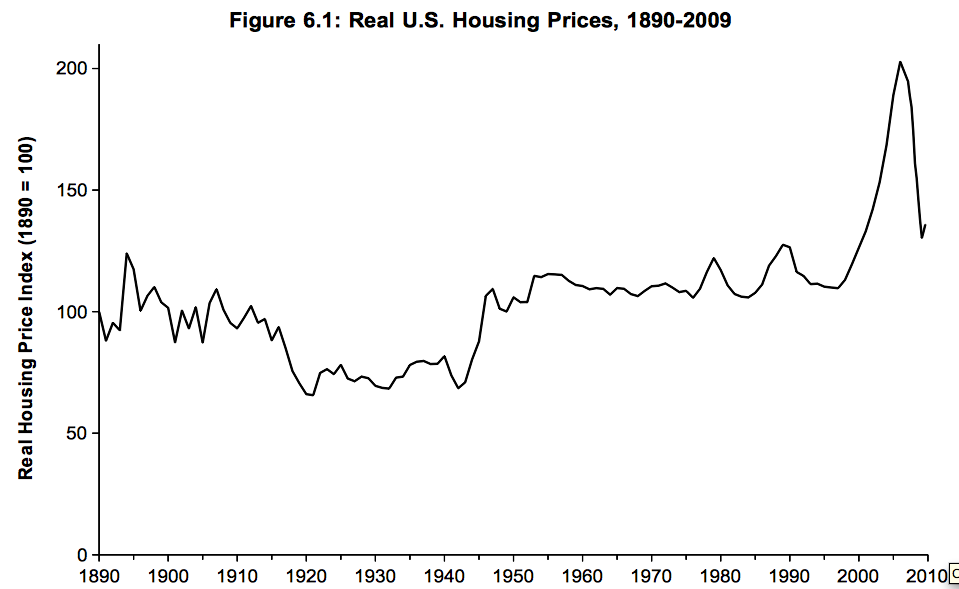
I’ve been telling my friends for a decade that housing is a bad investment. These are real housing prices over the past century, based on data collected by Robert Shiller:

Housing is generally a worse investment than either stocks or simple U.S. Treasury bonds. Then why do so many people think it’s such a great investment?

  1. Continue reading “Housing in Ten Words”

Management Consulting Myths

By James Kwak

Two people forwarded me Johann Hari’s Huffington Post article about management consultants, provocatively titled “The Great Management Consultancy Scam — and How it Could Be Coming for Your Job.” It seems that someone is once again bashing management consultants as witch doctors and scam artists, and I, improbably, must come to their defense. “Improbably” because I am generally critical of management consulting, and I have spent many hours with former McKinsey colleagues talking about how little we knew back when we were consultants. I am frequently asked by other students whether they should become consultants, and my general answer is, in a nutshell, “It’s a lousy job, and not nearly as exciting as the recruiting pitch makes it out to be, but it’s a good thing for your resume if you actually want to be in the business world.” (If you know me and are actually considering becoming a consultant, feel free to call me.)

Hari’s article is largely based on books by former consultants, primarily David Craig’s “brave” memoir (written five years ago; David Craig is a pseudonym). Here’s a quote from Craig: “We were proud of the way we used to make things up as we went along. . . . It’s like robbing a bank but legal. We could take somebody straight off the street, teach them a few simple tricks in a couple of hours and easily charge them out to our clients for more than £7000 per week.” According to Craig (according to Hari), all of management consulting boils down to recommending that the client lay off thirty percent of its staff, after one week of observation and analysis.

Continue reading “Management Consulting Myths”

More Telecom Hell

By James Kwak

So, I wanted to transfer phone and DSL from one house to another. I went to Verizon’s web site, clicked on the promisingly named “Moving to a New Home” link, and walked through the step-by-step wizard. It said I could have unlimited domestic calling and 3 MB DSL for $55 per month, which was a better deal than I was currently getting, so I signed up. The only issue was that the scheduling calendar only allowed install dates in the next month and I wanted a date six weeks out, but the live chat representative said I could just call in later and change the install date.

A few days later I went online to check on the order status in their online system and saw that my DSL order was nowhere to be  found. So I called up and, after much misunderstanding and aggravation, I figured out that my order had been canceled by their back-end system. Even though the front-end (web) system knew that I was an existing customer (remember, I clicked on “Moving to a New Home”) and offered me a discounted bundle, the back-end (probably mainframe system) didn’t want to give discounts to existing customers and wouldn’t allow the order to be processed.* After a little arguing, the representative said that she would manually book the order at the higher price and then go in and give me the originally promised discount.

The next time I checked my order status I saw that I had three different DSL orders in their system, which made me nervous, but there was nothing to do but wait.

Continue reading “More Telecom Hell”

Monopoly and Taxes

By James Kwak

A couple of weeks ago, Planet Money did a podcast based on a game of Monopoly. One of the participants was Russell Roberts, who professes to hate monopoly because it teaches the wrong lessons about business and the economy. At one point, Roberts said he would prefer the game if it had a progressive income tax with transfer payments to poor players. “As a result of that, you could get kids to resent taxes at an even earlier age.”

But Daniel Hamermesh, who likes Monopoly, called him on it. Hamermesh pointed out that if you had a transparent system of taxing the rich and transferring the money to the poor, players in the aggregate would be neutral, and might even understand the whole point of taxes and government spending.

Continue reading “Monopoly and Taxes”

Health Care Non-Solutions

By James Kwak

Ezra Klein makes an important point about our nation’s health care problem: it’s not just a government deficit problem. The underlying problem is that health care costs are not only growing faster than prices (inflation), but also faster than GDP (economic growth), and as a result the amount of stuff we as a nation will be able to afford, other than health care, will start to go down at some point in the future. (Picture originally from Joseph Newhouse in Health Affairs.)

This means that proposals to solve the long-term budget deficit problem by cutting Medicare benefits are not solutions: they simply shift the problem from the government to individuals–which means they shift the problem from us as taxpayers to us as old people or us as family members of old people.* If, for example, we increase the eligibility age for Medicare from 65 to 67, the government saves money, but only because people who are 65 and 66 lose money–or, alternatively, all of us lose money because their employers now have to pay more for health care.

Continue reading “Health Care Non-Solutions”

The Tilted Playing Field

By James Kwak

It’s been widely noted that financial reform is now entering a new phase as the action moves from Congress to the regulatory agencies that will write the hundreds of rules necessary to implement the reforms. During the congressional fight, the financial sector had a huge advantage in money and lobbyists, but we had one advantage: the fact that there was (from time to time) a lot of media coverage, and Congressmen care at least a little about public opinion.

In the rule-writing phase, the banks still have a huge advantage in money, lobbyists, and lawyers–and are hiring as many ex-regulators as they can to press their case. As our friend Jennifer Taub writes at The Pareto Commons:

What lies ahead, over the next year and beyond, will require far larger armies of lawyers, economists, finance experts and just plain able bodies and minds to monitor and influence the rulemaking process. Rumor has it that one bank alone plans to set up 100 teams of employees, tasked with particular rule makings. And that is just one bank.

Unfortunately, however, the pressure of the public spotlight is largely off, tilting the battlefield in favor of industry.

Continue reading “The Tilted Playing Field”

Yet Another Reason to Like Elizabeth Warren

By James Kwak

Bob Lawless points me to this 2006 blog post by Elizabeth Warren. Warren describes a first-year contracts class on the case that upheld a fine-print forum selection clause (a clause saying that if you want to sue us, you have to sue us in X jurisdiction–Florida, in this case) on the back of a cruise ship ticket.

Warren’s entire class (Harvard, let me say for the record) insists that, as a factual matter, this decision is good for consumers because . . . well, regular readers of this blog should be able to fill in stock Mickey Mouse economistic hand-waving as well as any first-year law school student. Of course! Forcing people to sue in Florida (or to accept binding arbitration in the forum of the company’s choice) deters frivolous lawsuits and lowers costs for the company, and it can pass those savings onto consumers. Why does it pass those savings onto consumers instead of putting them into shareholders’ (or managers’) pockets? Because in a perfect competitive market, if Alpha Cruise Lines doesn’t, then Beta Cruise Lines will, and Beta will underprice Alpha, . . . Consumers will read the fine print and can make an informed choice between the lower price with the forum selection clause and the higher price without the forum selection clause.

Continue reading “Yet Another Reason to Like Elizabeth Warren”

Hope

By James Kwak

A number of people have asked me what I think about the financial reform bill that was finally passed by the Senate. I don’t think I have much to add to what I’ve said already, but here’s one more angle.

“We can’t legislate wisdom or passion. We can’t legislate competency. All we can do is create the structures and hope that good people will be appointed who will attract other good people.”

That’s what Christopher Dodd said about the bill, as quoted by The New York Times. It’s become a commonplace observation by now that the reform bill, instead of making structural changes to the financial sector, instead increases regulators’ discretionary powers to constrain — or not constrain — the behavior of the industry.

As a result, the success of reform, in the words of its supposed architect, depends on hoping that presidents will appoint good people and that that will be enough to attract people to being regulators.

Continue reading “Hope”

Why Agencies Get Things Terribly Wrong

By James Kwak

There has been a lot of criticism of regulatory agencies in the past couple of years, from the Office of Thrift Supervision and the Securities and Exchange Commission (Madoff who?) to the Minerals Management Service. But most of the people in these agencies are not evil; on the contrary, I believe (without a ton of evidence in support at the moment) that a majority are conscientious, hard-working, and civic-minded, and a significant minority are actually quite good at what they do. So why do they get things so wrong?

A few days ago, Leslie Kaufman of The New York Times wrote an article describing how the Fish and Wildlife Service “signed off on the Minerals Management Service’s conclusion that deepwater drilling for oil in the Gulf of Mexico posed no significant risk to wildlife.” This sounds like classic incompetence, or corruption, or both.

But the report itself, it seems, was not so far off, at least in its details. The report assessed spills of up to 15,000 barrels of oil. As Kaufman paraphrases,

“In its 71-page biological assessment, the Minerals Management Service concluded that the chances of oil from a spill larger than 1,000 barrels reaching critical habitat within 10 days could be more than 1 in 4 for the piping plover and the bald eagle, as high as 1 in 6 for the brown pelican and almost 1 in 10 for the Kemp’s ridley sea turtle. When the model was extended to 30 days, the assessment predicted even higher likelihoods of habitat pollution. . . .

“‘Heavily oiled birds are likely to be killed,’ the assessment said.”

Fifty-one days after the well explosion, the amount of oil spilled is probably somewhere between one and three million barrels.

Continue reading “Why Agencies Get Things Terribly Wrong”

One Paragraph on the Financial Reform Bill

By James Kwak

From Mike Konczal:

“Examples? Off the top of my head, ones with a paper trail: [Treasury] fought the Collins amendment for quality of bank capital, fought leverage requirements like a 15-to-1 cap, fought prefunding the resolution mechanism, fought Section 716 spinning out swap desks, removed foreign exchange swaps and introduced end user exemption from derivative language between the Obama white paper and the House Bill, believed they could have gotten the SAFE Banking Amendment to break up the banks but didn’t try, pushed against the full Audit the Fed and encouraged the Scott Brown deal.”

(By the way, if you’re missing your financial commentary fix during my self-imposed hiatus, I recommend Mike’s blog highly–not that that’s news to anyone anymore.)

Continue reading “One Paragraph on the Financial Reform Bill”

Bad Software

By James Kwak

Planet Money did a story this week on the problems with medical billing. This is something I’ve been vaguely interested in for a long time; nine years ago, we seriously thought about it as a business opportunity for our company.

The Planet Money team said that there is $7 billion in waste in the medical billing process per year, which sounds like a lot until you realize that it isn’t. (Total healthcare costs in the United States are on the order of $2 trillion, I believe.) But the story had a great example of the problems with enterprise software that I’ve written about before.

Continue reading “Bad Software”