Author: James Kwak

Hoisted from the Archives

By James Kwak

What was the budget debate about eleven years ago?
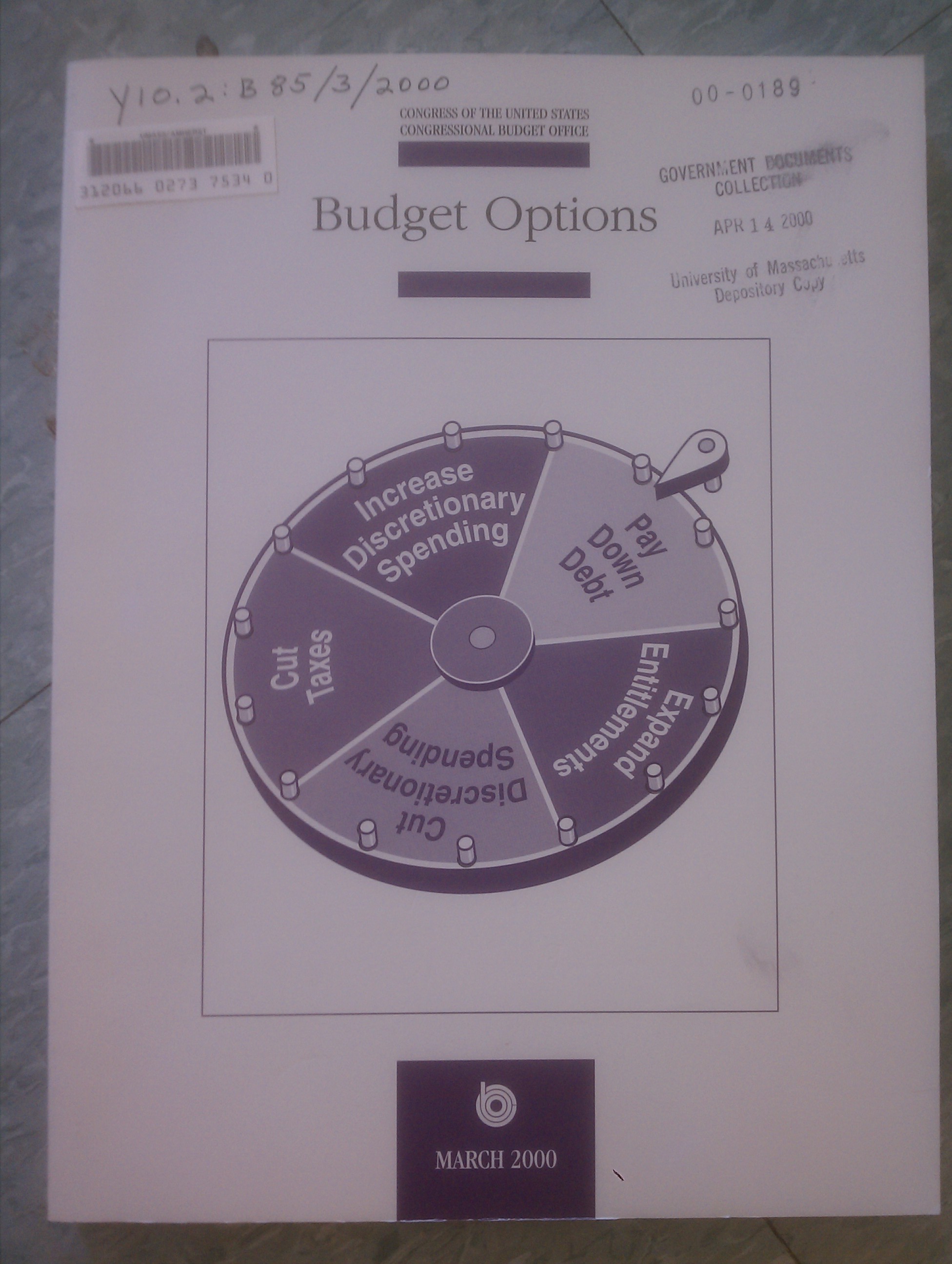
 

As you can see, that is the cover of the CBO’s March 2000 Budget Options report. (You can get it online, but without the cover.*) For most of the 1980s and 1990s, this report was called Reducing the Deficit: Spending and Revenue Options; this year’s version has reverted to that title.

The context for the picture above was the budget surpluses of the late 1990s. At the time, the CBO was projecting surpluses for at least the next twenty years, amounting to over $3 trillion in the first decade of the twenty-first century. (See the 2000 Budget and Economic Outlook, Summary Table 1.) And although most of the surpluses were off-budget (surpluses of Social Security payroll tax revenues over benefit payouts), there were supposed to be ten years of on-budget surpluses as well.

We all know what happened next: a (mild) recession, the Bush tax cuts of 2001 and 2003, the Afghanistan and Iraq Wars, and the Medicare prescription drug benefit, among other things. But the question for now is: did those surpluses really exist?
Continue reading “Hoisted from the Archives”

Long-Term Budget Forecasts for Beginners

By James Kwak

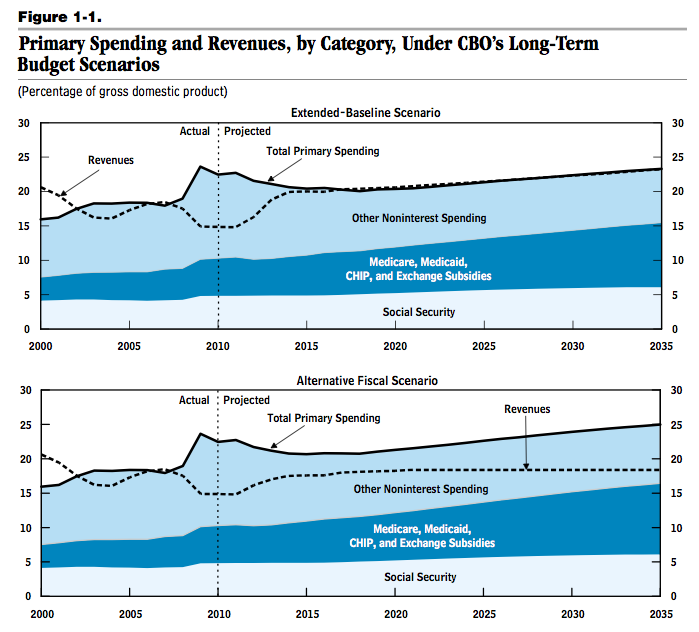
In this season of debate over long-term deficits, this is ground zero:

That’s the key chart from the Congressional Budget Office’s Long-Term Budget Outlook, published just last month, which I read from cover to cover. The CBO is generally considered the authoritative source of budget projections, and CBO “scoring” has been an important aspect of legislative debates over the past few years. Although politicians from both sides criticize the CBO when they don’t like its results, I think it’s fair to say that it is generally both respected and nonpartisan.

Now, when people say that the federal government faces a long-term budget gap, they (including me) are generally starting from the bottom half of this picture: the CBO’s “alternative fiscal scenario.” The alternative scenario is widely considered the most likely path the budget will follow under current policy (although the CBO itself makes no such claim*). That’s probably a close enough approximation for most purposes. But if you’re going to think hard about long-term budgetary paths, you need to be a bit more careful about what it means.

Continue reading “Long-Term Budget Forecasts for Beginners”

Are Subsidized Student Loans Worth the Price?

By James Kwak

Previous guest blogger Anastasia Wilson has written a post on her own blog comparing the student loan racket (for-profit colleges help people take out lots of federally guaranteed student loans to pay for their tuition, then do a lousy job educating them, walking away with the money and leaving students to default) to the subprime loan racket. The flagbearer for this parallel is Steve Eisman, who has gone from shorting subprime mortgages to now shorting for-profit colleges.

In theory, for-profit colleges should not be able to do this. If too many of their former students go into default, the Department of Education is supposed to prevent their new students from taking out federally subsidized loans. (Since the government is ultimately underwriting these loans, it should have the power to make sure that the loans are being used to buy an education that will help borrowers pay back those loans.) But colleges have so far been able to get around the rules by pushing defaults outside the time period that matters for regulatory purposes, as described by the Chronicle of Higher Education.

Continue reading “Are Subsidized Student Loans Worth the Price?”

What Is This “Washington”?

By James Kwak

(Warning: Very elementary post ahead. Most of you probably know all this already.)

Mitch McConnell, Senate Republican Leader, quoted in Bloomberg: “We have seen the consequences of giving Washington a blank check. My message to the president is simple: It’s time for Washington to focus on fixing itself. It’s time Washington take the hit, not the taxpayers.”

That sounds good (if you don’t like “Washington,” that is), but what does it mean? McConnell wants people to think that their tax dollars go to feed some animal named “Washington,” and therefore our budget problems can be solved by simply feeding Washington less — without “taxpayers” taking the hit.

That might be true if “Washington” simply consumed money for its own sake, but the problem is that most of the federal budget isn’t consumed by the federal government.

Continue reading “What Is This “Washington”?”

Straight Talk

By James Kwak

Gary Gensler, chair of the Commodity Futures Trading Commission, has gotten a fair amount of credit for being one of the good guys when it comes to financial regulation after the financial crisis. Kambiz Foroohar has a very favorable portrayal of Gensler in Bloomberg Magazine. It’s pretty much the usual, but I appreciated Gensler’s bluntness when it comes to his past positions on derivatives (as an official in the Rubin-Summers Treasury):

“As a Goldman Sachs Group Inc. (GS) partner and then Treasury undersecretary, Gensler had lined up with the hands-off- derivatives crowd behind the $601 trillion global market.

“He says the near-collapse of the world’s financial system changed his mind about regulation.

“’My thinking has evolved,’ Gensler says in his ninth- floor Washington office, which is decorated with artwork by his three daughters. ‘I was part of the consensus view on derivatives, and it’s fair to say that the consensus missed it. We should have done more to protect the American people.'”

That’s about the closest thing to an apology you’ll hear from anyone involved in creating the financial crisis.

“The Elderly” for Beginners

By James Kwak

As the AARP says that it is open to modest cuts in Social Security benefits, it’s worthwhile asking a more fundamental question: are Social Security and Medicare programs that benefit the elderly?

The answer may seem obvious. After all, the bulk of Social Security Old Age and Survivors Insurance benefits go to people over 62, and almost all Medicare beneficiaries are over 65. So it’s often observed in passing that our long-range budget issues are the product of transfers to the elderly. For example, in Restoring Fiscal Sanity 2005, Alice Rivlin and Isabel Sawhill write, “These big programs, which benefit primarily the elderly, will drive increases in federal spending in the longer run” (p. 36). Other commentators have occasionally argued that the problem is that the elderly have become too powerful and therefore claim too large a share of government spending, especially compared to the very young.* When you add to that the frequent complaint that, by running budget deficits, we are imposing burdens on our grandchildren, this age-based inequity seems even greater.

But the problem with this framing is that “the elderly” change every year. There’s nothing inherently wrong or unfair with a program in which you pay insurance premiums while you work and collect benefits when you retire. Saying such a program benefits the elderly is like saying that life insurance doesn’t benefit the insured, only the beneficiaries: it’s true in a trivial sense, but people still want and buy life insurance anyway.

Continue reading ““The Elderly” for Beginners”

And in This Corner . . .

By James Kwak

Over in the less-prestigious and less-well-paid online section of the Times, Bruce Bartlett has a good column on the comparative tax burden across advanced economies. He makes the point that one reason European taxes look higher is that we provide subsidies through the tax code while they do it through spending programs like family allowances — another example of how aggregate statistics are distorted by calling something a “tax credit” as opposed to “spending.” His other main point is that the main substantive reason why we pay lower taxes is that we pay for less of our health care spending through the government — and that isn’t working out so well for us.

When You Don’t Need To Worry About Facts

By James Kwak

Masquerading behind an invocation to “wisdom” in the title, David Brooks today finds his false equivalence (see here for another example) by comparing the the two parties’ approaches to Medicare: the Democrats, he says, favor “top-down centralized planning” while the Republicans favor the “decentralized discovery process of the market.”

David Brooks swallowing Republican talking points whole is not worthy of note, so I’ll just point out one: he calls the Ryan Plan a “premium support plan,” despite the categorial denial by Henry Aaron, the creator of the premium support idea.* But it’s marginally more interesting to point out Brooks’s finely-honed rhetorical dishonesty.

Continue reading “When You Don’t Need To Worry About Facts”

Not All Businessmen Are Smart, You Know

By James Kwak

Stephen Carter, a professor at the Yale Law School and an accomplished novelist, wrote a Bloomberg column based on a conversation with a medium-sized business owner he met on a plane. The gist of the column is that the businessman isn’t hiring more workers because he’s worried about the regulations changing on him. From this, Carter draws a general lesson about business and government:

“For medium-sized firms like his, however, there is little wiggle room to absorb the costs of regulatory change. Because he possesses neither lobbyists nor clout, he says, Washington doesn’t care whether he hires more workers or closes up shop. . . .

“Recessions have complex causes, but, as the man on the aisle reminded me, we do nothing to make things better when the companies on which we rely see Washington as adversary rather than partner.”

Jim Henley (hat tip Brad DeLong) has already pointed out the silliest thing about this column: anyone who has a growing business and isn’t hiring more people, and isn’t hiring them because he’s not sure about future regulatory changes, is making a mistake (or perhaps is in a very unusual business that is heavily exposed to some very particular and very concrete regulatory risk).

Continue reading “Not All Businessmen Are Smart, You Know”

Who Created This Mess?

By James Kwak

Not us, say the Republicans. “We didn’t create this mess,” a Republican said to Tim Geithner in a meeting recently, referring to the national debt and the need to raise the debt ceiling this summer. Yet, as the Times continues,

“Independent analyses have shown that more than half of the $14.3 trillion debt is from policies enacted during the past decade when Republicans controlled both the White House and Congress, and much of the rest from lost revenues and stimulus spending and tax cuts since Mr. Obama took office at the height of the financial crisis and recession.”

I did one of those “independent analyses” (although not one that has made it into the media) myself a few months ago.

Continue reading “Who Created This Mess?”

Health Care Rationing for Beginners

By James Kwak

“Obama-care kills Medicare as we know it. Obama-care raids $500 billion from Medicare to spend on Obama-care, puts in place a 15-panel board to ration Medicare by unelected bureaucrats.

“Our budget, repeals the raiding, gets rid of the rationing board, preserves this program, makes no changes for a person 55 years of age or older and saves Medicare, by reforming it for our generation, so it’s solvent. The president’s plan does not save Medicare, it allows it to go bankrupt, rations the program and raids the program. We get rid of the rationing, we stop the raiding and we save the program from bankruptcy.”

That was Paul Ryan on Fox News recently.

Ordinarily this wouldn’t be worth responding to, except to point out, as Sam Stein did, that Ryan’s proposed budget also “raids $500 billion from Medicare,” so the statement that “we stop the raiding” is, um, a lie. But it isn’t news that Paul Ryan has an issue with honesty, except perhaps for David Brooks.

But there’s a theme that is surfacing that goes something like this: OK, Ryan’s plan is extreme and has no chance. But we all know we spend too much on health care, and we have to spend less, which means that we have to ration care one way or another. Ryan does it by scrapping Medicare in favor of indexed vouchers; Obama does it by reducing Medicare payment rates and, more ominously, with “a 15-panel board to ration Medicare by unelected bureaucrats.”

Continue reading “Health Care Rationing for Beginners”

What’s Left of the Ryan Plan?

By James Kwak

Jennifer Steinhauer in the Times reports that some Republicans are running away from the Ryan Plan (you know, the one that changes Medicare from a health insurance plan to an underfunded subsidy), while others are trying to figure out if they should support in order to gain Tea Party votes. As policy, of course, it never had a chance to pass the Senate or of being signed by President Obama (and every Republican staffer Politico could find agrees), so it was pure political theater from the start. As Paul Krugman points out, the goal may have been to win over the pundits — a group that is vastly more concerned with the deficit than ordinary voters — but even that failed. (They got Jacob Weisberg, but he backpedaled furiously, and they got David Brooks, which was mainly amusing because then we got to watch Krugman trying to observe intra-Times decorum by not going after Brooks by name). Now Republicans are wondering if the loss of a Congressional seat in a conservative New York district was Ryan’s fault.

But while I’d like to think that the nation is recovering its senses, at least on what Republicans mean for Medicare, I’m not optimistic. Brad DeLong put it well:

“the political lesson of the past two years is now that you win elections by denouncing the other party’s plans to control Medicare spending in the long run — whether those plans are smart like the Affordable Care Act or profoundly stupid like the replacement of Medicare by RyanCare for the aged — sitting back, and waiting for the voters to reward you.”

Continue reading “What’s Left of the Ryan Plan?”

The Problem with Biomass, Part 2

By James Kwak

I’ve already introduced you to the Springfield biomass plant proposed by Palmer Renewable Energy (PRE). The issue in that post was PRE’s witnesses’ apparent unfamiliarity with the voluminous evidence that ambient air pollution increases both the incidence and the severity of asthma, along with other diseases.

In addition, PRE is claiming that their biomass plant won’t increase air pollution, anyway. In this press release gracefully repackaged as a news story by the Springfield Republican, we read, “The average annual impact on emissions such as nitrogen dioxide, sulfur dioxide, and particulate matter would be minuscule, Valberg and Raczynski [PRE’s environmental consultants] said.”

Continue reading “The Problem with Biomass, Part 2”

The Problem with Biomass, Part 1

By James Kwak

Did you know that my wife is a “high-paid consultant” for the shadowy anti-biomass movement? Neither did I — and I’m the one who handles all of our finances, so I should know.

Last night she testified at a hearing held by the Springfield City Council, which is considering revoking the permit of Palmer Renewable Energy (PRE) to build a biomass plant in Springfield. PRE was granted a special zoning permit to build the plant in 2008. Since then, PRE has increased the amount of fuel it intends to burn (meaning, among other things, that more diesel trucks will have to drive in and out to deliver the material) and changed the type of fuel from construction and demolition debris to “green wood chips” (which matters because the plant was initially permitted as a recycling facility).*

My wife, a professor of environmental economics and econometrics, testified about the link between emissions (from power plants and diesel trucks) and illness, particularly asthma. At the hearing, one of PRE’s witnesses claimed not to know where my wife was “getting” the idea that air pollution can cause asthma. (In a newspaper article, PRE had this to say about asthma: “Valberg said there are many theories on the causes of asthma, and that indoor air quality in homes and schools is actually more of concern than outdoor air. For opponents to state that the project will worsen asthma rates ‘is just not scientifically accurate,’ Valberg said.”)

Continue reading “The Problem with Biomass, Part 1”