Author: James Kwak

Who Wants Tax Cuts?

By James Kwak

Yesterday I wrote an Atlantic column about Republican presidential candidates’ fondness for tax plans that transfer massive amounts of money from the poor to the rich. The main question, to my mind, is why people like Herman Cain and Rick Perry talk about transferring massive amounts of money to the rich when polls show that even a majority of Republicans think the rich should pay more in taxes.

Many of the readers here could probably  have written that column themselves, but it does have a wonderful picture of Cain and Perry in all their well-dressed glory.

Are They Really That Good?

By James Kwak

The instinctive defense from Wall Street bankers is that they deserve the money they make: they’re just that good. By that logic, Jon Corzine was the best of the best: he was the head of Goldman, after all (although in his days, if I recall correctly, Goldman and Morgan Stanley were roughly tied in prestige). The failure of MF Global may have had many causes, but it does make one wonder: Are the people at Goldman really that good individually, or is it the firm (and its reputation, and its information flow) that makes them so good?

Andrew Ross Sorkin speculates that MF Global got Goldman-style risk-taking without Goldman-style compliance and risk management. I would just add: they also got it without a Goldman-style too-big-to-fail government guarantee.

What’s Wrong with Groupon?

By James Kwak

Groupon plans to go public later this week. According to the latest leaks, things are going well: the IPO valuation, scaled back from $30 billion to about $12 billion, may be raised because of a successful road show. Apparently even after the company conceded that the amount they pay to a merchant does not count as revenue, investors have decided they like what they see.

But there is still something fishy about Groupon’s business model.

Continue reading “What’s Wrong with Groupon?”

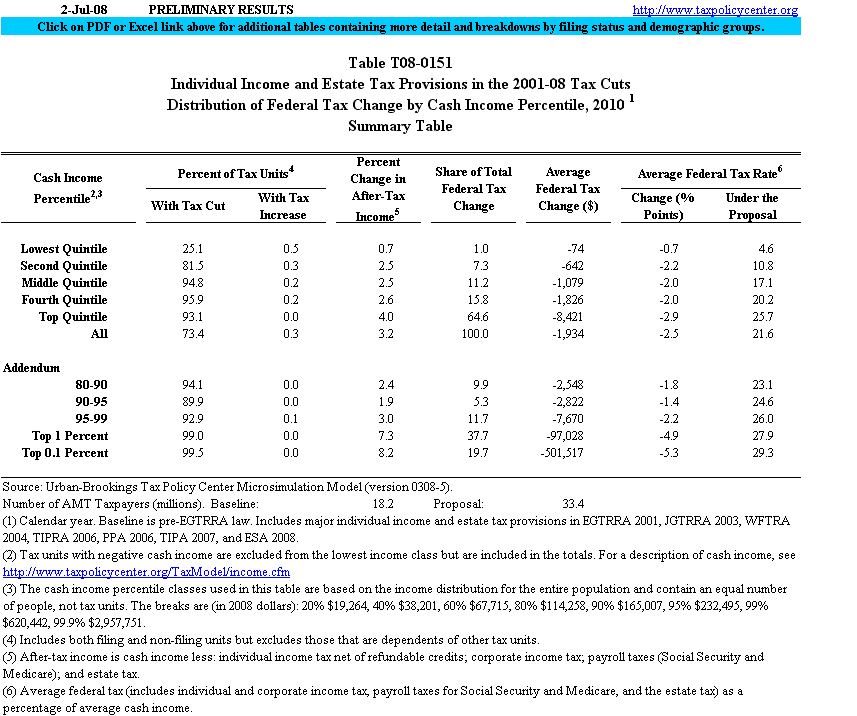
The Bush Tax Cuts and the 99 Percent

By James Kwak

I forgot to alert you to my latest Atlantic column, which went up on Monday. To my mind, Occupy Wall Street is a protest movement, and a valuable one, and the often-stated criticism that they should have concrete demands is kind of silly. (See Frank Pasquale’s response, point 5.) I have spent a fair amount of time reading the 99 Percent tumblr, however, and I think the kind of policies that would help the people who describe themselves there are pretty obvious. This is Mike Konczal’s summary:

“Upon reflection, it is very obvious where the problems are.  There’s no universal health care to handle the randomness of poor health.  There’s no free higher education to allow people to develop their skills outside the logic and relations of indentured servitude. Our bankruptcy code has been rewritten by the top 1% when instead, it needs to be a defense against their need to shove inequality-driven debt at populations. And finally, there’s no basic income guaranteed to each citizen to keep poverty and poor circumstances at bay.”

But in my opinion, the preliminary step to getting rich (and reasonably comfortable) people to pay for a better social safety net is to let the Bush tax cuts expire, as I argue in the column. Most importantly, it’s the only inequality-reducing policy I can think of that has any chance of happening in the next year—simply because it only requires doing nothing. How much would it reduce inequality? That’s just the reverse of what the tax cuts did in the first place. (If you can’t read the table, click on it for a larger version.)

More Bathtubs

By James Kwak

Last week I criticized David Brooks for not understanding the difference between stocks and flows (that is, between your paycheck and your bank balance). (Paul Krugman instead criticized the Tax Foundation, the source for Brooks’s error—I wonder why?)

It turns out that a lot of people make this kind of mistake. Difficulty understanding stocks and flows may be a fundamental cognitive error such as anchoring or availability bias. In one experiment by Matthew Cronin, Cleotilde Gonzalez, and John Sterman, more than half of a group of students at MIT Sloan—one of the top business schools in the country—could not figure out, from a chart of entrances to and exits from a department store, when the most and fewest people were in the store. These errors turn out to be robust to different framing stories, different ways of presenting the data, and even when getting the questions wrong meant you had to stay in the room for an hour.

Continue reading “More Bathtubs”

The More You Pay, the Less You Get

By James Kwak

Schumpeter at The Economist pointed me to a paper by Richard Cazier and John McInnis on one of my favorite topics: CEO hiring. Cazier and McInnis first confirm, not surprisingly, that pay for new, externally-hired CEOs is positively related to the past performance of their previous firms. In particular, they measure EXCESS_COMP as the difference between actual first-year compensation and the compensation that you would predict just based on the characteristics of the hiring firm; EXCESS_COMP turns out to be positively associated with the CEOs’ prior firms’ stock returns. That makes sense, since you would think that people from successful companies would be able to command a higher price than people from less successful companies, and it isn’t obviously controversial, since you would think they would deserve it.

But what do the new firms get for this pay premium? It turns out that their future performance, measured in terms of return on assets and operating return on assets, is negatively associated with excess compensation based on prior performance.* In other words, people from successful companies don’t deserve the pay premium because the higher the premium they are able to command, the less well they are likely to do.

Continue reading “The More You Pay, the Less You Get”

The Smugness of Unintended Consequences

By James Kwak

After my post on Corey Robin’s new book, a friend recommended Albert O. Hirschman’s Rhetoric of Reaction. As the title suggests, the book is about the rhetorical style of conservative thought dating back to Burke. Hirschman identifies three common tropes: perversity (that great-sounding progressive idea you have will have the opposite of its intended effect), futility (that great-sounding progressive idea won’t change anything, because you don’t understand the fundamental laws of the world), and jeopardy (that great-sounding progressive idea will destroy some other thing that we all agree is valuable, making everyone worse off in the end). Hirschman doesn’t dwell on this specific point, but it’s obvious that, similar to the argument Robin makes, these rhetorical devices can only exist in opposition to some progressive reform movement.

I thought the description of the contemporary form of the perversity thesis (e.g., welfare programs create poverty) was especially good. “Here the failure of foresight of ordinary human actors is well-nigh total as their actions are shown to produce precisely the opposite of what was intended; the social scientists analyzing the perverse effect, on the other hand, experience a great feeling of superiority—and revel in it” (Belknap Press, 1991, p. 36). This seems to me an accurate description of why the Economics 101 ideology is so powerful. People get a sense of superiority from owning counter-intuitive theoretical insights—even if those insights are wrong.

Continue reading “The Smugness of Unintended Consequences”

Bathtubs for Beginners

By James Kwak

In economics life there’s a basic conceptual distinction between a flow and a stock. A flow is a something that occurs over some period of time, like water pouring from a faucet into a bathtub. A stock is something that exists at a specific moment of time, like the water in that bathtub. You measure a flow over a period of time (e.g., gallons per minute); you measure a stock at a specific moment in time (e.g., gallons). For a business, the income statement (revenues and costs in a year) measures flows, while the balance sheet (assets and liabilities) measures a stock. That’s why the income statement is dated for a year (or a quarter) and the balance sheet is dated for a specific day. Everyone understands this. If you didn’t, you would get confused between your salary and your bank account.

But not David Brooks.

Continue reading “Bathtubs for Beginners”

Straight Out of Antiquity

By James Kwak

In their paper on the Tea Party, Vanessa Williamson, Theda Skocpol, and John Coggin (Chrystia Freeland summary here) argue that one of the central principles of the Tea Party is a division of the world into workers who deserve what they earn (including Medicare and Social Security, which they like) and undeserving “people who don’t work”—by which many mean the young, or even their own younger relatives.

We are the 99 Percent, the tumblr associated with Occupy Wall Street, is, among many other things, a kind of response to that worldview. The introduction takes it on directly:

“They say it’s because you’re lazy. They say it’s because you make poor choices. They say it’s because you’re spoiled. If you’d only apply yourself a little more, worked a little harder, planned a little better, things would go well for you. Why do you need more help? Haven’t they helped you enough? They say you have no one to blame but yourself. They say it’s all your fault.”

Continue reading “Straight Out of Antiquity”

Baseline Scenario Goes Glossy

By James Kwak

Simon and I wrote an article for the November issue of Vanity Fair about—well, about a lot of things. It’s about the eighteenth-century rivalry between Great Britain and France, the lessons of the American Revolutionary War, the Hamilton-Jefferson debates (again), and the War of 1812. It’s also about present-day fiscal policy and budgetary politics. The main question we take up is what the Founding Fathers (from the Constitutional Convention through their involvement in the War of 1812) thought about a strong central government, the national debt, and the taxes necessary to pay for them, and what that means for today. All that in less than 3,000 words, so there isn’t a lot of room for all the details.

You can read the article online here.

Wall Street and Silicon Valley

By James Kwak

Whenever someone criticizes “Wall Street,” someone else tries to defend Wall Street by saying that without it we wouldn’t have Silicon Valley and all of its wonders. Most recently, A.S. at Free Exchange says this:

“What would Silicon Valley have been without venture capital and private equity? Apple’s spectacular growth was made possible by the capital it raised in financial markets (it is a public company).

“Much of Apple’s initial investment came from an angel investor (a relative or friend who provides the start-up capital). But most new companies rely on formal capital markets. In a 2009 working paper, Alicia Robb and David Robinson investigated the capital structure of start-up firms, and found that 75% primarily relied on external financing from formal capital markets, usually credit cards and bank loans in their first year. They also found that firms that used formal credit were more successful.”

As critics of Wall Street go, I probably find this more annoying than most because, well, I worked in Silicon Valley. Most of these comments are obvious, but here goes anyway.

Continue reading “Wall Street and Silicon Valley”

The Bad Old Days

By James Kwak

There was a time when the main purpose of this blog was to explain just how some government policy or other official action was designed to benefit some large bank under the cover of the public interest. In a bit of nostalgia, I wrote this week’s Atlantic column on the Freddie Mac–Bank of America story reported on by Gretchen Morgenson. It’s clear that Bank of America got a sweetheart deal from Freddie. The question is why. Did Freddie Mac’s people, some of the most knowledgeable people in the country when it comes to mortgages, not realize they were giving away money? (Hint: Probably not.) Did FHFA examiners, some more of the most knowledgeable people in the country when it comes to mortgages, not realize that Freddie was giving money away? (Hint: See above.)

It’s amazing that after three full years of our government trying to give Bank of America money at every possible opportunity, it’s still a basket case. Now it’s charging people $5 per month to use their debit cards. Yes, this is a predictable response to new Federal Reserve regulations limiting debit card fees. But it’s easily avoidable: just find another bank. (Neither of mine charges me debit card fees.) Not every bank out there is still trying to pay for the Countrywide acquisition.

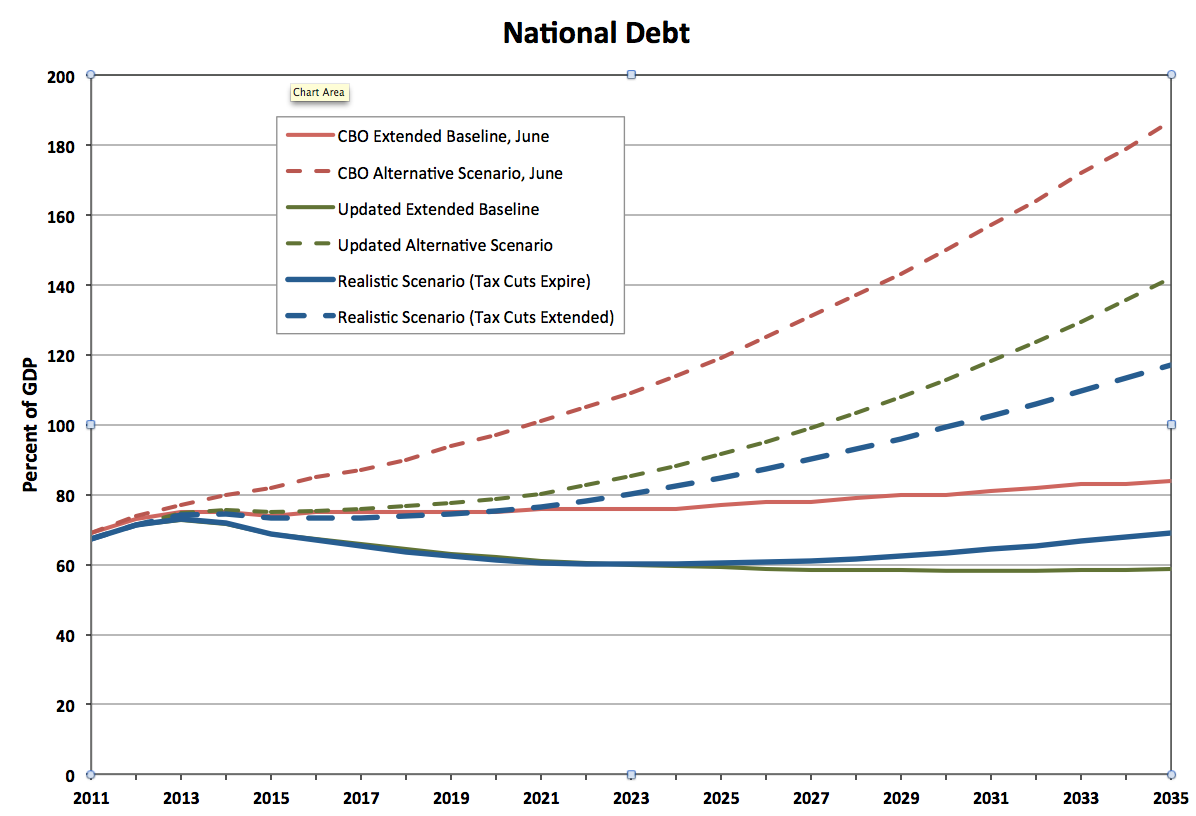
How Big Is the Long-Term Debt Problem?

By James Kwak

Articles about the deficits and the national debt generally talk about unsustainable long-term deficits that will drive the national debt up to a level where scary things happen. Sensible commentators usually acknowledge that our current deficits are a sideshow and the real problems happen in the 2020s and 2030s due to modestly increasing Social Security outlays and rapidly increasing health care spending. I admit that this has generally been my line as well; for example, in a previous post I said that the ten-year deficit problem is entirely a product of extending the Bush tax cuts, but that even if we let them expire things will get worse over the next two decades.

But looking at the numbers, it’s not clear that the long-term picture is really that bad. Here I’ll lay out the numbers, and then, as they say on Fox News, you can decide. The summary is the chart above; the details are below.

Continue reading “How Big Is the Long-Term Debt Problem?”

Edmund Burke and American Conservatism

By James Kwak

It has become a truism that modern American conservatism is revolutionary in the sense that it seeks to overturn the established order rather than to preserve it. “Reagan Revolution,” “Tea Party”—the very names for the movement announce that is about more than defending the status quo. In the conservative worldview, America (or “Washington,” or the “mainstream media,” or some other powerful stratum) is dominated by a liberal-intellectual-academic-bureaucratic-socialist-internationalist (pick two or more) elite that must be overthrown. So in at least a mythical sense, conservatism is about restoration, which is something very different from “conserving” what exists today.

When did this happen? According to one view of the world, to which I have been partial in the past, there was once an ideology called conservatism that really was conservative in the narrow sense: that is, it counseled maintaining existing institutions on the grounds that radical change was dangerous. The Rights of Man and the Citizen may be great, but soon enough you have the Committee of Public Safety and the guillotine. On this reading of history, conservatism became radical sometime after World War Two, when it gave up accommodation with the New Deal in favor of rolling the whole thing back, ideally all the way through the Sixteenth Amendment.

In The Reactionary Mind,* however, Corey Robin has a different take: conservatism, all the way back to Edmund Burke, has always been about counterrevolution, motivated by the success of left-wing radicals and consciously copying their tactics in an attempt to seize power back from them. Conservative thinkers were always conscious of the nature of modern politics, which required mobilization of the masses long before Nixon’s silent majority or contemporary Tea Party populism. The challenge is “to make privilege popular, to transform a tottering old regime into a dynamic, ideologically coherent movement of the masses” (p. 43). And the way to do that is to strengthen and defend privilege and hierarchy within all the sub-units of society (master over slave, husband over wife, employer over worker).

Continue reading “Edmund Burke and American Conservatism”

Should Social Security Be Progressive?

By James Kwak

My earlier rant on the Social Security wage base made me think of a more important question (actually, I was already thinking of it, hence the need to Google the earnings cap): Should Social Security be more progressive than it already is? The most common ways liberals want to make it more progressive are (a) eliminating the cap on taxable earnings altogether and (b) reducing benefits for high earners. For part of my brain the automatic answer is “yes,” but I think there is a reasonable argument for leaving things roughly the way they are.

First, there’s a straight-up political argument. Social Security is popular because people feel like they earn their benefits. If people thought it was a covert redistribution program, then the high earners would definitely be against it, and most of the middle class probably would be too because of the American allergy to welfare. In fact, there are certainly people who think it is “pure welfare”, like the author of the post I criticized last time around. But it isn’t:

Continue reading “Should Social Security Be Progressive?”