Author: James Kwak

Be Happy, Eat Fruits and Vegetables

By James Kwak

From the treasure trove that is the NBER working paper series, a friend forwarded me “Is Psychological Well-Being Linked to the Consumption of Fruit and Vegetables?” by David Blanchflower, Andrew Oswald, and Sarah Stewart-Brown (NBER subscription required). It got some media attention last month when the paper first came out, but I wanted to read it because, well, I eat a lot of fruits and vegetables: I generally aim for seven servings a day, although when life is busy it can be as low as three or four. (Right now I’m munching on dried mango slices.)

The core of the paper is a bunch of regressions that show that better psychological well-being (which is all the rage these days) is correlated with eating more fruits and vegetables, with benefits up to at least five servings and in some cases up to eight servings. This isn’t particularly surprising on its face, since eating fruits and vegetables is probably correlated with having a high income, exercising, being fit, cooking, and any number of other things that are conducive to happiness.

Continue reading “Be Happy, Eat Fruits and Vegetables”

Some Things Don’t Change

By James Kwak

Which of these things doesn’t belong? John Boehner: “The year 2013 should be the year we begin to solve our country’s debt problem through entitlement reform and a new tax code with fewer loopholes and lower rates.”

Can you imagine Bill Belichick (or any other football coach) saying, “This should be the year we win more games by giving up fewer yards on defense and improving our offense by reducing turnovers and gaining fewer yards per play”?

As long as Republicans persist in claiming to believe that lower tax rates will reduce deficits, nothing in Washington will change. Given their ability to deny both climate change and evolution, denying simple budgetary arithmetic is trivially easy.

And a Few Thoughts About the Election

By James Kwak

Just about everything has been said already, but:

  • There was a lot of talk, and rightly so, about Barack Obama’s overwhelming victory among Latinos. There was little talk about Obama’s even more overwhelming victory among Asian-Americans, who are the fastest-growing demographic group in the country. For decades people have said that Asian-Americans are a natural Republican constituency. But they said that about Latinos, too.
  • In the broad sweep of history, it will be hard to see 2012 as a turning point, given its endorsement of the status quo. With one exception: it was the night that gay rights broke through. Besides Tammy Baldwin, besides victory in all four states (Maine, Maryland, Minnesota, Washington), there was the roar of applause when Barack Obama said “gay or straight,” and even the Republican commentators talking about how their party had to get on the right side of the issue.
  • Last night, when the outcome was clear, David Brooks said that if Obama reached across the aisle, he could gain the support of 15 to 20 Republican senators—proving that he can smoothly transition from being unable to interpret polls to being unable to interpret election results.
  • Amid all the gratifying things about election night (with Elizabeth Warren at the top of the list), here are  few more: “Joe” the “Plumber” losing, the replacement of Joe Lieberman, Karl Rove and Donald Trump displaying their craziness.
  • And, of course, the final word must go to xkcd. Go math!


A Few Thoughts on Nate Silver

By James Kwak

Many people have spilled far more words on this topic than I can read, but I wanted to point out a few things that seem clear to me:

  • As Daniel Engber pointed out, the fact that Obama won (and that Silver called all fifty states correctly) doesn’t prove that Silver is a genius any more than Obama’s losing would have proven that he was a fraud.
  • In fact, Silver appears to have gotten a couple of Senate races wrong, but that still doesn’t prove anything, since his model spits out probabilities, not certainties.
  • To my mind, the crux of the debate was between: (a) people who believe that it is meaningful to make probabilistic statements about the future based on existing data (both current polls and parameters estimated from historical data); and (b) people who believe that there is something ineffable about politics that escapes analysis and that therefore there is something fundamentally wrong, or misleading, or fraudulent about the statistical approach. Silver, through no fault of his own, because associated with (a). To my mind, (a) is right and (b) is wrong because of logic and math, so the idea that one election could have settled the question was crazy to begin with.
  • Within camp (a), there are certainly valid methodological debates, and it’s by no means clear that Silver is the state of the art. Whether, in the last days of an election, he is any better than simple averages is an open question. The value Silver adds or doesn’t add can’t be judged by the final forecast, because one point of his model is to incorporate factors that are not incorporated in current polls (e.g., economic conditions). (Another aspect of the model is to not overreact to short-term trends—but that aspect also largely vanishes by the night before.) So the superiority of the  model, if it is superior, would appear months before the election, not the night before. But that is even harder to verify by ultimate results. Ideally you would have many elections and for each one you would have a Silver forecast six months before and a simple poll average six months before and you would see which had a higher batting average. I would bet on Silver, but we’ll never have enough data to resolve that question.

If the outcome makes people take statistics more seriously and pundits less seriously, that’s a good thing, but it’s not why you should take statistics more seriously.

New Threat to the Financial System: Gravity

By James Kwak

Last week reminded everyone that the heart of our financial system remains in Lower Manhattan, just a few feet above sea level. Amid all the tragedy and hardship, Knight Capital—the firm that earlier almost collapsed because of a software glitch—had to shut down its trading operations on Wednesday when its backup generators ran out of fuel.

Why? The answer is so ridiculous you wouldn’t believe me if I summarized it, so here is the story, according to the Wall Street Journal:

The company calculated that its three fuel tanks held a total of 1,200 gallons, or enough to power the generators “past 2 p.m.” [CEO Thomas Joyce] wrote. But the generators unexpectedly shut down at about 11:45 a.m. The problem: Fuel still in the tanks was useless. “Turns out the intake pipes, which [get] the fuel from tanks to generators, are higher than the bottom of the fuel tanks,” Mr. Joyce wrote. “In short, we had fuel but the construction of the fuel tanks prevented it from getting to the generators.”

So somewhere in the operational chain of command, somebody overlooked the fact that the effective capacity of their fuel tank was less than its actual capacity, because fuel doesn’t levitate. It sounds crazy to me, too, but the alternative is that the truth is even more embarrassing, and this is the story they concocted to cover it up.

Let’s hope that Citigroup knows how to measure the capacity of its backup generators. Some Masters of the Universe.

The Economist on Romney’s Fiscal Policy

By James Kwak

It should be no surprise that I am voting for Barack Obama on Tuesday, despite all his flaws and failures of the past four years. There are just too many dimensions on which he is clearly preferable to Mitt Romney. One of the more important ones, on which I spent most of last year (writing White House Burning), is fiscal policy. And here, since anything I write will be dismissed by many readers as liberal propaganda, is The Economist on the topic:

“Yet far from being the voice of fiscal prudence, Mr Romney wants to start with huge tax cuts (which will disproportionately favour the wealthy), while dramatically increasing defence spending. Together those measures would add $7 trillion to the ten-year deficit. He would balance the books through eliminating loopholes (a good idea, but he will not specify which ones) and through savage cuts to programmes that help America’s poor (a bad idea, which will increase inequality still further). At least Mr Obama, although he distanced himself from Bowles-Simpson, has made it clear that any long-term solution has to involve both entitlement reform and tax rises. Mr Romney is still in the cloud-cuckoo-land of thinking you can do it entirely through spending cuts: the Republican even rejected a ratio of ten parts spending cuts to one part tax rises.”

That’s just about the same summary I would have written.

Why Do People Think the Race Is a Tossup?

By James Kwak

There’s been a minor controversy in the blogosphere not about whether Obama or Romney should be president, and not about whether Obama or Romney is ahead in the polls, but about the esoteric question of whether one should interpret the polls to mean that Obama is the favorite or that the race is a “tossup.” This debate has largely swirled around Nate Silver, who aggregates polling data, recalculates confidence intervals, and incorporates other factors (drawn from analysis of previous elections), and for the past few weeks has rated Obama as having about a 60–80% chance of winning the election. In response, various members of the pundit class have argued that the national polls show a tied race, polls can’t predict the future, or even that since both sides (supposedly) think each has a 50.1 percent chance of winning, their chances must be equal. (See Felix Salmon for a summary.)

Silver has responded to all of the coherent objections that might be made to his forecast, in detail. But what’s at work here isn’t a reasoned debate about how to interpret polls. It’s sheer innumeracy, pure and simple. The statement that Obama has about a 75–80 percent chance of winning is roughly equivalent to the statement—which no one contests—that his average lead in Ohio is about 2–3 points, once you take the confidence interval into account. As Silver has said, it’s analogous to the statement that a team that’s ahead by a field goal deep in the fourth quarter has a better chance of winning than the team that’s behind; no one would call that game a “tossup,” even though either team could win. Even if you can’t predict the next turnover or breakaway running play, that wouldn’t lead you to believe the three-point lead is irrelevant.

It’s the same thing we saw in Moneyball—people who can’t understand numbers claiming that numbers have no practical value. Unfortunately, in political journalism the sample size is so small and the monetary stakes are so low that the incoherent innumerates will never be drummed out of the marketplace.

What the Federal Government Does

By James Kwak

Now is as good a time as any to remind people of who provides all those detailed projections of where Hurricane Sandy is going to hit and how strong it’s going to be: the federal government. No matter how you get your weather news—local TV or radio, The Weather Channel, AccuWeather, whatever—hurricane forecast information originally comes from the National Hurricane Center, which is part of the National Weather Service. The raw data come in part from the Hurricane Hunters, the pilots who fly planes into hurricanes, who are part of the Air Force Reserve and the National Oceanic and Atmospheric Administration. The computer models that predict where hurricanes are going to strike are developed by the NHC.

In August 2011, Simon and I were on vacation with our families in Southern Florida as Hurricane Irene was approaching the East Coast. Simon had the idea of using government weather services as the example to lead off chapter 4 of White House Burning, “What Does the Federal Government Do?” I like this example because almost everyone agrees that the federal government should be engaged in disaster prevention, disaster relief, and even weather forecasting. In 2005, Rick Santorum proposed a bill that would have prevented the National Weather Service from providing weather forecasts to the public—but he insisted that the NWS should gather weather data and provide it to private companies so that they could make money off of it. (AccuWeather is based in Pennsylvania, Satorum’s state, by the way.)

Continue reading “What the Federal Government Does”

The Effects of Golden Parachutes

By James Kwak

The indefatigable Lucian Bebchuk has written another empirical paper (Dealbook summary), this time with Alma Cohen and Charles Wang, on the impact of golden parachutes (agreements that pay off CEOs generously in case of acquisition by another company) on shareholder value.

Looking just at the question of whether a company is acquired and for how much, they find out that golden parachutes work about how you would expect. Companies whose CEOs have golden parachutes are more likely to get acquisition offers and are more likely to be acquired, presumably because their CEOs are les likely to contest takeovers. On the other hand, these companies tend to sell for lower acquisition premiums, again because their CEOs are more likely to be happy to be bought out.

“So far, so good,” Bebchuk writes. But the problem is that when you take a longer view, golden parachutes appear to be bad for shareholder value. Companies that adopt golden parachutes have lower risk-adjusted stock returns than their peers—despite the fact that they are more likely to be acquired. Some other factor is outweighing the positive effect (for the stock price) of more frequent takeovers.

Bebchuk proposes one explanation: Golden parachutes make being acquired relatively painless to CEOs. Therefore, they are less afraid of being acquired; and, therefore, they are less concerned about maximizing shareholder value in the first place.

Here’s another possibility: Companies are more likely to grant golden parachutes to their CEOs if they have: (a) CEOs who care more about maximizing their personal wealth than about their companies; (b) boards who are more concerned about doing favors for the CEO than about doing what’s right for the company; or (c) both. Those are not the kinds of companies you want to be investing in, since they’re likely to screw up all sorts of other things in addition to their executive compensation policies.

Incentive Effects of Higher Wages

By James Kwak

My Atlantic column this week is on a familiar theme: why don’t Barack Obama and Democrats provide an clear alternative vision to the Romney-Ryan state of nature, instead of slowly stumbling along in the Republicans’ wake? But it also brings up a question that I haven’t seen before.

The theoretical argument against higher tax rates is that it reduces the incentive to work because it changes the terms of the tradeoff between labor and leisure. That is, higher taxes reduce your effective returns from labor, while your returns from leisure remain constant, so you will substitute leisure for labor.

In the long term, however, real wages tend to go up; even in the past three decades, which have generally been bad for labor (and good for capital), they’ve gone up by about 11 percent. If tax rates remain constant, that should increase the effective returns to labor, causing people to substitute labor for leisure (i.e., work more). Put another way, you could increase tax rates and keep the tradeoff between labor and leisure constant.

I generally don’t buy these pure theoretical arguments, but my point is that if you believe that higher taxes reduce labor supply through the substitution effect, then you should acknowledge that the effect of higher taxes could be swamped by growth in real wages.

Financial Lobby: Stupid or Disingenuous? You Decide

By James Kwak

Courtesy of Matt Yglesias, from the Financial Services Forum:

“We write today to urge you to work together to reach a bipartisan agreement to avoid the approaching ‘fiscal cliff,’ and take concrete steps to restore the United States’ long-term fiscal footing.”

And later:

“But merely avoiding the fiscal cliff is not enough. We further urge you and your colleagues to enact legislation that truly restores the nation’s long-term fiscal soundness.”

It’s too obvious to waste more than a sentence spelling out what’s wrong here, so here it is: “Going over” the “fiscal cliff” is the single best thing we could do to “restore the United States’ long-term fiscal footing.” The CEOs of every big bank (who signed the letter) must know that. Right?

There are valid arguments against going over the fiscal cliff, but the national debt is not one of them. Going over the cliff would do more to address the long-term debt than anything any politician has proposed. And, as Yglesias points out, “If you care about inequality, jumping off the cliff offers by far the best chance for addressing it,” since it is the only plausible way to significantly increase taxes on the wealthy.

Why Reading the Front Page of the Newspaper Makes You Stupider

By James Kwak

At least when it comes to statistical issues:

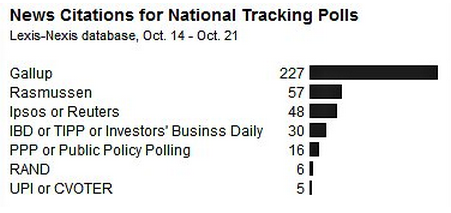
(Courtesy of Nate Silver.) Gallup is the huge outlier among the tracking polls, which shows Romney leading by 6–7 points. (On average, the national polls show an exactly tied race.)

This news is a few days old, but the general principle it illustrates is timeless. Reporting tends toward the dramatic and the surprising. In some cases, that’s probably fine—like if you read the paper for entertainment. When it comes to statistics that suffer from measurement error, it’s journalistic malpractice.

Revolving Doors Matter

By James Kwak

It is common fare for people like me to point disapprovingly to the revolving door between business and government, which ensures that every Treasury Department is well stocked with representatives of Goldman Sachs. In 13 Bankers, the revolving door was one of the three major channels through which the financial sector influenced government policy, alongside campaign contributions and the ideology of finance. The counterargument comes in various forms: people like Robert Rubin and Henry Paulson are dedicated civil servants who wouldn’t favor their firms or their industries, the government needs people with appropriate industry experience, etc.

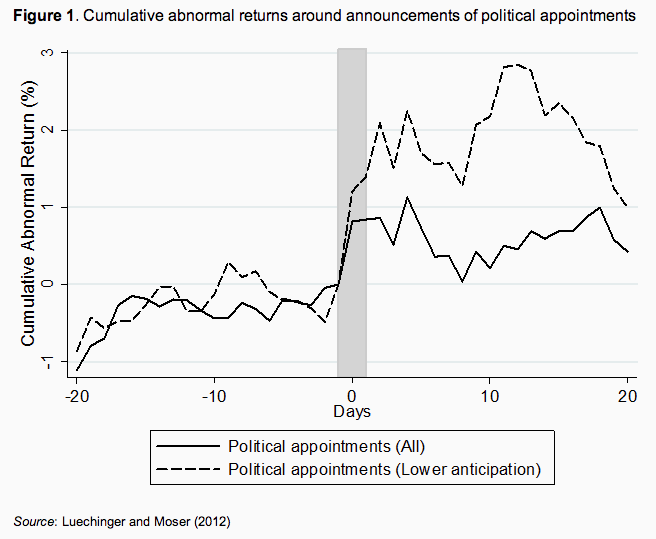
It is certainly possible that industry experts provide valuable skills and experience to the government. But that value comes with a cost; put another way, it’s not just the public good that benefits. Using data on Defense Department appointments, Simon Luechinger and Christoph Moser (paper; Vox summary) measured the impact of political appointments on the stock market valuation of appointees’ former firms; they also measured the impact on firms’ stock market valuations of hiring a former government official. In both cases, the stock market reacted positively to new turns of the revolving door. Here’s the chart for political appointments:

Continue reading “Revolving Doors Matter”

Bobbing and Weaving

By James Kwak

Mitt Romney’s latest attempt to make his tax plan seem plausible (that is to say, not a pack of blatant lies) is the idea of capping deductions at some level, like $17,000 or $25,000. Of course, as we all know, it doesn’t add up; Dylan Matthews provides a quick summary. If you cap deductions and you cut rates by 20 percent, everyone’s taxes go down, and the very rich (but not the super-super-rich) benefit the most.

This shouldn’t be news to anyone, because this problem has already been solved in its general form: there’s no way his numbers add up, because you could eliminate all the tax breaks for the rich and still not pay for a 20 percent rate cut. I confess I have some attachment to this issue because I think I was one of the first people to point out the mathematical impossibility of the Romney tax plan (the day after he announced the 20 percent rate cut).

Unfortunately, of course, this is all about politics, and arithmetic coherence is not the bar Romney needs to clear. He just needs to get enough undecided voters (stop and think for a second about what it means to be undecided right now) to think that his tax plan isn’t a complete fraud and to think that all of us self-appointed defenders-of-math are just Obama hacks. And this latest cap on deductions is probably enough to clear that much lower bar.

Luck, Wealth, and Richard Posner

By James Kwak

I disagree with Richard Posner—the old Richard Posner behind the law and economics movement—on so many things that I always worry when he seems to agree with me. Did I do write something stupid? I wonder.

A friend forwarded me Posner’s latest blog post, “Luck, Wealth, and Implications for Policy,” parts of which sound vaguely like a post I wrote three years ago, “Do Smart, Hard-Working People Deserve To Make More Money?“* In that post, I argued that even if differences in incomes are due to things that people ordinarily think of as “merit,” like intelligence and hard work, that doesn’t mean that rich people have a moral entitlement to their wealth, because they didn’t do anything to deserve their intelligence or their propensity to work hard. In summary, “I have little patience for the idea that rich people deserve what they have because they worked for it. It’s just a question of how far back you are willing to acknowledge that chance enters the equation.”

Continue reading “Luck, Wealth, and Richard Posner”