Month: October 2012

What the Federal Government Does

By James Kwak

Now is as good a time as any to remind people of who provides all those detailed projections of where Hurricane Sandy is going to hit and how strong it’s going to be: the federal government. No matter how you get your weather news—local TV or radio, The Weather Channel, AccuWeather, whatever—hurricane forecast information originally comes from the National Hurricane Center, which is part of the National Weather Service. The raw data come in part from the Hurricane Hunters, the pilots who fly planes into hurricanes, who are part of the Air Force Reserve and the National Oceanic and Atmospheric Administration. The computer models that predict where hurricanes are going to strike are developed by the NHC.

In August 2011, Simon and I were on vacation with our families in Southern Florida as Hurricane Irene was approaching the East Coast. Simon had the idea of using government weather services as the example to lead off chapter 4 of White House Burning, “What Does the Federal Government Do?” I like this example because almost everyone agrees that the federal government should be engaged in disaster prevention, disaster relief, and even weather forecasting. In 2005, Rick Santorum proposed a bill that would have prevented the National Weather Service from providing weather forecasts to the public—but he insisted that the NWS should gather weather data and provide it to private companies so that they could make money off of it. (AccuWeather is based in Pennsylvania, Satorum’s state, by the way.)
Continue reading “What the Federal Government Does”

The Effects of Golden Parachutes

By James Kwak

The indefatigable Lucian Bebchuk has written another empirical paper (Dealbook summary), this time with Alma Cohen and Charles Wang, on the impact of golden parachutes (agreements that pay off CEOs generously in case of acquisition by another company) on shareholder value.

Looking just at the question of whether a company is acquired and for how much, they find out that golden parachutes work about how you would expect. Companies whose CEOs have golden parachutes are more likely to get acquisition offers and are more likely to be acquired, presumably because their CEOs are les likely to contest takeovers. On the other hand, these companies tend to sell for lower acquisition premiums, again because their CEOs are more likely to be happy to be bought out.

“So far, so good,” Bebchuk writes. But the problem is that when you take a longer view, golden parachutes appear to be bad for shareholder value. Companies that adopt golden parachutes have lower risk-adjusted stock returns than their peers—despite the fact that they are more likely to be acquired. Some other factor is outweighing the positive effect (for the stock price) of more frequent takeovers.

Bebchuk proposes one explanation: Golden parachutes make being acquired relatively painless to CEOs. Therefore, they are less afraid of being acquired; and, therefore, they are less concerned about maximizing shareholder value in the first place.

Here’s another possibility: Companies are more likely to grant golden parachutes to their CEOs if they have: (a) CEOs who care more about maximizing their personal wealth than about their companies; (b) boards who are more concerned about doing favors for the CEO than about doing what’s right for the company; or (c) both. Those are not the kinds of companies you want to be investing in, since they’re likely to screw up all sorts of other things in addition to their executive compensation policies.

Bipartisan Trouble Ahead

By Simon Johnson

In Washington today, “bipartisan” is a loaded term. The traditional usage of bipartisan is an agreement across the usual political divide – sometimes a good idea and in many cases the only way to get things done. But a darker meaning applies all too frequently – a group in which the members, irrespective of party affiliation, are very close to special interests and work to advance an agenda that helps a few powerful people while hurting the rest of us.

Financial deregulation in the 1980s and 1990s was pushed by both Democrats and Republicans. It reached its apogee when Alan Greenspan, a Republican, was chairman of the Federal Reserve and Robert Rubin, a Democrat, was Treasury secretary. Bill Clinton was president; Newt Gingrich was speaker of the House.

This is probably why President Obama and Mitt Romney shied away this fall from the issue of who was responsible for the financial crisis that brought us the deep recession and slow recovery of the last five years. Both political parties share culpability for allowing parts of the financial sector to take excessive risk while financing themselves with a great deal of debt and relatively little equity.

In this context, the new Financial Regulatory Reform Initiative of the Bipartisan Policy Center seems eerily familiar. Continue reading “Bipartisan Trouble Ahead”

Incentive Effects of Higher Wages

By James Kwak

My Atlantic column this week is on a familiar theme: why don’t Barack Obama and Democrats provide an clear alternative vision to the Romney-Ryan state of nature, instead of slowly stumbling along in the Republicans’ wake? But it also brings up a question that I haven’t seen before.

The theoretical argument against higher tax rates is that it reduces the incentive to work because it changes the terms of the tradeoff between labor and leisure. That is, higher taxes reduce your effective returns from labor, while your returns from leisure remain constant, so you will substitute leisure for labor.

In the long term, however, real wages tend to go up; even in the past three decades, which have generally been bad for labor (and good for capital), they’ve gone up by about 11 percent. If tax rates remain constant, that should increase the effective returns to labor, causing people to substitute labor for leisure (i.e., work more). Put another way, you could increase tax rates and keep the tradeoff between labor and leisure constant.

I generally don’t buy these pure theoretical arguments, but my point is that if you believe that higher taxes reduce labor supply through the substitution effect, then you should acknowledge that the effect of higher taxes could be swamped by growth in real wages.

Financial Lobby: Stupid or Disingenuous? You Decide

By James Kwak

Courtesy of Matt Yglesias, from the Financial Services Forum:

“We write today to urge you to work together to reach a bipartisan agreement to avoid the approaching ‘fiscal cliff,’ and take concrete steps to restore the United States’ long-term fiscal footing.”

And later:

“But merely avoiding the fiscal cliff is not enough. We further urge you and your colleagues to enact legislation that truly restores the nation’s long-term fiscal soundness.”

It’s too obvious to waste more than a sentence spelling out what’s wrong here, so here it is: “Going over” the “fiscal cliff” is the single best thing we could do to “restore the United States’ long-term fiscal footing.” The CEOs of every big bank (who signed the letter) must know that. Right?

There are valid arguments against going over the fiscal cliff, but the national debt is not one of them. Going over the cliff would do more to address the long-term debt than anything any politician has proposed. And, as Yglesias points out, “If you care about inequality, jumping off the cliff offers by far the best chance for addressing it,” since it is the only plausible way to significantly increase taxes on the wealthy.

Why Reading the Front Page of the Newspaper Makes You Stupider

By James Kwak

At least when it comes to statistical issues:

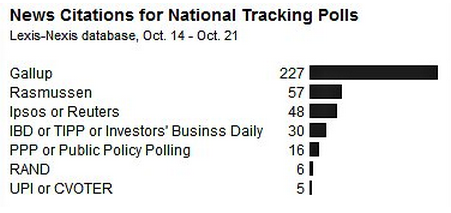
(Courtesy of Nate Silver.) Gallup is the huge outlier among the tracking polls, which shows Romney leading by 6–7 points. (On average, the national polls show an exactly tied race.)

This news is a few days old, but the general principle it illustrates is timeless. Reporting tends toward the dramatic and the surprising. In some cases, that’s probably fine—like if you read the paper for entertainment. When it comes to statistics that suffer from measurement error, it’s journalistic malpractice.

Revolving Doors Matter

By James Kwak

It is common fare for people like me to point disapprovingly to the revolving door between business and government, which ensures that every Treasury Department is well stocked with representatives of Goldman Sachs. In 13 Bankers, the revolving door was one of the three major channels through which the financial sector influenced government policy, alongside campaign contributions and the ideology of finance. The counterargument comes in various forms: people like Robert Rubin and Henry Paulson are dedicated civil servants who wouldn’t favor their firms or their industries, the government needs people with appropriate industry experience, etc.

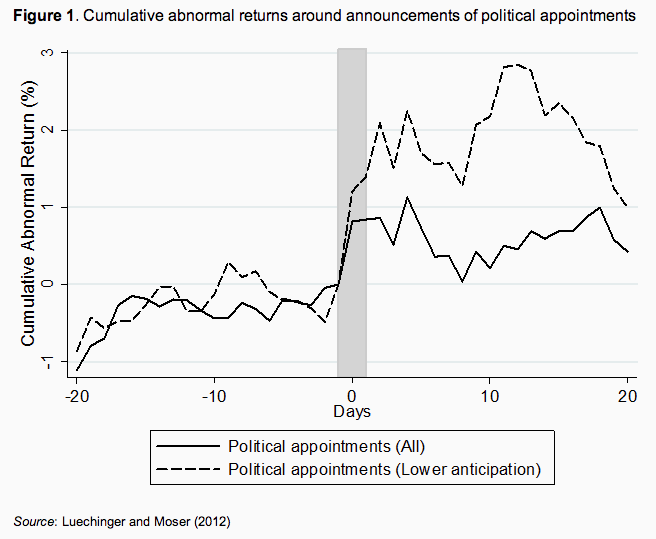
It is certainly possible that industry experts provide valuable skills and experience to the government. But that value comes with a cost; put another way, it’s not just the public good that benefits. Using data on Defense Department appointments, Simon Luechinger and Christoph Moser (paper; Vox summary) measured the impact of political appointments on the stock market valuation of appointees’ former firms; they also measured the impact on firms’ stock market valuations of hiring a former government official. In both cases, the stock market reacted positively to new turns of the revolving door. Here’s the chart for political appointments:

Continue reading “Revolving Doors Matter”

Bobbing and Weaving

By James Kwak

Mitt Romney’s latest attempt to make his tax plan seem plausible (that is to say, not a pack of blatant lies) is the idea of capping deductions at some level, like $17,000 or $25,000. Of course, as we all know, it doesn’t add up; Dylan Matthews provides a quick summary. If you cap deductions and you cut rates by 20 percent, everyone’s taxes go down, and the very rich (but not the super-super-rich) benefit the most.

This shouldn’t be news to anyone, because this problem has already been solved in its general form: there’s no way his numbers add up, because you could eliminate all the tax breaks for the rich and still not pay for a 20 percent rate cut. I confess I have some attachment to this issue because I think I was one of the first people to point out the mathematical impossibility of the Romney tax plan (the day after he announced the 20 percent rate cut).

Unfortunately, of course, this is all about politics, and arithmetic coherence is not the bar Romney needs to clear. He just needs to get enough undecided voters (stop and think for a second about what it means to be undecided right now) to think that his tax plan isn’t a complete fraud and to think that all of us self-appointed defenders-of-math are just Obama hacks. And this latest cap on deductions is probably enough to clear that much lower bar.

Luck, Wealth, and Richard Posner

By James Kwak

I disagree with Richard Posner—the old Richard Posner behind the law and economics movement—on so many things that I always worry when he seems to agree with me. Did I do write something stupid? I wonder.

A friend forwarded me Posner’s latest blog post, “Luck, Wealth, and Implications for Policy,” parts of which sound vaguely like a post I wrote three years ago, “Do Smart, Hard-Working People Deserve To Make More Money?“* In that post, I argued that even if differences in incomes are due to things that people ordinarily think of as “merit,” like intelligence and hard work, that doesn’t mean that rich people have a moral entitlement to their wealth, because they didn’t do anything to deserve their intelligence or their propensity to work hard. In summary, “I have little patience for the idea that rich people deserve what they have because they worked for it. It’s just a question of how far back you are willing to acknowledge that chance enters the equation.”

Continue reading “Luck, Wealth, and Richard Posner”

Why Taxes Should Pay for Health Care

By James Kwak

William Baumol and some co-authors recently published a new book on what is widely known as “Baumol’s cost disease.” This is something that Simon wanted to include in White House Burning, but I couldn’t find a good way to fit it in (and it would have gone in one of the chapter’s I was writing), so I it isn’t in there. (Baumol is cited for something else.) But in retrospect, I should have put it in.

Baumol’s argument, somewhat simplified, goes like this: Over time, average productivity in the economy rises. In some industries, automation and technology make productivity rise rapidly, producing higher real wages (because a single person can make a lot more stuff). But by definition, there most be some industries where productivity rises more slowly than the average. The classic example has been live classical music: it takes exactly as many person-hours to play a Mozart quartet today as it did two hundred years ago. You might be able to make a counterargument about the impact of recorded music, but the general point still holds. One widely cited example is education, where class sizes have stayed roughly constant for decades (and many educators think they should be smaller, not larger). Another is health care, where technology has vastly increased the number of possible treatments, but there is no getting around the need for in-person doctors and nurses.

Continue reading “Why Taxes Should Pay for Health Care”

Read This Book, Win The Election

By Simon Johnson

With the presidential election looming and both sides looking for a knockout blow in the vice-presidential debate on Thursday evening, now is a good time for both Democrats and Republicans to look for one more defining issue. The new book by Sheila Bair, “Bull by the Horns: Fighting to Save Main Street From Wall Street and Wall Street From Itself,” offers exactly that – to whichever party is smart enough and fast enough to take up the opportunity.

Ms. Bair lays out a compelling vision for both financial-sector reform and for dealing with the continuing mess around mortgages. Neither presidential campaign is likely to endorse her ideas in all their specifics. But if a candidate signaled that he had read and understood the main messages in this book, this would have great appeal both with undecided centrist votes and – importantly – with their respective bases. Continue reading “Read This Book, Win The Election”

43.4 = 30.9?

By James Kwak

Adam Davidson wrote his latest New York Times Magazine column about how Barack Obama and Mitt Romney largely agree on economic questions. This is a classic example of how to mislead through deceptively selective citation.

Here’s the core assertion:

For someone who lived in the first 150 years or so of this country, it might be hard to see what’s so different about the economic policies of Barack Obama and Mitt Romney. Romney seeks a 25 percent top corporate tax rate, and Obama is proposing 28 percent. Romney wants to eliminate capital-gains taxes for the typical investor and leave the rate at 15 percent for higher earners. Obama wants to increase it to 20 percent. They differ on how to tax the highest incomes. But for most Americans, the distinctions might be mistaken for a rounding error. Both men strongly support expanding free trade and maintaining close to the same level of Social Security and welfare benefits.

As anyone who follows fiscal policy knows, the corporate tax rate is a sideshow. It’s the individual income tax and payroll taxes that bring in the big dollars, and it’s the individual income tax that has the real impact (or not) on inequality.

Continue reading “43.4 = 30.9?”

File Under Fascinating

By James Kwak

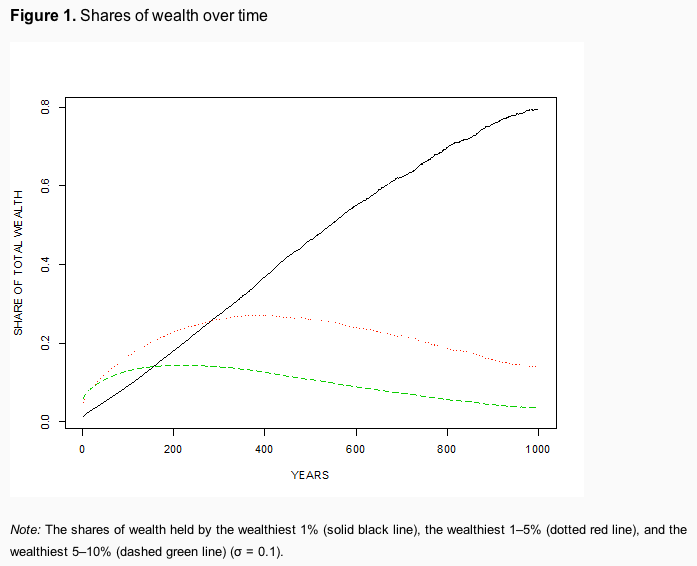
A reader pointed me to “Instability and Concentration in the Distribution of Wealth,” a paper by Ricardo and Robert Fernholz (Vox summary here). It’s a pretty mathematical paper (and I’m not just talking about the usual multivariate regression here), and I didn’t make it through all the equations. But the basic idea is to come up with a model that might explain the high degree of income and wealth inequality we see in advanced economies and particularly in the United States, where 1 percent of the population holds 33 percent of all wealth.

What’s fascinating is that the model assumes that all households are identical with respect to patience (consumption decisions) and skill (earnings ability). Household outcomes differ solely because they have idiosyncratic investment opportunities—that is, they can’t invest in the market, only in things like privately-held businesses or unique pieces of real estate. Yet when you simulate the model, you see an increasing share of wealth finding its way into fewer and fewer hands:

Continue reading “File Under Fascinating”

The Problems with Software Patents

By James Kwak

Charles Duhigg and Steve Lohr have a long article in the Times about the problems with the software patent “system.” There isn’t much that’s new, which isn’t really a fault of the article. Everyone in the industry knows about the problems—companies getting ridiculously broad patents and then using them to extort settlements or put small companies out of business—so all you have to do is talk to any random group of software engineers. And it’s not as much fun as the This American Life story on software patents, “When Patents Attack!” But it’s still good that they highlight the issues for a larger audience.

The article does have a nice example of examiner shopping: Apple filed essentially the same patent ten times until it was approved on the tenth try. So now Apple has a patent on a universal search box that searches across multiple sources. That’s something that Google and other companies have been doing for years, although perhaps not before 2004, when Apple first applied. There’s another kind of examiner shopping, where you file multiple, similar patents on the same day and hope that they go to different examiners, one of whom is likely to grant the patent.

Continue reading “The Problems with Software Patents”

Capital Gains Tax Rates and Savings

By James Kwak

Earlier this week, I  wrote my own “job creator’s” manifesto for The Atlantic, in response to Steven Pearlstein’s great parody. You can read it if you are interested in knowing what one “job creator” thinks our country needs.

There’s something I forgot to add, however. (Literally: while I was away from my computer I decided to add it, but then I forgot to do so before sending it to my editor.) As I’ve said before, the capital gains tax rate had no impact on my decision to start a company. It couldn’t have had any impact, because I didn’t know what it was.

Continue reading “Capital Gains Tax Rates and Savings”