Month: January 2010

Paul Krugman for Fed Chair: “Crazy”

Paul Krugman says that Simon’s idea that he should be chair of the Fed is “crazy.” Krugman’s point is either that he wouldn’t be confirmed or that he wouldn’t be able to bring the Open Market Committee along. Maybe he’s right about the former; a Republican filibuster does seem reasonably likely.

I don’t think he’s right about the latter; or, more precisely, I don’t think it matters. The FOMC is, on paper, a democratic body: they vote. There is a tradition that the votes are generally unanimous because of the perceived importance of demonstrating consensus. I don’t know how old this tradition is; it was certainly in place under Greenspan. But everyone knows that the members of the FOMC disagree about many things; that’s why the various bank president members go around giving speeches objecting (not in so many words) to the FOMC’s decisions. Given that we all know there are debates involved, how important is this fiction of consensus?
Continue reading “Paul Krugman for Fed Chair: “Crazy””

Two Good Thoughts About Financial Reform

From Economics of Contempt (hat tip Brad DeLong):

“The single best thing we could do for financial reform: Triple the budgets of all financial regulatory agencies. Immediately. Regulators are woefully understaffed; this is fact.”

I’m not sure about “single best,” but otherwise dead on. The agencies that are self-funding out of their businesses (banking for the Federal Reserve, insurance for the FDIC) have been less bad than the ones that are not (OCC, OTS).

Continue reading “Two Good Thoughts About Financial Reform”

Paul Krugman For The Fed

The case for Ben Bernanke’s reappointment was weak to start with, weakened with his hearings, and is now held together by string and some phone calls from the White House.  Bernanke is an airline pilot who pulled off a miraculous landing, but didn’t do his preflight checks and doesn’t show any sign of being more careful in the future – thank him if you want, but why would you fly with him again (or the airline that keeps him on)?

The support for Bernanke in the Senate hangs by a thread – with Harry Reid providing a message of support, albeit lukewarm, after the markets close.  The White House is telling people that if Bernanke is not reconfirmed there will be chaos in the markets and the economic recovery will be derailed.  This is incorrect.

The danger here is uncertainty – the markets fear a prolonged policy vacuum.  Fortunately, there is a way to address this.  Ben Bernanke should withdraw and the president should nominate Paul Krugman to take his place. Continue reading “Paul Krugman For The Fed”

Obama’s First Year

It’s late January and Scott Brown will be the next senator from Massachusetts, which means it’s time for critical retrospectives on Obama’s first year in office. I’m not going to try my own, but simply point you to two I found worthwhile. One, not surprisingly, is by Ezra Klein, who says this is Obama’s problem:

“Obama’s presidency has tried to show, not tell. He’s not given speeches about how government can work. He’s not tried to change minds about the theoretical possibility of government working. He’s tried to make government work. Winning achievements, not arguments, has been at the center of the administration’s agenda.”

Klein realizes the irony, of course; a president who is doing what we say we want presidents to do–govern–is being stonewalled by a right wing intent on winning the next elections, and sniped at by a left wing for compromising too much and for not scoring enough political points. But, as Klein says, whether the fault is Obama’s, Congress’s, or ours, it’s not working.

Continue reading “Obama’s First Year”

Secretary Geithner Needs To Get With The Program

The details of the new White House banking policy are somewhat vague and in places borderline incoherent – e.g., what exactly does “The President’s proposal will place broader limits on the excessive growth of the market share of liabilities at the largest financial firms…” mean (from point 2 in yesterday’s short and poorly edited statement)?

And the size restrictions currently in pencil on the back on an envelope near the president’s desk are almost certainly too lenient; the goal should not be a return to the status quo of 2007 or thereabouts – the clock must be rolled back much further and “too big to fail” completely removed from the financial map.

But the general principle behind our “Volcker Rule” is clear.  Here’s what President Obama said, “Banks will no longer be allowed to own, invest, or sponsor hedge funds, private equity funds, or proprietary trading operations for their own profit, unrelated to serving their customers.”

Whatever you think of that notion or the exact wording, this clearly implies that banks will get smaller.  Secretary Geithner apparently does not get this (transcript). Continue reading “Secretary Geithner Needs To Get With The Program”

Questions That Ben Bernanke Must Now Answer

Update: the Senate needs to hold a new hearing for Ben Bernanke – here’s the full proposal.

Ben Bernanke’s reconfirmation as chair of the Federal Reserve is in disarray.  With President Obama having launched, on Thursday morning, a major new initiative to rein in the power of – and danger posed by – our leading banks, key Senators rightly begin to wonder: Where does Ben Bernanke stand on the central issue of the day?

There are three specific questions that Bernanke must answer, in some convincing detail, if he is to shore up his weakening cause in the Senate.

  1. Does he support the President’s proposed emphasis on limiting the scope and scale of big banks?
  2. With regard to the key detail, is it his view that the size of big banks can be capped “as is” or – more reasonably – should we require these banks to contract or divest so as to return to the profile of system risk that prevailed say 15 or 20 years ago?
  3. If Congress cannot act in the short-term, because of opposition from Republicans and some Democrats, does he see the Fed’s role as taking the initiative in this arena – or will he wait passively for the legislature to act?

As running hard against the “too big to fail” banks is now a major theme of 2010 and beyond for the Democrats, how can any Democratic Senators feel comfortable voting for Ben Bernanke unless they know exactly what his position is on all of these points?

And given what we know about Bernanke’s record and positions relative to these questions, absent new information it is not a surprise to see his support dwindling.

By Simon Johnson

Sheila Bair’s Turn

Keith Epstein and David Heath of The Huffington Post have an in-depth article about how Sheila Bair got two mortgages on two different properties from Bank of America while she was discussing with them whether the bank could repay its TARP money to the government.

Let me start off by saying that I strongly, strongly doubt that Bair sought out a better deal on her mortgage because she is head of the FDIC or discussed her mortgage with any of the Bank of America bigwigs that she met with. That would be stupid, and it doesn’t fit with anything I know about her. (Granted, I know very little about her.)

That said, WHAT WAS SHE THINKING? Continue reading “Sheila Bair’s Turn”

As Is?

The White House background briefing is that their proposals would freeze biggest bank size “as is” — this makes no sense at all.

Twenty years of reckless expansion, a massive crisis, and the most generous bailout in human history are not a recipe for “right” sized banks. There is a lot of work the administration hasn’t done on the details — this is a classic policy scramble, in which ducks have not been lined up. But we should treat this as the public comment phase for potentially sensible principles — and an opportunity to propose workable details.  The banks are already hard at work, pushing in the other direction.

It’s a big potential policy change, and my litmus test is simple – does it, at the end of the day, imply breaking Goldman Sachs up into 4 or 5 independent pieces?

By Simon Johnson

13 Bankers

The day that President Obama came out in favor of size and scope limits for banks seems like a good day to tell you about our new book, 13 Bankers: The Wall Street Takeover and the Next Financial Meltdown–in which we argue for hard size limits on banks, among other things. While we end up talking about the financial crisis, the way the government responded to it, and the too big to fail issue, it’s really a book about power–the economic and political power of the banking industry both recently and throughout American history, the problems it creates, and what we can do about it.

The book will be out on April 6 (or maybe a week earlier), but you can already pre-order it wherever books are pre-ordered. In the meantime, to learn more, we have a new book web site with its own blog (for book-related news and thoughts).

Now, back to proof-reading . . .

By James Kwak

Welcome, Barack

So Barack Obama has come around to the idea that big banks need to be made smaller and that smarter regulation (contingent capital, enhanced capital requirements for large banks, resolution authority, etc.) just won’t cut it. Today he proposed limits on market share (measured by a bank’s share of total bank liabilities in the United States) and a prohibition on internal hedge funds, private equity funds, and proprietary trading.

This is great. It means that the administration is moving in the right direction–breaking up big banks–and the president is putting his name behind it. For more on why these are good ideas, see Mike Konczal.

OK, now for the caveats.

Continue reading “Welcome, Barack”

The White House Should Also Announce An Antitrust Investigation Into Major Banks

In the aftermath of Tuesday’s Massachusetts special election debacle, the White House today is set to announce a major change of strategy on financial reform, with the president to propose new legislation that will limit the size and complexity of banks.

Such legislation is unlikely to pass the Senate.  In fact, the approach to financial reform already in place, crafted by Senator Christopher J. Dodd with the blessing of the White House, was to trade away some parts of the House bill — including perhaps the potential new consumer protection agency for financial products — in return for sufficient Republican support to pass a bill in the next month or two.

But fresh from their success in the Democratic heartland, the Republicans will be less inclined than before to compromise in any meaningful way. They may keep negotiating, but the Senate Democratic choice will quickly become: pass a law with little sensible content, or don’t pass anything and look ineffectual.

Fortunately, there is an alternative — one laid out neatly by Krishna Guha of the Financial Times on Tuesday. Instead of pursuing the issue of those “too big to fail” financial institutions exclusively through legislation, the administration could launch instead one or more serious antitrust investigations into the behavior of our biggest banks. Continue reading “The White House Should Also Announce An Antitrust Investigation Into Major Banks”

Paul Volcker Prevails

Paul Volcker, legendary central banker turned radical reformer of our financial system, has won an important round.  The WSJ is now reporting:

President Barack Obama on Thursday is expected to propose new limits on the size and risk taken by the country’s biggest banks, marking the administration’s latest assault on Wall Street in what could mark a return — at least in spirit — to some of the curbs on finance put in place during the Great Depression.

This is an important change of course that, while still far from complete, represents a major victory for Volcker – who has been pushing firmly for exactly this.

Thursday’s announcement should be assessed on three issues. Continue reading “Paul Volcker Prevails”

One More Thing . . .

. . . on that deficit commission. If I were Peter Orszag, I would be tearing my hair out. (Or maybe not, since he’s happily engaged to be married later this year.)

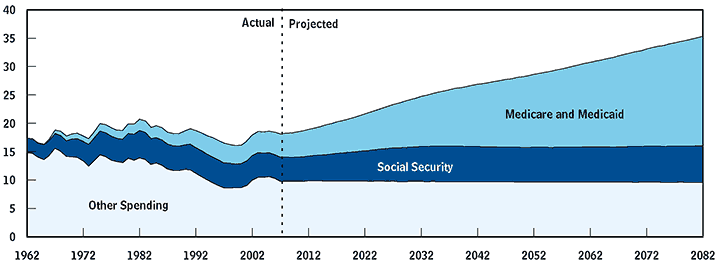
It’s obvious, and I’ve said it before, but I’ll say it again. The big long-term national debt problem is all about health care. This chart is from the January 2008 Budget and Economic Outlook of the Congressional Budget Office–for those keeping score, that’s one year before President Obama took office. It shows projected federal spending as a percentage of GDP.

Continue reading “One More Thing . . .”

Commission to the Rescue!

It looks like President Obama is going to create the bipartisan commission to cut the deficit that Kent Conrad and Judd Gregg have been pitching–except that now Judd Gregg is against it.

According to the original Conrad-Gregg plan, the commission would have eighteen members–eight named by Congressional Democrats, eight by Congressional Republicans, and two by the administration, for a ten-eight split; if fourteen of the eighteen could agree on a deficit-reduction plan, Congress would have to vote it up or down without amendments. The Conrad-Gregg proposal is expected to be voted down in the Senate. So instead, Obama would appoint a commission by executive order, with six people named by Congressional Democrats, six named by Congressional Republicans, and six named by the administration, including at least two Republicans–for a ten-eight split; if fourteen of the eighteen could agree on a deficit-reduction plan, Congress would vote it up or down without amendments; however, Congress could separately choose to amend it. According to the Washington Post, Gregg “called a presidentially appointed panel ‘a fraud’ designed to do little more than give Democrats political cover.” Huh? I’m guessing Gregg’s objection is that Obama’s plan is based on an agreement with Congressional leaders, rather than actual legislation–but if you can’t pass the legislation, what else do you want Obama to do?*

More, important, is this a good thing? My prediction is that it will amount to exactly nothing, although there is a possibility it could turn out badly. I simply don’t see how any plan can get the agreement of fourteen commission members–meaning all the Democrats and four of eight Republicans, or all the Republicans and six of ten Democrats, or something in between.

Continue reading “Commission to the Rescue!”

How Supposed Free-Market Theorists Destroyed Free-Market Theory

This guest post was contributed by Dan Geldon, a fellow at the Roosevelt Institute.  He is a former counsel at the Congressional Oversight Panel and a graduate of Harvard Law School.

Over the past year, there has been much discussion about how the financial crisis exposed weaknesses in free-market theory.  What has attracted less discussion is the extent to which the high priests of free-market theory themselves destroyed meaningful contracts and other bedrocks of functioning markets and, in the process, created the conditions for the theory’s weaknesses to emerge.

The story begins before Wall Street’s capture of Washington in the 1980s and 1990s and the deregulatory push that began around the same time.  In many ways, it started in 1944.

Continue reading “How Supposed Free-Market Theorists Destroyed Free-Market Theory”